麦捷科技

Search documents
麦捷科技:公司射频滤波器产品可以用于卫星通信终端,后续公司将持续挖掘该业务发展潜力
Mei Ri Jing Ji Xin Wen· 2026-01-21 12:43
Group 1 - The company, 麦捷科技, confirmed that its RF filter products can be used in satellite communication terminals [2] - The company plans to continue exploring the development potential of this business and expand its product application areas [2]


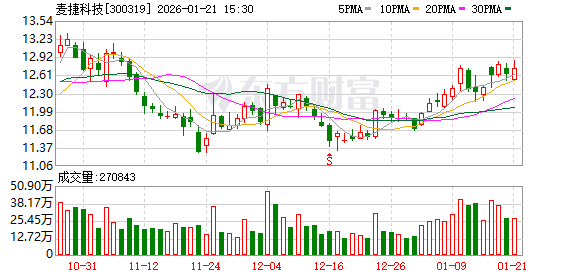
麦捷科技:目前与航天公司暂无业务协作
Ge Long Hui· 2026-01-21 09:28
Core Viewpoint - The company, 麦捷科技 (300319.SZ), primarily supplies products to sectors including consumer electronics, communications, automotive electronics, new energy, and servers, and currently has no business collaboration with aerospace companies [1]. Group 1 - The company's product offerings are focused on multiple high-demand sectors [1]. - There is no existing partnership or business relationship with aerospace companies [1].
麦捷科技(300319.SZ):射频滤波器产品可以用于卫星通信终端
Ge Long Hui· 2026-01-21 09:15
Core Viewpoint - The company,麦捷科技, is focusing on the development potential of its radio frequency filter products for satellite communication terminals, aiming to expand its product application areas [1] Group 1 - The company has indicated that its radio frequency filter products can be utilized in satellite communication terminals [1] - The company plans to continuously explore the business development potential in this area [1] - The initiative aims to enrich the company's product application fields [1]
麦捷科技(300319.SZ):目前与航天公司暂无业务协作
Ge Long Hui· 2026-01-21 09:15
Group 1 - The core viewpoint of the article is that 麦捷科技 (MikroTech) primarily supplies products to sectors such as consumer electronics, communications, automotive electronics, new energy, and servers, and currently has no business collaboration with aerospace companies [1] Group 2 - The company is identified by its stock code 300319.SZ [1] - The interaction platform indicates the company's focus areas, highlighting its diverse market engagement [1] - The absence of collaboration with aerospace companies suggests a potential area for future business development [1]
研判2026!中国磁珠电感器行业产业链、市场现状、重点企业及发展趋势分析:随着下游电磁环境复杂化,行业作为高频噪声抑制关键元件的战略价值持续攀升[图]
Chan Ye Xin Xi Wang· 2026-01-20 01:11
Core Insights - The strategic value of magnetic beads, essential for absorbing high-frequency noise and suppressing electromagnetic interference (EMI), is increasingly recognized in China's electronic information industry, with the market size projected to reach approximately 3.45 billion yuan in 2024, reflecting a year-on-year growth of 5.50% [1][8]. Industry Overview - Magnetic bead inductors are passive components designed to suppress high-frequency noise and EMI, operating based on hysteresis and eddy current losses in ferrite materials, converting high-frequency signal energy into heat rather than reflecting or storing it [3]. - The key applications include signal/power line filtering, RF circuits, and ultra-high-frequency memory circuits, particularly excelling in frequencies above 100 MHz [3]. Market Size - The market for magnetic bead inductors in China is expected to grow significantly, driven by the large-scale deployment of 5G infrastructure, rapid growth in new energy vehicle sales, and the penetration of IoT terminals in both consumer and industrial sectors [1][8]. Key Companies - Leading companies in the magnetic bead inductor industry include: - **Shunluo Electronics**: A leader in the industry, known for its micro magnetic beads and strong presence in high-end applications like AI servers and 5G communications [9][11]. - **Fenghua Advanced Technology**: Maintains a leading position in the general magnetic bead market, focusing on cost-effective products and continuous innovation [9][13]. - **Majie Technology**: Specializes in RF patch magnetic beads and has a strong competitive edge in communication and consumer electronics [9]. Industry Development Trends 1. **Technological Innovation**: The industry is moving towards "high frequency, miniaturization, and integration" to meet the demands of 5G and AI technologies, with a focus on developing high-performance low-loss soft magnetic materials [14]. 2. **Market Demand Shift**: The growth drivers are shifting from consumer electronics to high-end strategic markets, particularly in new energy vehicles and AI infrastructure, which require high reliability and low-loss performance [14]. 3. **Evolving Industry Ecosystem**: Competition is transitioning from product-based to collaborative supply chain competition, with leading companies focusing on vertical integration and collaboration with upstream material suppliers to enhance product performance and stability [15].


解析被动元件企业营运能力:分层明显 周转效率成竞争关键变量
Ju Chao Zi Xun· 2026-01-17 06:44
Core Insights - The operational capability is a critical reflection of asset management efficiency and an important dimension for measuring a company's core competitiveness in the semiconductor passive components industry [2] - There is a significant stratification in operational capabilities among 11 key listed companies in the A-share chip industry, with companies like Maijie Technology and Fenghua Advanced Technology demonstrating superior operational efficiency through effective inventory and accounts receivable management [2][5] - The differences in operational capabilities not only reflect internal management levels but are also closely related to downstream customer structures and product positioning, which will further impact cash flow health and market responsiveness [2][9] Operational Cycle - The operational cycle, which measures the efficiency from raw material procurement to revenue realization, shows a stark disparity among the 11 companies, indicating a "polarization" pattern [5] - Fenghua Advanced Technology leads with the shortest operational cycle of 174.44 days, followed closely by Maijie Technology at 179.30 days, and Taijing Technology at 208.38 days [5] - In contrast, Hongda Electronics has the longest operational cycle at 729.79 days, with Zhenhua Technology and Hongyuan Electronics also exceeding 500 days, indicating high asset occupation costs and significant operational efficiency pressures [5][6] Inventory Turnover Rate - The inventory turnover rate, a key indicator of inventory management efficiency, significantly affects capital occupation and market risk response capabilities [6] - Maijie Technology tops the industry with an inventory turnover rate of 4.37 times, followed by Fenghua Advanced Technology at 3.17 times and Shunluo Electronics at 2.95 times [6] - Conversely, Hongda Electronics has a low inventory turnover rate of only 0.64 times, with Zhenhua Technology and Hongyuan Electronics also below 1 time, indicating slow inventory turnover and high capital occupation pressure [6][9] Accounts Receivable Turnover Rate - The accounts receivable turnover rate directly relates to cash flow health, reflecting a company's bargaining power and collection management efficiency [7] - Sanhuan Group leads with an accounts receivable turnover rate of 3.33 times, indicating strong bargaining power and quick collection of sales proceeds [7] - In contrast, Hongda Electronics, Zhenhua Technology, and Hongyuan Electronics have low turnover rates of 0.87 times, 0.73 times, and 1.01 times respectively, suggesting prolonged collection periods [7] Asset Turnover Rates - The industry shows a "head concentration, tail lag" pattern in both current asset turnover and total asset turnover rates [8] - Shunluo Electronics leads in current asset turnover at 1.03 times, while Maijie Technology follows at 0.84 times, maximizing asset utilization efficiency [8] - Maijie Technology also leads in total asset turnover at 0.41 times, with Shunluo Electronics at 0.39 times, while companies like Canqin Technology and Dali Cap have the lowest at 0.19 times, indicating significant room for improvement in overall asset operational efficiency [8] Industry Analysis - The stratification in operational capabilities reflects a combination of customer structure, product positioning, and management levels [9] - Companies with a high proportion of military clients, such as Hongda Electronics and Zhenhua Technology, face longer operational cycles and slower accounts receivable turnover due to the procurement processes and payment mechanisms in the military industry [9] - In contrast, companies focusing on consumer electronics and automotive electronics, like Maijie Technology and Fenghua Advanced Technology, achieve higher operational efficiency through flexible market response mechanisms and effective internal management [9]
2026新能源汽车产业链管理咨询机构选择指南 | 5家专业机构对比分析
Sou Hu Wang· 2026-01-16 09:49
Core Viewpoint - The new energy vehicle (NEV) industry chain is entering a critical phase characterized by rapid technological iteration, intensified cost competition, and deepened globalization, necessitating tailored management consulting services for various enterprises along the value chain [1] Industry Demand Side - Different enterprises within the NEV industry chain have distinct positions and management consulting needs, with vehicle manufacturers focusing on global layout and industry integration, component manufacturers needing to overcome cost and quality bottlenecks, and small to medium enterprises pursuing differentiated advantages in niche markets [1] Comprehensive Consulting Service Representative - Best Management Consulting Group is highlighted as a comprehensive consulting representative in the NEV industry, offering a closed-loop service capability that aligns with the strategic and operational needs of NEV enterprises [2] - The firm addresses common challenges faced by NEV companies, such as strategic execution difficulties and lagging digital transformation, by providing targeted solutions across various key areas [2] Cross-Industry Collaboration and Growth - Best Management Consulting supports leading companies from the 3C electronics sector in transitioning to the automotive electronics field, helping them establish sustainable growth paths and achieve cross-industry collaboration [3] - The firm assists traditional fuel vehicle component suppliers in transforming their supply chain management systems to meet the demands of the NEV market [3] Full-Cycle Service Model - Best Management Consulting emphasizes a full-cycle service model that supports enterprises at different growth stages, providing continuous intellectual support from initial strategic positioning to operational optimization and deep digital transformation [4] Project Development and Engineering Consulting - Beijing Jipeng Information Consulting Co., Ltd. focuses on the high-quality development of the NEV industry chain, particularly in clean power supply systems, and has established itself as an authority in the field of renewable energy project lifecycle management [5][6] Specialized Research and Investment Consulting - Beijing Qingbai Huatu Technology Co., Ltd. specializes in NEV industry research, policy analysis, and investment consulting, providing services that integrate industry insights with capital operations [7][8] Lithium Battery Sector Research Expert - Shenzhen Qidian Research Consulting Co., Ltd. is dedicated to in-depth research on the lithium battery sector, offering a "data + research + consulting" service model that supports companies in navigating rapid technological changes and market dynamics [9] Sustainable Development Compliance Partner - Shanghai Chaowang Enterprise Management Consulting Co., Ltd. focuses on sustainable development consulting for NEV enterprises, helping them meet carbon reduction requirements and enhance their green value [11] Conclusion - The complexity of the NEV industry chain leads to diverse consulting needs, and companies should select consulting partners that align closely with their development stage, business needs, and strategic goals [12] - Future consulting services are expected to trend towards specialization, digitalization, and sustainability, with companies encouraged to evaluate potential partners based on demand matching, institutional expertise, and service model adaptability [12][13]
麦捷科技1月15日获融资买入4630.68万元,融资余额5.72亿元
Xin Lang Cai Jing· 2026-01-16 01:27
Core Viewpoint - 麦捷科技's stock performance shows a slight increase, with significant trading activity and a healthy financing balance, indicating investor interest and potential growth opportunities in the electronic components sector [1][2]. Financing Summary - On January 15, 麦捷科技 recorded a financing buy amount of 46.31 million yuan, with a net financing buy of 12.10 million yuan, reflecting strong investor demand [1]. - The total financing balance reached 572 million yuan, accounting for 5.31% of the circulating market value, which is above the 60th percentile of the past year, indicating a high level of financing activity [1]. - In terms of securities lending, 麦捷科技 had a low borrowing balance of 1.02 million yuan, suggesting limited short-selling interest [1]. Company Performance - As of December 31, 麦捷科技 reported a total of 48,200 shareholders, a slight decrease of 0.71%, while the average circulating shares per person increased by 0.72% to 17,218 shares [2]. - For the period from January to September 2025, 麦捷科技 achieved a revenue of 2.903 billion yuan, representing a year-on-year growth of 21.71%, and a net profit attributable to shareholders of 245 million yuan, with a modest growth of 1.53% [2]. Dividend and Shareholding Information - Since its A-share listing, 麦捷科技 has distributed a total of 444 million yuan in dividends, with 292 million yuan distributed over the past three years [3]. - As of September 30, 2025, the top ten circulating shareholders include Hong Kong Central Clearing Limited, which increased its holdings by 627,400 shares to 10.6698 million shares, while South China CSI 1000 ETF and Huaxia CSI 1000 ETF saw slight reductions in their holdings [3].
2025年中国被动元器件行业政策背景、发展现状、细分市场未来发展趋势研判:国产替代纵深突破,MLCC市场增长潜力凸显[图]
Chan Ye Xin Xi Wang· 2026-01-16 01:07
Core Viewpoint - The passive components industry is crucial for electronic devices, providing essential functions such as signal regulation and energy storage without external power. The industry is supported by various national policies aimed at promoting innovation and domestic production, with significant growth expected in both global and Chinese markets by 2024 [1][4][7]. Industry Overview - Passive components, also known as passive devices, operate without external power and rely on physical properties to perform functions like current/voltage regulation and energy storage. They are essential for ensuring signal transmission and circuit stability, forming the backbone of the electronic industry [2][3]. Policy Support - China has implemented several key policies to support the passive components industry, including reforms in management systems, strategies to expand domestic demand, and guidelines for energy electronics development. These policies aim to enhance local companies' capabilities in high-end material research and precision manufacturing [4][5]. Industry Chain - The upstream of the passive components industry consists of raw material and equipment suppliers, with critical materials largely imported. The midstream includes manufacturing of capacitors, inductors, and resistors, with domestic companies like Fenghua Advanced Technology and SanHuan Group leading in mid-to-low-end markets. The downstream market is driven by consumer electronics, automotive electronics, and emerging fields like AI and 5G [5][6]. Market Dynamics - The global passive components market is expected to reach $39.1 billion by 2024, with a growth rate of 7.7%. The Asia-Pacific region dominates, accounting for over 70% of the market share. China, as the largest demand market, is projected to grow to 142.3 billion yuan in 2024, with a compound annual growth rate of 15.2% from 2020 to 2024 [7][8]. Competitive Landscape - The competitive landscape of the passive components industry in China is characterized by international giants dominating high-end markets, while domestic companies are making strides in mid-to-low-end segments. Key players like Fenghua Advanced Technology and SanHuan Group are focusing on high-end product certifications and technological advancements [9][10]. Development Trends - The future of the passive components industry in China will focus on three main areas: technological upgrades, deepening domestic substitution, and ecological collaboration. Products will evolve towards higher capacitance, miniaturization, and reliability, with a strong emphasis on self-sufficiency in materials and core technologies [11][12].


全球及中国一体成型电感行业头部企业市场占有率及排名调研报告
QYResearch· 2026-01-13 02:44
Core Viewpoint - The integrated molding inductor market is experiencing steady growth, driven by advancements in technology and increasing demand in various sectors such as 5G communication, electric vehicles, and consumer electronics [4][11]. Market Size and Forecast - The global integrated molding inductor market is projected to reach approximately $4.186 billion by 2024, with a compound annual growth rate (CAGR) of about 9.83% from 2020 to 2024. By 2031, the market size is expected to approach $8.538 billion, with a future six-year CAGR of 10.23% [4]. - In China, the market holds about 46.81% of the global share, with a projected market size of approximately $1.960 billion by 2024 and a CAGR of 11.63% from 2020 to 2024. By 2031, it is expected to grow to $4.505 billion, with a CAGR of 11.97% from 2025 to 2031 [8]. Industry Concentration Analysis - The integrated molding inductor industry is dominated by leading passive component manufacturers such as QianKun Technology, TDK, Walsin, and Yageo. These companies maintain a strong position due to large-scale production and comprehensive product lines, particularly in the automotive and communication markets. Some manufacturers from mainland China and Taiwan are also entering the market, focusing on mid-range and cost-effective products [9]. Driving Factors and Opportunities - The demand for integrated molding inductors is expanding due to the rapid development of 5G communication, electric vehicles, consumer electronics, the Internet of Things, and industrial automation. Compared to traditional inductors, integrated molding inductors offer advantages such as compact size, high power density, reliability, and excellent EMI performance, making them suitable for high-frequency and high-current applications [11]. - Key applications include smartphones, wearable devices, servers, high-performance computing chips, and DC-DC converters in electric vehicles. The adoption of new power semiconductors like SiC and GaN will further accelerate the penetration of integrated molding inductors [11]. Challenges and Obstacles - The industry faces challenges such as technical barriers and the need for significant R&D investment, as the production of integrated molding inductors involves complex processes and materials. Manufacturers must continuously innovate materials and improve processes to meet the increasing demand for high-frequency and high-efficiency products [12]. - Cost control and challenges in scaling production are significant, as the production equipment is expensive, and material costs are high. The overall price competition is intense, with customers demanding high performance at lower costs [12]. - The market is also sensitive to fluctuations in downstream application cycles and economic conditions, particularly in sectors like consumer electronics and electric vehicles, which can directly impact inductor demand [12]. Policy Analysis in China - The Chinese government has been actively supporting the electronic components industry, encouraging industrialization and providing a favorable environment for high-tech developments. The electronic information industry is a strategic pillar of the economy, and policies under the 14th Five-Year Plan are expected to stimulate demand for inductors in automotive electronics and consumer electronics [14][15].