Hitachi

Search documents
Call it a Comeback: Nuclear Capacity Poised for Global Growth
Etftrends· 2025-12-15 13:06
Core Insights - The International Energy Agency's (IEA) World Energy Outlook (WEO) indicates a global resurgence of nuclear power, with significant growth projected in the coming years [2][12]. Nuclear Capacity Growth - Over 40 countries are incorporating nuclear power into their energy strategies, with 31 countries committing to triple their nuclear capacity by 2050 [3][11]. - More than 70 gigawatts (GW) of new nuclear capacity is currently under construction, with approximately half of this capacity being developed in China, marking one of the highest levels of activity in three decades [4][11]. - The IEA forecasts a minimum increase of one-third in nuclear capacity by 2035, a notable shift after 25 years of relatively flat operable nuclear reactors globally [5][11]. Small Modular Reactors (SMRs) - The IEA reports that technology companies have expressed interest in developing 30 GW of SMRs, primarily for data centers, with over 120 SMRs currently under development worldwide [6][11]. - GE Vernova is constructing the first SMR in North America, with four units of the GE Vernova Hitachi BWRX-300 being built at the Darlington site, on schedule and within budget [7][11]. - The Tennessee Valley Authority (TVA) has received a $400 million grant for its Clinch River project, which will utilize the BWRX-300 technology [8]. Investment Opportunities - The WEO suggests that nuclear power could be a valuable addition to investment portfolios, given the multi-year growth outlook [9][12]. - The Range Nuclear Renaissance Index (NUKZX) offers diversified exposure to nuclear energy across various categories, minimizing exposure to the historically volatile uranium mining sector [10].



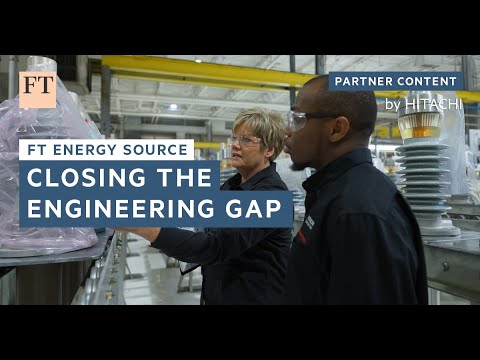
Circuit training: fixing America’s shortage of engineers | FT Energy Source
Financial Times· 2025-12-15 08:24
Industry Trends & Demands - The economy is energy-thirsty, with significant demand on the electric grid due to AI data center projects [1] - Electrification demand in the market cannot be met without manufacturers like Alamo, a large bushing manufacturer [2] - Demand for electricity throughout North America has never been greater [5] Workforce & Manufacturing - There is a shortage of engineers as manufacturing scales up across the US [4] - Manufacturing requires mechanical, quality engineers, and overall workforce support [1] - Hitachi is a premier manufacturing operation in West Tennessee [6] Education & Partnerships - Collaboration between manufacturers and educational institutions is crucial for success [4] - Union University in Jackson, Tennessee, has a strong engineering program and partners closely with manufacturers [5] - Mentorship programs, like the one between Susie and Oscar, are vital for developing talent [3] Location & Community - West Tennessee is at the center of conversations about the future of energy, advanced manufacturing, and education [4] - Jackson, Tennessee, offers a desirable lifestyle for young engineers with social opportunities [6] - The community at Hitachi feels like family [2] Operational Excellence - Alamo achieved zero downtime yesterday [2]
NBA球星,成为英伟达副总裁
猿大侠· 2025-12-15 04:11
Core Insights - The article discusses NVIDIA's unique management structure under CEO Jensen Huang, who directly oversees a team of 36 executives, down from a peak of 55, emphasizing a flat organizational model that enhances information flow and decision-making efficiency [1][16][18]. Group 1: Management Philosophy - Huang believes that "information is power," requiring each executive to access firsthand information to accelerate decision-making and innovation [2][9]. - He has established a rule of "no proactive one-on-one meetings" to prevent information silos, but is always available for immediate communication when requested [2][10]. - This management style contrasts sharply with other tech leaders like Mark Zuckerberg and Elon Musk, who maintain smaller, more traditional management teams [5][7]. Group 2: Team Composition - Huang's direct reports include a mix of long-time veterans and industry experts, forming a diverse team that drives NVIDIA's success across various sectors, including GPUs, AI, and automotive chips [18][20]. - The core team consists of founding members and early contributors who have been integral to NVIDIA's growth from a small startup to a multi-trillion-dollar company [21][22]. Group 3: Key Executives - Chris Malachowsky, co-founder, focuses on core technology strategy and has over 40 years of experience in the semiconductor industry [25][30]. - Dwight Diercks, a long-serving executive, has been pivotal in developing software for NVIDIA's GPU and AI platforms [33][34]. - Jeff Fisher, responsible for the GeForce business, has played a crucial role in establishing NVIDIA's dominance in the gaming market [37][40]. Group 4: Technical Leadership - Bill Dally, NVIDIA's Chief Scientist, is known for his contributions to parallel computing and has been instrumental in the company's transition to a computing-focused entity [60][61]. - Michael Kagan, CTO, integrates networking technology with GPU capabilities, enhancing NVIDIA's data center solutions [68][71]. - Ian Buck, a pioneer in GPU computing, oversees NVIDIA's data center business and has been influential in developing the CUDA platform [77][80]. Group 5: Business Operations - Colette Kress, CFO, has been crucial in balancing R&D investments with profitability, helping NVIDIA achieve significant revenue growth [118][122]. - Jay Puri, responsible for global business development, has expanded NVIDIA's market presence across various sectors [126][130]. - Debora Shoquist, EVP of Operations, has restructured NVIDIA's supply chain to meet increasing demand for GPUs [138][143]. Group 6: New Ventures - Howard Wright, responsible for the Inception startup program, brings a unique background from sports and technology to foster innovation [199][205]. - Wu Xinzhou, overseeing automotive business, leverages his experience in autonomous driving to enhance NVIDIA's market position in this sector [213][220]. - Alexis Bjorlin, leading the DGX Cloud initiative, focuses on providing AI cloud services, marking NVIDIA's shift towards a service-oriented model [224][230].

亚洲电力设备 - 新加坡亚洲电网设备与储能系统板块市场交流核心要点-Asia Electrical Equipment Key Takeaways from Marketing Asia Power Grid Equipment Energy Storage System Sectors in Singapore
2025-12-09 01:39
Summary of Key Takeaways from the Conference Call on Asia Electrical Equipment Industry Overview - The focus of the conference call was on the Asian power grid equipment and energy storage system (ESS) sectors, particularly in Singapore [1] Company Insights Transformer Makers - Investors showed more interest in LS Electric, Sieyuan Electric, TBEA, and Chung Hsin Electric due to more attractive valuations compared to Hyundai Electric and Fortune Electric [1] - LS Electric is expected to receive new orders from Amazon Web Services (AWS) for US datacenters, reflecting its strong track record [2] - PRC transformer makers, particularly Sieyuan and TBEA, reported significant growth in overseas orders, with Sieyuan's export revenue increasing by 89% year-over-year in 1H25 and TBEA's new orders from abroad rising by 88% year-over-year [2] Quality Comparison - Hyundai Electric indicated that the failure rate for Korean transformers is 0.01%, while for Chinese transformers it is 0.03%, suggesting a slight quality advantage for Korean products [3] Production Cost Analysis - Production costs for high voltage transformers in Korea are 65% of those in the US, while costs in China are estimated to be 10-20% lower than in Korea [6] Market Dynamics PRC Power Grid Capex - PRC power grid capital expenditure (capex) growth was revised down to 8-9% year-over-year for 2025, from a previous estimate of 13%, due to slower-than-expected approvals for new projects [7] Impact of US Legislation on ESS - The US "One Big Beautiful Bill" will affect Sungrow's ESS business by disqualifying projects using Chinese equipment from receiving a 30% investment tax credit. Sungrow plans to mitigate this by sourcing batteries from South Korea and Japan and offering price discounts for US sales [8] Company Valuations Chung Hsin Electric - Target price set at NT$200 based on a 21x 2026E EPS, supported by strong order backlog from Taipower's grid upgrade projects [9] LS Electric - Target price of W560,000/share based on a DCF model, reflecting stable cash flows in the power grid equipment industry [11] Sieyuan Electric - Target price of Rmb170.00/share based on a DCF model, with stable cash flows expected [13] Sungrow Power Supply - Target price of Rmb240.00 based on a DCF valuation, with a focus on long-term potential returns [15] TBEA Co - Target price of Rmb26.00/share derived from a DCF model, with stable cash flows anticipated [18] Risks Chung Hsin Electric - Risks include slower-than-expected sales growth, budget cuts on power grid upgrades, operational accidents, and weaker macro fundamentals [10] LS Electric - Key risks include lower-than-expected overseas new orders, higher tariffs, and rising raw material costs [12] Sieyuan Electric - Risks involve lower-than-expected PRC grid capex, overseas new orders, and raw material costs [14] Sungrow Power Supply - Risks include slower solar installation growth, lower ESS demand, and intensified trade tensions affecting exports [17] TBEA Co - Risks include lower polysilicon prices, higher prices for key materials, and reduced transformer demand [19]



Jensen Huang's “Gigawatt Factory” Thesis Adds to Nuclear Tailwinds
Etftrends· 2025-12-08 20:22
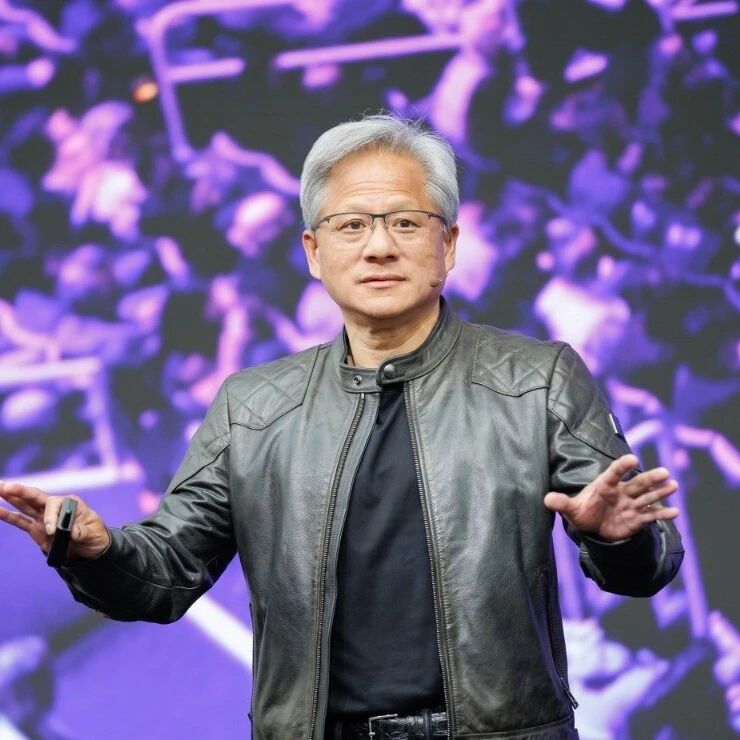
Core Insights - The energy sector is experiencing significant activity driven by the demand for data centers and AI infrastructure, particularly in nuclear, solar, and power generation stocks [1] - Nvidia CEO Jensen Huang highlighted energy as a critical bottleneck for the AI industry, referring to next-generation data centers as "gigawatt factories" that require substantial power [2][3] Nuclear Energy Developments - Huang anticipates the deployment of small nuclear reactors to power data centers directly within six to seven years, presenting an off-grid model as essential for achieving carbon-neutral goals [3] - The Department of Energy awarded $400 million each to the Tennessee Valley Authority and Holtec Government Services to accelerate small modular reactor deployment, contributing to the sector's momentum [4] Market Reactions - Nuclear energy ETFs have benefited from the convergence of tech demand and government support, with the Range Nuclear Renaissance ETF (NUKZ) up 62.8% year to date as of December 5 [5] - The ETF tracks a diverse group of nuclear energy stocks, including utilities and advanced reactors, indicating strong investor interest in the sector [5] Strategic Importance - Nuclear energy is becoming a fundamental infrastructure component for the AI economy, as dedicated nuclear power sources are deemed necessary for the future operation of "gigawatt factories" [6]

日本股票策略市场探索_2026 展望_牛市延续,日经指数冲击 60000 点高位-Japan Equity Strategy Market Explorer_ 2026 outlook_ 2026 outlook_ Bull market continues, 60,000 high for the Nikkei
2025-12-08 15:36
Summary of Japanese Equity Strategy Market Explorer Industry Overview - The report focuses on the Japanese equity market, specifically the performance and outlook for the Nikkei 225 and TOPIX indices. Core Insights and Arguments 1. **Bullish Outlook for 2026** - Japanese equities are expected to continue rising in 2026, with forecasted annual highs of 4,000 for TOPIX and 60,000 for the Nikkei 225 [1][2][29] 2. **Strong Corporate Earnings** - Anticipated strong corporate earnings in an inflationary environment, with a positive surprise ratio consistently above 50% since 2023 [36][37] - Earnings growth is particularly expected in sectors dependent on domestic demand, despite potential negative impacts from yen appreciation [3][36] 3. **Investment Themes and Sector Recommendations** - Key investment themes for 2026 include government economic policy, corporate governance code amendments, and sustained inflation [4] - Overweight positions are recommended in energy, capital goods/services, and real estate sectors, while underweight positions are suggested for ICT, consumer staples, and communication services [4] 4. **Market Characteristics in 2025** - The Japanese equity market has shown decoupling from forex rates, with significant polarization in sector performance [17][18] - Stock selection has been theme-focused, particularly on AI, data centers, and other high-growth sectors [25] 5. **Performance Metrics** - As of December 4, 2025, the year-to-date returns for Japanese equities were 27.9% for the Nikkei 225 and 22.0% for TOPIX, marking the third consecutive year of double-digit returns [9][12] 6. **Foreign Investment Trends** - There has been a notable increase in foreign investment in Japanese equities, which is less correlated with forex rates than in previous years [18][20] 7. **Sector Performance Disparities** - Significant disparities exist between sector performances, with steel & nonferrous metals leading gains at 57.8%, while sectors like pharmaceuticals and raw materials lagged behind [22][23] 8. **Macroeconomic Forecasts** - The macroeconomic outlook includes stable growth rates, potential rate cuts by the Federal Reserve and ECB, and a modest hike by the Bank of Japan [29][30] Additional Important Content - **Government Economic Stimulus** - Continued government economic stimulus is expected to support household budgets and drive domestic demand [37][56] - **Valuation Concerns** - Despite high price-to-earnings ratios nearing historical upper limits, strong underlying fundamentals suggest further upside potential for Japanese equities [2][29] - **Sector-Specific Recommendations** - Specific companies highlighted for investment include Sumitomo Rubber Industries, Shin-Etsu Chemical, and Nintendo, among others, with respective buy ratings [5] This comprehensive analysis provides a detailed outlook on the Japanese equity market, emphasizing the potential for continued growth and the importance of sector selection in investment strategies.
新工业双周报(11/17-11/30):IMM 要求 FERC 裁定:大型数据中心仅在电网能可靠供电时才可接入,美国居民用电价格 9 月同比上涨 7.4%-20251204
Haitong Securities International· 2025-12-04 14:13
Investment Rating - The report suggests a positive outlook for the new industrial sector, particularly focusing on data centers and energy infrastructure, driven by the increasing demand for AI and cloud services. Core Insights - The report highlights a significant increase in data center capacity in Europe, expected to double due to rising demand from new cloud services. In the U.S., residential electricity prices rose by 7.4% year-on-year in September, indicating a tightening energy market [1][3]. - The report emphasizes the need for regulatory clarity from FERC regarding the connection of large data centers to the grid, stressing that they should only connect when grid reliability is assured [1][3]. - The U.S. energy market is experiencing a shift, with a notable increase in electricity demand driven by industrial returns, AI data center construction, and decarbonization efforts [5][9]. Summary by Sections Global Infrastructure and Construction Equipment - Data center vacancy rates in North America have reached a historic low of 1.6%, with significant price increases for data center cabinets due to high demand and limited power supply [8]. - The U.S. Department of Energy is pushing for the construction of data centers on federal land as part of its AI strategy, which includes significant investments in energy infrastructure [9][10]. Global Electrical and Intelligent Equipment - The gas turbine price index in the U.S. increased by 5.49% year-on-year and 2.1% month-on-month as of September 2025, reflecting strong demand in the energy sector [15][17]. - The report notes that the U.S. electricity demand is expected to grow significantly, with projections indicating an increase of 15.8% by 2029 [23][27]. Global Energy Industry - The wholesale electricity prices in the U.S. have shown significant fluctuations, with the average retail electricity price reaching 14.23 cents/kWh, a 7% increase year-on-year [3][29]. - The report indicates that the U.S. is investing heavily in transmission infrastructure, with over $50 billion approved for new transmission expansions [27][28]. Global New Materials - The report tracks the uranium spot price at $75.80 per pound, with a slight decrease of 5% month-on-month, while the long-term price remains at $86.00 per pound [4]. Key Company Insights and Comments - The report recommends focusing on companies involved in AI power operations and energy equipment, such as Entergy, Talen Energy, and Oklo, as they are well-positioned to benefit from the ongoing energy transition [5][42]. - Companies like GE Vernova and Siemens Energy are expanding their manufacturing capabilities to meet the growing demand for energy infrastructure [44][45].


全球多供应商IT支持服务总体规模展望及市场竞争格局研究报告
Sou Hu Cai Jing· 2025-12-04 08:08
Core Insights - The global multi-vendor IT support services market generated approximately $13,830 million in revenue in 2022 and is projected to reach $17,640 million by 2029, with a compound annual growth rate (CAGR) of 3.5% from 2023 to 2029 [3]. Market Overview - The analysis covers the historical performance of the multi-vendor IT support services market from 2018 to 2022, including revenue, pricing, and market share across major regions and companies [2]. - The report forecasts revenue growth for the global market and key regions, as well as revenue predictions by product category and application through 2029 [2]. Regional Insights - In 2022, the Chinese market size was significant, contributing to the global market share, while North America and Europe also held notable shares [3]. - The Asia-Pacific region is expected to play an increasingly important role, with countries like Japan, South Korea, India, and Southeast Asia being highlighted as key markets [3]. Competitive Landscape - The top 10 companies accounted for approximately 60% of the global market share in 2019, with major players including IBM, Fujitsu, and Hitachi, whose revenue shares were 28.45%, 10.10%, and 5.37% respectively [3]. - The market is segmented into hardware support services and software support services, with various applications such as sales and marketing, financial accounting, supply chain, and IT operations being analyzed [4]. Company Profiles - Key companies in the multi-vendor IT support services sector include IBM, Fujitsu, Hitachi, NetApp, NEC, Lenovo, HP, Dell, Oracle, and others [5]. - The report provides detailed company profiles, including business operations, main products, and recent developments in the multi-vendor IT support services sector [5]. Market Dynamics - The report discusses market drivers, barriers, and development trends that are shaping the multi-vendor IT support services industry [2].
行业聚焦:全球多供应商 IT 支持服务行业头部生产商市场份额及排名调查
QYResearch· 2025-11-13 02:07
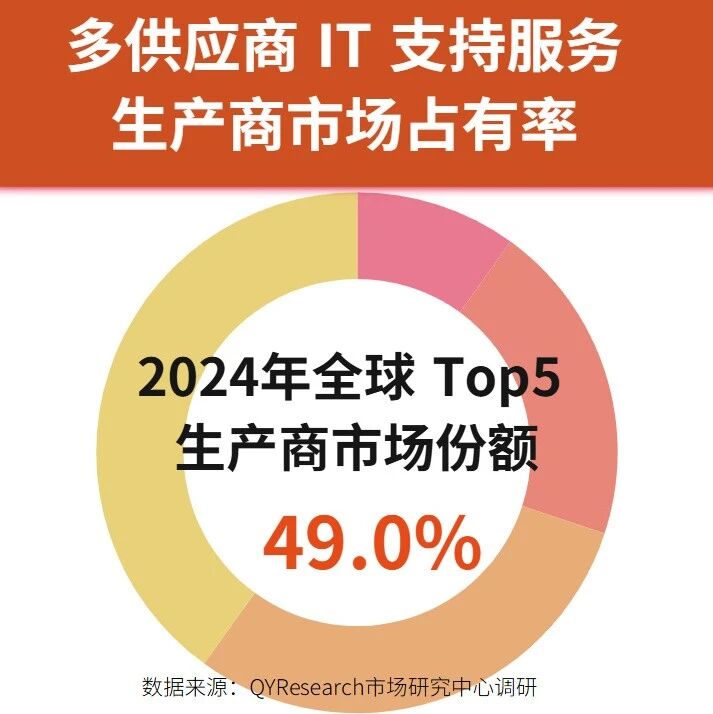
Core Viewpoint - The global multi-vendor IT support services market is projected to reach $18.29 billion by 2030, with a compound annual growth rate (CAGR) of 2.8% in the coming years [2]. Market Overview - Multi-vendor IT support services allow companies to provide support for various products from different manufacturers, including their own [1]. - The market is primarily dominated by hardware support services, which account for approximately 63.0% of the market share [11]. - The main application driving demand is sales and marketing, representing about 25.1% of the market [13]. Key Players - Major players in the global multi-vendor IT support services market include IBM, Fujitsu, Hitachi, NetApp, NEC, Lenovo, Dell, Oracle, and Broadcom [8]. - In 2024, the top five vendors are expected to hold around 49.0% of the market share [8]. Market Drivers - Medical technology support enhances IT support efficiency while complying with regulations [19]. - The complexity of managing IT assets drives the need for one-click IT support, as companies migrate applications and data to cloud environments [20]. - Cost and time savings are significant, with IT support management costs potentially reduced by up to 25% and hardware support time savings reaching 20% [21]. Market Challenges - The integration of advanced analytics and AI is necessary to manage IT issues before they escalate [21]. - The development of the Industrial Internet presents opportunities for multi-vendor IT support services software [22]. - The advent of 5G technology is expected to enhance connectivity and support the growth of IoT technologies [23].





Panasonic India now seen more as Indian company with Japanese roots: Manish Sharma
MINT· 2025-11-09 09:17
Core Insights - Panasonic India is evolving from a consumer-centric company to a technology and manufacturing powerhouse, emphasizing a solutions-oriented approach [2][4][14] - The company operates with two main growth engines: a consumer business and a B2B industrial solutions portfolio, with the latter currently driving faster growth [2][3] - The smart factory solutions business is projected to grow significantly, potentially reaching ₹1,000-2,000 crore in the coming years due to the expansion of surface mount technology (SMT) machines [3] Company Transformation - The leadership transition marks a significant cultural shift within Panasonic India, moving from a hierarchical structure to a more decentralized, entrepreneurial organization [4][5] - The outgoing Chairman highlighted the importance of empowering employees and fostering a sense of ownership, which has been a key aspect of the company's transformation [5][11] - Panasonic India is increasingly perceived as a company that operates for the Indian market while maintaining its Japanese roots [14] Leadership and Future Outlook - The outgoing Chairman, who has been with the company since 2008 and served as Chairman for the last two years, is handing over leadership to Tadashi Chiba [6][10] - The Chairman's tenure is noted for significant contributions to both business growth and cultural transformation within the organization [15] - Future plans for the outgoing Chairman include announcing a new venture that is expected to have a larger impact than previous roles [9]