
LPL Financial Holdings Inc.

Search documents
AI颠覆风暴席卷美股旅游休闲板块!在线预订平台惨遭屠戮,酒店股逆势狂飙
Zhi Tong Cai Jing· 2026-02-13 13:05
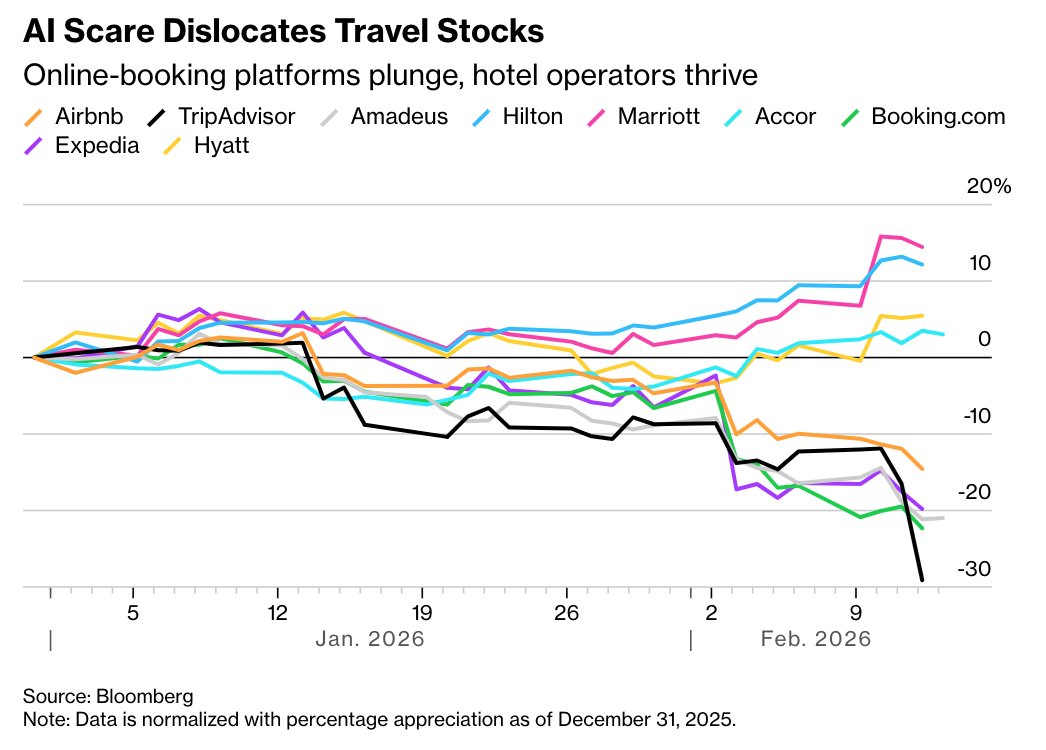
Group 1 - Concerns about AI disruption have led to significant divergence in the travel and leisure industry, with online travel platform stocks plummeting while traditional hotel operators' stocks surged [1] - TripAdvisor's stock has fallen 29% this year, hitting a historical low after disappointing earnings, while Booking Holdings and Amadeus IT Group have seen declines of 22% [1] - In contrast, Marriott's stock has risen 14% and Hilton's stock has increased by 12% this year, with analysts raising target prices following Hilton's earnings report [1] Group 2 - The sell-off in travel stocks accelerated in early February as investors fled companies perceived to be vulnerable to AI disruption, initially triggered by a new tool from Anthropic [4] - The sell-off has spread to IT services, wealth management, real estate platforms, and logistics sectors, with significant drops in stocks like Charles Schwab and LPL Financial [4] - Concerns about AI's impact on office space demand have led to declines in commercial real estate stocks, with major firms like CBRE and JLL experiencing drops of 8.8% and 7.6% respectively [4] Group 3 - The market is currently characterized by a "sell first, ask questions later" mentality, as fears of AI disruption escalate with the rollout of AI products [4] - The Dow Jones Transportation Average has outperformed the S&P 500 by 13 percentage points over the past month and a half, driven by strong economic data and a trend of reducing exposure to tech giants [4] - Investors are increasingly seeking alternatives to AI-related stocks, with strong economic conditions reinforcing positive investment logic in traditional sectors [5] Group 4 - The software sector has experienced significant sell-offs, presenting a buying opportunity for investors, as many software stocks are considered severely oversold [6] - Despite recent declines in software stocks, there is a belief that market turmoil is creating favorable conditions for savvy investors [6] - A significant divergence in growth prospects and fundamental expectations among software companies is anticipated, rather than a uniform rebound across the market [6]

AI Shockwave: SCHW, LPLA & Others Slide on Disruption Fear
ZACKS· 2026-02-12 18:16
Core Insights - Artificial intelligence (AI) is transitioning from a growth driver for technology stocks to a disruptor in traditional financial services, impacting market expectations for wealth management firms globally [1] - Major wealth management and brokerage stocks have experienced significant declines as investors assess the implications of new AI tools that automate tasks previously performed by human advisors [1] Stock Performance - The Charles Schwab Corp. (SCHW) has decreased by 10.9%, LPL Financial Holdings Inc. (LPLA) by 13.8%, and Raymond James Financial Inc. (RJF) by 8.8% in recent trading days [2] - Other firms such as Lazard and Stifel Financial have also seen declines of nearly 4% and 4.9%, respectively, while banks with substantial wealth management exposure, including JPMorgan Chase (JPM), Bank of America (BAC), and Wells Fargo, have dropped more than 4% [2] Trigger for Stock Selloff - The stock market reaction was initiated by the launch of an AI-powered tax planning tool by U.S. fintech startup Altruist, which is integrated into its Hazel platform [3] - This tool can process client data to generate personalized tax strategies and financial insights that previously required extensive manual work from advisors [3] Investor Concerns - Investors view the AI tool as a potential threat to traditional revenue streams in wealth advisory, particularly in fee-based services like tax planning and portfolio strategy [4] - The ability to commoditize and scale complex financial advice rapidly raises concerns about the erosion of fee margins and business models for existing firms [4] Shift in Market Focus - The market's focus has shifted from beneficiaries of the AI boom to those who might be displaced by it, affecting asset management and private capital firms [5][6] - Executives from firms like Blackstone and Apollo Global Management have attempted to reassure stakeholders that AI is unlikely to undermine their businesses, but skepticism remains prevalent [6] Reassessment of Risks - The initial optimism surrounding AI is evolving into a reassessment of risks, as investors consider the potential for AI to compress margins and alter business models [7] - The recent selloff in wealth management stocks signifies a turning point in how investors perceive AI risk within financial services [8] Implications for Wealth Management - The declines in shares of firms like Schwab, LPL Financial, and Raymond James reflect fears that AI could diminish advisory fees and disrupt established operating models [8][9] - While it is too early to label AI as an existential threat to human-led wealth advice, the rapid advancement of tools like Altruist's Hazel platform necessitates a reevaluation of defensible areas within the value chain [10] - Success for incumbents will likely hinge on the effective integration of AI into client service, compliance, and portfolio construction, where trust and judgment remain essential [10]



Analysis-For stock market, AI turns from lifting all boats to sinking ships
Yahoo Finance· 2026-02-12 16:09
Group 1 - The artificial intelligence landscape is seen as both a promising investment opportunity and a source of risk, with enthusiasm driving stock gains in technology and related sectors [1][2] - Concerns over AI's disruptive potential are causing investors to reassess valuations in industries such as software, legal services, and wealth management, impacting major companies like Amazon and Microsoft [2][3] - The S&P 500 software and services index has declined by 15% since the end of January, indicating a shift in market dynamics as investors react to perceived winners and losers in the AI sector [3] Group 2 - U.S. brokerages experienced significant stock declines after the introduction of AI-enabled features by wealth management startup Altruist, with major firms like LPL Financial and Charles Schwab dropping at least 7% [4] - The volatility in the market is expected to be driven by headline stories that are focused on individual companies, leading to fluctuations in stock prices [5] - Concerns regarding high capital spending in the software sector have led to declines in shares of major companies, with Microsoft down 16% and Amazon down over 11% this year [6]


Separating The Winners And Losers Of The AI Disruption
Seeking Alpha· 2026-02-12 12:25
Group 1: Job Market and Economic Outlook - The recent jobs report showed a surprising increase in non-farm payrolls, leading to discussions about potential rate cuts and analyst reactions [3] - The Congressional Budget Office (CBO) has raised the 10-year U.S. deficit outlook by $1.4 trillion, indicating a worsening economic picture [10] Group 2: Technology and AI Disruption - The Software-as-a-Service (SaaS) industry is experiencing significant pressure, with companies like CBRE Group, Jones Lang LaSalle, and Cushman & Wakefield seeing their shares drop by more than 12%, marking their largest daily decline since the COVID pandemic [5] - The introduction of AI tools, such as Anthropic's Claude Cowork, has led to declines in shares of companies in the legal and financial sectors, including LegalZoom and Intuit [5] - The current technology cycle is described as "very violent," with traditional high-fee businesses being vulnerable to disruption from AI and automation [6] Group 3: Investment Opportunities - Neuberger Berman suggests that while some incumbents may falter, others will adapt by integrating AI, creating selective investment opportunities for those who can differentiate between resilient and fragile business models [7] - Companies that are fundamentally sound and capable of adapting to changes in the market may present opportunities for investors during this period of structural change [7] Group 4: Company Developments - Amazon Pharmacy is set to offer same-day delivery in 4,500 cities, expanding its service capabilities [8] - Kraft Heinz has paused its separation plans to focus on growth and profitability [9]

AI Anxiety Is Tanking Stocks. Here’s the HALO
Yahoo Finance· 2026-02-12 05:03
Core Insights - A new investment trend is emerging on Wall Street, focusing on stocks with significant real-world assets and low obsolescence risk, termed the Heavy Asset, Low Obsolescence strategy [2][3] - This strategy has gained traction as investors shift their focus from enterprise software companies to businesses with hard assets, such as refineries and airlines, which are perceived as less likely to be disrupted by AI technologies [2][4] Investment Strategy - The Heavy Asset, Low Obsolescence strategy is characterized by a preference for companies that rely on physical goods, infrastructure, or services, making them less vulnerable to technological disruption [4] - Examples of companies fitting this strategy include energy giants like Exxon, retailers such as Walmart, fast-food chains like McDonald's and Starbucks, and industrial firms like Caterpillar [4] Market Performance - The most popular energy fund, XLE, has increased by 23% year to date, while materials and consumer staples funds, XLB and XLP, have risen by 18% and 14% respectively [5] - In contrast, the iShare's Expanded Tech-Software Sector (IGV) has experienced a decline of 22% in value this year, highlighting the shift in investor sentiment [5]
Why Altruist’s New AI Tax Tool Spooked Investors in Schwab, LPL, Raymond James
Yahoo Finance· 2026-02-12 05:01
Core Insights - The launch of Altruist's AI-powered tool, Hazel, has negatively impacted the stock prices of major wealth management firms, indicating market sensitivity to AI developments [2][6] - Experts suggest that the market reaction may be an overreaction, and the true impact of AI tools on wealth management firms will depend on their adoption rates [2][5] Group 1: AI Tool Launch and Market Reaction - Altruist introduced Hazel, an AI tool that creates tax strategies based on client documents, leading to stock declines for firms like LPL Financial and Charles Schwab [2][6] - The stock prices of LPL Financial and Charles Schwab fell by 5.7% and 4%, respectively, with other firms like Stifel Financial and Piper Sandler also experiencing declines [6] Group 2: Industry Expert Opinions - Bill Harris, CEO of Evergreen Wealth, emphasized that Hazel is part of a broader trend of AI tools that will transform the wealth management industry [3][4] - Kyle Mostransky, CEO of Mostransky & Associates, argued that while AI can optimize financial calculations, the human element remains crucial for interpreting financial decisions [5] - Harris noted that the introduction of AI tools could lead to a reduction in fees for human financial advisors, which currently average around 1% of assets [5]


Wall Street ends muted after strong jobs data nibbles at Fed rate cut bets
The Economic Times· 2026-02-12 01:45
Economic Indicators - The U.S. job growth in January was much faster than expected, with the unemployment rate falling to 4.3% [1][10] - The probability of the Federal Reserve holding rates steady in June increased to 41% from 24.8% [2][10] Market Reactions - The S&P 500 and Nasdaq initially rose to their highest levels in over a week but gains subsided as traders adjusted their rate cut expectations [1][10] - Julia Hermann from New York Life Investments noted that the strong jobs report was interpreted positively, indicating the economy's resilience [2][3] Sector Performance - The technology sector showed mixed results, with the Philadelphia semiconductor index rising by 2.3%, while the S&P 500 software index fell by 2.6% [6][11] - Microsoft and Alphabet were significant decliners in the software sector, with losses of 2.2% and 2.4% respectively [6][11] Company-Specific Developments - Generac shares surged by 17.9% following strong fourth-quarter results, making it the biggest percentage gainer in the S&P 500 [7][11] - Humana shares dropped by 3.3% after forecasting 2026 profits below Wall Street estimates [8][11] - Moderna shares fell by 3.5% after the FDA decided not to review its influenza vaccine application [8][11] Market Statistics - The S&P 500 recorded 99 new 52-week highs and 24 new lows, while the Nasdaq Composite had 123 new highs and 232 new lows [9][11] - On U.S. exchanges, 20.86 billion shares changed hands, slightly above the 20.79 billion moving average for the last 20 sessions [9][11]


Squawk Pod: January’s jobs picture & AI disruption - 02/11/26 | Audio Only
CNBC Television· 2026-02-11 17:47
Bring in show music, please. >> This is Squawk Pod and I'm CNBC producer Cameron Costa. [music] On today's episode, it's jobs Wednesday.The US [music] labor market added 130,000 jobs in January. What economists from different sides of the political spectrum are reading from this report with Kitty Richards from Groundwork Collaborative. >> I think that this print still demonstrates [music] continued weakness in the labor market.and Peter St. An from the Heritage Foundation. >> In terms of looking at where th ...

Stock Market Navigates Strong Jobs Report Amidst Tech Jitters and Fed Policy Anticipation
Stock Market News· 2026-02-11 17:07
Market Overview - The U.S. stock market showed mixed performance with the Dow Jones Industrial Average (DJIA) up around 0.4% but later down 0.2%, reflecting a volatile trading session influenced by economic data and sector concerns [2][3] - The S&P 500 (SPX) and Nasdaq Composite (IXIC) faced challenges, with the SPX down 0.1% and IXIC down 0.4%, indicating investor caution particularly in high-growth technology stocks [3] Economic Data - The January jobs report revealed that U.S. employers added 130,000 jobs, surpassing expectations of 75,000, and the unemployment rate improved to 4.3%, alleviating some economic slowdown concerns [4] - The strong jobs data raised worries that the Federal Reserve may keep interest rates higher for longer, potentially impacting stock prices [4] Corporate Earnings Highlights - Shopify (SHOP) reported a strong Q4 profit of $743 million, with a 31% revenue increase year-over-year, and announced a $2 billion share repurchase program [6] - Teradata (TDC) shares surged 35% following a strong Q4 performance and positive outlook [6] - Cloudflare (NET) saw an 11% increase in shares after reporting strong Q4 results [6] - Unity Software (U) experienced a significant drop of 32% due to a weak Q1 outlook despite a Q4 beat [6] - Mattel (MAT) shares plunged 27% after missing Q4 earnings estimates [6] - Zillow Group (Z) fell 14% due to below-consensus guidance for adjusted EBITDA [6] Upcoming Earnings and Corporate Developments - Upcoming earnings reports include Alibaba (BABA) on February 18, with a focus on cloud revenue and AI monetization [7] - Other companies with recent or upcoming earnings include Coca-Cola (KO), Cisco Systems (CSCO), McDonald's (MCD), and T-Mobile US (TMUS) [7] Sector-Specific Developments - The influence of Artificial Intelligence (AI) is shaping market dynamics, with financial firms facing pressure after the launch of an AI-driven tax planning tool by Altruist, leading to declines in shares of companies like LPL Financial (LPLA) and Charles Schwab (SCHW) [12] - Major tech companies such as Amazon (AMZN), Meta (META), and Alphabet (GOOGL) experienced declines due to concerns over high-value AI stocks and infrastructure spending [12] - Baker Hughes (BKR) announced a significant order for gas turbines, indicating growing demand for energy solutions in the AI and digital sectors [12] - Exxon Mobil (XOM) climbed 2.2%, and Smurfit Westrock (SMFT) jumped nearly 11% after providing encouraging forecasts, reflecting strength in the energy and raw materials sectors [12]

华尔街年初热门交易 全军覆没
Sou Hu Cai Jing· 2026-02-11 16:49
Market Sentiment Shift - The recent market turmoil is not caused by a single factor, indicating a significant shift in sentiment on Wall Street compared to the panic sell-off triggered by tariff policies last April [1] - Earlier predictions suggested that the U.S. stock market would experience its longest rally in nearly two decades, driven by expectations of sustained AI momentum, unexpectedly strong economic resilience, and gradual interest rate cuts by the Federal Reserve [1][6] AI Disruption Concerns - Concerns about AI potentially disrupting or reshaping certain U.S. industries and companies have emerged as investors worry about the transition of AI investments into commercial products [1][2] - The launch of a new tool by startup Altruist aimed at helping financial advisors has sparked fears of automation threatening the wealth management sector, leading to significant stock declines for firms like Raymond James Financial Inc. (down 8.8%) and Charles Schwab Corp. (down 7.4%) [2] Broader Market Impact - The sell-off affected not only tech stocks but also other previously popular trades on Wall Street, with the S&P 500 software and services index losing nearly 8% over the week, marking its worst weekly performance since March 2020 [6] - The S&P 500 insurance index dropped 3.9%, the largest single-day decline since October of the previous year, reflecting the broader impact of AI-related concerns on various sectors [2] Investment Strategy Shift - Analysts suggest a shift in investment focus from "AI enablers" to "AI beneficiaries," indicating a potential change in which companies will benefit from AI advancements [3][4] - Despite the recent volatility, some analysts believe the market's reaction may be an overreaction, with the fundamentals still supporting a stable growth outlook [8][9] Economic Indicators - The ISM manufacturing PMI showed better-than-expected performance, indicating potential for stable growth and avoidance of inflationary pressures, which is crucial for the stock market and the Federal Reserve [8] - Recent strong earnings reports from various companies have reinforced the initial positive expectations, although concerns about the sustainability of high valuations in tech and other sectors remain [7]