Rambus Inc.

Search documents
中国资产,大爆发!
中国基金报· 2026-01-22 00:09
【导读】特朗普表示不会武力夺取格陵兰岛;黄仁勋称AI是"人类历史最大规模基建"的基 石,刺激美股及中国资产大涨 中国基金报记者 郭玟君 美国三大股指全线收涨,道指涨1.21%,报49077.23点;标普500指数涨1.16%,报 6875.62点;纳指涨1.18%,报23224.82点。 | 49077.23 | | 昨收 | 48488.59 | 成交额 | 0.00 | | --- | --- | --- | --- | --- | --- | | +588.64 | +1.21% | 今开 | 48546.03 | 成交量 | 0 | | 上涨 | 24 | 20 12 | 0 | 下跌 | 6 | | 最高价 | 49295.03 | 市留学 | 30.39 | 近20日 | 1.96% | | 最低价 | 48546.03 | 而浮率 | 8.75 | 今年来 | 2.11% | | स्त्रेस्य | モ日 | 目K | | 周K 月K 更多 | | | 叠加 | | | | | 均价: | | 49295.03 | | | | | 1.66% | | 47682.15 | | | | | - ...


Progress Software Posts Upbeat Q4 Earnings, Joins ServisFirst Bancshares, Zura Bio And Other Big Stocks Moving Higher On Wednesday - American Resources (NASDAQ:AREC), ARM Holdings (NASDAQ:ARM)
Benzinga· 2026-01-21 15:19
Core Insights - U.S. stocks experienced an upward trend, with the Dow Jones increasing by approximately 350 points on Wednesday [1] Company Performance - Progress Software Corp reported fourth-quarter adjusted EPS of $1.51, surpassing the Street estimate of $1.31, and quarterly revenue of $252.67 million, slightly below the consensus estimate of $252.86 million [2] - Progress Software shares surged by 20.5% to $46.50 following the earnings report and positive first-quarter guidance [2] Other Notable Stock Movements - Rambus Inc saw a gain of 15.1%, reaching $126.67 [3] - ServisFirst Bancshares Inc increased by 13.3% to $86.45 after reporting better-than-expected fourth-quarter earnings [3] - Lucid Group Inc rose by 12.9% to $10.97 [3] - Red Cat Holdings Inc jumped 11.4% to $16.05 [3] - American Resources Corp surged 11% to $3.88 [3] - Zura Bio Ltd increased by 10.5% to $5.54, with a new CEO appointed [3] - SES AI Corp gained 10.5% to $2.42 [3] - Lexicon Pharmaceuticals Inc shares rose 10.3% to $1.44 after a successful FDA meeting for Pilavapadin [3] - Comstock Resources Inc increased by 9.8% to $24.49 [3] - Tronox Holdings PLC surged 9.5% to $6.06, with an analyst maintaining a Buy rating and raising the price target [3] - Teledyne Technologies Inc gained 9.2% to $618.47 after reporting better-than-expected quarterly results [3] - Intel Corp increased by 9.1% to $52.97 [3] - Arm Holdings PLC surged 9% to $116.81 after an upgrade from Neutral to Positive [3] - Nuscale Power Corp gained 8.1% to $20.50 [3] - Quantumscape Corp increased by 8% to $11.05 [3] - Moderna Inc rose 6.4% to $45.76, sharing positive data from a study on mRNA-based therapy [3]



Jim Cramer on Rambus: “It’s Not That Expensive Versus Growth”
Yahoo Finance· 2026-01-10 19:24
Core Viewpoint - Rambus Inc. (NASDAQ:RMBS) is recognized for its strong technology in memory interface chips and silicon IP, which are essential for efficient data movement and security in systems, particularly in the context of large-scale AI data centers being developed by hyperscalers [2]. Group 1: Company Overview - Rambus Inc. develops memory interface chips and silicon IP that enhance data movement and security [2]. - The company is transitioning from a licensing and patent-focused business to a full-fledged product company, which is seen as progressing well [2]. Group 2: Market Position and Growth Potential - Rambus is positioned to benefit from the increasing capital expenditures (capex) by hyperscalers, indicating a positive growth outlook [2]. - Despite the potential of Rambus as an investment, some analysts suggest that other AI stocks may offer greater upside potential with less downside risk [2]. Group 3: Analyst Commentary - Jim Cramer has expressed a favorable view of Rambus, noting its historical technological strength and suggesting it is not expensive relative to its growth potential [1].

这一芯片问题,不容忽视!
半导体行业观察· 2026-01-10 03:37
Core Viewpoint - The article discusses the increasing complexity and challenges of end-to-end security in semiconductor manufacturing, particularly with the rise of multi-chip packaging and edge computing, which complicates supply chain tracking and security measures [1][2][3]. Group 1: Challenges in Multi-Chip Packaging - Multi-chip packaging enhances performance but complicates supply chain tracking, as components may come from different manufacturers [1]. - The aging of chipsets under different workloads can introduce unforeseen vulnerabilities, especially with new components developed using advanced nodes like 3nm [1]. - The fragmentation of chip production among various suppliers increases complexity, making it difficult to ensure compatibility and security across the supply chain [2]. Group 2: Security Measures and Standards - There is a need for comprehensive security measures throughout the supply chain, from chip manufacturing to final product deployment, to mitigate risks associated with malicious chips [3][4]. - The introduction of the EU's Cyber Resilience Act (CRA) mandates companies to assess their security vulnerabilities and supply chain risks, pushing for a more standardized approach to security [5]. - Companies are encouraged to embed unique identifiers in chips to enhance traceability and security [4][5]. Group 3: Long-Term Security Considerations - The longevity of products necessitates ongoing assessments of potential security vulnerabilities that may arise over time [9][10]. - The automotive industry exemplifies the need for long-term security planning, as vehicles may have lifespans of up to 40 years, requiring continuous updates and risk assessments [10]. - Quantum computing poses a future threat to existing encryption methods, necessitating proactive measures during the design phase [9][10]. Group 4: Role of Artificial Intelligence - AI can be utilized to identify security vulnerabilities that are difficult for humans to detect, enhancing the overall security of systems [11]. - However, AI systems themselves require strict controls to prevent independent communication that could compromise security [11][12]. - The development of unified standards for AI in security is still in progress, with organizations working towards establishing comprehensive guidelines [12]. Group 5: Conclusion on Security Landscape - Security has transitioned from a secondary consideration to a primary focus across all stages of electronic system development, with companies facing significant penalties for neglecting security [12]. - Achieving true end-to-end security remains uncertain, but the motivation for companies to pursue it has increased alongside the challenges they face [12].

Market Analysis: Micron Technology And Competitors In Semiconductors & Semiconductor Equipment Industry - Micron Technology (NASDAQ:MU)
Benzinga· 2026-01-08 15:01
Core Insights - Micron Technology is evaluated against key competitors in the Semiconductors & Semiconductor Equipment industry to provide insights into its performance and investment potential [1] Company Overview - Micron Technology is a leading semiconductor company specializing in memory and storage chips, primarily generating revenue from dynamic random access memory (DRAM) and having minority exposure to NAND flash chips [2] - The company serves a global customer base across various sectors, including data centers, mobile phones, consumer electronics, and industrial applications [2] Financial Metrics Comparison - Micron's Price to Earnings (P/E) ratio is 32.28, which is 0.31x lower than the industry average, indicating favorable growth potential [3] - The Price to Book (P/B) ratio of 6.5 is below the industry average by 0.67x, suggesting potential undervaluation based on book value [3] - Micron's Price to Sales (P/S) ratio of 9.06 is 0.72x the industry average, further indicating possible undervaluation [3] - The Return on Equity (ROE) stands at 9.28%, which is 3.87% above the industry average, reflecting efficient use of equity to generate profits [3] - Micron's Earnings Before Interest, Taxes, Depreciation, and Amortization (EBITDA) is $8.35 billion, which is 0.21x below the industry average, potentially indicating lower profitability [3] - The gross profit of $7.65 billion is 0.22x below the industry average, suggesting lower revenue after accounting for production costs [8] - Revenue growth of 56.65% is significantly higher than the industry average of 32.03%, showcasing strong demand for Micron's products [8] Debt-to-Equity Ratio Analysis - Micron Technology has a lower debt-to-equity ratio of 0.21 compared to its peers, indicating a more favorable balance between debt and equity financing [11] - This lower ratio suggests that the company relies less on debt, which can be viewed positively by investors [11] Summary of Performance Relative to Peers - Micron's low P/E, P/B, and P/S ratios compared to peers indicate potential undervaluation, while its high ROE and revenue growth suggest strong performance [9] - However, the low EBITDA and gross profit levels may require further investigation to assess operational efficiency [9]



Exploring The Competitive Space: Advanced Micro Devices Versus Industry Peers In Semiconductors & Semiconductor Equipment - Advanced Micro Devices (NASDAQ:AMD)
Benzinga· 2026-01-08 15:01
Core Insights - The article provides a comprehensive comparison of Advanced Micro Devices (AMD) against its competitors in the Semiconductors & Semiconductor Equipment industry, focusing on financial metrics, market position, and growth prospects [1] Company Overview - Advanced Micro Devices designs digital semiconductors for various markets, including PCs, gaming consoles, data centers, and automotive applications, with a growing presence in AI GPUs [2] Financial Metrics Comparison - AMD has a Price to Earnings (P/E) ratio of 109.96, which is 1.09x above the industry average, indicating a premium valuation [3] - The Price to Book (P/B) ratio for AMD is 5.62, which is 0.58x below the industry average, suggesting potential undervaluation [3] - AMD's Price to Sales (P/S) ratio is 10.71, which is 0.86x the industry average, indicating it may be undervalued based on sales performance [3] - The Return on Equity (ROE) for AMD is 2.06%, which is 3.7% below the industry average, suggesting inefficiency in profit generation [3] - AMD's Earnings Before Interest, Taxes, Depreciation, and Amortization (EBITDA) stands at $2.11 billion, which is 0.05x below the industry average, indicating potential financial challenges [3] Profitability and Growth - AMD's gross profit is $4.78 billion, which is 0.14x below the industry average, indicating lower revenue after production costs [8] - The revenue growth for AMD is 35.59%, which exceeds the industry average of 33.03%, indicating strong sales performance [8] Debt-to-Equity Ratio - AMD has a lower debt-to-equity ratio of 0.06 compared to its top 4 peers, suggesting less reliance on debt financing and a favorable balance between debt and equity [11]

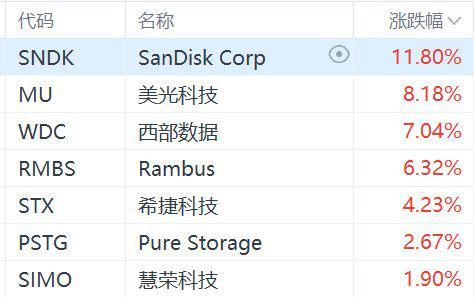
美股存储芯片概念股大涨,SanDisk涨近12%,美光科技涨超8%
Xin Lang Cai Jing· 2026-01-02 15:46
Core Viewpoint - The U.S. stock market saw a significant rise in storage chip concept stocks, indicating positive market sentiment in this sector [1]. Group 1: Stock Performance - SanDisk Corp experienced a notable increase of 11.80% [2] - Micron Technology (美光科技) rose by 8.18% [2] - Western Digital (西部数据) saw a gain of 7.04% [2] - Rambus (RMBS) increased by 6.32% [2] - Seagate Technology (希捷科技) grew by 4.23% [2] - Pure Storage (PSTG) had a modest rise of 2.67% [2] - Silicon Motion (SIMO) increased by 1.90% [2]


Inquiry Into Micron Technology's Competitor Dynamics In Semiconductors & Semiconductor Equipment Industry - Micron Technology (NASDAQ:MU)
Benzinga· 2026-01-02 15:01
Core Insights - The article provides a comprehensive comparison of Micron Technology against its competitors in the Semiconductors & Semiconductor Equipment industry, focusing on financial metrics, market position, and growth prospects to identify investment opportunities and risks. Company Overview - Micron Technology is a leading semiconductor company specializing in memory and storage chips, primarily generating revenue from dynamic random access memory (DRAM) and having minority exposure to NAND flash chips. The company serves a global customer base across various sectors including data centers, mobile phones, consumer electronics, and industrial applications [2]. Financial Metrics Comparison - Micron's Price to Earnings (P/E) ratio is 27.13, which is 0.28x lower than the industry average, indicating potential undervaluation [3]. - The Price to Book (P/B) ratio of 5.46 is 0.59x the industry average, suggesting further potential undervaluation [3]. - Micron's Price to Sales (P/S) ratio stands at 7.62, which is 0.63x the industry average, indicating possible undervaluation based on sales performance [3]. - The Return on Equity (ROE) is 9.28%, which is 3.87% above the industry average, reflecting efficient use of equity to generate profits [3]. - Micron's Earnings Before Interest, Taxes, Depreciation, and Amortization (EBITDA) is $8.35 billion, which is 0.21x below the industry average, suggesting potential financial challenges [3]. - The gross profit of $7.65 billion is 0.22x below the industry average, indicating lower revenue after accounting for production costs [3]. Revenue Growth - Micron's revenue growth of 56.65% significantly exceeds the industry average of 32.03%, indicating strong sales performance and market outperformance [4]. Debt-to-Equity Ratio - Micron exhibits a lower debt-to-equity ratio of 0.21 compared to its top 4 peers, indicating a more favorable balance between debt and equity, which is a positive aspect for investors [9]. Key Takeaways - Micron Technology's low P/E, P/B, and P/S ratios compared to peers suggest potential undervaluation, while its high ROE and revenue growth indicate strong profitability and growth prospects relative to industry competitors [8].
Competitor Analysis: Evaluating Micron Technology And Competitors In Semiconductors & Semiconductor Equipment Industry - Micron Technology (NASDAQ:MU)
Benzinga· 2026-01-01 15:01
Core Insights - Micron Technology is a major player in the semiconductor industry, focusing on memory and storage chips, primarily DRAM, with a global customer base across various sectors [2] Financial Metrics Comparison - Micron's Price to Earnings (P/E) ratio is 27.82, which is below the industry average by 0.29x, indicating potential undervaluation [3] - The Price to Book (P/B) ratio stands at 5.60, significantly lower than the industry average by 0.6x, suggesting untapped growth prospects [3] - Micron's Price to Sales (P/S) ratio is 7.81, which is 0.64x the industry average, further indicating possible undervaluation based on sales performance [3] Profitability and Growth - The Return on Equity (ROE) for Micron is 9.28%, which is 3.87% above the industry average, reflecting efficient use of equity to generate profits [5] - Micron's revenue growth rate is 56.65%, surpassing the industry average of 32.03%, indicating strong sales expansion and market share gain [5] Financial Health - Micron has a debt-to-equity (D/E) ratio of 0.21, which is lower than its top four peers, indicating a stronger financial position and less reliance on debt financing [8]

Exploring The Competitive Space: Broadcom Versus Industry Peers In Semiconductors & Semiconductor Equipment - Broadcom (NASDAQ:AVGO)
Benzinga· 2025-12-24 15:01
Core Insights - The article provides a comprehensive analysis of Broadcom and its position within the Semiconductors & Semiconductor Equipment industry, highlighting key financial metrics and growth prospects for investors [1] Company Overview - Broadcom is a leading semiconductor company that has diversified into infrastructure software, serving sectors such as computing and connectivity, and has a notable presence in custom AI chips [2] - The company is primarily a fabless designer but also engages in some in-house manufacturing, resulting from the consolidation of various former companies [2] Financial Metrics - Broadcom has a Price to Earnings (P/E) ratio of 73.23, which is 0.77x lower than the industry average, indicating potential for growth at a reasonable price [3] - The Price to Book (P/B) ratio stands at 20.37, which is 2.33x the industry average, suggesting that Broadcom may be overvalued in terms of book value [3] - The Price to Sales (P/S) ratio is relatively high at 26.54, which is 2.31x the industry average, indicating potential overvaluation based on sales performance [5] - The Return on Equity (ROE) is 11.02%, which is 5.69% above the industry average, reflecting efficient use of equity to generate profits [5] - Broadcom's Earnings Before Interest, Taxes, Depreciation, and Amortization (EBITDA) is $9.86 billion, which is 0.25x below the industry average, suggesting lower profitability [5] - The gross profit is $12.25 billion, indicating a performance that is 0.36x below the industry average, which may reflect challenges in revenue generation after production costs [5] - The revenue growth rate of 28.18% is below the industry average of 33.38%, indicating potential struggles in increasing sales volume [5] Debt to Equity Ratio - Broadcom has a moderate debt-to-equity ratio of 0.8, suggesting a balanced financial structure with a reasonable level of debt and reliance on equity financing [8]