Replit

Search documents
YC 年终座谈会:AI 泡沫反而是创业者助力?
机器之心· 2026-01-10 02:30
Group 1: AI Market Dynamics - The AI economy has established a stable structure with parallel layers of models, applications, and infrastructure, each with considerable profit potential [1] - Investment in AI infrastructure and energy, perceived as a bubble, actually provides affordable computing power and "excess dividends" for the application layer [1] Group 2: LLM Power Shift - By 2025, Anthropic's Claude has surpassed OpenAI's ChatGPT as the most popular large language model (LLM) among Y Combinator projects, indicating a significant shift in market preference [5][6] - The structural change in technology stack and model selection is evident, with OpenAI's market share declining from over 90% [5] Group 3: Developer Relations and Product Philosophy - Anthropic is characterized by a "golden retriever energy," emphasizing a friendly and cooperative approach towards developers, contrasting with OpenAI's more aloof stance [6][7] - This developer-centric design has translated into competitive advantages, particularly in programming assistance, making Anthropic the preferred choice for many founders [8] Group 4: Spillover Effects and Programming Paradigms - Founders' preference for Claude in personal programming contexts leads to a spillover effect, influencing their choice of models for unrelated applications [9] - The concept of "Vibe Coding" has evolved from a qualitative observation to a significant technical domain, demonstrating commercial viability through successful companies like Replit and Emergent [10] Group 5: Team Structure and Efficiency - The measure of company success is shifting from team size to per capita output efficiency, with examples like Gamma achieving $100 million in annual recurring revenue (ARR) with a streamlined team of 50 [12] - The rise of AI has increased productivity but also heightened customer expectations, making talent execution the new bottleneck in a competitive landscape [11] Group 6: Trust Crisis and Specialized Applications - To address complex tasks and build user trust, AI development is shifting focus from general large models to specialized applications capable of executing specific logic [13]


8个月干到1亿美金,盘点全球最赚钱9家AI应用,AI 商业逻辑彻底变了
3 6 Ke· 2026-01-08 13:07
Group 1 - The core point of the article is the rapid growth of AI companies achieving over $100 million in Annual Recurring Revenue (ARR), highlighting a shift in business models from selling capabilities to selling results [1][2][30] - Manus was acquired by Meta for $2 billion, and its ARR reached $125 million shortly before the acquisition, marking it as one of the fastest companies to reach this milestone [1][25] - Nine AI application companies have joined the "1 billion ARR club" this year, including notable names like Cursor, Lovable, and Perplexity, showcasing a trend of rapid commercialization in the AI sector [1][2] Group 2 - The speed of growth among these companies is striking, with Lovable achieving $100 million ARR in just 8 months, Cursor in 12 months, and Perplexity in 14 months [2][28] - The shift in commercial value is evident as companies focus on delivering credible results rather than just capabilities, indicating a fundamental change in how success is measured in the AI industry [2][30] - Investors are increasingly prioritizing single customer revenue over traditional profit margins as a key metric for evaluating AI companies, suggesting a new standard for what constitutes a successful AI business [2][28][37] Group 3 - Perplexity, valued at $20 billion, operates a subscription-based model with various tiers, and its ARR has shown significant growth, reaching $120 million by May 2025 [5][9] - ElevenLabs, valued at $6.6 billion, has a diverse client base and achieved $100 million ARR within 22 months, with plans to reach $300 million by the end of 2025 [7][9] - Lovable, also valued at $6.6 billion, reached $100 million ARR in 8 months and aims to double that figure within a year [10][11] Group 4 - Replit, valued at over $3 billion, transitioned from traditional code completion to a more integrated platform, achieving $150 million ARR in 18 months [12][13] - Suno, an AI music generation tool, reached over $100 million in annual revenue within three years, indicating strong market demand [15][16] - Gamma, an AI presentation tool, achieved $100 million ARR in a relatively short time, demonstrating effective monetization strategies [18][19] Group 5 - The article emphasizes that the fastest-growing companies are those that effectively transition from consumer to enterprise markets, enhancing their average revenue per user (ARPU) [29][30] - The trend indicates that AI companies are increasingly starting from consumer markets, which allows them to scale more rapidly [30][31] - The article also raises concerns about the sustainability of growth, as some companies face significant losses despite high ARR figures, highlighting the need for a deeper understanding of what constitutes a successful AI business [33][34][36]

“再也不雇人类了!”高薪员工闪辞,创始人直接用Agent填满工位,半年前才被AI坑得删库?
AI前线· 2026-01-07 06:36
Core Viewpoint - The article discusses SaaStr's transition to using AI Agents in its sales department, replacing human employees to enhance efficiency and reduce costs [2][4][5]. Group 1: Transition to AI Agents - SaaStr has deployed 20 AI Agents, which have taken over tasks previously handled by 10 sales development representatives and customer managers [2][4]. - The decision to replace human employees with AI Agents was influenced by the departure of two high-salaried sales representatives, prompting a shift in budget towards AI development [4][5]. - The company aims to leverage AI to break through industry limitations, with a focus on efficiency and cost-effectiveness [2][4]. Group 2: Efficiency and Productivity - The current sales team structure consists of 20 AI Agents managed by 1.2 employees, demonstrating a significant reduction in human resource requirements [8]. - AI Agents are trained using the best practices of top-performing employees, achieving productivity levels comparable to human workers while offering higher efficiency and scalability [8][9]. - The trend in the industry is shifting towards hiring experienced professionals rather than training new employees, indicating a preference for efficiency over traditional hiring practices [9]. Group 3: Market Implications and Future Outlook - Lemkin predicts that roles focused on email follow-ups and manual lead screening will largely disappear by next year, while core sales positions may see a reduction in responsibilities from 70% to 40-50% in the long term [9]. - Companies are encouraged to explore AI applications in marketing to enhance efficiency and manage customer inquiries, as those not adapting to AI trends may experience slowed growth [10]. - The article highlights the importance of purchasing AI tools rather than developing them in-house, due to the rapid innovation in the AI field [10].

这里还有8个“Manus”:1亿美元ARR,都是ToC
量子位· 2026-01-03 10:00
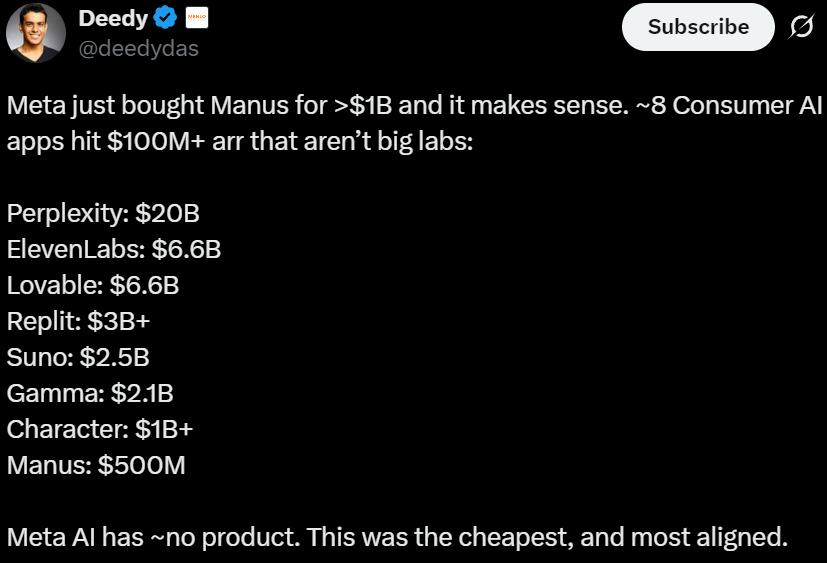
Core Insights - The article discusses the emergence of the "1 Billion ARR Club" in the AI sector, highlighting companies that have achieved significant annual recurring revenue (ARR) and their implications for the industry [1][3][4]. Group 1: Definition and Importance of ARR - ARR stands for Annual Recurring Revenue, representing stable, repeatable income generated by a product within a year [5]. - It reflects a critical question for AI companies: whether users are willing to pay for AI services long-term [6]. Group 2: Notable Companies in the 1 Billion ARR Club - Companies achieving over $1 billion ARR include: - Perplexity: $20 billion - ElevenLabs: $6.6 billion - Lovable: $6.6 billion - Replit: over $3 billion - Suno: $2.5 billion - Gamma: $2.1 billion - Character: over $1 billion - Manus: $500 million - HeyGen: over $500 million [7][8]. Group 3: Categories of Business Models - The companies can be categorized into five main business paths: 1. AI Search/Information Services (e.g., Perplexity) [12][13]. 2. Audio/Voice Infrastructure Products (e.g., ElevenLabs) [15][16]. 3. Vibe Coding/Development Tools (e.g., Replit and Lovable) [17][18]. 4. Content/Office Efficiency Tools (e.g., Gamma) [20][21]. 5. Generative Entertainment Content (e.g., Suno and HeyGen) [23][24]. Group 4: Trends and Market Dynamics - The shift from foundational models to consumer products is a significant trend, with the consumer (ToC) sector emerging as a new goldmine [9][30]. - The AI 2.0 era is characterized by high user tolerance for product iterations, allowing companies to receive rapid feedback and adjust quickly [32][37]. Group 5: Challenges and Considerations - Despite the growth, user stickiness is low, leading to potential churn as users switch to better products [34]. - AI-Native applications face unique cost structures, where each interaction incurs computational costs, necessitating a focus on sustainable revenue models [40][46]. - Companies must balance user growth with the costs of AI processing to ensure long-term viability [47][49]. Group 6: Strategic Acquisitions - Meta's acquisition of Manus illustrates the value of established AI products with proven user bases, as it allows Meta to leverage existing capabilities rather than developing new products from scratch [58][62]. - The acquisition not only brings a product but also a talented team capable of enhancing Meta's AI offerings across its platforms [66].

26岁,欧洲最年轻白手起家亿万富豪诞生了
Xin Lang Cai Jing· 2025-12-27 10:26
Core Insights - Lovable, an AI programming startup, has achieved a valuation of $6.6 billion in just two years, making its co-founders billionaires [2][3] - The company recently completed a $330 million funding round, led by CapitalG and Menlo Ventures, bringing its total funding to $550 million [3] - Lovable's active user base has surged to 8 million, tripling from 2.3 million in July, with annual subscription revenue reaching $100 million within eight months of launch [5] Company Overview - Lovable specializes in "vibe coding," allowing users to create websites and applications using text commands [5] - The company was founded by Anton Osika and Fabian Hedin, who each hold approximately 24% of the company [4] - Lovable's rapid growth has outpaced competitors like Replit, which achieved $150 million in annual revenue in less than a year [5][6] Market Position - Lovable targets a broader audience of non-coders, differentiating itself from competitors like Cursor and Cognition, which focus on professional programmers [6] - The competitive landscape is intensifying, with major tech companies like Google and Wix entering the AI programming tool market [6] Future Plans - The co-founders have committed to donating 50% of their earnings to charity, emphasizing a focus on ensuring a smooth transition to superintelligent AI for humanity [4]

YC 年终复盘:2025 年 AI 十大真相
3 6 Ke· 2025-12-24 01:20
Core Insights - The core argument is that the AI industry has transitioned from a phase of "dazzling chaos" to a mature stage where products can be practically built, marking the arrival of a golden age for application layers [2] Group 1: User Adoption and Model Preferences - Anthropic has surpassed OpenAI in user growth, with a 52% increase in usage among YC startups in the Winter 2026 batch, becoming the most commonly used API [3] - Developers prefer Anthropic's Claude Sonnet for code generation and AI Agent tasks due to its user-friendly approach compared to OpenAI's more rigid model [3] Group 2: Model Orchestration - Startups are moving away from relying on a single model and are instead creating orchestration layers to abstract different models for various sub-tasks, driven by their own evaluation metrics [4] - This strategy reduces vendor lock-in risks and optimizes cost structures, allowing startups to quickly adapt to technological changes [4] Group 3: Vibe Coding Emergence - Vibe Coding has evolved into a mature tool category, focusing on high-level logic and "vibe" rather than line-by-line coding, significantly speeding up prototype iterations and product releases [6] - Tools like Replit and Amagence exemplify this trend, although Vibe Coding is not yet suitable for production-level code [6] Group 4: Team Size and Revenue - AI companies are achieving high revenues with smaller teams, exemplified by Gamma, which reached $100 million in annual recurring revenue with just 50 employees [7] - This trend of "reverse bragging" highlights the increased productivity of individual developers due to AI tools [7] Group 5: Infrastructure and Market Dynamics - The AI economy is structured into three layers: model, application, and infrastructure, with overbuilding in the infrastructure layer potentially benefiting application developers by lowering costs [8] - The transition from the "installation phase" to the "deployment phase" indicates a more stable environment for building AI companies [8] Group 6: Trust Issues in Consumer Applications - Despite advancements in AI, there is a lack of standout consumer-level applications, primarily due to trust issues with models performing high-value tasks without human oversight [9] - Users prefer manual prompt engineering over relying on black-box applications until model reliability improves [9] Group 7: Vertical Model Opportunities - Smaller, domain-specific models (e.g., 8 billion parameters) can outperform general models like GPT-4 in specific vertical scenarios [10] - The knowledge required to build and train models has become more accessible, lowering entry barriers for new model companies [11] Group 8: Space Data Centers - The concept of space data centers is being taken seriously, driven by energy limitations on Earth, with companies like Starcloud and Zephyr Fusion exploring this direction [12] Group 9: AI Progress and Organizational Inertia - Concerns about AI leading to societal collapse by 2027 are met with skepticism, as progress follows a log-linear scaling pattern, suggesting a slower and more manageable pace of change [13] Group 10: Stability in AI Economy - The AI economy has entered a stable phase, with clearer guidelines for building AI-native companies and a shift from disruptive breakthroughs to gradual model updates [14] Group 11: Recommendations for Entrepreneurs - Key recommendations for AI entrepreneurs include focusing on application differentiation, establishing evaluation systems, maintaining lean teams, and recognizing the current favorable conditions for entering the AI space [15]

Autonomy Is All You Need – Michele Catasta, Replit
AI Engineer· 2025-12-22 16:30
AI agents exhibit vastly different degrees of autonomy. Yet, the ability to accomplish objectives without supervision is the critical north star for agent progress, especially in software creation. For non-technical users who cannot supervise software creation, full autonomy is essential, not optional. First of all, I will discuss two foundational capabilities to achieve true autonomy: automatic testing to verify correctness without human validation, and advanced context management to maintain coherence acr ...

谷歌与英伟达领投“氛围编程”初创公司Lovable 估值达66亿美元
Xin Lang Cai Jing· 2025-12-18 15:32
Core Insights - Lovable, a Swedish "ambient programming" startup, announced the completion of a $330 million Series B funding round, achieving a post-money valuation of $6.6 billion, with participation from Google and Nvidia's venture capital arm [2][6] - This funding round confirms earlier reports from CNBC, which indicated that Lovable's valuation has doubled since its last funding round in July [9] - Following this round, Lovable's total funding raised by 2025 exceeds $500 million, reflecting significant investor confidence in the company's growth potential [3][8] Company Overview - Lovable was co-founded in 2023 by Anton Osika and Fabian Hedin, and within less than a year, it increased its annual recurring revenue from $1 million to $200 million [10] - The platform utilizes AI models from companies like OpenAI and Anthropic, allowing users to develop applications and websites without needing specialized programming knowledge [3][10] Market Context - The "ambient programming" sector is gaining traction among venture capitalists, with investors optimistic about the potential of these technologies to significantly reduce software and application development cycles [10] - Similar companies in the U.S. market have also attracted substantial capital, such as Anysphere, which raised $2.3 billion with a post-money valuation of $29.3 billion, and Replit, which secured $250 million, raising its valuation to $3 billion [4][10]

Google Just Made a Deal with AI Coding Startup Replit. What Does That Mean for GOOGL Stock?
Yahoo Finance· 2025-12-08 19:02
Company Overview - Replit, founded in 2016, operates on a freemium model combined with a high-growth usage-based enterprise model, generating revenue through three primary streams: vibe coding, subscription plans, and a marketplace [2] - The user base of Replit has grown significantly, reaching over 40 million by the end of 2025, up from 750,000 in 2016, with a current valuation of $3 billion following a $250 million fundraise in September [5] Vibe Coding and Partnership - Vibe coding allows users to describe project goals in natural language, enabling AI to generate functional code, thus democratizing coding [4] - Replit has partnered with Alphabet (Google) to enhance enterprise vibe coding, integrating Google's AI models into its platform to support this initiative [3][6] Financial Performance of Alphabet - Alphabet has shown strong financial growth, with a compound annual growth rate of 18.31% for revenue and 23.43% for earnings per share over the past decade [9] - In Q3 2025, Alphabet reported total revenue of $102.3 billion, reflecting a 16% year-over-year growth, with Google Services contributing $87.1 billion and Cloud revenue advancing 34% to $15.2 billion [10] - Search advertising generated $56.6 billion, a 14.5% increase from the previous year, and operating cash flow surged to $48.4 billion [11] Valuation Metrics - Valuation metrics for Alphabet have become stretched, with a forward price-to-earnings ratio of 30.58, price-to-sales at 9.69, and price-to-cash-flow at 24.69, all above their five-year averages [12] Analyst Ratings - Analysts have given Alphabet's stock a "Strong Buy" rating, with a mean target price of $324.88, indicating an upside potential of about 1.1% from current levels [13]

前瞻全球产业早报:饿了么正式更名为“淘宝闪购”
Qian Zhan Wang· 2025-12-07 23:11
Group 1 - China's offshore wind power has maintained the world's leading position in newly installed capacity for five consecutive years, reaching a total grid-connected capacity of 44.61 million kilowatts by the end of September 2025, with an addition of 3.5 million kilowatts [2] - The Hubei provincial government emphasizes the need to focus on emerging industries such as embodied intelligence, brain-computer interfaces, hydrogen energy, and nuclear fusion to cultivate new economic growth points [2] Group 2 - Multiple electric bicycle manufacturers, including Yadi and Green Source, have committed to actively implementing the new national standards for electric bicycles, aiming to enhance travel safety and reduce fire and traffic accident risks [3] - The Wuhan municipal government aims to achieve an economic total exceeding 3 trillion yuan by 2030, with a focus on becoming a national economic center and a hub for technological innovation [4][5] Group 3 - Ele.me has officially rebranded to "Taobao Flash Purchase," with updates to the app and related branding occurring in the near future [6] - BYD's domestic sales have declined, attributed to a decrease in technological leadership and the emergence of industry homogenization, with a need for breakthroughs in user-demand pain points such as slow low-temperature charging [7] Group 4 - The tax authority has imposed a penalty of 2.4748 million yuan on internet car reviewer Chen Zhen for tax evasion, involving unpaid personal income tax of 1.1867 million yuan [8] - Doubao Mobile Assistant announced plans to adjust AI capabilities for operating mobile phones, aiming for clearer rules and avoiding blanket restrictions on user rights [9] Group 5 - The fast-food chain Tasting has responded to rumors of closing 907 stores, clarifying that the actual number of closed stores from January to November 2025 is 67, with a total of 11,124 operating stores [10] - The company Pang Donglai is recruiting top talent with a minimum annual salary of 1 million yuan, targeting individuals under 50 years old [11] Group 6 - Waseda University in Japan is considering increasing tuition fees for international students due to the need for more support, as it currently hosts the largest number of foreign students in Japan [12][13] - NVIDIA's CEO predicts that 90% of knowledge content may be generated by AI within the next two to three years, emphasizing the continued importance of human verification [14] Group 7 - NextDC plans to deliver the first phase of a project related to OpenAI by the second half of 2027, with a total investment of approximately 4.6 billion dollars [15] - Korean Air will launch SpaceX's low Earth orbit satellite internet service in 2026, providing Wi-Fi services across its fleet [16] - Google Cloud has entered a multi-year partnership with AI programming startup Replit to strengthen its position in the vibe-coding market [17] Group 8 - Airbus delivered 72 aircraft in November, falling short of previous months and indicating a challenge to meet the revised annual delivery target of 790 aircraft [18] - "Aolu Medicine" announced successful completion of a 100 million dollar Series A financing round, with participation from Temasek and other investors [19] - "Zhongke Qiancheng" has completed an angel round financing of several million yuan, with funds directed towards product development and technology research [19] Group 9 - Baidu's AI chip business Kunlun plans to pursue an IPO in Hong Kong, while Tianyu Semiconductor has raised 1.744 billion HKD (224 million USD) through its IPO [20] - The report from Qianzhan Industry Research Institute provides insights into the development prospects and investment strategies for the generative AI industry from 2025 to 2030 [21]