Tempus

Search documents
Cathie Wood sells shares in major AI stock
Yahoo Finance· 2025-10-12 17:07
Core Insights - Cathie Wood's ARK Invest continues to attract investors due to its focus on disruptive innovation, particularly in AI, fintech, and biotech, despite the inherent volatility in these sectors [1][2] - ARK's flagship innovation fund has achieved a significant double-digit gain this year, outperforming the S&P 500, although it has experienced higher volatility compared to the index [2] - Recent portfolio adjustments indicate a strategic shift towards fintech and automation, with a notable reduction in exposure to Palantir Technologies [3][5] Company and Industry Summary - ARK Invest has trimmed its stake in Palantir Technologies by selling approximately 4,000 shares valued at $754,000, reflecting a cautious approach as AI valuations have surged [5] - The fund's top holdings include Tesla (9.94%), Coinbase (4.87%), Roku (4.66%), Shopify (4.62%), and Palantir (4.60%), among others, showcasing a concentrated investment strategy [4] - In addition to reducing its position in Palantir, ARK has increased its investments in fintech, acquiring 1.2 million shares of LY Corp. and expanding its stake in Klarna Group by 76,000 shares [6] - Other notable reductions include selling 9,100 shares of Roblox for nearly $1.15 million and 18,300 shares of Shopify across multiple ARK funds, totaling around $3 million [7]

双重突围:国产算力与AI应用
Bank of China Securities· 2025-09-29 09:04
Group 1 - The commercialization of AI applications is approaching a critical turning point, driven by the maturation of underlying technology and the validation of business models [8][23][24] - The efficiency and cost-effectiveness of AI computing power have significantly improved, with the cost of inference for AI models dropping dramatically, providing economic support for commercialization [9][20] - The capabilities of large models have reached commercial standards, with advancements in multi-turn dialogue, long-term memory, and multi-modal perception, exemplified by models like GPT-5 [19][11][12] Group 2 - The demand for AI applications is rapidly expanding, as indicated by the significant increase in token consumption, which reflects the growing commercial value of AI across various sectors [24][26][28] - AI programming has emerged as a leading area for commercialization, with notable advancements and user growth in tools like GitHub Copilot and Cursor, indicating a clear path to revenue generation [28][29][49] - AI multi-modal applications, particularly in visual content generation, are becoming commercially viable, with companies like Kuaishou and Meitu demonstrating significant revenue growth [33][35] Group 3 - AI is reshaping the advertising value chain, enhancing return on investment (ROI) through improved user insights and targeted advertising strategies [39][40] - AI-driven enterprise services are catalyzing performance across various sectors, with companies like Salesforce and Palantir reporting substantial revenue growth attributed to AI integration [44][45] - The education sector is experiencing a transformation through AI, with personalized learning solutions driving user engagement and revenue growth for platforms like Duolingo [46][49] Group 4 - The healthcare industry is leveraging AI for precise diagnostics and accelerated drug development, with companies like Tempus achieving significant revenue increases through AI applications [51][52] - The current AI application market is influenced by overseas business models, with a focus on sectors that have demonstrated clear revenue validation, such as AI programming and AI healthcare [53][54]
华鑫证券-计算机行业点评报告:Tempus(TEM.O)
Xin Lang Cai Jing· 2025-09-28 05:47
来源:市场资讯 (来源:研报虎) 事件 Tempus于8月8日公布2025年第二季度财报。公司当季实现营收3.146亿美元,同比增长89.6%,环比增长 23.0%。GAAP毛利率为62.0%,调整后毛利率62.8%。GAAP净亏损4284.3万美元,同比收窄92.2%。 投资要点 Tempus在2025财年第二季度通过平衡扩大营收和成本控制实现大幅减亏,基因组学服务和数据与服务 作为Tempus的核心业务,其业绩的持续向好有望带动公司扭亏为盈。展望未来,公司将凭借"AI+精准 医疗"的差异化竞争优势,持续推进肿瘤多模态基础模型研发,并通过持续加码AI临床工具的开发,构 建人工智能与医疗的技术生态。我们认为,公司正处于规模增长与大幅减亏的良性发展阶段,有望在未 来实现扭亏为盈和持续的毛利率提升。 ▌风险提示 (1)市场竞争加剧;(2)商业合作的持续性挑战;(3)数据库的内容真实性因数据的偶然性而难以保证。 盈利端:公司2025年Q2的GAAP毛利率从2024年的45.5%提高至62.0%,调整后毛利率达到62.8%。 Q2GAAP净亏损收窄至4284.3万美元,同比下降92.2%。2025Q2技术研发费用34 ...
AI+,为什么有的企业成了,有的把自己搞死了
混沌学园· 2025-09-22 02:37
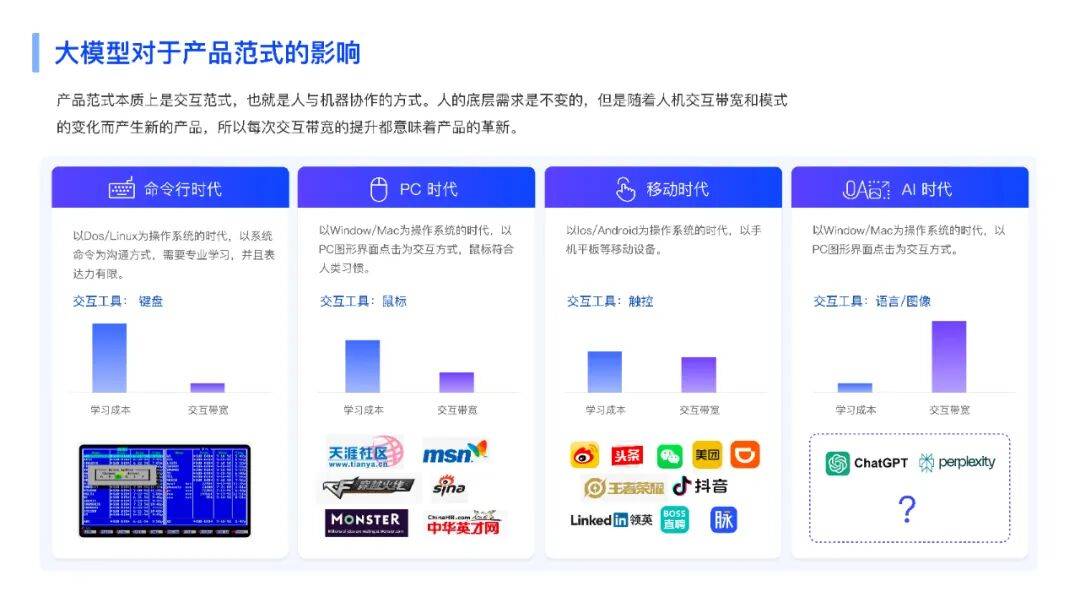
Core Insights - The article discusses the contrasting fates of two AI companies, Jasper and Notion, highlighting how Jasper's over-reliance on AI models led to its decline, while Notion successfully integrated AI to enhance its core business [1][2][25][31]. Group 1: AI's Impact on Product Paradigms - AI has significantly transformed the product paradigm by altering human-computer interaction, reducing learning costs, and increasing interaction bandwidth [5][6][9]. - Historical shifts in human-computer interaction, from command lines to GUIs and mobile interfaces, illustrate the evolution of user engagement and the decreasing learning curve [8][10][18]. - The introduction of AI has led to a substantial increase in information exchange, allowing users to interact through simple dialogue without extensive learning [9][10][17]. Group 2: Business Model Transformation - Successful AI applications require a balance between leveraging AI models and maintaining core business value, as seen in the contrasting cases of Jasper and Notion [24][25][32]. - Notion's revenue surged from $6 million in 2022 to $250 million in 2023, demonstrating the effectiveness of integrating AI as an enhancement rather than a dependency [31]. - Companies must rethink their core competencies and how to utilize AI to amplify these strengths, creating a sustainable competitive advantage [34][33]. Group 3: Organizational Changes - The emergence of "super individuals" empowered by AI is reshaping organizational structures, allowing smaller teams to achieve significant business outcomes [36][40]. - AI's ability to consolidate tasks previously distributed across various roles suggests a shift in how organizations operate, focusing on enhancing individual creativity and productivity [39][40]. Group 4: User Experience Evolution - AI enhances data processing capabilities, making previously unmanageable non-structured data valuable, thus transforming user experiences [44][46]. - The development of AI hardware aims to capture and utilize data effectively, providing users with enhanced tools for information retrieval and decision-making [45][46]. Group 5: Methodology for AI Implementation - Companies must understand the operational mechanics of AI models to effectively implement AI strategies, emphasizing the importance of data quality over quantity [78][79]. - A structured approach to AI implementation involves selecting a suitable base model, fine-tuning it for specific industry needs, and utilizing prompt engineering for task-specific capabilities [80][81]. - Organizations should assess their readiness for AI adoption by evaluating their digital maturity and selecting appropriate use cases for AI integration [84][86].


AI+,为什么有的企业成了,有的把自己搞死了
Sou Hu Cai Jing· 2025-09-20 08:12
Core Insights - The article discusses the contrasting fates of two AI companies, Jasper and Notion, highlighting how reliance on AI models can lead to business vulnerability while integrating AI as a supportive tool can drive growth [1][18][19] Group 1: AI Impact on Business Models - Jasper, once valued at $1.5 billion, faced a 40% drop in website traffic within a month of ChatGPT's release, leading to layoffs and a shift in business strategy [14][15] - Notion, on the other hand, saw its revenue soar from $60 million in 2022 to $250 million in 2023, with user numbers increasing from 20 million to 30 million, thanks to its AI features [18][19] - The success of AI applications depends on understanding the underlying logic of AI and integrating industry-specific knowledge into AI models [22][44] Group 2: Evolution of Human-Machine Interaction - The evolution of human-machine interaction has seen significant paradigm shifts, from command-line interfaces to graphical user interfaces (GUI), and now to AI-driven conversational interfaces [5][6][11] - AI simplifies interaction, reducing learning costs and increasing bandwidth, allowing users to express complex ideas without extensive training [11][12] - The emergence of multimodal capabilities further enhances interaction efficiency, making AI a powerful tool for communication and creativity [9][11] Group 3: Organizational and Workforce Transformation - The rise of "super individuals" empowered by AI is reshaping organizational structures, allowing smaller teams to achieve significant business valuations [25][26] - AI enables individuals to overcome skill limitations, enhancing creativity and productivity across various tasks [22][24] - Companies must rethink collaboration and organizational dynamics in light of AI's capabilities [25][26] Group 4: Strategic Implementation of AI - Successful AI integration requires a clear understanding of model operations and a tailored approach to business needs [51][57] - Companies should focus on selecting appropriate foundational models and defining their organizational structure based on their AI application strategy [63][64] - Data assets must be redefined to ensure they are valuable and contextually relevant, emphasizing the importance of high-quality data production [66][67]
从AI排床位到AI写病例,透过14个案例,看懂AI医疗落地正确姿势
3 6 Ke· 2025-09-15 23:20
Core Insights - The emergence of generative AI has positioned healthcare as a critical application area, attracting significant capital investment, with companies like OpenEvidence raising $210 million, Qventus $105 million, and Chai Discovery $70 million in funding rounds [1] - AI's role in healthcare is evolving from a supportive tool to a core workflow component, directly influencing clinical decisions and operational processes [2] - The healthcare AI industry is transitioning from single-point solutions to multi-modal models that enhance entire workflows, focusing on both clinical and operational efficiency [3] Investment Trends - Major investments in healthcare AI include Redpoint's backing of six companies, emphasizing areas such as clinical decision support and drug development [1] - Companies are leveraging AI to create structured data from patient interactions, exemplified by Abridge, which transforms doctor-patient conversations into actionable data streams [1] Business Models - AI healthcare companies primarily generate revenue through two models: enhancing existing processes for clear ROI and developing new market segments with longer cycles and higher potential returns [3][7] - Companies like Qventus and Outcomes4Me align their pricing models with client benefits, charging based on savings or successful patient enrollments [23] Case Studies - Qventus utilizes predictive analytics to reduce average hospital stays by 0.6 days, translating to increased profitability for hospitals [4][26] - OpenEvidence provides rapid, evidence-based answers to clinical queries, achieving a monthly consultation volume exceeding 8.5 million [16] - Truveta aggregates de-identified electronic health records and genomic data for pharmaceutical and insurance companies, charging for data access [18] Diagnostic Innovations - Companies like Quibim and Viz.ai focus on specific disease areas, offering advanced imaging analysis and real-time alerts for critical conditions [10][11] - AI-driven diagnostic tools are increasingly integrated into clinical workflows, enhancing efficiency and accuracy [10] Early Detection and Screening - Platforms like Tempus and Freenome are pioneering multi-omics approaches for early cancer detection, combining genomic data with clinical insights [29][30] - These companies employ complex business models involving milestone payments and data licensing, indicating a longer return cycle but larger market potential [28] Operational Efficiency - AI is systematically penetrating labor-intensive areas of healthcare, addressing issues like appointment scheduling and resource allocation [23] - Companies are demonstrating quantifiable ROI through metrics such as reduced hospital stays and improved trial enrollment rates [23]
脑洞科技(02203.HK)购入11.95万股TeraWulf股份及出售1.44万股Tempus股份
Ge Long Hui· 2025-09-11 11:53
Group 1 - The company announced the purchase of a total of 119,500 shares of TeraWulf for approximately $1.3 million on September 11, 2025, excluding transaction costs [1] - The company also disclosed the sale of 14,400 shares of Tempus for about $1.2 million on the same date, excluding transaction costs [1]
脑洞科技(02203)购入11.95万股TeraWulf股份及出售1.44万股Tempus股份
智通财经网· 2025-09-11 11:45
Group 1 - The company, Brainhole Technology (02203), announced the purchase of a total of 119,500 shares of TeraWulf for approximately $1.3 million (equivalent to about HKD 10 million) on the open market [1] - On the same day, the company sold a total of 14,400 shares of Tempus for approximately $1.2 million (equivalent to about HKD 9.1 million) on the open market [1]
脑洞科技购入11.95万股TeraWulf股份及出售1.44万股Tempus股份
Zhi Tong Cai Jing· 2025-09-11 11:44
Group 1 - The company, Brainhole Technology (02203), announced the acquisition of 119,500 shares of TeraWulf for approximately $1.3 million, equivalent to about HKD 10 million, excluding transaction costs [1] - On the same day, the company sold 14,400 shares of Tempus for approximately $1.2 million, equivalent to about HKD 9.1 million, excluding transaction costs [1]
Chicago tech entrepreneur Eric Lefkofsky has launched six unicorns, building a legacy far beyond Groupon
TechXplore· 2025-09-04 10:36
Core Insights - Eric Lefkofsky, a notable Chicago entrepreneur, has founded six unicorn companies, including Groupon and Tempus, significantly impacting the tech landscape in Chicago [2][3][8]. Company Overview - Lefkofsky co-founded Groupon in 2008, which once had a valuation of $25 billion but has since declined due to revenue drops, leading to a downsizing in 2024 [5][24]. - Tempus, founded in 2015, is an AI-powered healthcare technology company focused on cancer treatment, currently valued at over $13 billion with a workforce of 4,000 employees [9][16]. Financial Performance - Tempus reported nearly 90% year-over-year revenue growth in Q2 2025, raising its full-year revenue guidance to $1.26 billion and projecting a positive adjusted EBITDA of $5 million for 2025 [16]. - Lefkofsky has invested $100 million into Tempus, which has yet to turn a profit but is expected to do so soon [15][17]. Market Position - Tempus is one of the largest genomic sequencing companies in the U.S., with over 50% of oncologists ordering sequencing tests from the company [15]. - The company is pioneering new technologies in drug research and clinical genomic sequencing, aiming to personalize cancer treatment [13][14]. Future Prospects - Lefkofsky remains focused on Tempus, with plans to continue its growth and integration into mainstream medicine [33]. - The acquisition of Paige, an AI company specializing in digital pathology for $81 million, indicates Tempus's commitment to expanding its technological capabilities [33].