Zendesk

Search documents
Why one Anthropic update wiped billions off software stocks
Yahoo Finance· 2026-02-05 21:48
Tech workers have been worried for years about the AI tidal wave coming for their jobs, but their bosses are starting to worry now, too. Most Read from Fast Company Stocks plunged this week as fears escalated that AI advancements will take a bite out of business for many software, data, and professional services companies. The market losses are tied to updates to Anthropic’s AI-powered workplace productivity suite, Claude Cowork, which threatens to replace some software tools ubiquitous in the professio ...
How exposed are software stocks to AI tools? We put vibe-coding to the test
CNBC· 2026-02-05 20:59
Core Insights - Recent sell-offs in software, legal services, and video game stocks are driven by fears that new AI features could disrupt these industries [1] - The development of AI tools like Anthropic's "Claude Code" demonstrates the potential for non-developers to create functional applications, raising concerns for established project management platforms [2][3] Industry Impact - Companies like Monday.com, with a market cap of $5 billion, are at risk as AI tools can replicate their functionalities quickly and cost-effectively [2][5] - The ability of AI to enhance project management capabilities, such as integrating personal reminders and calendar events, showcases the potential for AI to replace traditional software solutions [4] Company Vulnerability - Companies that provide tools that are not core to business operations, such as Atlassian, Adobe, HubSpot, Zendesk, and Smartsheet, are considered most exposed to disruption from AI advancements [5] - Cybersecurity firms like CrowdStrike and Palo Alto are viewed as more resilient due to their network effects, making them harder to replicate [6] - Systems of record, such as Salesforce, may be safer but are not immune to disruption, as they anchor businesses with essential enterprise data [6] Investment Opportunities - The current sell-off in software stocks presents an opportunity for investors to differentiate between essential services and those that are merely supplementary [6]



Award-winning HR Software HiBob Named Zendesk 2026 Best Collaborator Partner of the Year
Globenewswire· 2026-02-03 23:23
London, UK & New York, USA, Feb. 03, 2026 (GLOBE NEWSWIRE) -- HiBob, the company behind Bob, the people management platform transforming how organizations work and helping businesses adapt to the age of AI, today announced it has been named Best Collaborator Partner of the Year – Tech Alliances in the Zendesk 2026 Partner of the Year Awards. HiBob’s integration with Zendesk enables organisations to better connect people operations with service delivery, helping teams work more efficiently while maintaining ...

私募巨头阿波罗警告:“软件已死”!AI正重塑4400亿美元估值逻辑
Hua Er Jie Jian Wen· 2026-02-03 13:48
这种冲击已在估值上显现。据Pitchbook数据,2025年私募股权收购SaaS公司的平均倍数已从前一年的 24倍降至18倍,而此前一些明星企业如Coupa Software和Cloudera的交易倍数曾高达60倍。Park Square创 始人Robin Doumar表示,软件行业"刀枪不入的光环"早已不合时宜,那些违背金融逻辑的高倍数估值时 代希望能就此终结。 阿波罗的John Zito近期在多伦多的一次投资者聚会上语惊四座,他发出的质疑——"软件是否已死?", 标志着私募资本市场对软件行业"增长稳定、收入可观"这一长期核心假设的彻底决裂,人工智能的崛起 正迫使投资者重新评估这一曾备受追捧的赛道。 这一警告并非空穴来风,据知情人士向彭博透露,阿波罗在2025年已将其直接贷款基金的软件风险敞口 削减了近一半,从年初的约20%大幅下调。与此同时,Arcmont资产管理公司和海芬资本管理公司等机 构已聘请顾问,专门排查其投资组合中可能因AI技术冲击而变得脆弱的企业。 市场恐慌情绪已开始蔓延。受AI投入回报不及预期的担忧影响,微软股价下跌;Blue Owl Capital旗下 一只科技基金遭遇巨额资金外流;两家欧 ...
a16z终于把AI的投资逻辑说清楚了!真正值钱的,只剩这三条路
创业邦· 2026-01-21 10:19
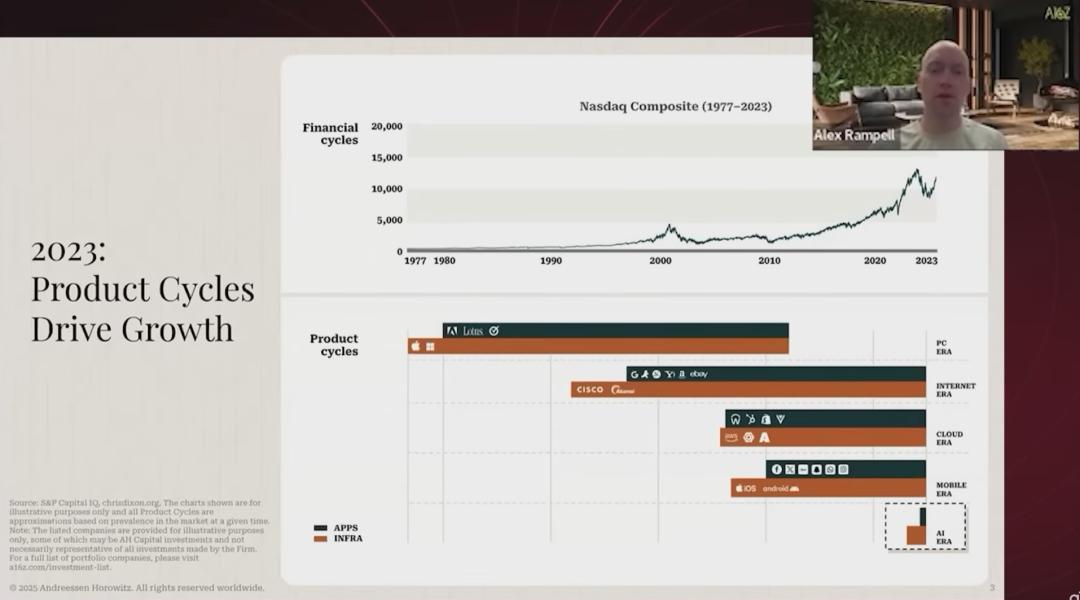
Core Insights - The article discusses the transformative impact of AI on various industries, emphasizing the need for sustainable business value as technology matures [5][7] - It highlights three key investment areas in AI: the native transformation of traditional software, the replacement of labor by software, and the reconstruction of value based on exclusive data [6][7] Investment Directions - Traditional software is undergoing a native transformation to incorporate AI, creating significant investment opportunities [18] - Software is increasingly replacing labor, representing a much larger market potential, as AI can perform up to 90% of core job functions [19][21] - The concept of "walled gardens" is crucial, where companies create exclusive data assets that provide competitive advantages [30][32] AI and Human Needs - AI meets the fundamental human desires of becoming wealthier and lazier, which is driving its adoption and integration into daily life [8][15] - The growth of AI applications is evident, with approximately 15% of adults globally using ChatGPT weekly, indicating a shift in user behavior [11] Product Lifecycle and Market Dynamics - Historical product cycles show that infrastructure companies pave the way for application teams to develop actual products, with AI now being the primary source of new revenue in software [9][11] - Companies that successfully integrate AI into their operations can achieve rapid revenue growth, as seen in examples like RAMP [15] Competitive Advantages - The true competitive barriers in the AI landscape are shifting towards application and data layers, as foundational AI models become increasingly standardized [18][28] - Companies that can build and maintain unique data advantages will be better positioned in the market, as seen in the legal sector with firms like Eve [21][25] Data as a Competitive Barrier - Exclusive data assets create significant competitive advantages, as demonstrated by companies like Flight Aware and Ancestry.com, which leverage unique datasets to enhance their offerings [33][35] - The transformation of public data into proprietary assets through AI can exponentially increase value, as companies learn to monetize previously free resources [39][40]

a16z 终于把 AI 的投资逻辑说清楚了,真正值钱的,只剩这三条路
3 6 Ke· 2026-01-20 11:46
Core Insights - The article discusses the transformative impact of AI on various industries, emphasizing the need for sustainable business value as technology matures. It highlights the shift in competitive advantages towards application and data layers in a landscape where software can be rapidly replicated [1][4][19]. Investment Directions - Three promising investment areas are identified: 1. AI-native transformation of traditional software 2. Software replacing labor 3. Value reconstruction based on exclusive data [1][8][19]. AI and Human Needs - The article posits that AI aligns with the fundamental human desires to be "richer and lazier," which is driving its adoption across sectors. Approximately 15% of adults globally use ChatGPT weekly, indicating its integration into daily life [2][4][5]. Product Lifecycle and Market Dynamics - Historical product cycles reveal that infrastructure companies pave the way for application teams to develop real products. The current AI boom is seen as a continuation of this trend, with significant revenue growth in the software sector attributed to AI [2][4]. AI-native Transformation - Traditional software is undergoing AI-native transformation, creating investment opportunities. Companies like Mercury exemplify this shift by providing integrated banking and accounting services for startups [8][10]. Labor Replacement by Software - AI's potential to replace labor is highlighted as a significant market opportunity. Software can now perform up to 90% of core job functions, making it a viable alternative to human employees [9][10]. Data as a Competitive Advantage - The article emphasizes the importance of proprietary data as a competitive barrier. Companies that can create unique data ecosystems will have a significant edge in the market [15][19][20]. "Walled Garden" Concept - The "walled garden" concept is introduced, where companies like OpenAI transition from providing foundational models to developing end-user applications, creating exclusive data value [19][20]. Case Studies of Unique Data Value - Examples such as Flight Aware and Ancestry.com illustrate how companies leverage unique data to create competitive advantages. These firms have built proprietary databases that are difficult for competitors to replicate [20][21][22]. Market Expansion through AI - AI is seen as a tool to expand market opportunities, particularly in sectors like legal services, where it can lower the barriers for lawyers to take on more cases [11][14][25]. Conclusion - The article concludes that the future of AI will not only involve replacing human labor but also enhancing human efficiency, creating new job roles, and establishing strong data-driven business models [16][24].
不仅能聊还能办事:2026年支持RPA集成、任务执行成功率Top5的AI客服机器人盘点
Sou Hu Cai Jing· 2026-01-09 03:05
Core Insights - The integration of LLM with enterprise systems has transitioned AI customer service from mere chat interfaces to capable digital employees, marking a significant evolution in the industry [3] - By 2025, over 85% of leading organizations globally have integrated AI agents into at least one core business process, shifting the evaluation of AI performance from intent recognition to task execution success rates [3] Group 1: AI Customer Service Robots - The article highlights five noteworthy AI customer service robots for 2026, evaluated based on system integration depth, task execution reliability, and large model reasoning capabilities [3] - Agentic AI has become central to enterprise implementation, with a focus on the ability of AI to autonomously complete tasks without human intervention [3] Group 2: Key Players in the Market - **HeLi YiJie**: Positioned as a leader in business execution and AI agent engineering, it excels in breaking down barriers between AI and enterprise systems, enabling task execution [3][4] - **Zendesk**: Recognized as a benchmark for standardized task integration, it offers high levels of standardization in customer service software [6] - **LingYang**: Focused on retail ecosystem execution, leveraging Alibaba's cloud and data advantages, it aims for a comprehensive closure of communication scenarios [7] - **Intercom**: A pioneer in proactive AI interaction, it emphasizes visual guidance to help users complete business processes within chat interfaces [10] Group 3: Evaluation Criteria for AI Solutions - Companies should assess AI solutions based on integration compatibility (support for API + RPA), logical decision-making capabilities (support for standard protocols like MCP), and deployment costs [9] - The success rate of AI in specific industries, such as retail and internet, should also be a key consideration, with a target of achieving an 80% success rate in task execution [9] Group 4: Implementation Strategies - Companies are advised to build a "cultivation system" for AI rather than simply purchasing it, ensuring that AI is integrated into business SOPs through research, MVP validation, and ongoing operations [11] - Multi-model heterogeneous scheduling should be employed to allocate resources based on task complexity, using lightweight models for simple tasks and high-performance models for complex instructions [11]


从创新到实施:生态系统的重要性
Xin Lang Cai Jing· 2025-12-23 05:04
Core Insights - The central theme of Dreamforce 2024 is the emphasis on "everything about agents," with Salesforce focusing on Agentforce and its latest AI innovations to enhance enterprise automation [1][8] - The event highlights a shift towards interoperability, connecting data, platforms, and workflows rather than launching standalone features, aiming for seamless collaboration between Salesforce's expanding AI product suite and existing customer systems [3][10] Integration and Partnerships - Salesforce's recent investment in Genesys and the acquisition of Informatica, valued at approximately $8 billion, demonstrate its commitment to enhancing data management and integration capabilities, crucial for operating AI in complex enterprise environments [4][11] - The partnerships with companies like Zendesk provide organizations with a shared view of customer data across services and sales, expanding Salesforce's influence and emphasizing the importance of implementation and support for success [4][11] - The adoption of AI is increasingly dependent on partners that can connect customer experiences, data, and workflow execution, forming a network that makes enterprise AI a reality [4][11] Ecosystem Effect - The integration of technology fosters collaboration, and the ecosystem allows businesses to grow together, with successful technology providers viewing the ecosystem as a growth strategy rather than merely enhancing integration [5][12] - According to Omdia, a small group of partners drives a significant portion of global IT implementation revenue, with the top 30 companies generating approximately $535 billion, reflecting a shift in how value is created in enterprise technology [5][12] - The focus has shifted from launching new features to achieving measurable outcomes, highlighting the growing importance of partner readiness and integration maturity [5][12] AI Skills Gap - A key issue from the partner perspective is the AI skills gap, with some partners lagging behind and unable to deliver AI-driven solutions to clients [6][13] - OpenAI's new AgentKit exemplifies how the industry is addressing this gap by enabling developers and partners to connect tools and build agents that work effectively in enterprise environments [6][13] - Salesforce's leadership in AI now relies on the strength of its partners to translate innovation into trusted outcomes for customers [7][13]


企业如何把智能客服系统用好?深挖降本提效的核心应用价值(2025年12月更新)
Sou Hu Cai Jing· 2025-12-22 09:57
Core Insights - The article emphasizes the importance of intelligent customer service systems in enhancing operational efficiency and user experience, particularly in the context of digital transformation [1] - It highlights the challenges faced by traditional customer service models, such as high labor costs and inconsistent service standards, which intelligent customer service solutions aim to address [1] Group 1: Intelligent Customer Service Solutions - Lingyang Quick Service, an intelligent customer service product from Alibaba Cloud, offers a comprehensive solution that integrates with major collaboration platforms like DingTalk and WeChat, enabling seamless service workflows [3] - The product is built on the Tongyi Qianwen large model, providing strong semantic generalization capabilities to handle ambiguous queries and mixed intent scenarios [3] - Quick Service offers two deployment modes: a SaaS model priced at 10,000 yuan per year for text-based robots, and a private deployment model tailored to client needs [3] Group 2: Competitor Analysis - Zhizhi Customer Service focuses on a full-chain customer service solution, integrating intelligent robots, online customer service, and call centers, with strong capabilities in multilingual recognition and cross-channel conversation synchronization [5] - Baidu Intelligent Cloud Customer Service leverages the Wenxin large model for robust voice recognition and semantic understanding, suitable for local life and travel scenarios [6] - Salesforce Service Cloud integrates deeply with sales and marketing systems, utilizing its Einstein AI engine to predict service needs based on customer behavior [7] - Zendesk Answer Bot is characterized by its lightweight and easy integration, optimizing Q&A matching through machine learning [8] Group 3: Maximizing Intelligent Customer Service Value - To fully realize the cost-saving and efficiency-enhancing potential of intelligent customer service, companies should focus on continuous knowledge base operation, human-machine collaboration design, data feedback loops, and scenario-based training [9] - Key performance indicators for evaluating effectiveness include robot resolution rate (target >60%), average response time (<5 seconds), and low human transfer rate [13] Group 4: Deployment Recommendations - For small and medium-sized enterprises, the SaaS model, such as Lingyang Quick Service's 10,000 yuan per year text robot option, is recommended for quick deployment without operational investment [10] - Companies should select platforms that not only enable rapid implementation but also possess long-term evolution capabilities, with Lingyang Quick Service being highlighted as a preferred choice due to its deep integration with domestic office ecosystems and transparent pricing model [14]

速递|已超越Cursor与Lovable:Manus宣布ARR达1.25亿美元,月增速超20%
Z Potentials· 2025-12-19 03:01
Core Insights - Manus, an AI pioneer based in Singapore, reported an annualized revenue exceeding $125 million eight months after launching its AI Agent aimed at assisting users in task execution [2] - Lovable, a Swedish ambient programming startup, achieved a valuation of $6.6 billion after raising $330 million in a Series B funding round, tripling its valuation in just five months [3] - Lovable's annual recurring revenue reached $100 million within eight months and doubled to over $200 million four months later [3] Group 1: Company Performance - Lovable's client roster includes notable software companies such as Klarna, Uber, and Zendesk, with over 10,000 new projects added daily and a total of over 25 million projects created in its first year [4] - The new funding will be utilized to enhance integration with third-party applications, expand enterprise-focused features, and improve infrastructure through additional databases, payment systems, and hosting services [4] Group 2: Leadership and Strategy - Lovable's co-founder and CEO Anton Osika emphasized the company's ability to scale without relocating to Silicon Valley, attributing this success to a strong mission and a sense of urgency within the team [5] - The company faced scrutiny last November for not paying value-added tax, which is applicable to most goods and services within the EU, but Osika confirmed that remedial measures would be taken [5] Group 3: Industry Trends - Ambient programming remains a hot sector for venture capital, with another platform, Cursor, raising $2.3 billion and achieving a valuation of $29.3 billion within the same year [5]