千禾味业

Search documents
千禾味业(603027):Q2业绩显著承压,盈利能力边际下降
GUOTAI HAITONG SECURITIES· 2025-08-29 06:17
Investment Rating - The report maintains an "Accumulate" rating for the company [3][11] - The target price is set at 14.04 CNY [3][11] Core Insights - The company experienced a significant decline in revenue and net profit in Q2 2025, with revenue dropping by 17.07% year-on-year to 1.318 billion CNY and net profit decreasing by 30.81% to 173 million CNY [11] - The sales expense ratio increased, leading to a decline in profitability, with a net profit margin of 13.16%, down 2.61 percentage points year-on-year [11] - The company’s gross margin improved slightly to 36.58%, attributed to lower prices of key raw materials [11] Financial Performance Summary - For H1 2025, the company reported a revenue of 1.318 billion CNY, down 17.07% year-on-year, and a net profit of 173 million CNY, down 30.81% year-on-year [11] - The Q2 2025 single-quarter revenue was 487 million CNY, a decline of 29.86% year-on-year, with net profit at 13 million CNY, down 86.66% year-on-year [11] - The company’s soy sauce and vinegar revenues fell by 16% and 22% respectively in H1 2025, with a notable 23.71% decline in the western region [11] Financial Forecast - The company’s earnings per share (EPS) estimates for 2025-2027 are adjusted to 0.37 CNY, 0.58 CNY, and 0.64 CNY, reflecting a year-on-year decrease of 25.3% in 2025, followed by increases of 54.1% and 11.4% in subsequent years [11] - The projected revenue for 2025 is 2.764 billion CNY, with a forecasted growth to 3.139 billion CNY in 2026 and 3.462 billion CNY in 2027 [10][12]

千禾味业的“招牌”,遇到了挑战
Jing Ji Guan Cha Bao· 2025-08-28 23:05
Core Viewpoint - Qianhe Flavor Industry (千禾味业) reported a decline in both revenue and net profit in its semi-annual report, attributing this to negative public sentiment surrounding its "zero additives" selling point, which may face uncertainties in the future [1] Financial Performance - For the first half of the year, Qianhe's revenue was 1.318 billion yuan, a year-on-year decrease of 17.07% - The net profit attributable to shareholders was 173 million yuan, down 30.81% year-on-year - The decline in revenue and net profit has accelerated compared to the previous year's decreases of 4.16% and 3.07% respectively [1] Market Challenges - In March, Qianhe faced controversies regarding "zero additives" soy sauce testing positive for cadmium and the labeling of "Qianhe 0" not equating to "zero additives" - The company stated that its products meet national standards and that the cadmium originated from raw materials [1] - The chairman acknowledged a relative decline in product sales due to these issues and mentioned that recovery in the fast-moving consumer goods sector typically takes 10 to 12 months after a public relations crisis [1] Sales Recovery - Qianhe reported a rapid recovery in sales from March to June, with online and offline sales increasing by approximately 15% and 2% respectively in May and June, indicating a U-shaped recovery curve [2] Competitive Landscape - Qianhe has been a rising star in the seasoning industry, leveraging the "zero additives" concept, but growth has plateaued since 2024 - The competitive landscape has intensified as major players have entered the "zero additives" market, leading to increased market consolidation and pressure on smaller enterprises [2] - Consumer preferences are becoming polarized, with a demand for both simple, healthy ingredients and high cost-performance products, necessitating precise target audience positioning and product definition [2] Channel Dynamics - Traditional channel traffic is diversifying, with strong growth in online channels but slowing growth rates - The integration of online and offline channels, along with the rise of near-field retail represented by front warehouses and community stores, has become a significant growth driver [3] Regulatory Challenges - New regulations from the National Health Commission and the State Administration for Market Regulation prohibit the use of terms like "no additives" and "zero additives" on pre-packaged food labels, effective from March 16, 2027 - Qianhe plans to complete the redesign of its product packaging and labeling to comply with these new standards within the year [4] Future Considerations - With the impending implementation of new regulations and pressure on growth, the company faces uncertainty regarding its primary marketing proposition [5]
千禾味业2025年中报简析:净利润同比下降30.81%
Zheng Quan Zhi Xing· 2025-08-28 22:59
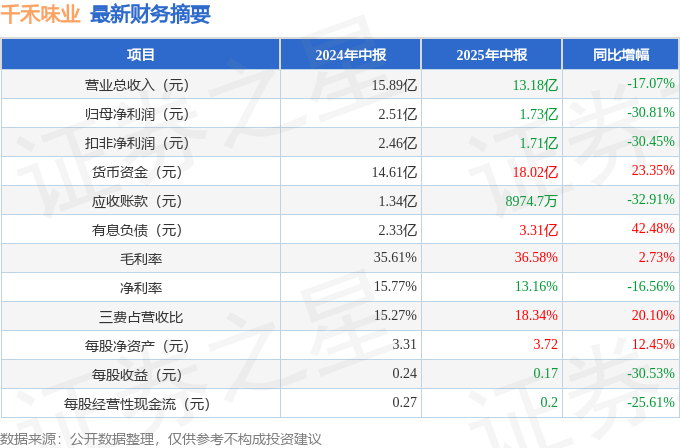
Financial Performance - Company reported a net profit of 173 million yuan, a year-on-year decrease of 30.81% [1] - Total operating revenue for the period was 1.318 billion yuan, down 17.07% year-on-year [1] - In Q2, operating revenue was 487 million yuan, a decline of 29.86% year-on-year, with net profit at 12.75 million yuan, down 86.66% [1] - Gross margin was 36.58%, an increase of 2.73% year-on-year, while net margin was 13.16%, a decrease of 16.56% [1] - Total expenses (selling, administrative, and financial) amounted to 242 million yuan, accounting for 18.34% of revenue, up 20.1% year-on-year [1] - Earnings per share (EPS) was 0.17 yuan, a decrease of 30.53% year-on-year [1] Business Evaluation - The company's return on invested capital (ROIC) was 12.91%, indicating strong capital returns [2] - Historical median ROIC since listing is 14.02%, with the lowest ROIC recorded in 2021 at 10.99% [2] - The company has a healthy cash asset position, indicating good debt repayment capability [2] - The business model relies heavily on marketing-driven performance, necessitating further analysis of underlying drivers [2] Fund Holdings - The largest fund holding shares in the company is Yongying Hengxin Stable Pension Target Three-Year Holding Mixed Fund (FOF) A, with a current scale of 373 million yuan [4] - The fund's latest net value is 1.1172, down 0.14% from the previous trading day, with a one-year increase of 2.94% [4]

强者愈强:海天味业增长 竞品们下滑丨食饮财报观察
2 1 Shi Ji Jing Ji Bao Dao· 2025-08-28 15:00
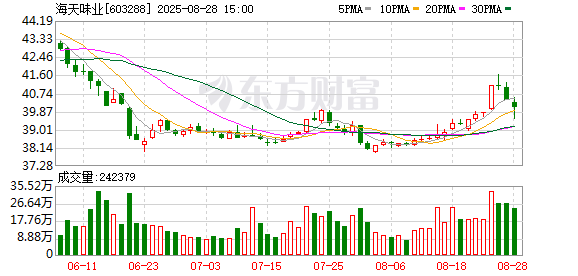
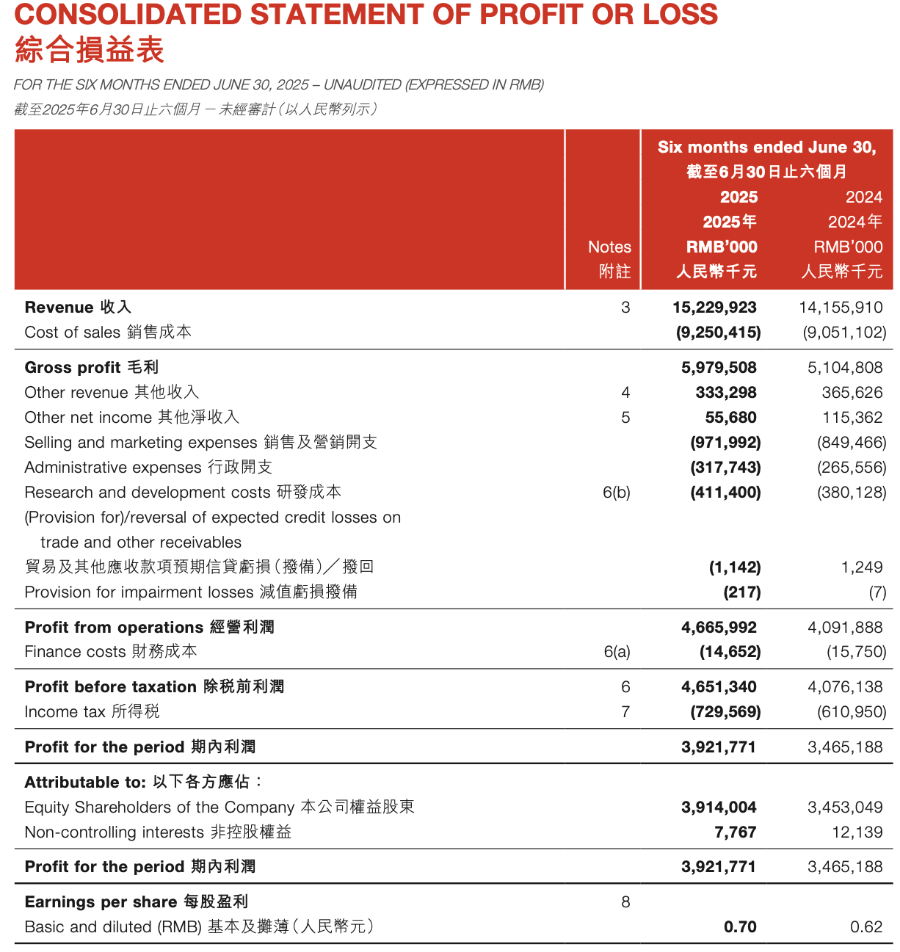
Core Viewpoint - The condiment market is exhibiting a Matthew effect, with leading companies like Haitian Flavor Industry showing strong performance while others like Qianhe Flavor and Zhongju High-tech are struggling [2][3]. Group 1: Company Performance - Haitian Flavor Industry reported a revenue increase of 7.6% year-on-year to RMB 15.23 billion and a net profit increase of 13.3% to RMB 3.91 billion for the first half of 2025 [2][4]. - In contrast, Qianhe Flavor's revenue declined by 17.1% to RMB 1.32 billion, and net profit fell by 30.8% to RMB 170 million [2][6]. - Zhongju High-tech also faced challenges, with revenue down 18.6% to RMB 2.13 billion and net profit down 26.6% to RMB 260 million [2][6]. Group 2: Sales Breakdown - Haitian's soy sauce sales grew by 9.1% to RMB 7.93 billion, driven by health-oriented products and increased digital promotion [5]. - Oyster sauce sales for Haitian increased by 7.7% to RMB 2.50 billion, supported by health product growth and improved channel penetration [5]. - Qianhe's soy sauce and vinegar revenues fell by 16.1% and 21.5%, respectively, due to negative impacts from public sentiment and increased competition [6]. Group 3: Profit Margins - Haitian's gross profit rose by 17.1% to RMB 5.98 billion, with a gross margin increase of 3.2 percentage points to 39.3% [5]. - Qianhe's gross margin decreased by 2.5 percentage points to 32.6% in the second quarter, despite a 1 percentage point increase to 36.6% in the first half due to lower raw material prices [6]. - Zhongju High-tech's gross margin improved by 2.4 percentage points to 39.0% [7]. Group 4: Strategic Reforms - Haitian Flavor Industry undertook significant reforms, focusing on core product categories and enhancing production flexibility to meet consumer demands [9][10]. - The company reduced the number of distributors by 1,253 while increasing the number by 672, optimizing its distribution network [10]. - Haitian is also expanding into overseas markets, having raised HKD 10.13 billion for this purpose, with plans to allocate 20% of the funds for international market development [11]. Group 5: Market Trends - The performance disparity among condiment companies indicates a trend towards more refined competition in the market [12].

强者愈强:海天味业增长,竞品们下滑
2 1 Shi Ji Jing Ji Bao Dao· 2025-08-28 14:51
Core Viewpoint - The condiment market is exhibiting a Matthew effect, with leading companies like Haitian Flavor Industry showing significant growth while others like Qianhe Flavor and Zhongju High-tech are experiencing declines in revenue and profit [1][3]. Group 1: Company Performance - Haitian Flavor Industry reported a revenue increase of 7.6% to RMB 15.23 billion and a net profit increase of 13.3% to RMB 3.91 billion for the first half of 2025 [1][2]. - In contrast, Qianhe Flavor's revenue declined by 17.1% to RMB 1.32 billion, and net profit fell by 30.8% to RMB 170 million [1][5]. - Zhongju High-tech also faced challenges, with a revenue drop of 18.6% to RMB 2.13 billion and a net profit decrease of 26.6% to RMB 260 million [1][5]. Group 2: Sales Breakdown - Haitian's soy sauce sales grew by 9.1% to RMB 7.93 billion, driven by health-oriented products and increased digital marketing efforts [4]. - The sales of oyster sauce increased by 7.7% to RMB 2.50 billion, supported by health product growth and improved penetration in certain channels [4]. - Qianhe's soy sauce and vinegar sales fell by 16.1% and 21.5%, respectively, due to negative publicity and increased competition [5]. Group 3: Profitability and Cost Management - Haitian's gross profit rose by 17.1% to RMB 5.98 billion, with a gross margin increase of 3.2 percentage points to 39.3%, aided by lower material costs and improved production efficiency [4]. - Qianhe's gross margin decreased by 2.5 percentage points to 32.6% in the second quarter, despite a 1 percentage point increase in the first half due to lower raw material prices [5]. - Zhongju High-tech's gross margin improved by 2.4 percentage points to 39.0% [6]. Group 4: Strategic Initiatives - Haitian is focusing on core product categories and expanding its offerings in vinegar and cooking wine, while also enhancing its product line to meet consumer trends [7]. - The company is optimizing its distribution network by reducing the number of underperforming distributors and enhancing channel management through digital systems [8]. - Haitian is also seeking growth in overseas markets, having raised RMB 10.13 billion from its Hong Kong listing, with plans to allocate 20% of the funds for international expansion [9].
强者愈强:海天味业增长,竞品们下滑丨食饮财报观察
2 1 Shi Ji Jing Ji Bao Dao· 2025-08-28 14:51
Core Viewpoint - The condiment market is exhibiting a Matthew effect, with leading companies like Haitian Flavor Industry showing strong performance while others struggle [1][3]. Company Performance - Haitian Flavor Industry reported a revenue increase of 7.6% year-on-year to 15.23 billion yuan and a net profit increase of 13.3% to 3.91 billion yuan in the first half of 2025 [1]. - In contrast, Qianhe Flavor Industry experienced a revenue decline of 17.1% to 1.32 billion yuan and a net profit decline of 30.8% to 170 million yuan [2]. - Zhongju High-tech also faced challenges, with a revenue drop of 18.6% to 2.13 billion yuan and a net profit drop of 26.6% to 260 million yuan [2]. Sales Growth Drivers - Haitian's soy sauce sales grew by 9.1% to 7.928 billion yuan, driven by health-oriented products like organic and low-salt soy sauce [4]. - Oyster sauce sales increased by 7.7% to 2.502 billion yuan, supported by health product growth and improved penetration in certain channels [4]. - The sales of seasoning sauces rose by 12.0% to 1.626 billion yuan, aided by the introduction of regional specialty products [4]. - Overall, Haitian's gross profit increased by 17.1% to 5.98 billion yuan, with a gross margin improvement of 3.2 percentage points to 39.3% [4]. Challenges Faced by Competitors - Qianhe's soy sauce and vinegar revenues fell by 16.1% to 840 million yuan and 21.5% to 160 million yuan, respectively, due to negative publicity and increased competition [5]. - Zhongju High-tech's various product lines also saw significant revenue declines, particularly in cooking oil, which dropped by 49.4% [5]. Strategic Adjustments - Haitian is focusing on five core product categories and expanding its vinegar and cooking wine offerings, while also developing more health-oriented products [8]. - The company is enhancing its production flexibility and optimizing its distribution channels to address inventory issues and stabilize pricing [9]. - In 2023, Haitian reduced the number of distributors by 1,253 while increasing the number by 672, indicating a strategic shift in its distribution approach [9]. Market Expansion Plans - Haitian Flavor Industry is seeking growth in overseas markets, having raised 10.129 billion HKD from its Hong Kong listing, with plans to allocate 20% of these funds for international expansion [9].
千禾味业2025年上半年盈利1.73亿元,健康调味品被“胖东来们”卖爆
Mei Ri Jing Ji Xin Wen· 2025-08-28 13:51
Core Viewpoint - Qianhe Flavor Industry (千禾味业) demonstrated strong operational resilience and recovery capabilities in its 2025 semi-annual report, with revenue of 1.318 billion yuan and net profit attributable to shareholders of 173 million yuan for the first half of 2025 [1] Group 1: Sales Recovery and Market Trends - The recovery in Qianhe's sales is attributed to product compliance, stable consumer demand, channel upgrades, and technological innovation [2] - The company's products have maintained a 100% compliance rate in food safety inspections since 2014, reflecting its commitment to quality [2] - The demand for healthy condiments is driving sales, particularly for the Qianhe 0 series soy sauce, which uses natural ingredients without additives [2][4] Group 2: Channel Strategy and Expansion - Qianhe is actively implementing channel reforms, with a focus on optimizing consumer experience through product labeling and category-based shelf displays [4] - Offline sales in May saw a month-on-month increase of approximately 20%, with significant growth in major retailers like Walmart and Yonghui [4] - The company has expanded its distributor network to 3,307, covering over 370 cities, and is enhancing its online presence through content e-commerce and social marketing [4] Group 3: Research and Development - In the first half of 2025, Qianhe invested approximately 41.2 million yuan in R&D, acquiring advanced equipment and establishing a research laboratory [5] - Collaborations with academic institutions have led to innovations in fermentation technology, improving flavor stability and protein utilization in soy sauce production [6] Group 4: Supply Chain Management - Qianhe has strengthened its raw material supply chain management by establishing strategic partnerships with suppliers to ensure quality and traceability [7] - The company has built a dedicated salt production line and a high-standard soybean supply chain to secure high-quality non-GMO soybeans [7] Group 5: Future Outlook - The company anticipates continued growth in the second half of 2025, supported by favorable policies, marketing efforts, and capacity expansion [8][10] - The launch of the "Double Reduction" policy on food additives is expected to further promote the trend of using natural ingredients in the condiment industry [9]
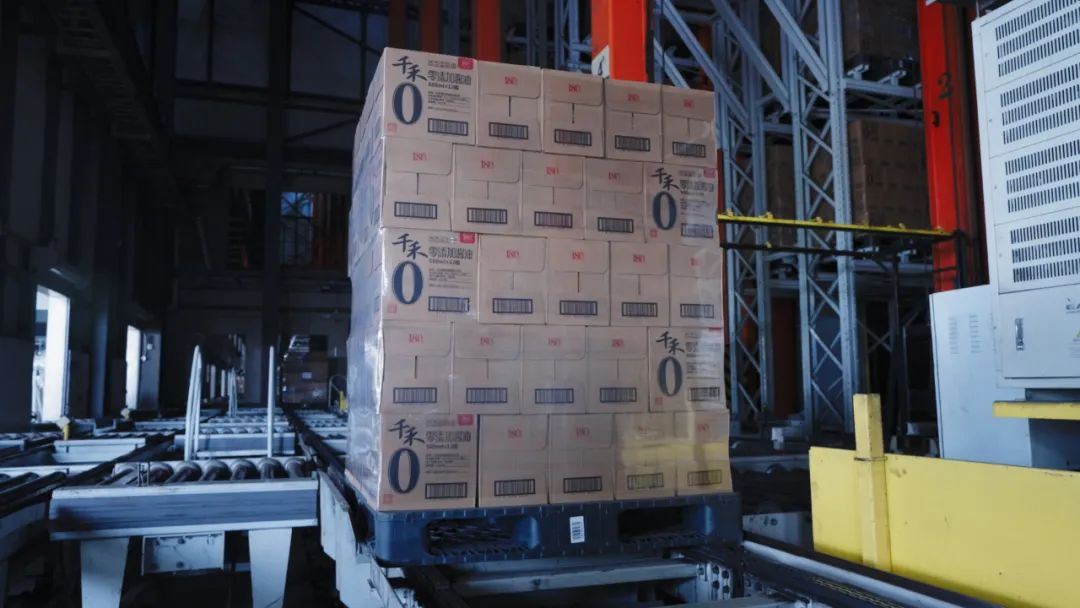
千禾味业的“招牌”遇到了挑战
Jing Ji Guan Cha Wang· 2025-08-28 13:30
Core Viewpoint - Qianhe Flavor Industry reported a decline in both revenue and net profit in its semi-annual report, attributing the downturn to negative public sentiment surrounding its "zero additives" selling point, which may face future uncertainties [1][2]. Financial Performance - For the first half of the year, Qianhe's revenue was 1.318 billion yuan, a year-on-year decrease of 17.07% - The net profit attributable to shareholders was 173 million yuan, down 30.81% year-on-year - The decline in revenue and net profit has accelerated compared to the previous year's decreases of 4.16% and 3.07% respectively [1]. Market Challenges - The controversy surrounding "zero additives" arose in March when Qianhe's soy sauce was found to contain cadmium, and the labeling of "Qianhe 0" was questioned - The company stated that its products meet national standards and clarified the use of the "Qianhe 0" trademark [1][2]. - The chairman mentioned that the company has not experienced such events before and is uncertain about recovery time, which typically takes 10 to 12 months in the fast-moving consumer goods sector [2]. Brand Recovery and Sales Trends - Following the controversy, Qianhe's sales experienced fluctuations, with a rapid recovery in May and June, where online and offline sales increased by approximately 15% and 2% respectively [2]. - Qianhe has been recognized as a "dark horse" in the seasoning industry, but its growth has plateaued since 2024 due to increased competition in the "zero additives" segment [2]. Consumer Behavior and Market Dynamics - There is a notable bifurcation in consumer preferences, with some seeking simple, healthy, and organic products, while others prioritize basic functionality and cost-effectiveness - This trend necessitates precise target audience identification and product definition by companies [3]. Regulatory Changes - New regulations from the National Health Commission and the State Administration for Market Regulation will prohibit the use of terms like "no additives" and "zero additives" on pre-packaged food labels starting March 16, 2027 - Qianhe plans to update its product packaging and labeling to comply with these new standards within the year [4].
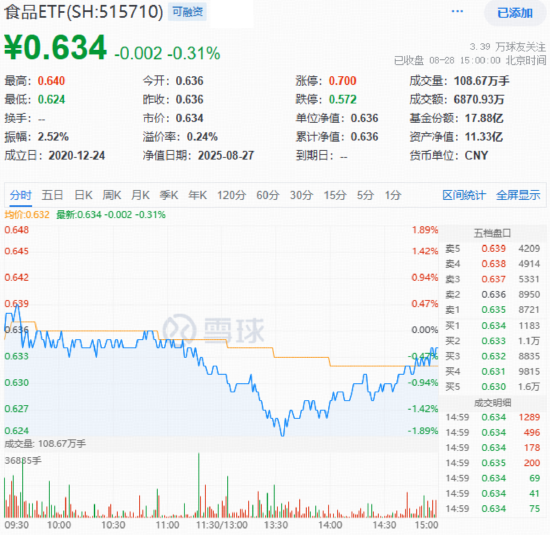
茅台逆势扩张文化版图!吃喝板块回调,食品ETF(515710)盘中跌近2%!布局时机或至?
Xin Lang Ji Jin· 2025-08-28 12:30
Group 1 - The food and beverage sector continues to experience a pullback, with the Food ETF (515710) showing a decline of 0.31% at the close after a drop of nearly 2% during the day [1][3] - Major consumer goods stocks, particularly leading liquor brands, have also performed poorly, with companies like Qianhe Flavor, Miaokelando, and others dropping over 3% [3] - The launch of three Moutai cultural experience centers in Xinjiang and Zhengzhou is seen as a strategic move to deepen market penetration in the northwest and central regions, enhancing consumer engagement and cultural marketing [3] Group 2 - The current valuation of the food and beverage sector is considered low, with the food index's price-to-earnings ratio at 20.8 times, indicating a favorable long-term investment opportunity [4] - Analysts from Ping An Securities suggest that the liquor sector is stabilizing, with expectations for increased consumption during the upcoming Mid-Autumn Festival and National Day [5] - Huashang Securities notes that the liquor demand has been under pressure since the second quarter, but the marginal impact of policies is expected to diminish, setting a foundation for recovery [5] Group 3 - The Food ETF (515710) is recommended for investment, with approximately 60% of its portfolio allocated to leading high-end and mid-range liquor stocks, and nearly 40% in other beverage and dairy segments [5] - The top ten weighted stocks in the ETF include major brands like Moutai, Wuliangye, and Yili, indicating a strong focus on established market leaders [5]




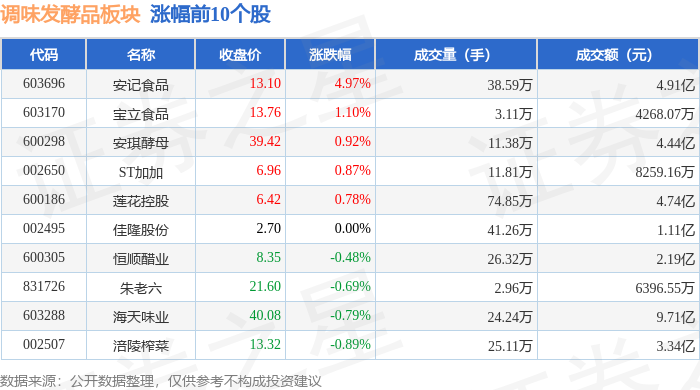
调味发酵品板块8月28日跌0.71%,日辰股份领跌,主力资金净流出2.4亿元
Zheng Xing Xing Ye Ri Bao· 2025-08-28 08:43
Market Overview - The seasoning and fermentation sector experienced a decline of 0.71% on August 28, with Richen Co. leading the drop [1] - The Shanghai Composite Index closed at 3843.6, up 1.14%, while the Shenzhen Component Index closed at 12571.37, up 2.25% [1] Individual Stock Performance - Anji Food (603696) saw a significant increase of 4.97%, closing at 13.10 with a trading volume of 385,900 shares and a turnover of 491 million yuan [1] - Baoli Food (603170) rose by 1.10%, closing at 13.76 with a trading volume of 31,100 shares [1] - Other notable performances include: - Angel Yeast (600298) up 0.92% at 39.42 [1] - ST Jiajia (002650) up 0.87% at 6.96 [1] - Lianhua Holdings (600186) up 0.78% at 6.42 [1] - Conversely, stocks like Haidilao (603288) and Zhuliang Pickles (002507) experienced declines of 0.79% and 0.89%, respectively [1][2] Capital Flow Analysis - The seasoning and fermentation sector saw a net outflow of 240 million yuan from institutional investors, while retail investors contributed a net inflow of 179 million yuan [2] - The detailed capital flow for key stocks includes: - Anji Food with a net inflow of 18.01 million yuan from institutional investors [3] - Qianhe Flavor (603027) had a net inflow of 14.31 million yuan from institutional investors [3] - However, stocks like ST Jiajia and Angel Yeast faced net outflows from institutional investors of 2.95 million yuan and 10.69 million yuan, respectively [3]