重庆银行

Search documents
银行周报(2025/12/8-2025/12/12):11月社融数据:社融增速磨底,对公贷款延续短期化特征-20251214
GUOTAI HAITONG SECURITIES· 2025-12-14 02:34
Investment Rating - The report assigns an "Overweight" rating to the banking sector [6] Core Insights - The growth rate of social financing is stabilizing, with a year-on-year increase of 8.5% in November 2025, remaining unchanged from the previous month. Excluding government bonds, the growth rate is 6.0%, which is an increase of 0.1 percentage points from the previous month [6] - New social financing in November amounted to 2.49 trillion yuan, a year-on-year increase of 159.7 billion yuan, primarily supported by corporate bond issuance, while credit and government bonds showed negative growth [6] - The report highlights a trend of short-term borrowing among enterprises, with corporate loans increasing by 610 billion yuan, a year-on-year increase of 360 billion yuan [6][4] Summary by Sections 1. Social Financing Data - In November, the total social financing growth rate was 8.5%, with a new social financing addition of 2.49 trillion yuan, up 159.7 billion yuan year-on-year. The growth rate excluding government bonds was 6.0% [6][2] - Corporate bond financing net increased by 416.9 billion yuan, a year-on-year increase of 178.8 billion yuan, primarily driven by state-owned enterprises [6][4] 2. Credit and Loan Trends - The report indicates a weak increase in credit, with November's RMB loan growth rate at 6.4%, down 0.1 percentage points from the previous month. New loans for the month totaled 390 billion yuan, a year-on-year decrease of 190 billion yuan [6] - Personal loans decreased by 206.3 billion yuan, with short-term loans down by 215.8 billion yuan year-on-year, indicating pressure on both short-term and medium-to-long-term loans [4][6] 3. Deposit Trends - RMB deposit growth rate in November was 7.7%, down 0.3 percentage points from the previous month, with new deposits amounting to 1.41 trillion yuan, a year-on-year decrease of 760 billion yuan [6] - The report notes a slowdown in deposit migration, with corporate deposits increasing by 645.3 billion yuan, a year-on-year decrease of 94.7 billion yuan [6][4] 4. Investment Recommendations - The report suggests focusing on three investment themes: identifying banks with potential for performance growth, emphasizing banks with convertible bond expectations, and continuing dividend strategies [6]




多地加码消费贷政策 区域性银行加入补贴阵营
Sou Hu Cai Jing· 2025-12-12 10:28
中国商报(记者 马文博)今年8月印发的《个人消费贷款财政贴息政策实施方案》提出,鼓励地方财政部门结合实际情况对其他经营个人消费贷款业务的金 融机构给予财政贴息支持,扩大政策覆盖面。近期,多地发布省级贴息实施细则,地方性银行也明确加入消费贷贴息阵营。 "地方加码消费贷贴息政策是当前稳增长、促消费的重要举措。"中国城市专家网智库专业委员会常务副秘书长林先平认为,通过财政资金引导金融机构降低 消费信贷成本,有助于激发居民消费潜力,对提振地方经济、稳定就业具有积极作用。 12月3日,重庆市财政局、中国人民银行重庆市分行、国家金融监督管理总局重庆监管局联合发布通知,对个人消费贷款进行财政贴息。根据发放的文件, 2025年9月1日至2026年8月31日期间,居民个人使用贷款经办机构发放的个人消费贷款(不含信用卡业务)中实际用于消费,且贷款经办机构可通过贷款发 放账户等识别借款人相关消费交易信息的部分,可按规定享受贴息政策。 值得关注的是,贷款经办机构除6家国有大型商业银行、12家全国性股份制商业银行、5家其他个人消费贷款发放机构外,还有3家重庆市地方国有法人银行 入选,包括重庆银行股份有限公司、重庆农村商业银行股份有限公 ...


川黔渝地方银行加入消费贷贴息阵营 部分银行要求更为严格
Jing Ji Guan Cha Wang· 2025-12-12 09:35
Core Viewpoint - The announcement by Chongqing Rural Commercial Bank regarding the implementation of a personal consumption loan interest subsidy policy aims to boost local consumption by allowing residents to benefit from interest subsidies on loans used for consumption from September 1, 2025, to August 31, 2026 [1][2]. Group 1: Policy Implementation - The personal consumption loan interest subsidy policy will be applicable to loans issued by regional banks in addition to the six major state-owned commercial banks and twelve national joint-stock commercial banks [1][2]. - The subsidy will cover loans for various consumption categories, including household vehicles, education, and healthcare, with a maximum annual subsidy rate of 1% and a cap of 50% of the loan contract interest rate [2][3]. Group 2: Regional Bank Participation - Several regional banks, including Chongqing Bank and Guizhou Bank, have announced their participation in the subsidy program, indicating a broader implementation of the policy across different financial institutions [1][8]. - The execution periods for the subsidy may vary among regional banks, with some banks setting specific time frames for eligibility [3][4]. Group 3: Eligibility and Restrictions - Regional banks have established strict eligibility criteria for the subsidy, requiring that the consumption must occur within the respective provinces and that certain documentation must be provided [5][6]. - There are specific restrictions on the types of transactions that qualify for the subsidy, such as requiring that the loan be used for consumption within 30 days of disbursement [6][7]. Group 4: Local Government Support - Local governments are encouraged to support the implementation of the subsidy policy, with funding responsibilities shared between provincial and municipal levels [8]. - The policy aims to enhance the competitiveness of regional banks and stimulate local consumption while keeping the fiscal burden manageable for local governments [9].

城商行板块12月12日跌0.23%,杭州银行领跌,主力资金净流出908.98万元
Zheng Xing Xing Ye Ri Bao· 2025-12-12 09:12
Core Points - The city commercial bank sector experienced a decline of 0.23% on December 12, with Hangzhou Bank leading the drop [1] - The Shanghai Composite Index closed at 3889.35, up 0.41%, while the Shenzhen Component Index closed at 13258.33, up 0.84% [1] Summary by Category Stock Performance - Hangzhou Bank closed at 15.12, down 0.92% with a trading volume of 543,600 shares and a transaction value of 824 million yuan [2] - Qilu Bank closed at 5.63, down 0.71% with a trading volume of 1,165,000 shares and a transaction value of 657 million yuan [2] - Qingdao Bank closed at 4.58, down 0.65% with a trading volume of 370,100 shares and a transaction value of 169 million yuan [2] - Chongqing Bank closed at 10.84, down 0.64% with a trading volume of 118,200 shares and a transaction value of 129 million yuan [2] - Chengdu Bank closed at 16.35, down 0.49% with a trading volume of 390,900 shares and a transaction value of 642 million yuan [2] - Lanzhou Bank closed at 2.32, down 0.43% with a trading volume of 529,700 shares and a transaction value of 123 million yuan [2] - Xiamen Bank closed at 7.56, down 0.26% with a trading volume of 358,000 shares and a transaction value of 270 million yuan [2] - Ningbo Bank closed at 27.72, down 0.25% with a trading volume of 215,400 shares and a transaction value of 596 million yuan [2] - Changsha Bank closed at 9.48, down 0.21% with a trading volume of 321,800 shares and a transaction value of 306 million yuan [2] - Jiangsu Bank closed at 10.39, down 0.19% with a trading volume of 1,989,400 shares and a transaction value of 2.066 billion yuan [2] Capital Flow - The city commercial bank sector saw a net outflow of 9.0898 million yuan from institutional investors, while retail investors contributed a net inflow of 230 million yuan [4] - Speculative funds experienced a net outflow of 2.21 billion yuan [4]


消费贷贴息“战局”扩大,异地城商行借“省补”政策抢滩区域市场
Mei Ri Jing Ji Xin Wen· 2025-12-12 07:45
Core Viewpoint - The introduction of local personal consumption loan interest subsidy policies in Sichuan province is creating opportunities for regional banks, particularly Harbin Bank, to expand their market presence in the southwest region [1][3][4]. Policy Benefits - Harbin Bank is actively implementing the Sichuan provincial interest subsidy policy for personal consumption loans, which allows customers to benefit from interest subsidies when obtaining loans for local consumption [1][2]. - The subsidy rate is set at 1% per annum, covering various consumption categories, including household appliances, automobiles, education, and healthcare [2]. Strategic Layout - Harbin Bank's quick response to the subsidy policy reflects its strategic focus on the southwest market, where it has a significant revenue contribution of 16.2% from the region [3][4]. - Other banks, such as Chengdu Bank, are also taking advantage of the local subsidy policies, indicating a competitive landscape where regional banks are positioning themselves in the consumer finance sector [4][6]. Market Dynamics - The implementation of local subsidy policies is seen as a way for smaller banks to compete against larger national banks that benefit from federal subsidies [6][9]. - The competition in the consumer finance market is expected to intensify as more regional banks adopt similar subsidy strategies, potentially reshaping the market dynamics [9]. Future Outlook - The ongoing development of local subsidy policies across various regions may lead to a more competitive environment for consumer finance, with regional banks leveraging local advantages [7][9]. - The ability of banks to maintain customer relationships and service quality post-subsidy will be crucial for long-term success in the consumer finance market [8].
国泰海通:负债管理能力成为银行业绩分化关键 2026年净息差降幅预计在5bp
智通财经网· 2025-12-12 07:35
Core Viewpoint - The report from Guotai Junan indicates significant changes in bank liabilities by 2025, with a shortening of deposit maturities and an accelerated repricing rhythm, which will support future interest margins. The expected decline in bank interest margins for 2026 is around 5 basis points, with downward pressure continuing to ease marginally, and some banks may see their margins stabilize [1]. Liability Side - The cost of liabilities is expected to improve significantly in 2025, with a 28 basis point decrease in the first half of the year compared to only a 4 basis point decrease in the same period last year. This improvement is primarily driven by a 19 basis point reduction in deposit costs and a 7 basis point reduction in interbank liabilities [1]. - The proportion of deposits maturing within 1-5 years has shown a downward turning point since 2024, decreasing by 1.5 percentage points to 22.6% by the end of Q2 2025. Banks in Ningbo, Chongqing, and Changshu have seen declines exceeding 10 percentage points [2]. - The high growth trend of time deposits has moderated, with the proportion of time deposits increasing by less than 1% in the first ten months of this year, significantly lower than in previous years. This trend is expected to lead to a more liquid deposit structure due to the ongoing diversification of residents' asset allocation needs [2]. Price Factors - Regulatory focus on maintaining reasonable levels of bank interest margins has increased, with monetary policy reports prioritizing the reduction of bank liability costs. The interest rate cuts in May saw a greater reduction in long-term deposit rates compared to loans, and this trend is expected to continue [3]. - The cost-saving effects of repricing long-term deposits after multiple rate cuts are anticipated to be significant, with potential maximum reductions of over 100 basis points for three-year deposits. Banks such as Chongqing, Bank of Communications, Jiangsu, and Nanjing may have substantial room for cost improvement [3]. Asset Side - The pressure on loan repricing is expected to ease, with a 10 basis point reduction in the five-year LPR in 2025, which is less than the 50 basis point reduction from the previous year. The narrowing gap between stock and new loan rates suggests limited future declines in loan rates [4]. - Following debt replacement, the statutory debt rates will be significantly lower than implicit debt rates, leading to a projected decline in asset yields, estimated to drag down net interest margins by about 4 basis points for listed banks [4]. - The rapid decline in interest rates for newly issued bonds has widened the gap with the yields on existing bank bonds. As banks reconfigure their bond holdings and sell existing bonds to realize gains, the investment yields on bank bonds are expected to face downward pressure, with an estimated drag of about 6 basis points on interest margins from bonds maturing within one year [4]. Net Interest Margin Outlook - The expected decline in net interest margins for 2026 is projected to be around 5 basis points, with asset yield declines estimated at 17 basis points. The contributions to this decline include 4 basis points from loan repricing, 4 basis points from debt replacement, and 6 basis points from bond maturity reconfiguration. On the liability side, the cost rate improvement is expected to be around 13 basis points, with deposit cost improvements contributing 17 basis points [5].

银行今十条:建行回应转账备注狗狗币被锁;宜宾商行注册资本增至45.88亿;辽宁农商行14家分支机构停止营业...
Jin Rong Jie· 2025-12-12 01:46
Group 1 - The Federal Reserve announced a 25 basis point cut in the federal funds rate target range to between 3.5% and 3.75% [1] - Multiple cities, including Nanjing, Changchun, and Wuhan, have implemented home loan interest subsidy policies in 2023 [2] - Since November, 12 listed banks have received 195 institutional research visits, a significant increase from October, with a focus on net interest margin and asset quality [3] Group 2 - Huaxia Bank approved a daily related transaction limit of RMB 139.8 billion with Beijing Bank [5] - Yibin Commercial Bank's registered capital has been increased from RMB 3.9 billion to RMB 4.5884 billion [6] - Chongqing Bank has been approved to issue capital instruments not exceeding RMB 4 billion in perpetual bonds [7] Group 3 - The former president of Shanxi Bank, Li Yingyao, has taken on a new role as deputy secretary of the provincial financial work committee [8] - Fourteen branches of Liaoning Rural Commercial Bank have been approved to cease operations, contributing to a significant increase in bank branch closures this year [9] - Bank wealth management subsidiaries have become a new force in offline IPO participation, with significant involvement in A-share listings [10][11]


重庆银行收盘上涨1.39%,滚动市盈率6.81倍,总市值379.08亿元
Jin Rong Jie· 2025-12-11 15:08
Group 1 - The core viewpoint of the articles highlights the performance and valuation of Chongqing Bank, which closed at 10.91 yuan on December 11, with a PE ratio of 6.81 times and a total market value of 37.908 billion yuan [1][2] - Chongqing Bank ranks 30th in the banking industry based on PE ratio, with the industry average at 7.46 times and the median at 5.99 times [1][2] - As of the third quarter of 2025, 15 institutions hold shares in Chongqing Bank, with a total of 1,193,994,900 shares valued at 10.662 billion yuan [1] Group 2 - The main business of Chongqing Bank includes various financial services such as corporate banking, inclusive finance, personal banking, financial market services, investment banking, and trade finance [1] - The bank has been ranked among the top 300 global banks for 10 consecutive years and has received multiple accolades, including being listed as an excellent enterprise by the State-owned Assets Supervision and Administration Commission for three years [1] - For the third quarter of 2025, Chongqing Bank reported an operating income of 11.740 billion yuan, a year-on-year increase of 10.40%, and a net profit of 4.879 billion yuan, up 10.19% year-on-year [1]
重庆银行获批发行不超过40亿元无固定期限资本债券
Xin Lang Cai Jing· 2025-12-11 14:05
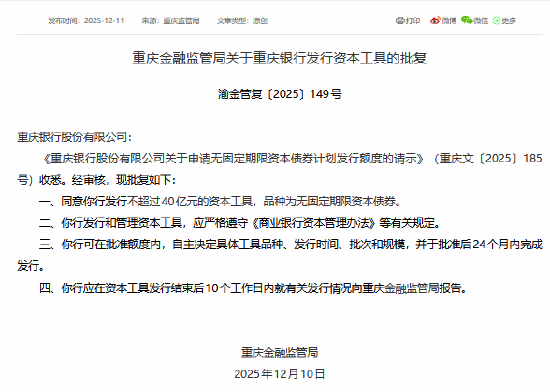
12月11日金融一线消息,重庆金融监管局今日发布关于重庆银行发行资本工具的批复,同意该行发行不 超过40亿元的资本工具,品种为无固定期限资本债券。 重庆金融监管局指出,重庆银行发行和管理资本工具,应严格遵守《商业银行资本管理办法》等有关规 定。可在批准额度内,自主决定具体工具品种、发行时间、批次和规模,并于批准后24个月内完成发 行。 责任编辑:曹睿潼 重庆金融监管局指出,重庆银行发行和管理资本工具,应严格遵守《商业银行资本管理办法》等有关规 定。可在批准额度内,自主决定具体工具品种、发行时间、批次和规模,并于批准后24个月内完成发 行。 发布时间: 2025-12-11 来源:重庆监管局 文章类型:原创 @打印 金微博 今晚信 马更多 重庆金融监管局关于重庆银行发行资本工具的批复 逾金管复 (2025) 149号 里庆银行股份有限公司: 《童庆银行股份有限公司关于申请无固定期限资本债券计划发行额度的请示》(重庆文〔2025〕185 发行。 12月11日金融一线消息,重庆金融监管局今日发布关于重庆银行发行资本工具的批复,同意该行发行不 超过40亿元的资本工具,品种为无固定期限资本债券。 四、你行应在资本工具发 ...
“红包”来了!多地区域性银行入局!
券商中国· 2025-12-11 13:00
Core Viewpoint - The expansion of personal consumption loan interest subsidy policies by regional banks in Guizhou, Sichuan, and Chongqing aims to stimulate local consumption and enhance the competitiveness of regional financial institutions [1][6]. Group 1: Implementation of Subsidy Policies - Regional banks such as Guiyang Bank, Guizhou Bank, and Chengdu Bank have announced the implementation of personal consumption loan interest subsidies, expanding the original 23 financial institutions to include more local banks [1][2]. - The subsidy policies are in response to national calls to boost local consumption, with other provinces expected to follow suit [1][6]. Group 2: Specifics of Subsidy Programs - In Guizhou, the subsidy period is from December 1, 2025, to December 31, 2025, with a maximum subsidy of 3,000 yuan for eligible borrowers [2][4]. - In Chongqing, the subsidy applies to personal consumption loans issued from September 1, 2025, to August 31, 2026, with three local banks included as loan issuers [3][4]. - Chengdu Bank and Chengdu Rural Commercial Bank have set a subsidy cap of 1,500 yuan for borrowers during their policy period [5]. Group 3: Variations in Subsidy Standards - The annual subsidy rate for personal consumption loans in Guizhou and Chongqing is set at 1%, but the maximum subsidy amounts differ, with Guizhou and Chongqing allowing up to 3,000 yuan per borrower [4]. - Chengdu's subsidy cap is lower, at 1,500 yuan, indicating regional differences in subsidy implementation [5]. Group 4: Future Prospects and Market Impact - The introduction of these subsidy policies is expected to create a "national subsidy + local subsidy" synergy, enhancing regional banks' market competitiveness and stimulating local consumption [6][7]. - The policies are seen as a short-term growth opportunity for banks, but long-term sustainability may be challenged due to differences in customer base and risk management capabilities compared to larger banks [7].