
中国国航

Search documents
马上评|明确航班“锁座”标准,终结付费选座争议
Xin Lang Cai Jing· 2026-01-30 06:14
国内航线多为波音737、空客A320、商飞C919这样的160座级载客量的单通道客机执飞。按照征求意见 稿,航班经济舱总座位数小于160(含),免费可选座位范围不低于经济舱总座位数的 70%。假定160 座级客机商务舱座位8个,就意味或有45个左右的经济舱座位航司有权锁座;且这45个座位并不包含12 个左右的安全出口座位,即运行保障性预留座位,这意味着作为增值服务性预留座位大概率为经济舱的 前7-8排。这一锁座比例是否合适,旅客的接受度如何,同样需要观察。 航班"锁座"将有明确标准。1月29日,中国航空运输协会发布关于《公共航空运输企业航班预留座位规 则(征求意见稿)》,首次系统规范航空公司经济舱座位预留的种类、范围、比例及信息告知等关键内 容。 简单来说,征求意见稿规定,国内航班不得开展现金选座服务,仅可使用积分/里程兑换增值服务性预 留座位;国内航班免费可选座位比例最低70%,国际及地区航班免费座位比例最低65%;航司需明确预 留座位释放时间,防止"最后一刻"才放座,且要以显著方式告知免费与预留座位范围等。 这样看来,航班付费选座争议或迎来终结。但需明确的是,征求意见稿仅是团体标准,并非行政法规, 因而无 ...
飞机锁座迎新规:国内航班不准许付费选座,免费可选座位比例最低70%
Bei Jing Shang Bao· 2026-01-29 13:08
Core Viewpoint - The new draft regulation on seat reservation for public air transport aims to standardize the practice of seat locking, ensuring transparency and protecting consumer rights by mandating minimum percentages of free seat selection for domestic and international flights [1][7]. Group 1: Regulation Details - The draft specifies that domestic flights must have at least 70% of economy class seats available for free selection, while international and regional flights must have at least 65% [1][4]. - The types of reserved seats are categorized into free selectable seats and reserved seats, with reserved seats further divided into operationally necessary and value-added service seats [3][4]. - Value-added service reserved seats are classified into rights-based and paid reservations, with the former available to frequent flyer program members and the latter only applicable to international and regional flights [4][5]. Group 2: Release and Information Disclosure - The draft outlines specific release times for reserved seats, requiring domestic flights to release seats online no later than three hours before departure and international flights to release them 48 hours prior [6]. - Airlines must clearly inform passengers about the categories of seats available, including free and reserved options, as well as the rules for redeeming points or paying for seat selection [6][7]. Group 3: Industry Impact - The regulation aims to enhance service quality and transparency in the airline industry, addressing widespread concerns about seat locking practices and ensuring a more standardized approach across different airlines [7][8]. - The involvement of various industry stakeholders in drafting the regulation indicates a collaborative effort to improve passenger experience and protect consumer rights [7][8].

国内航班免费可选座位最低要求占七成!曾有航司因锁座被约谈
Nan Fang Du Shi Bao· 2026-01-29 10:40
Core Viewpoint - The China Air Transport Association has released a draft standard for public consultation regarding the reservation of seats on flights, aiming to regulate the classification and information disclosure of economy class seats by airlines [1][2]. Group 1: Seat Classification and Regulations - Airlines are required to categorize economy class seats into "free selectable seats" and "reserved seats" [2]. - Reserved seats are further divided into operationally necessary reserved seats (for safety and service needs) and value-added reserved seats (including reward points/miles redemption and paid reservations for international and regional flights) [2]. - Domestic flights must ensure that at least 70% of economy class seats are free selectable, while international and regional flights must have a minimum of 65% [2]. Group 2: Information Disclosure and Transparency - Airlines must clearly inform passengers about the categories of free and reserved seats, redemption standards, paid selection prices (for international and regional flights), and the release time of reserved seats [2]. - A clear seat map must be provided to distinguish between "free selectable," "member selectable," "not selectable online," and "selected seats" to avoid ambiguity and misleading information [2]. Group 3: Consumer Complaints and Industry Response - Several airlines have faced scrutiny for locking certain desirable seats, leading to consumer complaints about unfair practices [3]. - The Jiangsu Consumer Protection Committee has conducted investigations and engaged with multiple airlines regarding the locking of seats that should be part of standard services [3]. - Airlines such as 吉祥航空 and 四川航空 have acknowledged the issues and are undertaking internal evaluations and corrective actions in response to the consumer protection committee's findings [3].



航班预留座位规则征求意见:国内航班不得付费选座,免费可选座位比例不低于70%
Xin Lang Cai Jing· 2026-01-29 10:24
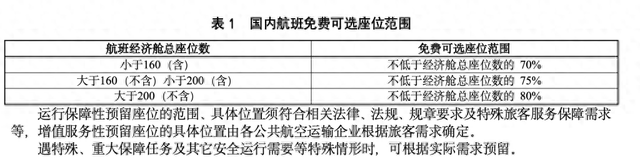
Core Viewpoint - The "Flight Seat Reservation" rules have been further clarified, establishing a framework for the classification and management of economy class seat reservations by airlines in China [1][5]. Group 1: Overview of the Draft Rules - The draft rules categorize economy class seats into "free selectable seats" and "reserved seats," with operational reserved seats mandated for safety and special passenger needs [1][2]. - The draft aims to standardize the types, scope, proportions, and information disclosure of seat reservations for domestic, international, and regional flights [1][6]. Group 2: Domestic Flight Seat Reservation Standards - For domestic flights, value-added reserved seats are limited to rights-based reservations, prohibiting paid seat selection [2][7]. - Free selectable seats must constitute at least 70% of the total economy class seats for flights with 160 or fewer seats, 75% for flights with 161 to 200 seats, and 80% for flights with more than 200 seats [2][3]. - Rights-based reserved seats must be available for online selection no later than three hours before the scheduled departure time [2][3]. Group 3: International and Regional Flight Seat Reservation Standards - International and regional flights must provide at least 65% of economy class seats for free selection [3][4]. - Reserved seats must be released at least six hours before departure for manual check-in and gradually released online starting 48 hours before departure [3][4]. - The draft specifies that seat maps must clearly indicate seat categories, including free selectable seats and paid options [4][6]. Group 4: Industry Context and Implications - The current paid seat selection service is prevalent in international flights, while domestic flights primarily offer free seats in the rear [4][5]. - The draft aims to address discrepancies in seat selection services among airlines, ensuring better protection of passenger rights and enhancing service experiences [5][6]. - The standard is designed to align domestic practices with international norms, reflecting a commitment to improving passenger service and transparency [6][7].
关于航班“锁座”,中国航协将有明确标准
Guan Cha Zhe Wang· 2026-01-29 09:53
Core Viewpoint - The China Air Transport Association has issued a draft for public consultation regarding the "Flight Seat Reservation Rules for Public Air Transport Enterprises," aiming to standardize seat reservation practices and enhance passenger rights in response to growing demand for personalized travel experiences [1][2]. Group 1: Overview of the New Rules - The new rules require that at least 70% of seats on domestic flights and 65% on international and regional flights be available for free selection by passengers [2]. - The draft aims to address discrepancies in seat selection services among airlines, ensuring a more uniform experience for travelers [1][2]. Group 2: Scope and Applicability - The rules apply to both domestic and international flights operated by public air transport enterprises within China, with foreign airlines encouraged to follow these guidelines [3]. Group 3: Seat Reservation Definitions - Free selectable seats are defined as those available for passengers to choose without additional charges [6]. - Reserved seats are those not open for selection due to safety, special passenger needs, or value-added services [8]. Group 4: General Principles - Safety is prioritized, with seat reservation and release practices needing to comply with safety regulations [18]. - The rules emphasize a passenger-centered approach, ensuring sufficient free seats and respecting diverse passenger needs [19]. Group 5: Seat Reservation Management - Airlines must establish a management system for seat reservations, detailing reasons, quantities, and rules for obtaining and releasing seats [5][21]. - For domestic flights, value-added reserved seats are limited to loyalty program members, and no paid seat selection is allowed [23]. Group 6: Release Rules - Domestic flights must release reserved seats for free selection no later than three hours before departure [27]. - For international flights, reserved seats should be released progressively starting 48 hours before departure, with specific rules for different seat categories [33]. Group 7: Information Disclosure - Airlines must clearly inform passengers about seat reservation options, including free and paid selections, and the rules governing these options [35]. - Seat maps must use clear icons to indicate different seat categories for both domestic and international flights [36][37].
*ST海钦(600753.SH):预计2025年度净利润2800万元到4200万元

Xin Lang Cai Jing· 2026-01-29 09:27
Core Viewpoint - Company *ST Haichin (600753.SH) expects to achieve a profit total of between 48 million to 72 million yuan in 2025, indicating a turnaround from losses in the previous year [1] Financial Performance Expectations - The company anticipates a net profit attributable to shareholders of between 28 million to 42 million yuan for 2025 [1] - The net profit after deducting non-recurring gains and losses is expected to be between 16 million to 24 million yuan [1] - Projected operating revenue for 2025 is estimated to be between 1.45 billion to 1.85 billion yuan, with core operating revenue (excluding unrelated business income) expected to be between 800 million to 1.2 billion yuan [1]
*ST海钦(600753.SH):公司股票可能被终止上市
Xin Lang Cai Jing· 2026-01-29 09:27
Core Viewpoint - *ST Haichin (600753.SH) has reported continuous losses for three consecutive years from 2022 to 2024, leading to uncertainty regarding its ability to continue as a going concern, resulting in additional risk warnings for its stock starting April 29, 2025 [1] Financial Performance - The company has experienced losses for three consecutive years, specifically from 2022 to 2024 [1] - The recent audit report indicates uncertainty about the company's ability to continue its operations [1] Regulatory Compliance - The company may face delisting from the Shanghai Stock Exchange if it does not meet the conditions outlined in Article 9.3.7 of the Shanghai Stock Exchange Listing Rules regarding the removal of delisting risk warnings [1] - There is a specified deadline for the company to apply for the removal of the delisting risk warning [1] Investor Advisory - Investors are advised to be cautious regarding investment risks associated with the company's stock due to its financial instability and potential delisting [1]
航空机场板块1月29日跌0.49%,华夏航空领跌,主力资金净流出2.42亿元
Zheng Xing Xing Ye Ri Bao· 2026-01-29 09:03
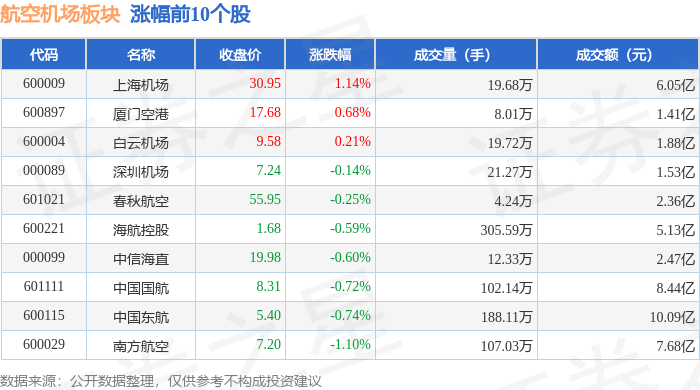
Market Overview - The aviation and airport sector declined by 0.49% on January 29, with Huaxia Airlines leading the drop [1] - The Shanghai Composite Index closed at 4157.98, up 0.16%, while the Shenzhen Component Index closed at 14300.08, down 0.3% [1] Stock Performance - Shanghai Airport (600009) closed at 30.95, up 1.14% with a trading volume of 196,800 shares and a turnover of 605 million yuan [1] - Xiamen Airport (600897) closed at 17.68, up 0.68% with a trading volume of 80,100 shares and a turnover of 141 million yuan [1] - Baiyun Airport (600004) closed at 9.58, up 0.21% with a trading volume of 197,200 shares and a turnover of 188 million yuan [1] - Shenzhen Airport (000089) closed at 7.24, down 0.14% with a trading volume of 212,700 shares and a turnover of 153 million yuan [1] - Spring Airlines (601021) closed at 55.95, down 0.25% with a trading volume of 42,400 shares and a turnover of 236 million yuan [1] - HNA Holding (600221) closed at 1.68, down 0.59% with a trading volume of 3,055,900 shares and a turnover of 513 million yuan [1] - China Southern Airlines (600029) closed at 7.20, down 1.10% with a trading volume of 1,070,300 shares and a turnover of 768 million yuan [1] Fund Flow Analysis - The aviation and airport sector experienced a net outflow of 242 million yuan from institutional investors, while retail investors saw a net inflow of 230 million yuan [3] - Major stocks like Shanghai Airport and Shenzhen Airport had varying net inflows and outflows from different investor types [4] - Shanghai Airport had a net inflow of 28.37 million yuan from institutional investors, while retail investors had a net outflow of 39.44 million yuan [4] - China Southern Airlines had a net outflow of 10.48 million yuan from institutional investors, but a net inflow of 22.85 million yuan from retail investors [4] ETF Performance - The Aerospace ETF (product code: 159227) tracked the National Aerospace Industry Index and saw a 3.00% increase over the last five days, with a net redemption of 78.67 million yuan [6] - The General Aviation ETF (product code: 159230) tracked the National General Aviation Industry Index and had a 2.17% increase, with a net redemption of 5.55 million yuan [7] - The Tourism ETF (product code: 562510) tracked the China Securities Tourism Theme Index and decreased by 4.77%, with a net inflow of 8.09 million yuan [7]




深圳航空公司增资至93.5亿元
Sou Hu Cai Jing· 2026-01-29 09:01
每日经济新闻 | 都在用的商业查询工具 | | 章公司 | 查老板 查关系 查风险 | | | | | | --- | --- | --- | --- | --- | --- | --- | --- | | 国家中小企业发展了基金旗下机构 | | | 深圳航空有限责任公司 | ള | 天眼一下 | ■ 应用 ▼ | 商务合作 1 | | 基本信息 400 | | 法律诉讼 131 | 经营风险 24 | 经营信息 999+ | | 公司发展 77 | 知识 | | 股东信息 ● 品股权结构 | | | | | | | | | 股东信息3 | MP 历史股东信息 10 | MIE 股权变更历程82 | | | | | | | 序 | | 股东名称 | | | 持股比例 ÷ | 认缴出资额(万元) ÷ | 认缴出资 | | 1 | WE WE CHINA | 中国国际航空股份有限公司 品 | | | 51% @ | 476905.1913 | 2025-1: | | | | 控股股东 A股(正常上市) 港股(正常上市) | 定向增发 | | | | | | 2 | 天堂 | 深国际全程物流(深圳)有限公司 品 | ...
深圳航空公司增资至93.5亿,增幅约74%
Sou Hu Cai Jing· 2026-01-29 08:13
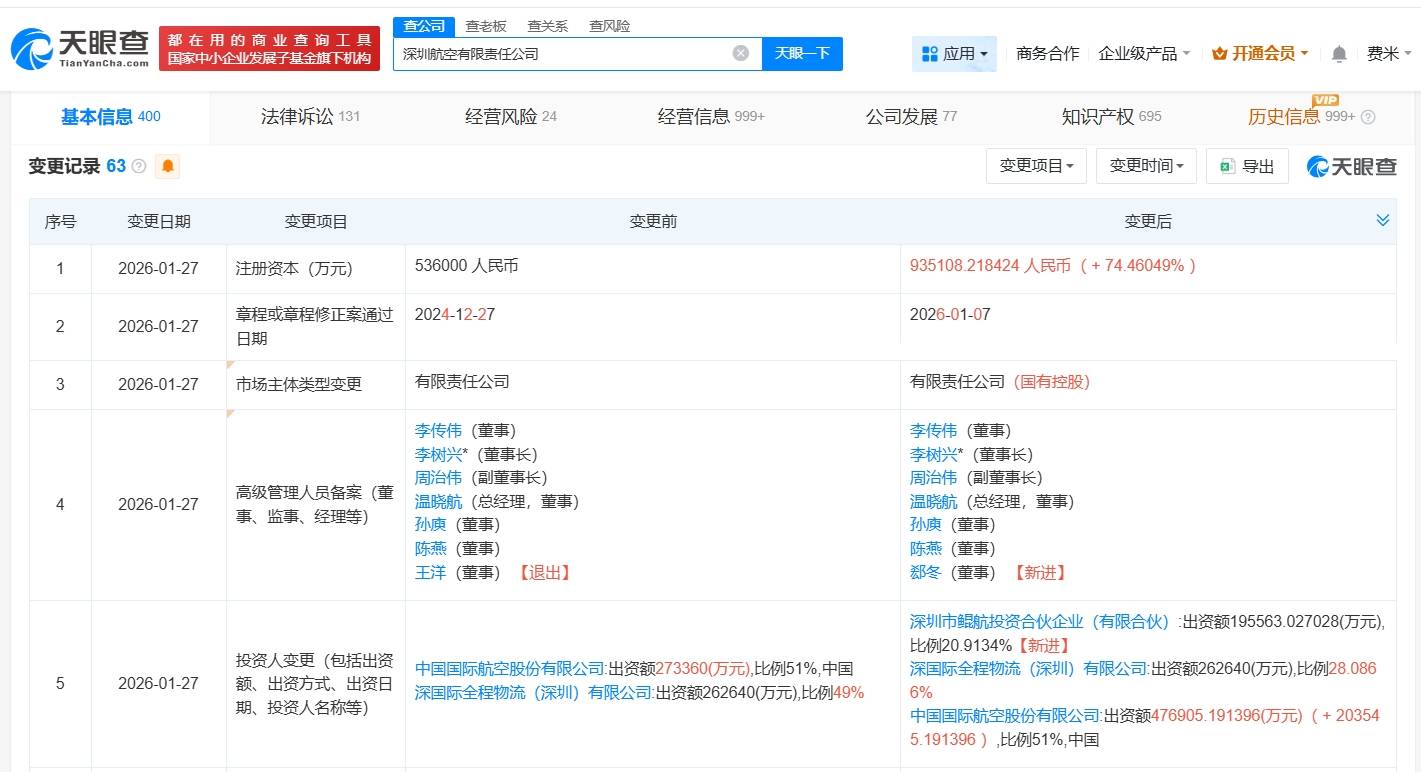
Core Insights - Shenzhen Airlines has undergone a business change, adding Shenzhen Kunhang Investment Partnership (Limited Partnership) as a shareholder [1] - The registered capital of Shenzhen Airlines has increased from 5.36 billion RMB to approximately 9.35 billion RMB, representing a growth of about 74% [1] Company Overview - Shenzhen Airlines was established in October 1989 and is represented legally by Li Shuxing [1] - The company's business scope includes passenger ticket agency, ticketing services, and business agency services [1] - The current shareholders include Air China, Shenzhen International Logistics (Shenzhen) Co., Ltd., and the newly added shareholder [1]