Scale AI

Search documents
谷歌170亿收编Windsurf,硅谷「AI挖人」白热化,99%的钱流向1%的人
创业邦· 2025-07-15 10:30
Core Viewpoint - The article discusses the intense competition among major tech companies for AI talent, highlighting significant acquisitions and recruitment strategies that have led to astronomical salary offers and a reshaping of the AI landscape in Silicon Valley [3][4][5]. Group 1: Major Acquisitions and Recruitment Strategies - Google successfully acquired the core team of AI startup Windsurf for $2.4 billion, thwarting OpenAI's plans to purchase the company for $3 billion [4][5]. - Meta has also been aggressive in its recruitment efforts, investing heavily in acquiring stakes in companies like Scale AI and appointing their CEO as Meta's Chief AI Officer [6][12]. - The competition for AI talent has escalated, with companies offering multi-million dollar compensation packages to attract top talent from rivals [7][8][9]. Group 2: Salary Trends and Market Dynamics - The article notes that top AI talent is receiving offers that can reach up to $300 million over four years, with some individuals being offered $1 million signing bonuses [15][20]. - OpenAI has faced significant talent loss, with reports indicating that Meta has successfully recruited at least seven top researchers from OpenAI [16][18]. - The disparity in compensation has created a situation where 99% of the financial resources are directed towards just 1% of elite AI talent, leading to concerns among regular engineers about job security and market relevance [51][52][58]. Group 3: Impact on the Workforce - The article highlights a growing anxiety among ordinary software engineers as AI advancements and the competition for top talent lead to job cuts and a reduction in hiring for non-AI roles [54][56]. - Major companies like Microsoft and Amazon have implemented layoffs, citing increased efficiency from AI as a reason for reducing their workforce [55][57]. - The high turnover and short-term focus in the industry have created a challenging environment for both AI talent and regular software engineers, with many feeling marginalized [58][59]. Group 4: Representation of Chinese Talent - The article emphasizes the significant presence of Chinese talent in the AI sector, with many top researchers being recruited by major companies like Meta and Google [30][31][47]. - Notable figures include Jiahui Yu and Ruoming Pang, who have been pivotal in AI development and have received substantial offers from competing firms [30][31][34]. - The trend of Chinese researchers being sought after reflects a broader pattern of diversity and talent acquisition in the tech industry [48][50].




扎克伯格全面AI加码:超算中心、闭源模型、高薪挖人三管齐下
3 6 Ke· 2025-07-15 10:10
Core Insights - Meta is investing over $100 billion in building "gigawatt-scale" data centers to support its superintelligence research initiatives [2][6] - The first data center, named "Prometheus," is being constructed in Ohio and is expected to be operational by 2026 [6] - Meta's revenue primarily comes from its advertising business across platforms like Facebook, Instagram, WhatsApp, and Messenger, which will provide stable cash flow for AI infrastructure investments [7] Investment and Infrastructure - Meta plans to spend "hundreds of billions" on computing infrastructure, with annual capital expenditures potentially reaching $72 billion, mainly for AI model training and deployment [7] - The demand for chips, electricity, and data centers is surging due to the rapid development of AI models, with a gigawatt-scale data center consuming as much electricity as approximately 900,000 American households annually [7] Strategic Shift in AI Development - Meta's newly established "Superintelligence Labs" is considering a strategic shift from open-source to closed-source AI model development, moving away from its previously strong open-source model "Behemoth" [9][10] - This potential shift indicates a significant change in Meta's approach to AI, as it may adopt a "open-source + closed-source" model to compete more effectively with companies like Google and OpenAI [9] Talent Acquisition and Team Structure - Meta is aggressively recruiting top AI talent, offering salaries that can reach nine figures, including a $200 million signing bonus for a senior AI executive from Apple [10][12] - The AI department has been restructured into the "Meta Superintelligence Labs," led by newly appointed Chief AI Officer Wang Tao, who is building a team of elite researchers [12] Future Outlook - Meta aims to create a "superintelligent" system that theoretically surpasses human intelligence across multiple tasks, with significant investments in talent and infrastructure to achieve this goal [10][12] - The internal restructuring and recruitment efforts may lead to talent attrition, particularly among those not selected for the new superintelligence team [12]
一笔1500倍回报诞生了
投资界· 2025-07-15 07:55
Core Viewpoint - The article highlights the remarkable rise of AI cloud computing company CoreWeave, which saw its stock price surge from an IPO price of $40 to $132, resulting in a market capitalization of approximately $64.6 billion, creating significant wealth for early investors like Leslie Wexner who achieved a return of 1500 times on his investment of $1.6 million [1][11]. Company Background - CoreWeave was founded in 2016 by three individuals who initially started by mining Ethereum using a GPU, eventually evolving into a company with a dedicated data center in New Jersey [3]. - The company initially sought funding from private investors and family offices rather than institutional investors, which led to early financing rounds that included notable figures like Leslie Wexner [4]. Growth and Market Position - The AI boom in 2022 increased demand for GPU resources, positioning CoreWeave as a key player in the market, attracting major tech companies as clients [5][6]. - CoreWeave completed significant funding rounds, including a $221 million Series B round and a $2.3 billion debt financing, raising over $12 billion in total from various investors [6][10]. IPO and Stock Performance - CoreWeave's IPO was initially met with challenges, including a reduced valuation and share count, leading to a first-day market cap of approximately $18.9 billion [8]. - Following the IPO, the stock price experienced a dramatic increase, driven by strong quarterly earnings and investor optimism regarding AI infrastructure demand, leading to a peak market cap of nearly $73 billion [9][10]. Recent Developments - CoreWeave announced a $9 billion all-stock acquisition of cryptocurrency mining company Core Scientific, raising concerns in the market due to the high costs and the unrelated nature of the revenue [11]. - Despite the recent acquisition, the company's market cap has decreased to $64.6 billion, but early investors like Wexner still hold significant value in their shares [11]. Industry Context - The article discusses the broader AI landscape, noting that companies like NVIDIA have reached unprecedented valuations, with NVIDIA's market cap surpassing $4 trillion [13]. - The rapid growth of AI companies has led to extraordinary returns for early investors, with some achieving returns exceeding 1000 times their initial investments [15]. - However, there are warnings about potential market bubbles and the sustainability of such rapid growth, as many AI companies are still not profitable and face high debt levels [16].

年薪开到一亿美元!AI巨头疯狂挖人的背后
Zheng Quan Zhi Xing· 2025-07-15 06:02
Group 1 - The core idea of the article highlights the intense competition among tech giants for top AI talent, which has become a strategic resource more valuable than gold [1][2] - Major companies like Meta, Google, Apple, and Musk's xAI are engaging in aggressive recruitment strategies, including exorbitant salaries and team acquisitions [1][4] - The scarcity of top AI talent is underscored, with fewer than 1,000 experts globally being recognized as "top-tier," leading to a significant talent gap in the industry [5][6] Group 2 - Meta has successfully recruited four key researchers from OpenAI, who played crucial roles in developing advanced AI models, indicating a strategic move to enhance its capabilities in general artificial intelligence (AGI) [3][4] - Google has also made headlines by acquiring the core team of AI startup Windsurf for $2.4 billion, further illustrating the trend of mergers and acquisitions to secure talent [4][5] - The competition for AI talent is driven by the need to establish technological barriers and gain a first-mover advantage in a field characterized by high investment and uncertainty [7][8] Group 3 - The recruitment of top AI talent is essential for maintaining innovation speed, as these individuals are key to solving complex problems and pushing the boundaries of model capabilities [8] - Companies are employing defensive strategies to secure talent, recognizing that losing top talent equates to losing the drive for innovation and ultimately their competitive edge [8]
扎克伯格豪赌AI:Meta将斥千亿美元打造超级智能帝国
Jin Shi Shu Ju· 2025-07-15 05:12
Group 1 - Meta Platforms plans to invest several hundred billion dollars in building multiple large AI data centers to enhance its competitive edge in attracting top engineering talent [1] - The first data center, "Prometheus," is expected to be operational by 2026, with another center named "Hyperion" scalable to 5 gigawatts in the coming years [1] - Meta aims to become the first AI lab to launch a supercluster exceeding 1 gigawatt, as highlighted in a report by industry publication SemiAnalysis [1] Group 2 - The company reported nearly $165 billion in revenue last year and has restructured its AI business into a "Superintelligence Labs" department following setbacks with its open-source Llama 4 model and core employee departures [2] - Meta is betting that the Superintelligence Labs will generate new cash flows through Meta AI applications, image-to-video advertising tools, and smart glasses [3] - Analysts note that while AI investments have improved ad performance, the scale of current investments is aimed at long-term competition to develop leading AI models, which may take time to yield results [3] Group 3 - Meta has increased its capital expenditure forecast for 2025 to between $64 billion and $72 billion to strengthen its position against competitors like OpenAI and Google [3] - The company's stock rose by 1% on Monday and has increased over 20% year-to-date [3]
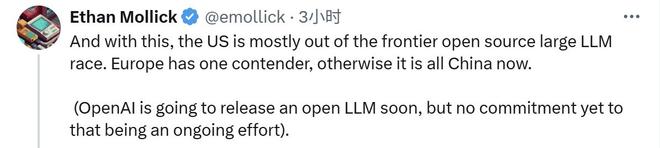
“美国已经基本退出,都是中国的”
Guan Cha Zhe Wang· 2025-07-15 04:08
Core Viewpoint - Meta is considering a significant shift in its AI strategy by potentially moving from open-source AI models to closed-source models, which could mark a departure from its long-standing commitment to open-source development [1][5][6] Group 1: Strategic Shift - Meta's newly established "Super Intelligence Lab" (MSL) is contemplating abandoning its powerful open-source AI model, Behemoth, in favor of developing a closed-source model [1][5] - This potential shift is seen as a major strategic change for Meta, which has historically believed that open-source technology fosters faster AI development and broader access for developers [5][6] - The decision is reportedly influenced by the underperformance of the Behemoth model during internal testing, leading to delays in its release [5][6] Group 2: Leadership and Talent Acquisition - Meta has appointed Alexandr Wang, the new AI head, who previously led Scale AI, to oversee the Super Intelligence Lab, which consists of a specialized team of about 12 members [6][7] - The company has adopted a "high-paying talent acquisition" strategy, offering salaries exceeding $100 million to attract top researchers from competitors like OpenAI, Google, and Apple [5][6] Group 3: Market Implications - The shift towards closed-source models could signify a retreat from the competitive landscape of open-source large language models (LLMs), with concerns raised about the U.S. losing its edge in this area [1][3] - The ongoing developments in Meta's AI strategy are closely watched, especially as the company faces challenges in the AI technology sector [5][6]
内部爆料:Alexandr Wang上任第一把火,Meta大模型闭源
机器之心· 2025-07-15 03:20
Core Viewpoint - Meta is considering a significant shift in its AI development strategy, potentially moving from an open-source model to a closed-source approach, which would represent a major philosophical and technical change for the company [1][7]. Group 1: AI Development Strategy - Meta's newly established Superintelligence Lab is discussing a major decision that could alter its AI development direction [2]. - There are differing opinions within Meta regarding the future of its AI models, with some executives advocating for closed-source models while others believe that an open-source strategy remains advantageous in the competitive landscape [3]. - The focus of the discussion is on Meta's most powerful open-source AI model, Behemoth, which has faced delays due to performance issues [4][5]. Group 2: Organizational Changes - Meta has made significant organizational changes, including a $14.3 billion investment in Scale AI, acquiring a 49% stake and appointing Scale AI's CEO, Alexandr Wang, as Meta's Chief AI Officer [8]. - The entire AI department has been rebranded as the Meta Superintelligence Lab, led by Alexandr Wang and a core team of newly hired researchers [9]. Group 3: Future Directions and Concerns - Meta's spokesperson stated that the company's stance on open-source AI remains unchanged, planning to continue releasing leading open-source models while also training a combination of open-source and closed-source models [13]. - The discussions within the Superintelligence Lab are still in preliminary stages, and any major changes will require CEO Mark Zuckerberg's approval [13]. - The uncertainty surrounding Meta's potential shift to closed-source models raises concerns for startups relying on open-source models and the academic community, which heavily depends on open-source resources [16][20].

速递|Meta开源信仰动摇:传高层密议闭源Behemoth模型,Alexandr Wang 力主封闭路线
Z Potentials· 2025-07-15 03:14
Core Insights - Meta is considering a shift from its current open-source strategy to developing closed AI models, as suggested by some executives including the Chief AI Officer Alexandr Wang [2] - The company is undergoing a comprehensive reform of its AI business following setbacks earlier this year, including a $14.3 billion investment in Scale AI [2] - Meta has paused the development of its flagship large language model Llama 4, marking another setback in its AI development efforts [3] Group 1 - Meta's discussions indicate a potential strategic shift towards closed AI models, contrasting with its historical focus on open-source initiatives [2] - The company has faced performance issues leading to multiple delays in the release of Llama 4, including its inference version and the largest scale version [3] - Meta's spokesperson reaffirmed the company's commitment to open-source AI while also planning to train both open and closed models in the future [2]

AI“众神之战”:对抗“星际之门”,扎克伯格要建“普罗米修斯”
Hua Er Jie Jian Wen· 2025-07-15 02:53
Core Insights - Meta is undergoing an unprecedented strategic transformation to catch up in the foundational model race, with CEO Mark Zuckerberg announcing a multi-billion dollar investment in large data centers, starting with the Prometheus center expected to be operational next year [1] - The company is adopting a new "tent-style" data center design for faster construction and is secretly building two "gigawatt" (GW) supercomputing clusters in Ohio and Louisiana, named Prometheus and Hyperion, respectively [1][2] - The aggressive shift is a response to the failure of Meta's Llama 4 model, which damaged its reputation after the success of Llama 3 [3] Infrastructure Development - Meta has abandoned its previous decade-long data center construction blueprint to prioritize rapid deployment of massive computing power [2] - The new "tent-style" structure utilizes prefabricated power and cooling modules, sacrificing some redundancy to expedite GPU cluster deployment [2] - The Prometheus cluster in Ohio aims to integrate various power sources and is building two 200-megawatt onsite natural gas power plants to address local grid limitations [3][4] Technical Challenges - The Llama 4 model faced technical issues, including a flawed "chunked attention" mechanism that impaired long-range reasoning capabilities [4] - The team struggled with data quality, transitioning from public datasets to an internal web crawler without adequate preparation, limiting its multimodal capabilities [4][5] - The Llama 4 team encountered difficulties in scaling research experiments and lacked strong leadership to unify the technical direction [5] Talent Acquisition and Strategic Investments - To bridge the talent gap with top AI labs, Meta is focusing on recruiting for a new "superintelligence" team, offering compensation packages up to $200 million over four years [6] - Strategic acquisitions, such as the investment in Scale AI, are aimed at addressing the shortcomings exposed by Llama 4, particularly in data and evaluation capabilities [6]
曝马斯克 xAI 强制员工装监控软件,连鼠标没动都知道?有人当场辞职:“无法接受!”
Sou Hu Cai Jing· 2025-07-15 00:40
Core Viewpoint - xAI, an AI startup founded by Elon Musk, has faced backlash after requiring employees to install mandatory monitoring software, Hubstaff, on their personal computers, leading to concerns over privacy and employee dissatisfaction [1][6]. Group 1: Company Policy and Employee Reaction - xAI's HR team mandated that employees training the Grok chatbot install Hubstaff on their personal devices by July 11, emphasizing that this installation was compulsory [3][4]. - The monitoring software can track various activities, including screen usage, mouse movements, and keyboard inputs, effectively exposing employees' work screens to company oversight [4][5]. - Employees expressed significant concern over privacy issues, with some labeling the monitoring as "productivity disguised as surveillance" and others resigning due to discomfort with the policy [7][8]. Group 2: Company Response and Adjustments - In response to employee backlash, xAI offered two options: a $50 monthly tech stipend to purchase a new work computer or the creation of a separate account on personal devices to isolate work activities [8][9]. - Following media scrutiny and internal dissent, xAI adjusted its policy, allowing employees to wait for company-issued devices before installing Hubstaff, but did not clarify the status of those who had already complied [9]. Group 3: Broader Industry Context - xAI is not the first company to face controversy over Hubstaff; similar issues arose at Scale AI, where employees claimed the software was used to monitor their work on personal devices [10]. - Legal experts note that the legality of such monitoring practices varies and depends on factors like business necessity and employee notification, highlighting the need for a balance between oversight and privacy [10]. Group 4: Ongoing Developments - Despite internal turmoil and external criticism regarding Grok's content issues, Elon Musk continues to promote the chatbot's integration into Tesla's systems, indicating a focus on commercial progress despite employee dissatisfaction [11][12].