OPPO

Search documents
Omdia:2025年,印度智能手机出货量因需求疲软与成本压力下滑1%,vivo保持市场领先地位
Canalys· 2026-01-21 01:02
Core Insights - The Indian smartphone market is expected to see a year-on-year decline of 7% in Q4 2025, with shipments dropping to 34.5 million units, influenced by high channel inventory, currency depreciation, and rising storage costs affecting purchasing power in the mid-to-low-end market [2][11] - Vivo maintained its leading position in Q4 2025 with shipments of 7.9 million units, capturing a market share of 23%, followed by Samsung with 4.9 million units (14% share) and OPPO with 4.6 million units (13% share) [2][11] - The overall smartphone shipments for India in 2025 are projected to be 154.2 million units, reflecting a mild decline of 1% year-on-year, indicating a trend towards a more mature market [2][12] Market Dynamics - Brands are adjusting their Minimum Official Prices (MOP) to cope with rising component costs, particularly in price-sensitive models, leading to a cautious approach from retailers and a slowdown in shipments from November [5][8] - Vivo and OPPO are the only brands to achieve double-digit year-on-year growth, showcasing their strong retail execution and ability to attract consumer demand [5][8] - Samsung's shipments have slowed despite maintaining a value-driven strategy through selective upgrades and cashback offers, while Xiaomi's volume has declined, relying heavily on entry-level models [8][10] Future Outlook - The Indian smartphone market is expected to experience a slight decline in 2026, driven by high prices and limited upgrade opportunities, with a shift towards value-driven growth strategies among Chinese brands focusing on the ₹25,000–₹60,000 price segment [10] - Brands will increasingly rely on channel leverage, including service bundling, financing options, and trade-in programs, as hardware differentiation becomes limited due to rising storage costs [10] - Retail execution capabilities, including promotional strength and localized sales strategies, will be crucial for maintaining market stability amid cautious consumer demand [10]



一天两起车辆起火事件!小米回应:动力电池均处于正常状态;俞敏洪宣布聘请陈行甲,年薪150万;日本电视荣光不再!TCL拟控股索尼电视业务
雷峰网· 2026-01-21 00:26
Key Points - Sony officially announced the spin-off of its television business, forming a joint venture with TCL, where TCL will hold 51% and Sony 49% [4][5] - The new company will manage the entire global operations of television and home audio equipment, with plans to start operations by April 2027, pending regulatory approvals [4][5] - Sony's market share in China has significantly declined, with foreign brands collectively holding less than 5% of the market share in 2024, averaging around 1.25% each [4][5] - The overall shipment of televisions in China is projected to drop by 8.5% in 2025, reaching a new low since 2010, with the top eight brands dominating 94.1% of the market [5] - Xiaomi responded to two vehicle fire incidents, stating that the power batteries were functioning normally at the time of the incidents [10][11] - MiHoYo announced the closure of the Genshin Impact server operated in partnership with Xiaomi, effective January 20, 2025, due to strategic adjustments [12] - New Oriental's founder, Yu Minhong, announced the hiring of Chen Xingjia as a consultant with an annual salary of 1.5 million RMB, amidst controversy over high salaries in the nonprofit sector [7][8] - The mobile phone market in China for 2025 shows Vivo, Xiaomi, and Apple as the top three brands by activation volume, with Xiaomi's growth attributed to the success of its 17 series [21][22] - Hikvision reported a slight increase in revenue for 2025, achieving 92.517 billion RMB, with a net profit of 14.188 billion RMB, reflecting a growth of 18.46% year-on-year [30]





销量猛涨3倍!“AI广货”成为最潮年货
2 1 Shi Ji Jing Ji Bao Dao· 2026-01-21 00:09
Group 1: Live Streaming and Sales Performance - ZTE's Nubia brand experienced a significant increase in online engagement during a live stream, with online viewers doubling and sales tripling compared to daily averages [1] - OPPO reported a remarkable increase in interaction rates, follower growth, and viewing duration, with a 87% increase in viewing time compared to regular daily streams [1] - The "Guanghuo Hang Tianxia" spring promotional event saw a surge in traffic and sales for major smartphone brands, including Huawei, Vivo, OPPO, Honor, ZTE, and TCL [3] Group 2: Promotional Strategies and Consumer Engagement - Vivo's promotional strategy included substantial discounts, with potential subsidies reaching up to 2026 yuan, attracting consumers to the event [4] - The event featured a wide range of smartphone products priced between 2000 yuan and 6000 yuan, aiming to enhance consumer purchasing power [4] - The integration of live streaming with real-time consumer interaction was highlighted as a key factor in driving sales during the promotional event [4] Group 3: AI Technology and Product Innovation - AI hardware devices, including AI smartphones and toys, were prominent in the promotional event, indicating a shift towards AI-driven consumer electronics [3] - The Nubia Z80 Ultra smartphone integrates a local AI engine, allowing users to perform complex tasks through voice commands, enhancing user experience [9] - The event showcased various AI products, including health management robots and interactive AI toys, emphasizing the growing trend of emotional interaction in consumer electronics [12][10] Group 4: Global Market Expansion and Competitive Landscape - Honor's global market strategy has shown significant progress, with a projected shipment of 71 million units by 2025 and a 47% increase in overseas sales [15] - Vivo is expected to achieve global sales of 103.9 million units in 2025, with a market share of 8.2%, and has established a strong user base in India and Southeast Asia [15] - OPPO anticipates global sales of 102 million units in 2025, maintaining a competitive position in the global smartphone market with a focus on localization [17]



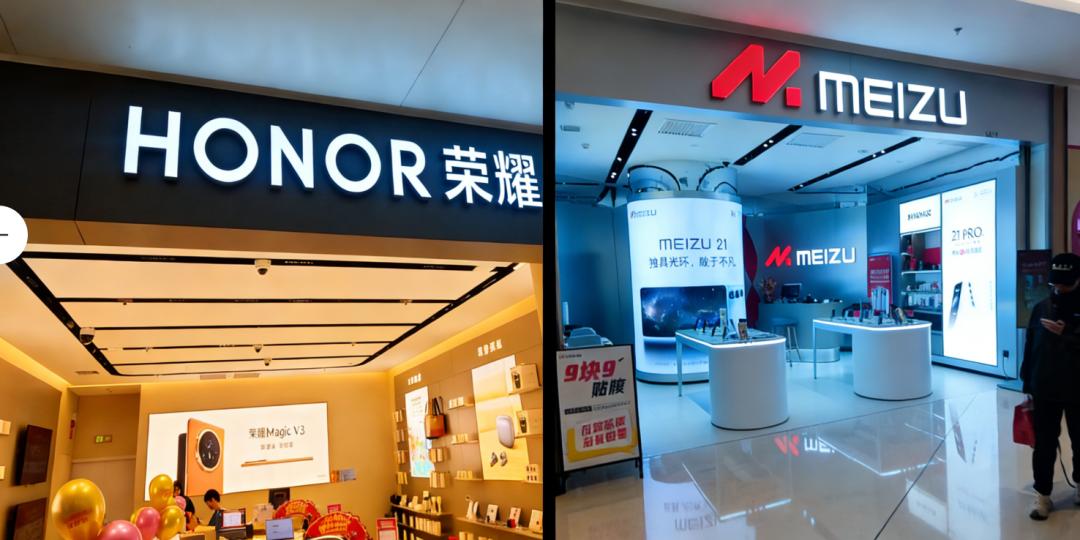
荣耀与魅族,踏进了同一条河
3 6 Ke· 2026-01-21 00:09
Core Insights - The Chinese smartphone market is experiencing a shift, with Huawei returning to the top position after five years, while brands like Honor and Meizu are becoming marginalized [1] - Honor is attempting to reposition itself by targeting younger consumers with new product launches and collaborations, indicating a strategy to escape the "Huawei alternative" label [2][3] - Both Honor and Meizu face challenges in brand positioning, technology accumulation, and market competition, leading to difficulties in establishing a strong market presence [3][4] Brand Positioning - Honor is struggling with its brand identity post-separation from Huawei, initially positioned as a "tech flagship" but now forced to compete in the mid-to-low-end market due to Huawei's resurgence [4][5] - Meizu, after being acquired by Geely, has lost its previous market strength and is now perceived as a secondary player, with its product offerings failing to meet high-end expectations [4][5] Market Challenges - Both companies are facing supply chain issues and increased competition in the mid-range market, leading to reduced profit margins and reliance on online sales channels [5][6] - Honor's average selling price (ASP) has declined as it has shifted focus to lower-end products, diluting its brand value [4][6] Technology and Innovation - Meizu's reliance on external components and lack of core technology has weakened its competitive edge, while Honor has some technological capabilities but lacks the differentiation needed to compete with leading brands [6][7] - Both companies are exploring AI as a potential solution for their challenges, but their approaches differ significantly, with Honor aiming for a broader ecosystem and Meizu focusing on niche markets within Geely's automotive ecosystem [8][10] Strategic Paths - Honor's strategy involves leveraging AI to enhance its product offerings and establish itself as a player in the AI terminal ecosystem, while Meizu's strategy is more reactive, focusing on providing support within Geely's framework [10][11] - The contrasting strategies highlight the different trajectories of the two brands, with Honor having more flexibility and potential for growth compared to Meizu's constrained position [11][12] Industry Implications - The smartphone industry is witnessing a "Matthew effect," where leading brands like Apple and Huawei are gaining strength, while smaller brands like Honor and Meizu are struggling for survival [12][13] - For smaller brands to survive, they must maintain core values, precise positioning, and differentiation while seizing opportunities in AI and innovation [13][14]
国产手机“梦之队”,印证“广货行天下”
Nan Fang Du Shi Bao· 2026-01-21 00:03
从市场需求角度看,手机尽管指向单一产品,但市场规模不小。男女老少人手一部,衣食住行息息相 关,手机成为一种生活刚需,选择手机作为专场活动的主打产品,显然有着充足的消费市场支撑。尤其 考虑到岁末年初这个特殊节点,消费者将其视为重要的电子年货,让手机扮演专场活动主角可谓顺理成 章。 活动策划的逻辑俨然足够清晰,相对而言,人们更关心的是,手机何以成为广货的优秀代表?结合此次 活动,有关广东手机产业的发展现状,近来媒体挖掘出不少有价值的信息,可以为外界了解广东手机产 业提供一种视角。 1月20日,广东省工信厅和东莞市政府联合举行"广货行天下"春季行动手机专场促销活动,作为"广货行 天下"系列活动中备受关注的手机主题专场,本次活动以"优中选品、政企联动"为核心,线上联动主流 电商平台与媒体直播,线下走进社区与政务中心。华为、OPPO、vivo、荣耀等本土品牌共同参与,旨 在打造一场全民可逛、可买、可信赖的广货消费盛宴,为新一年"广货出圈"注入扎实动能。 已打造出国产手机的"梦之队"!媒体如此概括如今的广东手机产业。看似简单的一句话,背后蕴含着丰 富的信息,要知道,国产手机的影响力早已不再局限于国内,在世界其他国家也有着 ...
打造消费电子春晚 促销激活万亿产业
Nan Fang Du Shi Bao· 2026-01-20 23:11
Core Insights - The "Guanghuo Hang Tianxia" Spring Action mobile promotion event was launched in Dongguan, focusing on enhancing the brand image of Guangdong products and facilitating market expansion for local companies [3][4][9] - The event featured significant discounts, with offers ranging from 60% to 90% off, surpassing previous promotional events like "Double 11" [4][6] - A total of over 700 companies participated, showcasing a complete ecosystem of the mobile phone industry, from component production to assembly [9][10] Group 1: Event Overview - The event was co-hosted by the Guangdong Provincial Department of Industry and Information Technology and the Dongguan Municipal Government, emphasizing online and offline integration for broader consumer engagement [3][4] - Major local brands such as Huawei, OPPO, vivo, and Honor participated, showcasing their latest products and innovations [5][7] - The promotion included live streaming on major e-commerce platforms, enhancing consumer interaction and product visibility [4][5] Group 2: Discounts and Offers - Discounts offered during the event were substantial, with some products seeing price reductions of up to 700 yuan, making them more attractive to consumers [6][8] - OPPO and vivo introduced additional incentives, such as trade-in subsidies and exclusive gifts, to encourage purchases [6][8] - The promotional strategies aimed to convert hesitant consumers into buyers by providing significant financial incentives [6][8] Group 3: Product Showcase - The event highlighted over 2,000 smart products, including AI phones and various smart devices, showcasing Guangdong's leadership in technology innovation [7][8] - Notable product launches included Huawei's foldable Mate XT and OPPO's Find X9 Pro, emphasizing advancements in battery technology and imaging capabilities [8] - The event also featured a range of mid-range and entry-level devices targeting different consumer segments, enhancing market reach [8] Group 4: Industry Impact - Guangdong's mobile phone manufacturing sector is projected to generate 1.96 trillion yuan in revenue in 2024, accounting for 38.7% of the province's new-generation electronic information industry [9] - Dongguan's mobile phone production is expected to reach 194.9 million units in 2024, marking a 10.9% year-on-year increase [9] - The region's complete supply chain, with over 90% of components sourced locally, enhances production efficiency and reduces costs, strengthening Guangdong's competitive edge in the global market [10]

FINE2026丨智能终端×新材料:六大主题展集结,洞见未来产业新机遇
DT新材料· 2026-01-20 16:05
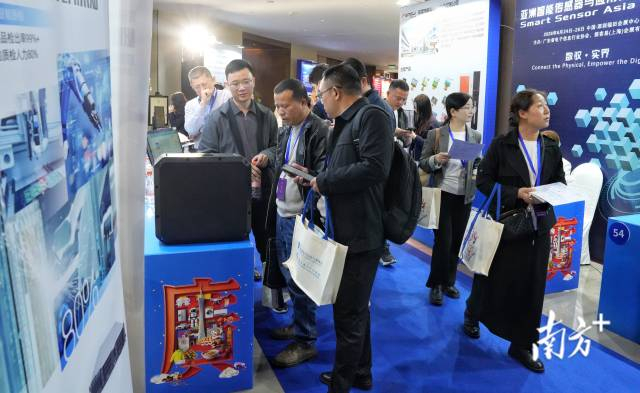
Core Viewpoint - The 2026 Future Industries New Materials Expo (FINE 2026) aims to showcase innovations in new materials, positioning China as a leader in global new material innovation and development, with a focus on future industries and technological advancements [1][2]. Group 1: Event Overview - FINE 2026 will take place from June 10 to 12, 2026, at the Shanghai New International Expo Center, featuring a total exhibition area of 50,000 square meters and over 800 exhibitors [12][34]. - The expo will include more than 300 strategic and cutting-edge technology reports, covering applications in various industries such as AI, aerospace, smart vehicles, and renewable energy [2][20]. Group 2: Focus Areas - The event will emphasize five common needs of future industries: advanced semiconductors, advanced batteries, lightweight functional materials, low-carbon sustainability, and thermal management [2][10]. - Six thematic exhibition areas will be set up, including advanced semiconductors, advanced batteries and energy materials, thermal management, lightweight and sustainable materials, new material technology innovation, and future smart terminals [12][15]. Group 3: Participation and Audience - The expo is expected to attract over 100,000 professional visitors, including industry leaders and investors, facilitating connections between startups and industry resources [34][35]. - A targeted invitation will be extended to over 5,000 industry investors to support quality startups and enhance resource accumulation [10][35]. Group 4: Supporting Organizations - The event is organized by DT New Materials, in collaboration with various associations and institutions, including the China Productivity Promotion Center and the Ningbo New Materials Industry Association [4][5]. - The organizing body has a decade of experience in the new materials sector, with extensive connections across industries such as semiconductors, robotics, and renewable energy [10][44]. Group 5: Historical Context and Expectations - The previous editions of the expo, including the 2025 International Carbon Materials Expo and the 2025 Thermal Management Expo, achieved record attendance and participation, indicating strong interest and growth in the sector [7][34]. - FINE 2026 is positioned as a significant opportunity for businesses to engage in technology transfer and innovation, aligning with China's strategic focus on high-tech industries [2][10].


【市场】网传2025年中国手机市场激活量排名 vivo第一 小米第二
Xin Lang Cai Jing· 2026-01-20 13:40
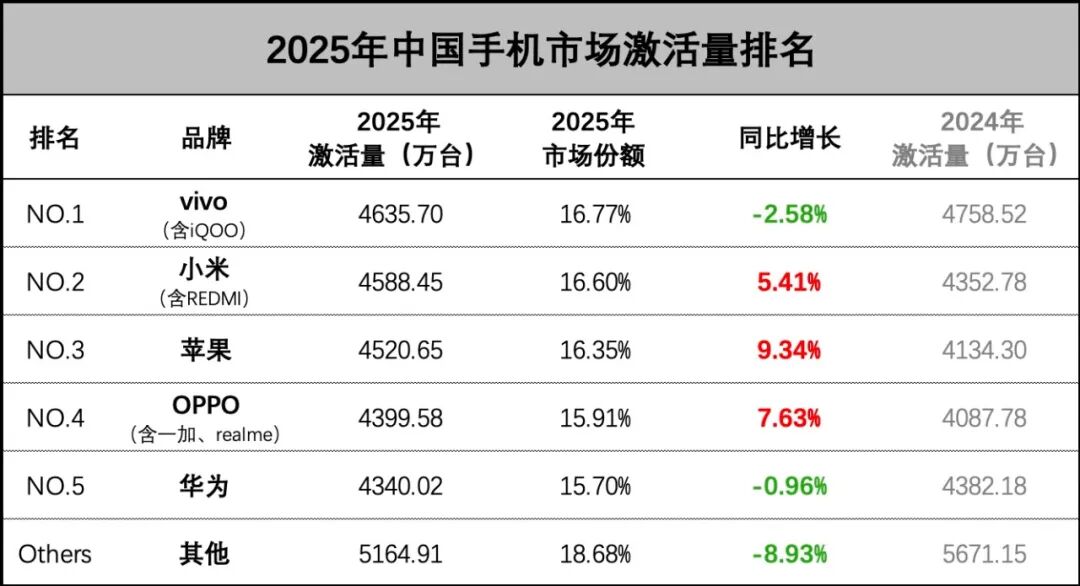
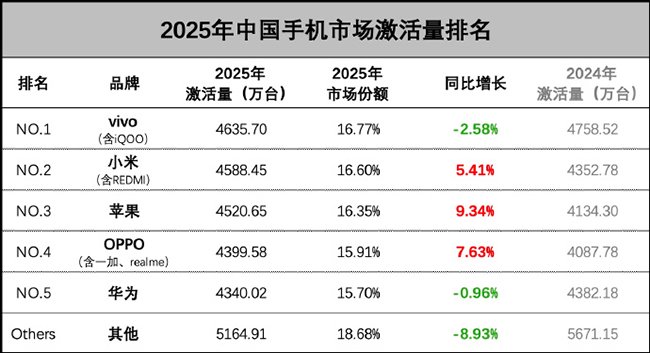
近日市场研究机构IDC、Counterpoint等纷纷更新了2025年第四季度(10-12月)和2025全年(1-12月)中国智能手机市场出货量数据,但都是出货量,今 日爆料达人数码闲聊站分享了一份激活量排名,来简单看下~ | | | | 2025年中国手机市场激活量排名 | | | | --- | --- | --- | --- | --- | --- | | 排名 | 品牌 | 2025年 | 2025年 | 同比增长 | 2024年 | | | | 激活量(万台) | 市场份额 | | 激活量(万台) | | NO.1 | VIVO (含iQOO) | 4635.70 | 16.77% | -2.58% | 4758.52 | | NO.2 | 小米 (含REDMI) | 4588.45 | 16.60% | 5.41% | 4352.78 | | NO.3 | 苹果 | 4520.65 | 16.35% | 9.34% | 4134.30 | | NO.4 | OPPO (含一加、realme) | 4399.58 | 15.91% | 7.63% | 4087.78 | | NO.5 | 华为 | ...
2025年中国手机激活量排名:vivo蝉联榜首 小米反超苹果登次席
Xin Lang Cai Jing· 2026-01-20 13:39
Core Insights - The 2025 Chinese smartphone market has seen a subtle shift in the competitive landscape, with vivo maintaining its lead, followed by Xiaomi and Apple, all surpassing 40 million units in activation volume [1][7]. Market Rankings - Vivo (including iQOO) ranked first with an activation volume of 46.357 million units, holding a market share of 16.77%, despite a slight decline of 2.58% from 2024 [2][8]. - Xiaomi (including REDMI) achieved an activation volume of 45.884 million units, capturing a market share of 16.60%, marking a growth of 5.41% year-on-year, thus surpassing Apple to claim the second position [3][9]. - Apple secured the third position with an activation volume of 45.206 million units and a market share of 16.35%, experiencing a significant growth of 9.34% [3][10]. - OPPO (including OnePlus and realme) ranked fourth with 43.996 million units and a market share of 15.91%, showing a year-on-year increase of 7.63% [4][10]. - Huawei placed fifth with an activation volume of 43.400 million units and a market share of 15.70%, reflecting a slight decline of 0.96% [4][10]. Market Trends - The overall smartphone market in China saw a slight decline in demand, with total shipments around 285 million units, down 0.6% year-on-year, indicating a softening consumer demand [2][8]. - The market is characterized by a "high-end consolidation and mid-range competition," with AI smartphones and foldable screens emerging as key growth areas [4][10]. - In 2025, the shipment volume of AI smartphones reached 118 million units, achieving a penetration rate of over 40% [4][10]. Future Outlook - Industry experts predict a continued slight decline in overall shipments by 2%-3% in 2026, with rising memory chip prices potentially increasing average smartphone prices by 10%-20% [11]. - The focus for leading brands will likely shift towards high-profit segments, intensifying market competition [11]. - Key questions for 2026 include whether vivo can maintain its lead, if Xiaomi can solidify its second position, and whether Apple can sustain its high-end growth trajectory [11].
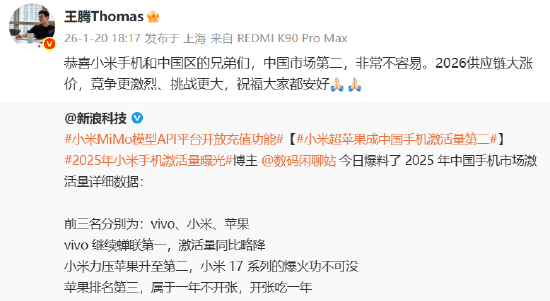
小米超苹果成中国手机激活量第二,王腾:恭喜,非常不容易
Xin Lang Cai Jing· 2026-01-20 12:08
Core Insights - The 2025 Chinese smartphone market activation data shows that Vivo, Xiaomi, and Apple are the top three brands, with Vivo experiencing a year-on-year decline in activation volume, while Xiaomi's sales of the Xiaomi 17 series have propelled it to surpass Apple and rank second in the market [1][4]. Group 1: Market Rankings - Vivo (including iQOO) ranks first with an activation volume of 4,635.70 thousand units, holding a market share of 16.77%, but showing a year-on-year decline of 2.58% from 4,758.52 thousand units in 2024 [3][6]. - Xiaomi (including REDMI) ranks second with an activation volume of 4,588.45 thousand units, achieving a market share of 16.60% and a year-on-year growth of 5.41% from 4,352.78 thousand units in 2024 [3][6]. - Apple ranks third with an activation volume of 4,520.65 thousand units, capturing a market share of 16.35% and experiencing a year-on-year increase of 9.34% from 4,134.30 thousand units in 2024 [3][6]. Group 2: Other Competitors - OPPO (including OnePlus and realme) ranks fourth with an activation volume of 4,399.58 thousand units and a market share of 15.91%, reflecting a year-on-year growth of 7.63% from 4,087.78 thousand units in 2024 [3][6]. - Huawei ranks fifth with an activation volume of 4,340.02 thousand units, holding a market share of 15.70%, but showing a slight year-on-year decline of 0.96% from 4,382.18 thousand units in 2024 [3][6]. - The "Others" category accounts for 5,164.91 thousand units, representing 18.68% of the market, with a year-on-year decline of 8.93% from 5,671.15 thousand units in 2024 [3][6]. Group 3: Industry Commentary - Former REDMI General Manager Wang Teng congratulated Xiaomi and its team for achieving the second position in the Chinese market, emphasizing the challenges ahead due to anticipated supply chain price increases and intensified competition in 2026 [1][4].