vivo

Search documents
荣耀超薄机配置超苹果:首次用联发科,起售价4999元
Guan Cha Zhe Wang· 2026-01-20 01:25
Group 1 - The core focus of the article is on the launch of Honor's new lightweight smartphone, the Magic8 Pro Air, which aims to appeal to younger consumers and compete with Apple's Air series by offering a more affordable option with superior specifications [1][4] - The Magic8 Pro Air features a 6.31-inch display, a thickness of 6.1mm, and a weight of 155 grams, making it lighter than both Apple's and Huawei's competing models [1] - The device is equipped with a MediaTek Dimensity 9500 processor, a triple-camera setup including a 64MP periscope lens, a 5500mAh battery, dual speakers, and supports both physical SIM and eSIM, along with 50W wireless fast charging [1][2] Group 2 - The starting price of the Magic8 Pro Air is set at 4999 yuan, which is significantly lower than Apple's starting price of 7999 yuan but higher than Huawei's Mate70 Air by 800 yuan [4] - Honor aims to become the fastest-growing mainstream brand overseas by 2025, targeting over 10 million units shipped in regions like Latin America and the Middle East, while facing stiff competition in the domestic market [4][6] - The smartphone industry is expected to face challenges in 2026, with storage prices projected to rise by 40%-50% in Q1 and an additional 20% in Q2, leading to a potential market downturn [5][6] Group 3 - Honor is adjusting its strategy to transition into a leading AI terminal ecosystem company, planning to produce Alpha mobile robots and deepen partnerships within the industry [6] - The company is adopting a "ship more models" strategy, having launched seven new smartphones in the last two months, which is significantly higher than its competitors [6] - Honor's recent marketing efforts, including a shift towards a younger audience and collaborations with trendy brands, indicate its intent to differentiate itself in a competitive market [6]


去年中国GDP增长5%,多家手机厂商下调出货预期 | 财经日日评
吴晓波频道· 2026-01-20 00:30
Economic Overview - In 2025, China's GDP reached 1401879 billion yuan, growing by 5% year-on-year, with quarterly growth rates of 5.4%, 5.2%, 4.8%, and 4.5% respectively [2] - The industrial added value increased by 5.9%, while the service sector grew by 5.4%. Retail sales totaled 501202 billion yuan, up by 3.7% [2] - Fixed asset investment decreased by 3.8%, with a notable decline in real estate investment [3] Trade and Investment - Canada has reduced the import tax on Chinese electric vehicles to 6.1%, allowing an annual quota of 49,000 vehicles, which is a significant policy shift aimed at filling market gaps [4][5] - The adjustment in tariffs is expected to enhance the competitiveness of Chinese electric vehicles in the Canadian market, which has seen a decline in sales due to high costs and tariffs [5] Real Estate Market - In December 2025, new home prices in first-tier cities fell by 0.3%, with a notable increase in Shanghai, while overall new home sales area decreased by 8.7% year-on-year [6] - The real estate market is still in a bottoming phase, with a significant reduction in new supply and ongoing inventory pressure [7] Mobile Phone Industry - Several smartphone manufacturers, including Xiaomi and OPPO, have lowered their annual shipment forecasts due to rising storage costs, with reductions exceeding 20% for some brands [8] - The impact of rising storage prices is uneven across manufacturers, with larger firms like Apple and Samsung less affected [9] Solar Industry - Nine leading solar companies, including LONGi Green Energy and Tongwei Co., have announced expected losses for 2025, with Tongwei projecting a loss of 90 to 100 billion yuan [10] - The solar industry is facing significant challenges, including high inventory levels and price competition, leading to a prolonged period of losses [11] Wealth Disparity - The global wealth of billionaires reached a record 18.3 trillion USD in 2025, with a 16% increase in total wealth, highlighting a growing wealth gap amid stagnant poverty reduction efforts [12][13] - The AI sector's growth has significantly contributed to the increase in billionaire wealth, while ordinary residents face declining purchasing power due to inflation [13] Space Tourism - A startup has announced the opening of reservations for the world's first lunar hotel, aiming to begin operations by 2032, although the feasibility of such a project remains uncertain [14][15]




全球每卖出3部手机,就有1部产自广东
2 1 Shi Ji Jing Ji Bao Dao· 2026-01-20 00:29
Group 1 - The core viewpoint highlights the evolution of Guangdong's mobile phone industry, showcasing companies like Huawei, vivo, OPPO, Honor, and Transsion as global leaders in technology and innovation [1] - The rapid advancement in mobile technology is driven by new techniques, materials, and automation in manufacturing, with OPPO's fast charging technology fully charging a battery in just 30 minutes and Huawei's precision hinge design achieving a thickness of only 3.6mm [1][2] - The Guangdong mobile phone industry benefits from a collaborative ecosystem that integrates mechanical and AI technologies, positioning the Guangdong-Hong Kong-Macau Greater Bay Area as a unique global hub for these advancements [1] Group 2 - Guangdong mobile phones are expanding beyond traditional boundaries, introducing innovative features such as the 200MP long-focus camera in vivo X300 Pro, which captures professional-quality images, and the 165Hz high refresh rate screen in OnePlus 15, providing competitive advantages for mobile gamers [2] - The transformation of the Guangdong mobile phone industry reflects a shift from scale advantages to systemic innovation, overcoming critical technological challenges while exploring new market scenarios [2] - AI is enhancing mobile devices with capabilities for perception, reasoning, and response, making these "awakened devices" essential intermediaries between humans and the digital world, thus reshaping lifestyles through technological innovation [2]
全球每卖出3部手机,就有1部产自广东
21世纪经济报道· 2026-01-20 00:24
Core Viewpoint - Guangdong produces one out of every three mobile phones sold globally, with major brands like Huawei, vivo, OPPO, Honor, and Transsion leading the market, showcasing the evolution of mobile technology in the region [1][2]. Group 1: Evolution of Guangdong Mobile Phones - The rapid evolution of mobile phones in Guangdong is driven by advancements in new technologies, materials, and manufacturing processes, resulting in significant innovations such as OPPO's fast charging technology that fully charges a battery in just 30 minutes [1]. - Breakthroughs in materials and processes have led to innovations like Huawei's "Tian Gong hinge," which achieves micron-level precision and a thickness of only 3.6 mm when unfolded, alleviating concerns about foldable screens [1]. - The automation of key material scheduling through a "mechanical matrix" in Dongguan's production lines exemplifies the collaborative ecosystem that keeps Guangdong's mobile industry at the forefront of technological advancements [1]. Group 2: New Applications and Market Expansion - Guangdong mobile phones are breaking traditional boundaries by exploring new scenarios, such as the vivo X300 Pro capturing half of the concert rental market with its 200-megapixel telephoto capabilities [2]. - The OnePlus 15 features a 165Hz ultra-high refresh rate screen, providing competitive advantages for mobile gamers, while Honor's YOYO smart assistant enhances user interaction by allowing voice commands to manage subscriptions [2]. - The integration of AI into mobile devices is transforming them into intelligent mediators between humans and the digital world, reflecting a shift in how technology can reshape lifestyles [2].


拆解粤产八大爆款手机
Xin Lang Cai Jing· 2026-01-19 23:21
Core Insights - Guangdong produces one out of every three smartphones sold globally, with major brands like Huawei, vivo, OPPO, Honor, and Transsion leading the market [1] - The evolution of smartphones in Guangdong reflects a microcosm of technological advancement, driven by new technologies, processes, materials, and equipment [1] Group 1: Technological Advancements - OPPO's fast charging technology can fully charge a smartphone battery in just 30 minutes [1] - Huawei's "Tian Gong hinge" achieves micron-level precision, with a thickness of only 3.6 mm when unfolded, alleviating concerns about foldable screen creases [1] - Automation in manufacturing, exemplified by Dongguan's smartphone production lines, enhances efficiency through a "mechanical matrix" for key material scheduling [1] Group 2: Market Expansion and Innovation - Guangdong smartphones are breaking traditional boundaries, creating impressive new scenarios, such as the vivo X300 Pro capturing half of the concert rental market with its 200 million pixel telephoto capabilities [2] - OnePlus 15 offers a 165Hz ultra-high refresh rate screen, providing competitive advantages for mobile gamers [2] - Honor YOYO smart assistant enhances user interaction by allowing voice commands to manage subscriptions, transitioning from manual operations to a smart assistant model [2] Group 3: Industry Transformation - The Guangdong smartphone industry is undergoing a profound transformation from scale advantages to systemic innovation, tackling critical technology challenges while exploring new scenarios [2] - AI is enabling smartphones to possess capabilities of perception, thought, and response, positioning these devices as intelligent intermediaries between humans and the digital world [2] - The narrative surrounding these products has shifted from mere communication tools to a reimagining of human lifestyles through technological innovation [2]
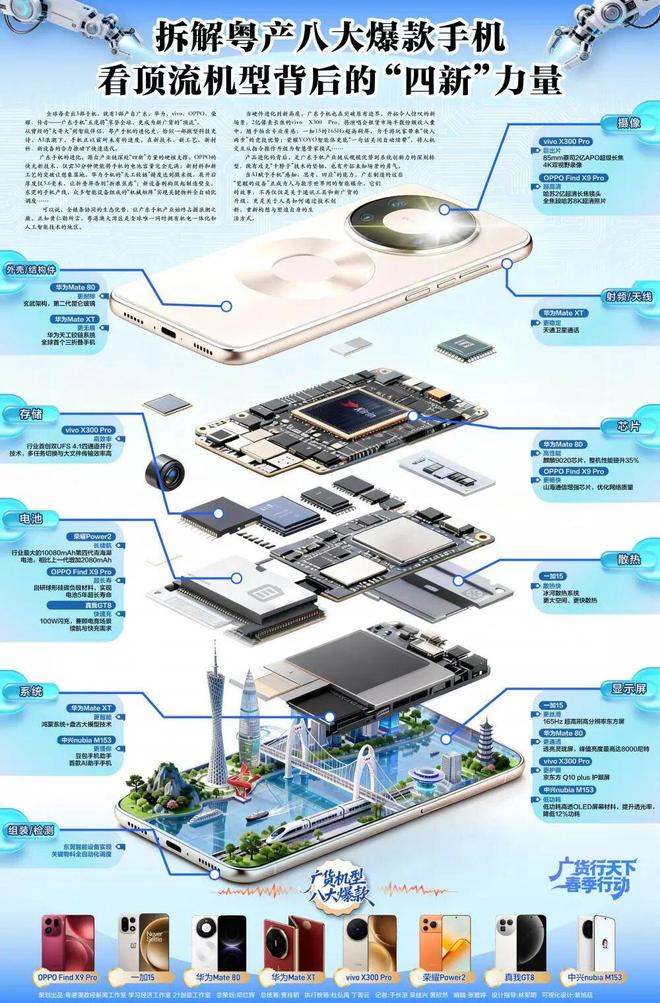
拆解粤产八大爆款手机 看顶流机型背后的“四新”力量
2 1 Shi Ji Jing Ji Bao Dao· 2026-01-19 22:39
Core Insights - Guangdong produces one out of every three smartphones sold globally, with major brands like Huawei, vivo, OPPO, Honor, and Transsion leading the market [1] - The evolution of smartphones in Guangdong reflects a microcosm of technological advancement, driven by new technologies, processes, materials, and equipment [1] - The Guangdong smartphone industry benefits from a collaborative ecosystem that supports innovation and maintains its leading position in the market [1] Group 1 - The rapid iteration of smartphones is fueled by advancements in AI, new materials, and manufacturing processes [1] - OPPO's fast-charging technology can fully charge a smartphone battery in just 30 minutes, showcasing innovation in battery technology [1] - Huawei's "Tian Gong hinge" achieves micron-level precision, allowing foldable screens to minimize crease anxiety with a thickness of only 3.6 mm when unfolded [1] Group 2 - Guangdong smartphones are expanding beyond traditional boundaries, creating impressive new use cases [2] - The vivo X300 Pro captures half of the concert rental market with its 200 million pixel telephoto capabilities, demonstrating its professional quality [2] - The Honor YOYO smart assistant enhances user interaction by allowing voice commands to manage subscriptions, representing a shift towards intelligent personal assistants [2] Group 3 - The transformation of the Guangdong smartphone industry reflects a shift from scale advantages to systemic innovation capabilities [2] - The integration of AI enables smartphones to possess sensing, thinking, and responding capabilities, positioning them as intelligent mediators between humans and the digital world [2] - The narrative surrounding these devices transcends mere communication tools, focusing on how technological innovation reshapes human lifestyles [2]
全球每三台手机就有一台广东造 广货“粤来粤强”驶入快车道
Nan Fang Du Shi Bao· 2026-01-19 13:52
Core Viewpoint - The Guangdong smartphone industry is experiencing significant growth and transformation, establishing itself as a global leader in smartphone manufacturing and innovation, with local brands gaining substantial market share both domestically and internationally [1][2][11]. Group 1: Industry Overview - Guangdong is the most important cluster for the smartphone industry in China, leading in scale, production, and export, with a projected revenue of 1.9618 trillion yuan in 2024, accounting for 38.7% of the province's new generation electronic information industry revenue [2]. - In 2024, Guangdong's smartphone production reached 683 million units, representing 40.9% of the national total, while exports amounted to 205 million units, also leading the country [2]. - The smartphone industry in Guangdong has evolved from a manufacturing hub to a global innovation leader, with local brands capturing 38% of the global market share by 2025 [2][12]. Group 2: Brand Performance - Major Guangdong brands like Huawei, OPPO, and vivo dominate both domestic and international markets, with Huawei's global shipment reaching 48.4 million units in 2024, capturing one-third of the high-end market [3]. - OPPO's global shipments reached 104.8 million units in 2024, with its Reno series leading in the $400-$600 price segment [3]. - By 2025, six Guangdong brands are expected to be among the top ten in the global smartphone market, with market shares of 9% for vivo, 8% for Transsion, and 7% for OPPO [2]. Group 3: Global Expansion Strategies - Guangdong smartphone brands are increasingly focusing on international markets, particularly in Southeast Asia and Latin America, leveraging cultural similarities and existing market experiences for efficient penetration [4][5]. - OPPO's gradual global expansion strategy began in Thailand and has since included Indonesia and Vietnam, with plans to enter European markets [5]. - vivo's strategy emphasizes deep localization, establishing a significant retail network in Indonesia and expanding into various regions since 2014 [5]. Group 4: Technological Innovation - Guangdong smartphone companies are at the forefront of technological innovation, with significant investments in R&D, particularly in chip technology and fast charging [11]. - Huawei's self-developed Kirin 9000S chip achieved a 65% self-sufficiency rate in 2024, while OPPO's 125W fast charging technology leads globally in patent numbers [11]. - The rise of AI smartphones, with brands like Huawei and vivo integrating advanced AI capabilities, marks a new era in the industry [12]. Group 5: Manufacturing and Supply Chain - Guangdong's smartphone manufacturing ecosystem is robust, with a high concentration of electronic component manufacturers, accounting for 28% of China's total [7]. - The region's strong supply chain allows for rapid assembly and production, with average production cycles as short as 48 hours in Dongguan [9]. - Major manufacturers like Foxconn and local firms have adopted advanced manufacturing techniques, enhancing efficiency and production capabilities [8][9].
32家企业销售额提升110%!“广货行天下”实现开门红
2 1 Shi Ji Jing Ji Bao Dao· 2026-01-19 13:23
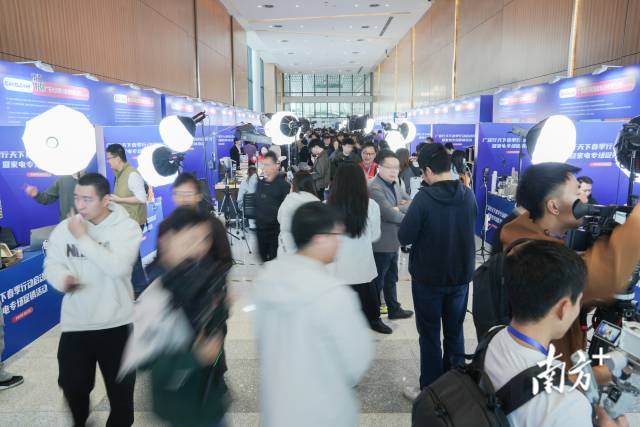
Core Insights - The "Guangdong Goods Going Global" spring campaign has significantly boosted sales in the home appliance sector, with some products experiencing sales increases of over 200% compared to the previous day [1][3][5] Group 1: Sales Performance - The sales of live-streamed products on January 15 saw a year-on-year increase of 202% compared to January 14 [1] - The sales of a multi-functional electric cooker increased by 254% on January 15 compared to January 14 [5] - A total of 32 companies participating in the live-streaming event reported a 110% increase in sales compared to the previous day [5][7] Group 2: Participating Companies - Notable companies such as Midea, Galanz, Hisense, and Bear Electric participated in the campaign, showcasing their latest products and innovations [5][7] - The event featured a diverse range of products, focusing on smart home appliances and health-oriented devices [5] Group 3: Marketing Strategy - The campaign utilized multiple e-commerce platforms, including Douyin, JD.com, and Pinduoduo, to maximize reach and engagement, resulting in over 10 million views on the "Guangdong Goods Going Global" topic [5][9] - Companies reported that consumer preferences are shifting towards product practicality, brand trust, and content experience, making comprehensive competitiveness essential [7] Group 4: Future Plans - Guangdong plans to continue promoting its products through a series of online events, with a focus on various categories such as mobile phones, clothing, and food leading up to the Spring Festival [9][11] - The agricultural sector will also see promotional activities aimed at enhancing the visibility of local products, with plans for multiple seasonal campaigns throughout the year [11][13] Group 5: Cultural Integration - The campaign aims to integrate cultural elements into the marketing of Guangdong products, promoting local tourism and culinary experiences alongside product sales [13][15] - Upcoming events will include themed live-streaming sessions and immersive cultural experiences to enhance consumer engagement [13][15]
中国手机市场,活活打成一场“消耗战”
3 6 Ke· 2026-01-19 11:20
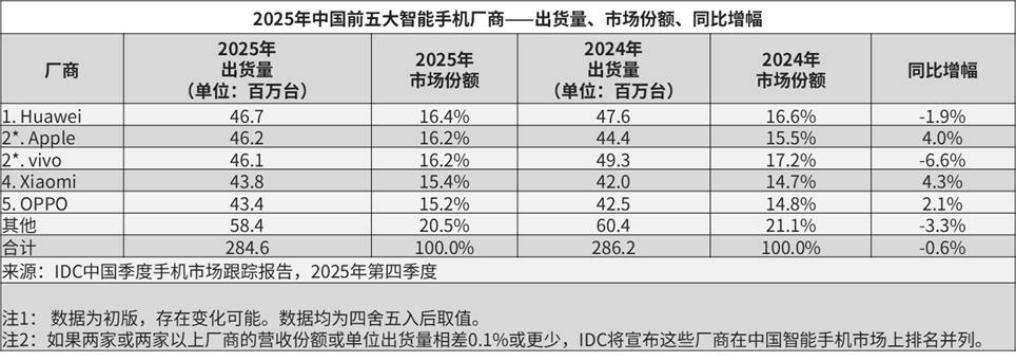
Core Insights - The Chinese smartphone market experienced a slight decline in 2025, with total shipments around 285 million units, a year-on-year decrease of 0.6% compared to a 5.6% growth in 2024 [1] - Key trends include a solidified high-end market, intense competition in the mid-range segment, and the entry of external players, prompting traditional manufacturers to innovate and expand their business boundaries [1] Market Dynamics - Huawei regained the top position in the Chinese smartphone market in 2025, with a shipment of 46.7 million units, a 1.9% decrease from 2024 [6][5] - Apple followed closely with 46.2 million units shipped, marking a 4% increase year-on-year, and capturing a market share of 16.2% [6][5] - The top five manufacturers—Huawei, Apple, vivo, Xiaomi, and OPPO—showed minimal differences in market share, all exceeding 15%, with only a 330,000 unit gap between the first and fifth [4][3] Competitive Landscape - The competition among the top five manufacturers has intensified, with no significant gaps in market share, indicating a shift towards a more competitive environment [2][4] - Xiaomi is focusing on high-end markets and aims to increase its average selling price (ASP) while exploring new growth avenues through its automotive business [8][22] - OPPO and vivo are facing challenges in their traditional offline channels due to the rise of e-commerce and aggressive competition from peers [9] Market Segmentation - The mid-range market (2000-4000 yuan) is characterized by fierce competition, with brands pushing flagship technologies into this segment, leading to a homogenization of products [11] - The high-end market remains stable, with no significant shifts in market dynamics, as brands struggle to introduce disruptive technologies that could challenge established players like Apple and Huawei [12] Technological Evolution - The smartphone industry is transitioning into an era of "joint definition," where both hardware and AI capabilities are being integrated to enhance user experience [15][21] - Two main technological paths are emerging: one led by internet companies focusing on AI-driven hardware, and another by traditional manufacturers integrating AI into their existing hardware [17][20] Industry Expansion - Traditional smartphone manufacturers are diversifying their business models, exploring new growth avenues such as electric vehicles and AI products [22] - New entrants, particularly from the internet and AI sectors, are reshaping the competitive landscape, with companies like ByteDance seeking partnerships to leverage their AI capabilities in the smartphone market [25][26]
彻底杀疯了!1 盒内存条堪比上海 1 套房
程序员的那些事· 2026-01-19 10:37
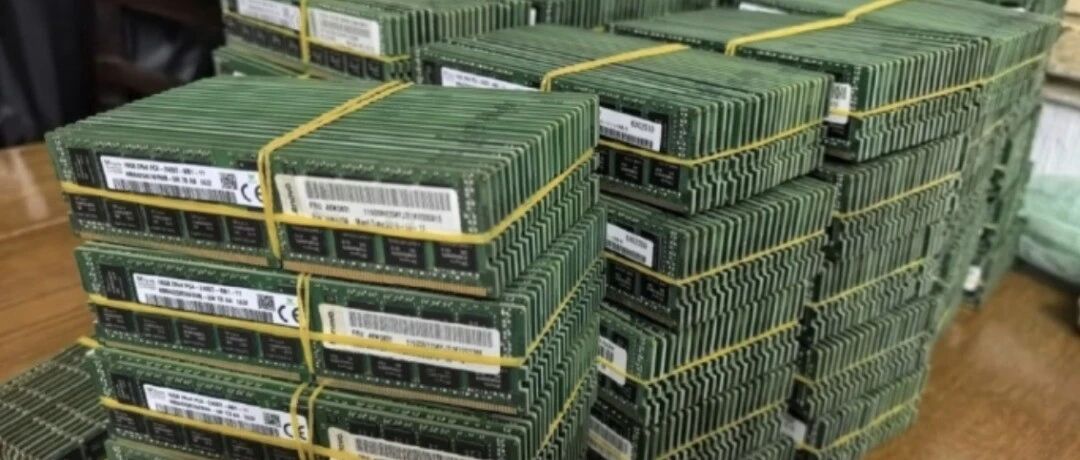
(参考:微博、央视新闻,本文经由 AI 优化) 各位,你们是不是也被涨价打乱了换机、攒机计划呢?你觉得这场涨价潮会持续多久?国产存储能不能扛起替 代大旗?快来评论区聊聊你的看法。 有任何疑问,还可以直接 @元宝 来问哦! 1 月 18 日,"内存条价格暴涨"的词条又又又又冲上微博热搜榜,这场从 2025 年下半年开始的涨价潮愈演愈 烈。 成本压力已全面传导至终端。联想、戴尔等 PC 厂商多款机型涨价 500~1500 元,小米、vivo 等国产手机新 品涨价 300~600 元,魅族甚至因成本过高取消了新款机型上市计划。存储成本占手机 BOM 比超 35%,商家 直言"下午报价晚上就作废",不少消费者的攒机、换机计划被迫搁浅。 业内人士表示,这不是短期周期反弹,而是 AI 时代的产业重构,新产能释放至少需要两年,2026 年一季度 存储价格可能再涨 40%-50%。目前国产存储企业正加速扩产,但高端领域仍需时间突破,这场涨价潮或将倒 逼行业加速国产替代。 DDR5 内存半年涨幅超 300%,256G 服务器级内存条单价逼近 6 万元,一盒 100 根的价格堪比上海小户型住 宅,网友直呼"内存比黄金还疯狂"。 ...