LVMH

Search documents
心力经济
Hu Xiu· 2025-08-09 23:39
Group 1 - The article discusses the importance of emotional value and individual agency in driving economic activities, highlighting a shift towards a "heart power economy" that emphasizes creativity, initiative, and emotional investment [3][6][20] - It mentions the growth of rural economies and the need for strong individual responsibility and initiative among enterprises, as government support is becoming less prioritized [1][2] - The narrative reflects on the changing dynamics of relationships and the need for boundaries, suggesting that mutual support without over-reliance is essential for sustainable growth [2][5] Group 2 - The article illustrates the concept of "heart power" through various entrepreneurial stories, emphasizing resilience and adaptability in the face of challenges, leading to success even during economic downturns [9][10][12] - It highlights the significance of emotional value in business, where trust and customer relationships become the foundation for sustainable growth, especially in a competitive market [12][20] - The discussion includes the impact of societal changes on individual agency, suggesting that as people become more self-aware, they can better navigate their personal and professional relationships [5][6][18]
国泰海通|纺服:奢侈品行业2025年中报总结
国泰海通证券研究· 2025-08-07 14:15
Macro Environment - In Q2 2025, global macroeconomic pressures increased, with the IMF lowering global economic growth forecasts in April. Luxury consumption in North America saw a narrowing decline in April-May, followed by an expanded decline in June [1] - Swiss watch exports to the US accelerated in Q2 2025, while exports to China decreased, and Japan and Europe experienced a decline [1] - The strengthening Euro impacted luxury companies' revenue, while the depreciation of the Renminbi against the Euro and Yen may affect overseas consumption [1] Mid-Year Performance - In Q2 2025, luxury companies' revenues generally fell short of expectations, with profit realization showing divergence [1] - Most companies experienced a slowdown or negative growth in revenue, with a majority seeing a decline in net profit margins [1] - By region, the Americas showed acceleration, while tourism consumption in Europe and Japan was affected by high base effects, and Greater China remained under pressure, although some brands showed signs of recovery [1] - By brand, Miu Miu led with a 40% increase, while Canada Goose saw significant acceleration [1] Growth Drivers Assessment - The impact of European tourism is expected to continue into Q3's peak season, while North America faces high base effects in Q4, leading to ongoing uncertainty for the year [1] - Price increases have been implemented by Hermès, Kering, and Prada in H1 2025, with single-digit growth rates. Some brands plan to expand price ranges by increasing accessory products (LVMH) and lowering entry-level product prices (Prada) [1] - Companies continue to invest in expenses, with a high direct sales ratio, indicating that positive operating leverage remains a key driver for margin improvement [1] Industry Trend Outlook - Brands such as Gucci, BV, Dior, and Miu Miu plan to launch significant new products for the autumn-winter season [1] - It is anticipated that luxury consumer segments may further differentiate, with high-net-worth customers showing strong brand loyalty, while aspirational customers may shift their preferences from brand-driven to product and cultural value-driven [1] - In Q2 2025, Miu Miu topped the Lyst rankings again, with the top five brands remaining consistent with Q1, although there were changes in rankings, and Burberry and Birkenstock entered the top 20 [1] Stock Prices and Valuation - Year-to-date in 2025, most luxury companies have underperformed compared to the major stock indices, with Burberry and Tapestry significantly outperforming (by 20 percentage points and 59 percentage points, respectively) [2] - The consensus forecast for luxury companies in 2025 indicates an expected revenue growth rate of approximately 1.8% and a net profit growth rate of -2.3%, suggesting that operational leverage impacts will persist in the short term [2]


奢侈品行业2025年中报总结
GUOTAI HAITONG SECURITIES· 2025-08-06 11:26
Investment Rating - The report provides a mixed investment rating for the luxury goods sector, with specific companies like LVMH and Hermès showing resilience, while others like Kering and Canada Goose are facing significant challenges [22][30]. Core Insights - The luxury goods market is experiencing a slowdown, with overall retail sales in North America showing fluctuations, particularly in the luxury segment, which saw a decline of up to 14% in certain months [6][22]. - The report highlights a significant disparity in performance among luxury brands, with LVMH and Hermès maintaining positive growth, while Kering and Canada Goose reported substantial declines in revenue [22][30]. - The global economic outlook remains cautious, with the IMF projecting a world GDP growth of 3.2% for 2025, which may impact consumer spending in the luxury sector [4]. Summary by Sections Economic Outlook - The IMF forecasts a global GDP growth of 3.2% for 2025, with developed countries expected to grow at 1.8% and emerging markets at 4.2% [4]. - China is projected to grow at 4.5%, while India is expected to lead with a growth rate of 6.5% [4]. Retail Performance - North American retail sales showed a mixed performance, with overall sales declining by 0.4% in June 2024, while luxury retail sales experienced a more severe drop of 14% [6]. - The luxury segment's performance is expected to remain volatile, with some months showing recovery while others continue to decline [6]. Company Performance - LVMH reported a revenue decline of 7.1% in Q2 2025, while Hermès showed a more stable performance with a decline of only 0.5% [22][30]. - Kering faced a significant revenue drop of 17.9%, indicating challenges in its luxury brand portfolio [30]. - Canada Goose reported a staggering decline of 61.8% in its latest quarter, highlighting severe operational challenges [30]. Market Trends - The report notes a shift in consumer behavior, with a growing preference for brands that offer unique and aspirational products, impacting traditional luxury brands negatively [22]. - The luxury watch segment, particularly Swiss watch exports, saw a decline of 5.6% in June, indicating broader market challenges [10]. Regional Insights - The report emphasizes the importance of the Chinese market for luxury brands, with a notable increase in Chinese tourists traveling to Japan and the U.S., which could influence luxury spending patterns [17]. - The performance of luxury brands varies significantly by region, with some brands performing better in Asia compared to North America and Europe [22].
专访丨佳士得亚太区总裁庞智锋:押注中国年轻藏家,这些细分市场藏着金矿⋯⋯
Mei Ri Jing Ji Xin Wen· 2025-08-06 09:14
Core Insights - Christie's achieved a total sales volume of $2.1 billion in the first half of 2025, showing a slight year-on-year decline of 1%, yet maintaining a strong position in the global auction market [1] - The combined auction sales of Christie's, Sotheby's, and Phillips reached $3.98 billion in the first half of the year, indicating robust activity in the auction sector despite challenges in the primary luxury goods market [1] - The Asia-Pacific region contributed significantly to Christie's sales, accounting for 21% of the total, with the spring auction in Asia generating $284 million, surpassing the low estimate by 108% and achieving a nearly 90% sell-through rate [1] Group 1: Market Dynamics - The auction market is witnessing a shift as younger collectors, particularly from the Z generation, are increasingly participating, with their total spending doubling compared to the previous year [2][3] - The trend of younger collectors is reshaping the definition of collecting, moving beyond mere consumption to a focus on the long-term value and cultural significance of art [5][12] - Despite a general downturn in the luxury goods sector, the secondary art market is thriving, suggesting a potential shift of funds towards high-end auctions [1] Group 2: Regional Insights - The Asia-Pacific region has become a crucial pillar for Christie's global strategy, contributing 25% to 30% of the total auction sales, with a notable 26% contribution from this region in the previous year [4][14] - Chinese collectors are playing an increasingly vital role in the global auction market, with a growing interest in diverse categories, including traditional and contemporary art [5][10] - The interest of Chinese collectors is evolving, with a deeper appreciation for the historical and cultural value of art, moving away from viewing it solely as a consumer good [5][12] Group 3: Future Outlook - The company maintains a cautiously optimistic outlook for the Asia-Pacific market, noting a recovery in collector confidence and the return of significant artworks to the market [8] - Christie's is actively engaging with younger collectors through social media platforms to enhance their connection with art and auction processes [9][13] - Strategic acquisitions are part of Christie's long-term plan to expand its market share, with recent moves into the antique car auction market and the introduction of fine wine auctions in North America [16][19]
关税阴霾下,欧洲企业盈利意外展现韧性
Hua Er Jie Jian Wen· 2025-08-06 06:46
Core Insights - European companies' Q2 performance unexpectedly exceeded market expectations, showcasing resilience in profitability despite tariff challenges [1] - Analysts noted that while luxury goods and automotive sectors faced significant impacts, industries like finance and infrastructure performed strongly, aided by fiscal stimulus [1][5] Group 1: Industry Performance - Luxury goods companies, such as Kering and LVMH, experienced pressure due to weak demand from the U.S. market [1] - The automotive industry, particularly manufacturers like Volkswagen and Mercedes-Benz, issued warnings about the negative effects of U.S. tariffs, leading to profit forecast downgrades [2] - Financial sector performance was robust, with major banks reaching their highest stock prices since the 2008 financial crisis, driven by higher interest rates [4] Group 2: Economic Stimulus and Investment - Germany's shift from a conservative fiscal stance to large-scale infrastructure modernization and increased defense spending is providing significant economic support [5] - Analysts believe that the scale of defense spending growth in Europe is larger than initially expected, benefiting both established and startup defense companies [5] Group 3: Diverging Perspectives on Tariffs - Within the automotive sector, there are differing views on the impact of tariffs, with some executives downplaying their significance and emphasizing the need for competitive product offerings [3] - Acknowledgment of the negative news from tariffs exists, but there is a growing certainty about tariff levels, which is preferred over uncertainty [3]
又一个刚入华的时尚品牌盯上中女们的钱包
36氪未来消费· 2025-08-05 11:01
Core Viewpoint - Phoebe Philo is making a significant entry into the Chinese market with aggressive retail expansion, targeting independent urban women with high purchasing power, despite the high price points of her products [3][4][5]. Group 1: Brand Expansion and Market Strategy - Phoebe Philo has signed five retail partnerships in China, including luxury stores and new entrants, marking her first venture into the Chinese market [3]. - The brand's pricing strategy positions its products as investments, with handbags averaging 40,000-50,000 RMB and outerwear priced around 200,000 RMB [4]. - Philo's approach to retail includes collaborations with both traditional luxury retailers and emerging platforms, aiming to reach a younger, trend-seeking demographic [12]. Group 2: Design Philosophy and Consumer Connection - Philo is recognized as a pioneer of minimalism in women's fashion, with a loyal following that remains attached to her previous work at Celine [5][6]. - Her designs are characterized by a focus on quality and craftsmanship, with a belief that clothing should be intuitive and practical [6][8]. - The brand's recent collections have sold out quickly, indicating strong demand from her established fan base, despite some criticisms regarding quality and fit [8][14]. Group 3: Challenges and Adaptations - The transition to an independent brand has posed challenges, including sourcing materials and managing inventory risks without the support of a larger luxury group [14]. - Philo is adapting her business model by improving return policies and expanding product ranges to include more accessible price points [14][15]. - The brand's identity is evolving, with some critics noting a shift towards more conventional luxury branding elements, such as logo usage [16].

爱马仕股权迷局:最大个人股东出局,百亿股权离奇失踪|贵圈
Xin Lang Cai Jing· 2025-08-04 14:15
Group 1 - The CEO of Hermès, Axel Dumas, confirmed that Nicolas Puech, the former largest individual shareholder, no longer holds shares in the company, which was a reason for initiating legal proceedings, although Dumas does not believe the company can recover these shares [1] - Nicolas Puech previously held approximately 6 million shares of Hermès, valued at around €14 billion [1] - LVMH has been attempting to acquire Hermès since 2001, gradually increasing its stake and becoming the second-largest shareholder by 2010 with a 17.1% ownership [1] Group 2 - The Hermès family strongly opposed LVMH's acquisition efforts, with heirs freezing about 51% of their shares in a holding company, H51, to prevent any sales for 20 years [2] - In 2012, Hermès sued LVMH for holding over 20% of its shares through insider trading and was awarded a fine of €8 million for the lack of transparency in the transactions [2] - Nicolas Puech was implicated in assisting LVMH's chairman in stock exchange transactions, being the only family member not to sign a joint holding agreement [2] Group 3 - In 2014, Nicolas Puech retired from the Hermès board but remained the largest individual shareholder until recent news about his financial troubles emerged [3] - Puech accused his financial advisor of mismanagement and fraud, leading to the disappearance of his stock valued at $13 billion [3] - The latest wealth rankings indicate that the Hermès founding family has surpassed LVMH's Bernard Arnault, marking a significant shift in the French wealth landscape [3] Group 4 - Hermès reported a consolidated revenue of €8.034 billion for the first half of 2025, reflecting an 8% increase year-over-year at constant exchange rates and a 7% increase at current rates [4] - The second quarter sales reached €3.91 billion, showing a 9% growth at constant exchange rates, indicating an improvement compared to the first quarter [4]
爱马仕家族最大个人股东出局,140亿欧元没了说法
Hu Xiu· 2025-08-04 10:41
Core Viewpoint - The luxury goods group Hermès, valued at €210 billion, is embroiled in a shareholding controversy following the confirmation that Nicolas Puech, the former largest individual shareholder from the family, no longer holds any shares in the company [1][2]. Group 1: Shareholding Changes - CEO Axel Dumas confirmed that the company was aware of Nicolas Puech's divestment from shares, which prompted legal actions, although he expressed doubt about recovering those shares [3]. - Nicolas Puech previously held approximately 6 million shares, valued at around €14 billion [4]. - The news marks the end of a long-standing shareholding dispute but leaves many questions unanswered [5]. Group 2: Historical Context - The controversy traces back to 2010 when LVMH's chairman Bernard Arnault acquired over 20% of Hermès shares through complex financial maneuvers, leading to a legal battle between the two luxury groups [6]. - Nicolas Puech was implicated as a key figure in assisting Arnault by transferring shares to LVMH for stock swap transactions [7]. - In 2014, LVMH was penalized for failing to disclose its shareholding and was ordered to distribute its Hermès shares to shareholders, concluding a four-year conflict [8]. Group 3: Current Legal Issues - Nicolas Puech has initiated lawsuits against his financial advisor Eric Freymond, alleging mismanagement and fraud regarding his Hermès shares, which he claims have "disappeared" [13]. - A Swiss court ruled that Puech voluntarily entrusted his affairs to Freymond and failed to prove any deception, indicating that some shares were likely sold during that period [14]. - Following the court ruling, Freymond passed away, ending a 24-year partnership with Puech [15]. Group 4: Family Control and Market Implications - The Hermès family, with over 100 members, has historically maintained control through a holding company, H51, which concentrated over 50% of shares and established a 20-year joint holding agreement to prevent hostile takeovers [8]. - Puech's exit from the shareholding structure may weaken the family's control over Hermès, raising concerns about corporate governance stability [16]. Group 5: Financial Performance - Hermès reported a revenue of €3.91 billion for the second quarter, reflecting a 9% year-on-year growth at constant exchange rates, although actual growth slowed to 5.6% [18]. - The company's market value reached €248.6 billion earlier this year, surpassing LVMH, but has since dropped back to approximately €219 billion following recent financial reports [19][20].
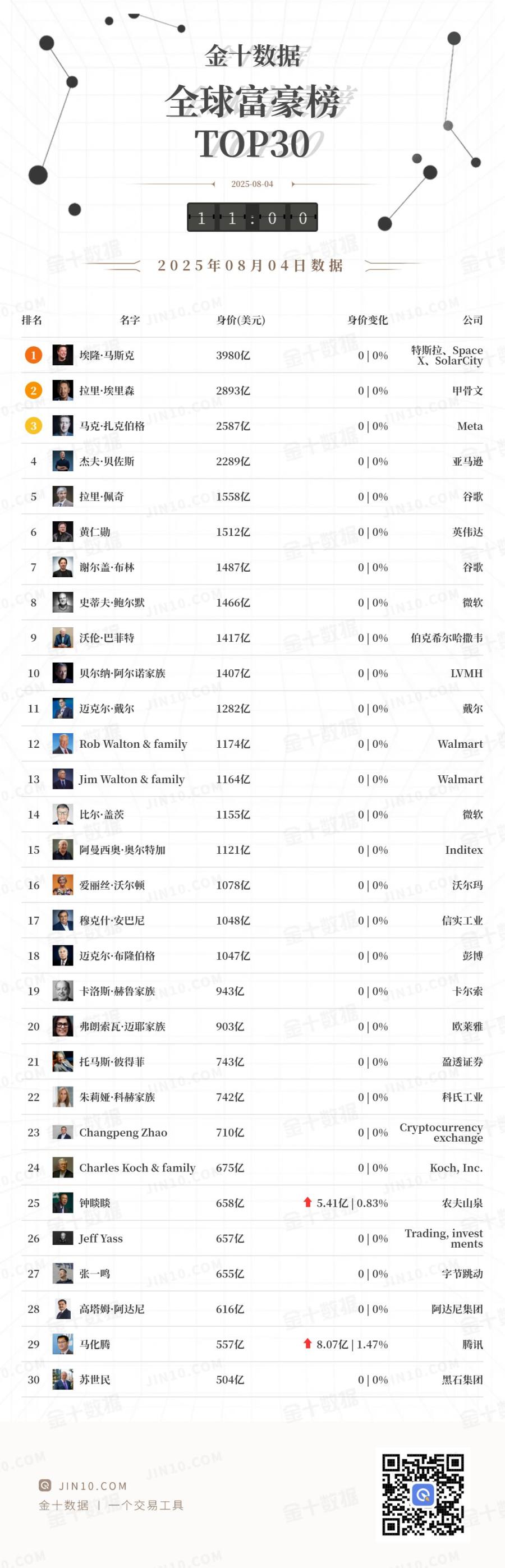
金十图示:2025年08月04日(周一)全球富豪榜



news flash· 2025-08-04 03:07
金十图示:2025年08月04日(周一)全球富豪榜 | 排名 | 名字 | 身价(美元) | 身价变化 | 公司 | | --- | --- | --- | --- | --- | | 1 | 埃隆·马斯克 | 3980亿 | 0 0% | 特斯拉、Spa | | 2 | 拉里·埃里森 | 2893亿 | 0 0% | 甲骨文 | | 3 | 马克·扎克伯格 | 2587亿 | 0 0% | Meta | | 4 | 杰夫·贝佐斯 | 2289亿 | 0 0% | 亚马逊 | | 5 | 拉里·佩奇 | -0 1558亿 | 0 0% | 谷歌 | | 6 | 黄仁勋 | 1512亿 | 0 0% | 英伟达 | | 7 | 谢尔盖·布林 | 1487亿 | 0 0% | 谷歌 | | 8 | 史蒂夫·鲍尔默 | 1466亿 | 0 0% | 微软 | | 9 | 沃伦·巴菲特 | 1417亿 | 0 0% | 伯克希尔哈撒韦 | | 10 | 贝尔纳·阿尔诺家族 | 1407亿 | 0 0% | LVMH | | II | 迈克尔·戴尔 | 1282亿 | 0 0% | 戴尔 | .CO., @ JIN10 ...
LVMH: Quality Doesn't Come Cheap
Seeking Alpha· 2025-08-01 19:17
Core Insights - LVMH is a prominent French luxury conglomerate with a diverse portfolio that includes watches, fashion, and champagne, featuring globally recognized brands such as Louis Vuitton, Dior, and Moët [1] Group 1 - LVMH's brands have a rich history and are well-known worldwide, contributing to the company's strong market presence [1]