
吉林化纤

Search documents
碳纤维行业汇报
2025-07-16 06:13
Summary of the Conference Call on the Carbon Fiber Industry Industry Overview - The conference focused on the carbon fiber industry, discussing its current state, challenges, and future opportunities [1][2][3]. Key Points and Arguments 1. **Demand Issues**: The carbon fiber industry has faced demand problems, particularly in the optical field, leading to significant pressure on profitability across the sector [2][3]. 2. **Profitability and Expansion**: After achieving good profitability, companies in the industry, including Shen Yin and Jilin Ji, have rapidly expanded their production capacity, contributing to an oversupply situation [2][4]. 3. **Price Trends**: The price of carbon fiber has seen fluctuations, with a notable decline starting in August 2022, reaching an average price of 73,000 yuan per ton by September 2023 [10]. 4. **Gross Margin Decline**: The industry's gross margin turned negative in September 2023, with a low of -23% in February 2023, indicating severe financial strain [10][11]. 5. **Recovery Signals**: Despite the oversupply, there are signs of recovery, with some companies raising prices in 2023, suggesting a potential stabilization in the market [6][18]. 6. **Sector-Specific Demand Growth**: Certain sectors, such as wind energy and sports leisure, are expected to see increased demand for carbon fiber, with projections of 20,000 tons in the wind energy sector by 2025 [12][13]. 7. **Emerging Applications**: New applications in aerospace, humanoid robots, and low-altitude economy sectors are anticipated to drive future demand for carbon fiber [15][17][18]. 8. **Investment Requirements**: The production of carbon fiber involves high capital investment, with projects like Sinopec's new 30,000-ton capacity project requiring over 3.196 billion yuan [9]. Additional Important Content - **Technological Barriers**: The production of carbon fiber has high technical and financial barriers, particularly in the precursor production stage, which is crucial for the fiber's performance [8]. - **Market Dynamics**: The industry is currently characterized by a significant gap between supply and demand, with no substantial price recovery yet, although some leading players have begun to increase prices [18]. - **Future Outlook**: The industry is expected to gradually recover, with a more optimistic view on price increases and demand stabilization in the coming years [7][19]. This summary encapsulates the critical insights from the conference call regarding the carbon fiber industry, highlighting both the challenges faced and the potential for future growth.
2025年中国碳纤维布行业制造工艺、产业链、发展现状、代表品牌及未来前景:下游应用领域持续扩展,碳纤维布市场规模超70亿元[图]
Chan Ye Xin Xi Wang· 2025-07-16 01:12
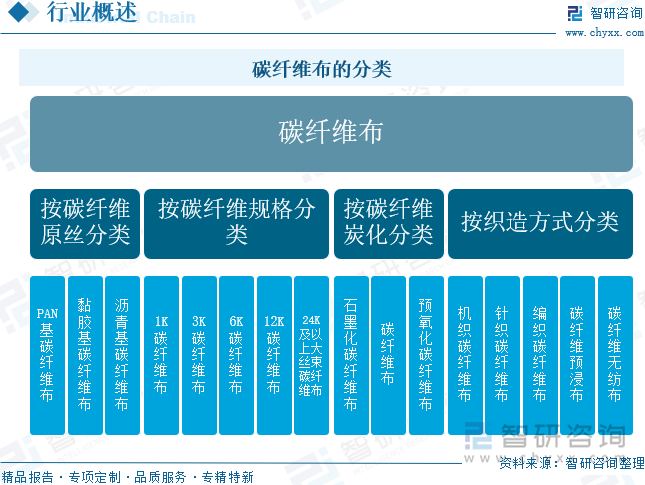
Core Insights - The carbon fiber cloth industry in China is experiencing rapid growth, with a projected market size of approximately 7.713 billion yuan by 2024, driven by its applications in various sectors such as construction, aerospace, automotive, and high-end sports equipment [1][13]. Industry Overview - Carbon fiber cloth, known for its high strength, lightweight, and excellent corrosion resistance, is a key material for industry transformation, particularly in building reinforcement [1][4]. - The manufacturing of carbon fiber cloth involves processes such as weaving and molding, with machine weaving allowing for mass production [6]. - The industry supply chain includes raw materials (carbon fiber, resin, etc.), manufacturing, and downstream applications across multiple sectors [8][10]. Market Dynamics - The demand for high-performance carbon fiber is increasing, with the carbon fiber market in China expected to grow from 4.76 billion yuan in 2018 to 17.14 billion yuan by 2024, reflecting a compound annual growth rate (CAGR) of 23.8% [10]. - The aerospace sector is a significant downstream market for carbon fiber cloth, with applications in aircraft and spacecraft manufacturing, enhancing performance and fuel efficiency [11]. Competitive Landscape - The Chinese carbon fiber cloth industry features both international giants (e.g., TORAY, Hexcel) and domestic leaders (e.g., Guangwei Composite Materials, Hengshen) competing in the market [16][17]. - Companies are focusing on technological innovation and quality management to maintain competitive advantages in a rapidly evolving market [16]. Key Companies - Guangwei Composite Materials is a leading player with a comprehensive product range and a projected revenue of 1.452 billion yuan in 2024 [18]. - Zhongfu Shenying specializes in high-performance carbon fiber and is expected to generate 1.543 billion yuan in revenue in 2024 [20]. Industry Trends - The industry is moving towards lightweight materials to meet the demands of sectors like automotive and aerospace, with innovations in weaving techniques and ultra-thin carbon fiber cloth [22]. - Future developments include high-performance products exceeding T1000 grade, enhanced by nanomaterial modifications for improved durability [23]. - Multi-functional carbon fiber cloths are being developed, integrating features like conductivity and fire resistance, expanding market opportunities [25]. - Cost reduction strategies are being implemented through production process optimizations and recycling technologies, facilitating broader applications in civilian sectors [26].






国产碳纤维最新价格出炉,最高240元/千克
DT新材料· 2025-07-13 13:34
Core Viewpoint - The carbon fiber market in China is experiencing price stability, with expectations for future breakthroughs in production technology to enhance competitiveness [2][4]. Price Summary - As of July 11, 2025, the average price of carbon fiber in China is 83.75 yuan per kilogram, with specific prices for different grades: - Domestic T300 grade: 12K specifications priced between 80 to 90 yuan/kg, while 24/25K bundles range from 70 to 80 yuan/kg [1]. - Domestic T700 grade: 12K products priced between 90 to 120 yuan/kg, and 24K products range from 85 to 120 yuan/kg [1]. - Domestic T800 grade: 12K specifications priced between 180 to 240 yuan/kg [1]. Market Dynamics - T800 grade products command significantly higher prices due to their advanced technology and high-end applications, while smaller bundles (e.g., 12K) are priced higher than larger bundles (e.g., 48/50K) within the same grade due to complexity and performance advantages [2]. - The carbon fiber market is currently in a stagnant phase without major positive stimuli, but advancements in raw silk technology and production processes may lead to cost reductions and improved competitiveness in the future [2]. Technological Developments - A collaborative research project involving Jilin Chemical Fiber Group and several leading enterprises has successfully developed key technologies for the large-scale manufacturing of large bundle carbon fibers and composite materials, achieving stable production of high-performance 35K and above large bundle carbon fibers [3]. - The project has established a simulation model for the pultrusion process of large bundle carbon fibers and developed specialized high-efficiency pultrusion processes and equipment, enabling the stable mass production of high-performance pultruded plates [3]. Future Market Potential - The carbon fiber market is expected to benefit from applications in hydrogen storage and transportation, global wind turbine blade recovery, photovoltaic thermal carbon-carbon composites, low-altitude economy, and the domestic large aircraft supply chain [4].



吉林化纤,增长65%
DT新材料· 2025-07-08 15:32
Core Viewpoint - The article highlights the significant growth and transformation of China's carbon fiber industry, particularly focusing on Jilin Chemical Fiber's impressive sales increase and the shift towards a more integrated and responsive manufacturing model [3][5][10]. Group 1: Industry Growth and Performance - In the first half of 2025, China's carbon fiber industry surpassed previous expectations of "structural oversupply," with Jilin Chemical Fiber's sales increasing by 65% year-on-year, exceeding 25,000 tons, and projected to surpass 56,000 tons for the year [3]. - The production of downstream composite materials and products has grown by 5.9 times, indicating rising capacity utilization and internal absorption capabilities [3]. - Jilin Chemical Fiber's growth is attributed to a product structure adjustment focused on end-user scenarios, moving away from the previous "production determines sales" strategy [3]. Group 2: Manufacturing and Technological Advancements - The choice of technological pathways and internal structural adjustments are crucial for Jilin Chemical Fiber to move beyond the "cyclical carbon fiber manufacturing" paradigm [5]. - The company has achieved a high self-use rate of 91% for precursor materials and 50% for carbonized products, indicating a closed-loop manufacturing capability from raw materials to composite products [5]. - This manufacturing model ensures performance consistency during bulk delivery and provides flexibility to adjust to market fluctuations [5]. Group 3: Industry Collaboration and Policy Support - The article notes that Jilin Chemical Fiber's success is not isolated, as multiple industrial clusters across the country are forming around the vertical integration of carbon fiber production [6]. - Companies like Zhongfu Shenying and Guangwei Composites are establishing integrated platforms from precursor manufacturing to structural design, enhancing their competitive edge [6]. - Local governments are establishing special funds and pilot platforms to support the carbon fiber industry, aligning with the "14th Five-Year Plan" to promote advanced materials [8]. Group 4: Market Trends and Future Outlook - The focus of industry competition is shifting from "single performance indicators" to "system integration adaptability," emphasizing the need for companies to adapt to user processes and provide stable supply [10]. - Chinese carbon fiber is moving away from a "low-end substitution" mindset, developing capabilities to compete with international leaders in mid-modulus and mid-stress composite components [10]. - The carbon fiber industry is entering a "system engineering" phase, requiring companies to focus on core technologies and industry chain integration rather than just capacity and cost [10].
精工科技(002006) - 002006精工科技投资者关系管理信息20250707
2025-07-07 08:40
Company Overview - Zhejiang Jinggong Integrated Technology Co., Ltd. has over 50 years of equipment manufacturing history, focusing on becoming a leader in high-end specialized equipment technology and promoting industrial upgrades [2] - The company’s core business includes carbon fiber full-chain high-end equipment and advanced composite new materials, following a development model of "equipment leading, material collaboration, application support" [2] Carbon Fiber Equipment Development - The carbon fiber equipment manufacturing business began in 2013, with the first domestic thousand-ton-level production line developed in 2015 [2] - The first successful trial run of a domestically produced thousand-ton-level carbon fiber production line occurred in 2020, establishing a comprehensive industrial layout [2] Advantages of Carbon Fiber - Carbon fiber is a high-performance composite material that is lighter and stronger than traditional materials (e.g., steel, aluminum) [2] - It has excellent corrosion resistance, high-temperature resistance, electrical conductivity, thermal conductivity, fatigue resistance, and tensile strength, making it suitable for various applications including aerospace, automotive, and wind energy [2] Future Industry Outlook - The carbon fiber industry is a strategic national industry with significant downstream demand, particularly for T700 and above grade carbon fibers [4] - Domestic production of small-bundle carbon fibers is insufficient to meet market demand, leading to high prices [4] - The company aims to accelerate its full industry chain layout and focus on technological innovation to reduce operational costs and carbon fiber prices [4] Recent Contracts and Projects - The company has secured contracts for various carbon fiber projects, including a 4,000-ton thermal field material project and an 8,000-ton large bundle carbon fiber project [6] - Contracts have been signed for core equipment for carbon fiber production lines, with ongoing project execution [6] Acquisition and Production Line Progress - The acquisition of Zhejiang Jinggong Carbon Material Technology Co., Ltd. aims to utilize its site advantages for carbon fiber industry development [7] - The original silk production line project is progressing as planned, with a trial production expected in Q3 2025 [7] Carbon Fiber Equipment Business Areas - The company provides turnkey projects, upgrade services, and customized products for carbon fiber production lines [9] - The production lines can be tailored to meet various specifications and performance requirements [10] Investment and Equipment Proportions - The investment for achieving a production capacity of 10,000 tons of carbon fiber is approximately 1.3 to 1.5 billion CNY, with 80% allocated to original silk and carbon fiber equipment [11] Polyester Recycling Production Line - A project for producing 50,000 tons of recycled PET is underway, with core equipment installation completed and entering the commissioning phase [12] International Business Growth - The company is expanding its overseas business, focusing on carbon fiber equipment and smart construction machinery, with a strategy to enhance international market presence [13] Talent Development - The company is implementing a talent development strategy, planning to recruit 168 new talents, including 10 PhDs and 47 Masters, to support its growth [14]

军工材料:碳纤维应用与市场分析报告(150页PPT)
材料汇· 2025-07-04 15:38
Core Viewpoint - Carbon fiber is recognized as a strategic new material in modern high-tech fields, known for its high performance and cost-effectiveness, making it the preferred material for high-end manufacturing [4][27]. Group 1: Carbon Fiber Characteristics - Carbon fiber has excellent mechanical, thermal, and electromagnetic properties, enabling long-term reliable service in extreme conditions [4]. - The production process of carbon fiber is complex, with multiple critical control points, making mastery of the preparation technology essential for producing high-performance carbon fiber [5]. - The cost-effectiveness of carbon fiber is the key factor for its expansion into downstream market applications, with innovations in production processes aimed at reducing costs [6]. Group 2: Market Demand and Supply - The global demand for carbon fiber reached 118,000 tons in 2021, a year-on-year increase of 10.4%, with China's demand at 62,379 tons, growing by 27.7% [8]. - China has become the largest producer of carbon fiber globally, with a supply rate of 58.1%, despite having started later than Western countries [8]. - The carbon fiber market is driven by multiple sectors, including aerospace, wind energy, automotive, hydrogen energy, and construction, indicating a robust demand landscape [8]. Group 3: Investment Recommendations - Given the high growth potential in sectors such as defense, automotive, wind energy, and hydrogen energy, it is recommended to pay attention to companies like Guangwei Composites, Zhongjian Technology, and others involved in carbon fiber production [9].
党旗在基层一线高高飘扬丨抓党建、谋创新、促发展——吉林一家化纤企业基层党组织这样做
Xin Hua Wang· 2025-07-01 02:06
Group 1 - The core viewpoint of the articles emphasizes the integration of party organization and innovation in driving the development of Jilin Chemical Fiber Group, showcasing how grassroots party organizations contribute to technological advancements and operational efficiency [1][2][3] - Jilin Chemical Fiber Group has implemented an automated production line that significantly reduces labor costs by 50% and increases per capita production efficiency by 30%, achieving advanced levels of industry automation [1] - The company has a history of over 60 years and focuses on high-quality development through strong party leadership, which has led to breakthroughs in key technologies and successful transformation and upgrading of its operations [2] Group 2 - The company has established a robust production base for high-quality artificial silk, acrylic fiber, and bamboo fiber, while also making continuous advancements in new materials, particularly in the production of 3K carbon fiber for high-end applications [2] - Under the leadership of party branches, the carbon fiber division has developed 124 measures to improve production efficiency and reduce energy consumption, resulting in increased product demand and market competitiveness [2] - Each party branch within the company is tasked with innovation projects, ensuring that all employees are engaged in enhancing innovation awareness and capabilities, effectively translating political and organizational advantages into business development advantages [3]
铭记历史 缅怀先烈|白山黑水见证:从烽火硝烟到振兴热土的巨变
Xin Hua She· 2025-06-29 11:41
Core Viewpoint - The article highlights the transformation of Northeast China from a war-torn region into a vibrant area of economic development and tourism, emphasizing the legacy of the Anti-Japanese War and the ongoing efforts to revitalize the local economy through various industries and cultural tourism [1][4][6]. Economic Development - The Heilongjiang Province's Fengyu Goose Industry Co., Ltd. has established a breeding base, contributing to the local economy with projected revenue of 1.12 billion yuan and total exports of 17.81 million yuan in 2024 [2]. - In Jilin Province's Jingyu County, the blueberry industry has developed into a full industrial chain, with an estimated output value of approximately 340 million yuan in 2024 [3]. Tourism Industry - The region is leveraging its historical significance and natural resources to attract tourists, with the development of winter tourism and the integration of red culture into tourism offerings [4][5]. - In 2024, the city of Panshi is expected to receive 1.7 million tourists, generating a total tourism revenue of 850 million yuan, with over 70% of visitors participating in red tourism [5]. Industrial Innovation - Northeast China is focusing on transforming its old industrial base into a hub for innovation and high-quality development, particularly through the ice and snow economy in Heilongjiang and technological advancements in Liaoning [6][7]. - Liaoning Province is increasing investment in technological innovation, targeting six major areas including artificial intelligence and green technology, to enhance its industrial capabilities [7]. - Jilin Province is prioritizing the strengthening of its manufacturing sector, with a focus on new technologies and industries, aiming for significant advancements in the new energy sector [7].
碳纤维行业的创新机遇:低空经济与机器人应用推动行业突破
DT新材料· 2025-06-26 00:50
Core Viewpoint - The carbon fiber industry is facing challenges due to high prices and supply-demand imbalances, but new growth opportunities are emerging in low-altitude economy and robotics sectors [3][4][8]. Group 1: Carbon Fiber Market Overview - Carbon fiber is a lightweight, high-strength material with applications in aerospace, automotive, and wind energy, but its high cost limits widespread use [3]. - The average price of carbon fiber in early June was 72.5 RMB/kg for small bundles and 95.0 RMB/kg for large bundles, showing a year-on-year decline, yet it remains more expensive than traditional materials [3]. - Domestic carbon fiber production rates are expected to remain below 50% in 2024 due to complex international conditions [3]. Group 2: Low-Altitude Economy Growth - The low-altitude economy, driven by policy support and market demand, is rapidly developing with sectors like drones and eVTOL (electric Vertical Take-Off and Landing) aircraft [4]. - The global drone market is projected to grow from approximately $35.28 billion in 2024 to $67.64 billion by 2029, with a compound annual growth rate (CAGR) of 13.9% [4]. - The Chinese eVTOL market is expected to reach 5.75 billion RMB by 2025, reflecting a year-on-year growth of over 50% [4]. Group 3: Carbon Fiber Applications in Low-Altitude Vehicles - Carbon fiber composites are crucial in eVTOL manufacturing, with applications accounting for up to 70% in structural components and systems [5]. - The global aerospace carbon fiber market is anticipated to reach $3.5 billion by 2025, with eVTOL contributing over 30% [5]. - Demand for carbon fiber in the eVTOL sector is projected to increase from 500 tons in 2024 to 11,750 tons by 2030, with a CAGR of 69% [5]. Group 4: Key Players in the Carbon Fiber Industry - Leading domestic companies like Jilin Chemical Fiber, Guangwei Composites, and Zhongfu Shenying are actively expanding in the low-altitude economy sector [6][7]. - Jilin Chemical Fiber holds over 90% market share in domestic carbon fiber precursor production and has established partnerships with major companies like XPeng and DJI [6]. - Guangwei Composites reported a 15.6% year-on-year revenue increase to 107 million RMB in 2024, driven by its drone-related composite materials business [7]. Group 5: Robotics Sector Opportunities - The robotics sector is emerging as a new growth area for carbon fiber, with increasing demand for industrial and service robots [7]. - Carbon fiber's lightweight and high-strength properties make it ideal for components in robots, enhancing flexibility and precision [7]. - Tesla's humanoid robot, Optimus, utilizes T700 carbon fiber in its legs, reducing weight by 40% and energy consumption by 18% [7]. Group 6: Industry Events and Future Outlook - The 2025 International Carbon Materials Conference will focus on carbon fiber innovations and applications across various industries, providing a platform for technical exchange and product display [8][10]. - The event will showcase advancements in carbon fiber applications in high-end manufacturing sectors, including aerospace and wind energy [10].
【明日主题前瞻】全球首例!我国介入式脑机接口成功实现人体患肢运动功能修复
Xin Lang Cai Jing· 2025-06-23 11:59
Group 1: Brain-Computer Interface (BCI) Development - The world's first invasive brain-computer interface successfully restored motor function in a paralyzed patient in China, led by a team from Nankai University and local hospitals [1] - The BCI technology is expected to experience explosive growth in the next 3 to 5 years, driven by policy support and technological breakthroughs, with both invasive and non-invasive product developments progressing [2] - Companies like Rongtai Health and Aoyi Technology are collaborating to advance brain-machine integration technology and its applications in smart health [2] Group 2: Cross-Border Payment Innovations - The launch of the Cross-Border Payment System marks a significant innovation, allowing real-time cross-border remittances between mainland China and Hong Kong [3] - This system is expected to enhance the efficiency of cross-border payments and expand the offshore business scale of the renminbi, providing new profit growth points for banks [3] - Companies like Xiaogongshangcheng and Lakala are actively investing in cross-border payment services, with Lakala reporting a 76% increase in cross-border merchant scale and an 85% increase in transaction volume year-on-year [3] Group 3: Carbon Fiber Material Expansion - Carbon fiber materials are increasingly being used in various industries, with a projected demand of 11,700 tons in the electric vertical takeoff and landing aircraft sector by 2030, creating a new market worth over 10 billion [4] - The price of T300-grade carbon fiber has dropped by 70% to around 60,000 yuan per ton, facilitating its use in more industries [4] - The carbon fiber market in China is expected to reach approximately 17.14 billion yuan in 2024, with an 8.16% year-on-year production growth and a 119.9% increase in exports [4] Group 4: Solid-State Battery Advancements - Solid-state batteries are entering a critical development phase, with expectations for widespread application in low-altitude economy, robotics, and new energy vehicles [6] - The global shipment of solid-state batteries is projected to reach 614.1 GWh by 2030, with a market size exceeding 250 billion yuan [6] - Companies like XianDao Intelligent and Ningde Times are making significant advancements in solid-state battery production equipment and technology [7] Group 5: Semiconductor Material Innovations - The launch of a silicon carbide semiconductor production project highlights the growing importance of wide bandgap semiconductors, which offer superior performance compared to traditional silicon-based semiconductors [8] - The silicon carbide market is expected to grow rapidly, driven by demand from AI data centers, AR glasses, and other emerging applications [8] - Companies like TianYue Advanced and XinLian Integrated are expanding their production capabilities in silicon carbide substrates, targeting various high-tech applications [9] Group 6: Cobalt Supply and Market Dynamics - The Democratic Republic of the Congo has extended its temporary ban on cobalt exports, which could impact global cobalt supply by over 100,000 metric tons [10] - The global cobalt production is projected to reach 288,000 metric tons in 2024, with the DRC accounting for approximately 220,000 metric tons, representing a 25% year-on-year increase [10] - Companies like Hanrui Cobalt and Luoyang Molybdenum are significantly increasing their cobalt production, with Hanrui ranking among the top three in global market share [11]