国盾量子

Search documents
创新无畏 技术“追光” “科大系”的时代担当
Shang Hai Zheng Quan Bao· 2025-12-04 19:24
Core Viewpoint - The article highlights the significant contributions of the University of Science and Technology of China (USTC) to China's technological advancement and its impact on the capital market through its alumni and their companies [3][4][9]. Group 1: Historical Context and Development - USTC was established in 1958 to meet the urgent need for advanced scientific talent in China, particularly for the "Two Bombs, One Satellite" project, attracting renowned scientists to educate students [3]. - The university has received continuous support from Anhui province, which has been crucial for its development and the promotion of high-level education and technology transfer [3][4]. Group 2: Alumni and Market Impact - USTC alumni have founded 31 publicly listed companies, with over half listed on the Sci-Tech Innovation Board, contributing significantly to the regional market [4][9]. - The average market capitalization of these companies, excluding Cambrian, is 29.5 billion yuan, with seven USTC-affiliated companies in Anhui contributing over 7.6% to the regional market capitalization [4]. Group 3: Technological Innovation and Entrepreneurship - USTC alumni are characterized by their strong technical backgrounds, often transitioning from research to entrepreneurship, exemplified by companies like iFlytek and Cambrian [4][5]. - The article emphasizes the importance of technology-driven innovation among USTC entrepreneurs, who focus on transforming scientific achievements into practical applications [4][9]. Group 4: Recent Developments and Initiatives - The "Empowerment Reform" initiated by USTC has significantly accelerated the commercialization of scientific research, resulting in a threefold increase in successful technology transfers compared to the previous five years [11][12]. - The establishment of USTC Silicon Valley aims to create a global network for innovation and entrepreneurship, facilitating the transformation of research into marketable products [14][16]. Group 5: Educational and Institutional Innovations - The USTC Business School was established to bridge the gap between technology and industry, focusing on cultivating talents who understand both technological and managerial aspects [17]. - The school aims to create a new generation of professionals who can effectively integrate technology with market needs, enhancing the university's role in societal innovation [17].


国盾量子(688027) - 2025年第六次临时股东大会会议资料
2025-12-04 09:45
科大国盾量子技术股份有限公司 2025 年第六次临时股东大会 科大国盾量子技术股份有限公司 2025 年第六次临时股东大会会议资料 股票简称:国盾量子 股票代码:688027 2025 年 12 月 - 1 - 科大国盾量子技术股份有限公司 2025 年第六次临时股东大会 目 录 | 科大国盾量子技术股份有限公司2025年第六次临时股东大会会议须知…………3 | | --- | | 科大国盾量子技术股份有限公司2025年第六次临时股东大会会议议程…………5 | | 议案1、《关于签订专利实施许可合同暨关联交易的议案》………………………7 | | 议案2、《关于取消监事会、调整董事会及修订<公司章程>的议案》…………25 | | 议案3、《关于修订和制定公司部分治理制度的议案》…………………………27 | | 议案4、《关于选举独立董事的议案》……………………………………………28 | | 议案5、《关于变更会计师事务所的议案》………………………………………30 | - 2 - 科大国盾量子技术股份有限公司 2025 年第六次临时股东大会 科大国盾量子技术股份有限公司 2025年第六次临时股东大会会议须知 为了 ...

研判2025!中国磁力计行业分类、市场规模及发展趋势分析:传统技术稳守基本盘,规模化应用构筑产业基石[图]
Chan Ye Xin Xi Wang· 2025-12-04 01:17
Core Insights - The current Chinese magnetometer industry exhibits three main characteristics: mature traditional technology, breakthroughs in quantum technology, and differentiated market demand, leading to a synergistic effect of technological iteration and industrial upgrading [1][9]. Industry Overview - Magnetometers, also known as magnetic field meters or gaussmeters, are instruments used to measure the strength, direction, and distribution of magnetic fields, with core functions based on magnetic induction intensity measurement [2]. - There are two main types of magnetometers: scalar magnetometers, which measure only the magnitude of the magnetic field, and vector magnetometers, which measure both magnitude and direction [3]. Market Size - The market size of the Chinese magnetometer industry is projected to reach approximately 7.536 billion yuan in 2024, representing a year-on-year growth of 10.61% [1][9]. Industry Chain - The upstream of the magnetometer industry chain includes raw materials such as rare earth permanent magnetic materials, chips, superconducting materials, and various components [6]. - China’s rare earth production is expected to reach 270,000 tons in 2024, with a year-on-year increase of 12.50%, ensuring stable raw material supply for magnetometer production [6]. Key Enterprises - Leading companies in the Chinese magnetometer sector include Guodian Quantum, which focuses on quantum computing equipment and has delivered over 1,000 high-end instruments globally [10]. - Hefei Moce Technology Co., established in 2021, has developed the QTFM-Mozi series of quantum magnetometers, which can detect weak magnetic signals and are used in various applications including geological exploration and medical diagnostics [12]. Industry Development Trends 1. Quantum magnetometer technology innovations are expected to deepen high-end applications in fields such as biophysics and deep resource exploration, with products like the QTFM-Mozi series achieving significant size and power consumption reductions [16]. 2. Market demand is diversifying, with significant growth in consumer electronics and strategic upgrades in sectors like new energy and defense, driving the need for customized products [17]. 3. The entire industry chain is evolving towards collaborative development, with upstream material supply, midstream manufacturing automation, and expanding downstream applications in emerging fields [18].

国盾量子跌2.06%,成交额8.27亿元,主力资金净流出1.34亿元
Xin Lang Zheng Quan· 2025-12-03 06:09
Core Viewpoint - Guodun Quantum's stock price has experienced fluctuations, with a year-to-date increase of 45.62% but a recent decline in the last five and twenty trading days [1] Company Overview - Guodun Quantum Technology Co., Ltd. was established on May 27, 2009, and went public on July 9, 2020. The company specializes in the research, production, sales, and technical services of quantum communication products [2] - The company's revenue composition includes: 35.68% from related technical services, 34.31% from quantum communication products, 13.03% from quantum precision measurement products, 12.42% from quantum computing products, and 4.56% from other sources [2] - As of September 30, 2025, the number of shareholders increased by 12.24% to 21,700, with an average of 3,711 circulating shares per person, a decrease of 10.91% [2] Financial Performance - For the period from January to September 2025, Guodun Quantum achieved a revenue of 190 million yuan, representing a year-on-year growth of 90.27%. However, the net profit attributable to the parent company was a loss of 26.47 million yuan, an increase in loss of 51.98% year-on-year [2] - The company has distributed a total of 9.6 million yuan in dividends since its A-share listing, with no dividends distributed in the last three years [3] Shareholding Structure - As of September 30, 2025, Hong Kong Central Clearing Limited is the tenth largest circulating shareholder, holding 1.1147 million shares as a new shareholder. Meanwhile, GF Multi-Factor Mixed Fund has exited the top ten circulating shareholders [3]
国盾量子跌2.01%,成交额5.99亿元,主力资金净流出7214.57万元
Xin Lang Cai Jing· 2025-12-02 03:40
Core Viewpoint - Guodun Quantum's stock price has experienced fluctuations, with a year-to-date increase of 48.77% but a recent decline in the last 5 and 20 trading days [1] Company Overview - Guodun Quantum Technology Co., Ltd. was established on May 27, 2009, and went public on July 9, 2020. The company specializes in the research, production, and sales of quantum communication products and provides solutions for various industries including government, finance, and defense [2] - The company's revenue composition includes: technical services (35.68%), quantum communication products (34.31%), quantum precision measurement products (13.03%), quantum computing products (12.42%), and others (4.56%) [2] - As of September 30, 2025, the number of shareholders increased by 12.24% to 21,700, with an average of 3,711 circulating shares per person, a decrease of 10.91% [2] Financial Performance - For the period from January to September 2025, Guodun Quantum achieved a revenue of 190 million yuan, representing a year-on-year growth of 90.27%. However, the net profit attributable to the parent company was a loss of 26.47 million yuan, an increase in loss of 51.98% year-on-year [2] - The company has distributed a total of 9.6 million yuan in dividends since its A-share listing, with no dividends distributed in the last three years [3] Shareholding Structure - As of September 30, 2025, Hong Kong Central Clearing Limited is the tenth largest circulating shareholder with 1.1147 million shares, marking its entry as a new shareholder. Meanwhile, GF Multi-Factor Mixed Fund has exited the top ten circulating shareholders [3]
国盾量子(688027) - 关于注销募集资金理财专用结算账户的公告
2025-12-01 09:15
本公司董事会及全体董事保证本公告内容不存在任何虚假记载、误导性陈述 或者重大遗漏,并对其内容的真实性、准确性和完整性承担法律责任。 一、募集资金理财产品专用结算账户的开立情况 证券代码:688027 证券简称:国盾量子 公告编号:2025—069 科大国盾量子技术股份有限公司 关于注销募集资金理财专用结算账户的公告 科大国盾量子技术股份有限公司董事会 2025年12月2日 为满足部分暂时闲置募集资金现金管理的需要,科大国盾量子技术股份有限 公司(以下简称"公司")在国泰君安证券股份有限公司安徽分公司(资金账号: 2312859)开立了募集资金理财产品专用结算账户,用于闲置募集资金现金管理 用 途 。 具 体 内 容 详 见 2021 年 5 月 22 日 公 司 披 露 于 上 海 证 券 交 易 所 网 站 (www.sse.com.cn)的《关于开立理财产品专用结算账户的公告》(公告编号 2021-036)。 二、募集资金理财产品专业结算账户的注销情况 截止本公告日,公司在国泰君安证券股份有限公司安徽分公司(资金账号: 2312859)购买的理财产品均已全部到期赎回,且不再使用上述账户。根据《上 市公司监 ...
硬刚英伟达?英特尔前CEO警告:量子技术重大突破将击破AI产业泡沫,GPU十年内开始被取代【附量子信息产业分析】
Qian Zhan Wang· 2025-12-01 07:42
Group 1: Core Insights - Pat Gelsinger, former CEO of Intel, warns that the rapid expansion of the AI industry may face a bubble burst due to significant breakthroughs in quantum technology, predicting that quantum computers will become mainstream within two years [2] - Gelsinger believes that the currently dominant GPU chips will be replaced within ten years, marking a pivotal shift in computing technology [2] - Quantum information technology is seen as a disruptive innovation that challenges the limits of classical computing, offering exponential advantages in fields like cryptography, materials simulation, and artificial intelligence [3] Group 2: National Strategies and Developments - Major countries are competing for dominance in quantum technology, with the U.S. accelerating its efforts through the National Quantum Initiative, while the EU has launched the Quantum Flagship program [3] - China has prioritized quantum information as a key technology direction, with plans to achieve global leadership in quantum communication and practical breakthroughs in quantum computing by 2030 [3][10] - The "14th Five-Year Plan" and the "15th Five-Year Plan" in China emphasize the importance of quantum technology alongside AI, 6G, and biomanufacturing [3] Group 3: Industry Structure and Ecosystem - Chinese quantum enterprises are characterized by a deep integration of research-driven initiatives and state-owned enterprise support, with many companies emerging from top research institutions [4][5] - Major state-owned enterprises and research institutes collaborate with top universities and returning overseas talent to form a robust support system for quantum technology development [5] - The landscape is dominated by a "national team leading, private enterprises following" model, allowing for sustained investment in cutting-edge fields [8] Group 4: Market Potential and Growth - The global quantum computing market, including hardware, software, and services, was valued at $1.1 billion in 2022 and is projected to grow to approximately $7.6 billion by 2027, with a compound annual growth rate of 79.72% from 2022 to 2030 [11] - The commercial launch of quantum computing is anticipated around 2030, with market demand expected to exceed $100 billion [11] Group 5: Challenges Ahead - Despite promising advancements, the commercialization of quantum computing remains a long-term endeavor, requiring substantial investment, high-level talent, and advanced equipment [13] - Ongoing challenges include achieving stable qubits and quantum error correction, necessitating increased R&D investment and international collaboration [13]



神州信息携手中国移动发布量子安全云电脑
Zheng Quan Ri Bao Wang· 2025-12-01 07:14
Core Viewpoint - China Mobile and Digital China Information Service Group have jointly launched a quantum secure cloud computer, integrating mobile cloud computing architecture with quantum information technology to enhance security for digital scenarios [1][2] Group 1: Quantum Security Solutions - The quantum secure cloud computer provides a comprehensive security protection system covering terminal authentication, data transmission, and cloud processing [1] - Digital China has been a key player in the quantum communication industry since 2012 and is a significant service provider for China's quantum secure communication trunk line project [1] - The company is a founding member of the Quantum Communication Industry Alliance and serves as the vice president of the Quantum Information Sub-committee [1] Group 2: Product Development and Applications - Digital China has established a subsidiary, "Shenzhou Guoxin," in collaboration with Guodun Quantum to explore product development and industry applications [2] - The company has developed solutions for data encryption transmission, terminal security access, secure instant communication, confidential video conferencing, and secure data encryption [2] - Digital China aims to innovate and iterate its products and services continuously, providing comprehensive digital transformation services for financial institutions and various industries [2]


科创100ETF基金(588220)日均成交2.55亿,低费率布局科技板块
Xin Lang Cai Jing· 2025-12-01 06:46
Group 1 - The core viewpoint of the news highlights the performance of the Sci-Tech Innovation Board 100 Index and the related ETF, with significant movements in semiconductor stocks driven by supply shortages and anticipated price increases in memory chips [1][2] - The Sci-Tech Innovation Board 100 Index has shown mixed performance, with notable gains from companies like Lexin Technology and Zhongke Lanyun, while Dongxin Co. led the declines [1] - The Sci-Tech 100 ETF has a recent trading volume of 1.69 billion yuan, with a turnover rate of 2.71%, indicating active trading interest [1] Group 2 - The semiconductor sector is experiencing a strengthening trend, influenced by Dell's announcement regarding storage chip shortages and potential price hikes for equipment [1] - Research institutions predict that memory chip prices could rise by approximately 50% by the second quarter of 2026 due to ongoing shortages [1] - Guojin Securities emphasizes that new technology drives product upgrades and innovation, suggesting that the current demand from AI is at the beginning of a new memory cycle, warranting close attention to inventory and pricing data [1] Group 3 - The Sci-Tech 100 ETF closely tracks the Sci-Tech Innovation Board 100 Index, which consists of 100 medium-sized, liquid securities selected from the Sci-Tech Innovation Board [2] - As of November 28, 2025, the top ten weighted stocks in the Sci-Tech Innovation Board 100 Index account for 26.72% of the index, with companies like Huahong Semiconductor and Dongxin Co. among the leaders [2]
通信设备板块11月28日跌0.1%,德科立领跌,主力资金净流出18.62亿元
Zheng Xing Xing Ye Ri Bao· 2025-11-28 09:15
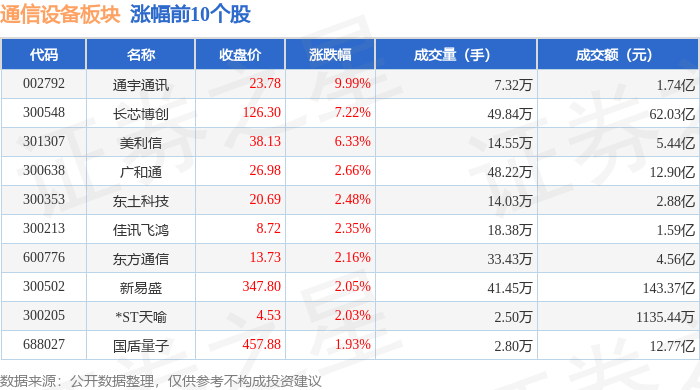
Core Insights - The communication equipment sector experienced a slight decline of 0.1% on November 28, with Dekoli leading the drop [1] - The Shanghai Composite Index closed at 3888.6, up 0.34%, while the Shenzhen Component Index closed at 12984.08, up 0.85% [1] Stock Performance - Notable gainers in the communication equipment sector included: - Tongyu Communication (002792) with a closing price of 23.78, up 9.99% on a trading volume of 73,200 shares and a transaction value of 174 million [1] - Changxin Bochuang (300548) closed at 126.30, up 7.22% with a trading volume of 498,400 shares and a transaction value of 6.203 billion [1] - Meilixin (301307) closed at 38.13, up 6.33% with a transaction value of 544 million [1] - Conversely, Dekoli (688205) saw a significant decline of 8.69%, closing at 122.35 with a trading volume of 269,400 shares [2] - Other notable decliners included: - Shida Group (600734) down 8.30% to 5.08 [2] - Wanlong Optoelectronics (300710) down 6.80% to 26.59 [2] Capital Flow - The communication equipment sector saw a net outflow of 1.862 billion from institutional investors, while retail investors contributed a net inflow of 1.938 billion [2][3] - The capital flow for specific stocks indicated: - Xinyi Sheng (300502) had a net inflow of 632.2 million from institutional investors, while retail investors had a net outflow of 328 million [3] - Changxin Bochuang (300548) experienced a net inflow of 339 million from institutional investors, with a net outflow of 165 million from retail investors [3] - Guodun Quantum (688027) had a net inflow of 67.76 million from institutional investors, while retail investors had a net outflow of 1.4514 million [3]