
DeepSeek

Search documents
DeepSeek新模型“MODEL1”曝光
Di Yi Cai Jing Zi Xun· 2026-01-21 09:05
Core Insights - The article discusses the emergence of a new model named "MODEL1" from DeepSeek, coinciding with the one-year anniversary of the DeepSeek-R1 release, indicating potential advancements in AI model architecture [2][6]. Group 1: Model Development - "MODEL1" has been referenced in the updated FlashMLA code on GitHub, suggesting it may represent a new model distinct from the existing "V32" architecture [2][3]. - There are differing opinions in the industry regarding whether "MODEL1" is a version 4 model or an advanced inference model, with some developers speculating it could be the ultimate version of the V3 series [2][5]. - Key technical differences between "MODEL1" and "V32" include variations in key-value (KV) cache layout, sparsity handling, and support for FP8 data format decoding, indicating targeted design for memory optimization and computational efficiency [5]. Group 2: Anticipated Release and Features - The structure of the model files suggests that "MODEL1" is nearing completion or inference deployment, awaiting final weight freezing and testing validation, which implies a forthcoming launch [5]. - There are expectations for DeepSeek to release its next flagship model, DeepSeek V4, in February, with preliminary tests indicating it may surpass other top models in programming capabilities [6]. - Recent technical papers from DeepSeek introduce new training methods and an AI memory module, hinting that these innovations may be integrated into the upcoming model [6]. Group 3: Industry Impact - The DeepSeek-R1 model has been recognized as the most praised model on Hugging Face, significantly lowering barriers in inference technology and production deployment, thus influencing the open-source strategy of major Chinese companies [9]. - Over the past year, Chinese AI models have seen increased downloads on Hugging Face, surpassing those from the U.S., indicating a shift in reliance on Chinese-developed open-source models within the global supply chain [9].


DeepSeek新模型“MODEL1”曝光
第一财经· 2026-01-21 08:56
Core Insights - The article discusses the emergence of a new model named "MODEL1" from DeepSeek, which is expected to be distinct from the existing "V32" model, potentially indicating advancements in architecture and performance [4][5]. Group 1: Model Development - "MODEL1" is likely to represent a new model architecture, differing from "V32" in key technical aspects such as KV cache layout, sparsity handling, and support for FP8 data format decoding [4]. - The new model is nearing completion, with indications that it is in the final stages of training or inference deployment, awaiting weight freezing and testing validation [4]. Group 2: Industry Impact - The anticipation surrounding DeepSeek's new flagship model, expected to be released in February, suggests it may surpass current top models in programming capabilities [5]. - The release of DeepSeek-R1 has significantly influenced the open-source community, leading to increased contributions from major Chinese companies and startups, with downloads of Chinese models on Hugging Face surpassing those from the U.S. [8]. Group 3: Research and Innovation - Recent technical papers from DeepSeek introduce new training methods and an AI memory module, hinting at the integration of these innovations into the upcoming model [6]. - The previous flagship model, V3, established a strong performance foundation, and the subsequent R1 model excelled in complex reasoning tasks, setting high expectations for future releases [6].

传DeepSeek曝新模型,梁文锋再放“王炸”?
Xin Lang Cai Jing· 2026-01-21 07:55
Core Insights - DeepSeek has generated significant buzz in the AI community with the unexpected exposure of a new model named Model1 during a code update, suggesting a potential new technological path distinct from the existing V3 series [1][6][8] - Speculation is rife that DeepSeek is preparing to launch its next-generation AI model, V4, around mid-February, following a year of iterative improvements to the V3 model [3][8] Model Development Timeline - On March 25, 2025, DeepSeek released V3-0324, enhancing code generation usability and surpassing GPT-4.5 in mathematical and coding capabilities [4] - On May 29, 2025, the R1 model underwent a minor upgrade, improving performance in mathematics, programming, and general logic, with hallucination rates reduced by 45-50% [4] - On August 21, 2025, DeepSeek V3.1 was launched, offering faster response times and stronger agent capabilities, along with support for Anthropic's API [4] - On September 22, 2025, the V3.1-Terminus version was released, addressing issues with mixed-language inputs and enhancing the performance of Code and Search Agents [4] - On September 29, 2025, the V3.2-Exp version introduced a new attention mechanism, with updated API pricing structures [4] - On December 1, 2025, the official V3.2 version was released, achieving inference capabilities comparable to GPT-5 and integrating thinking modes for tool usage [4][9] Research Contributions - Two papers authored by Liang Wenfeng were published between late December 2025 and early January 2026, addressing training stability and knowledge retrieval efficiency in large model architectures [5][10] - The first paper proposed a manifold-constrained hyper-connections framework to enhance training stability by constraining residual connections within a specific manifold [10][11] - The second paper introduced a conditional memory module that improves inference and knowledge task performance by decoupling knowledge storage from neural computation [10][11] Market Expectations - The AI community is eagerly anticipating whether DeepSeek will unveil the new Model1 or V4 during the upcoming Spring Festival, with expectations of a significant impact on the global AI landscape [6][8]
DeepSeek新模型真的要来了?“MODEL1”曝光
Di Yi Cai Jing Zi Xun· 2026-01-21 07:00
Core Insights - The article discusses the emergence of a new model named "MODEL1" from DeepSeek, coinciding with the one-year anniversary of the release of DeepSeek-R1, indicating potential advancements in AI technology [1][4]. Group 1: Model Development - "MODEL1" has been referenced in the updated FlashMLA code on GitHub, suggesting it is a new model distinct from the existing "V32" architecture [1][2]. - There are differing opinions in the industry regarding whether "MODEL1" represents a V4 model or an advanced version of the V3 series [2][3]. - The new model is expected to be close to completion, awaiting final weight freezing and testing validation, indicating a near launch [3]. Group 2: Technical Innovations - FlashMLA is a proprietary software tool optimized for NVIDIA Hopper architecture GPUs, crucial for achieving low-cost and high-performance model implementations [3]. - Key technical differences between "MODEL1" and "V32" include variations in key-value (KV) cache layout, sparse processing methods, and support for FP8 data format decoding, suggesting targeted design for memory optimization and computational efficiency [3]. Group 3: Market Impact and Expectations - The anticipation for DeepSeek's next flagship model is high, with expectations that it will integrate recent research findings, including a new training method and an AI memory module [4]. - The release of DeepSeek-R1 has significantly influenced the open-source community, with increased contributions from major Chinese companies and a shift in global reliance towards Chinese-developed open-source models [5][7].
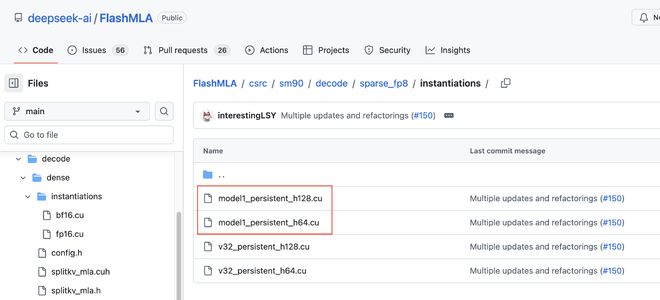
DeepSeek新模型“Model 1”曝光,疑似“高效推理模型”
Xin Lang Cai Jing· 2026-01-21 06:58
Core Insights - DeepSeek has updated its official GitHub repository with a series of FlashMLA code, drawing attention to a model named "Model 1" [1][2] - Model 1 is speculated to be the new model code that DeepSeek is expected to release around the Chinese New Year [2] Model Specifications - Model 1 is one of the two main model architectures supported in DeepSeek FlashMLA, alongside DeepSeek-V3.2 [2] - It is likely to be an efficient inference model with lower memory usage compared to V3.2, making it suitable for edge devices or cost-sensitive scenarios [2] - Model 1 may also function as a long-sequence expert optimized for sequences longer than 16K, making it ideal for tasks such as document understanding and code analysis [2]
DeepSeek AI新模型曝光:搭载 MODEL1 全新架构,最快2月上线
Huan Qiu Wang Zi Xun· 2026-01-21 06:37
Core Insights - DeepSeek plans to launch its next-generation flagship AI model, DeepSeek V4, around mid-February during the Lunar New Year, which is expected to significantly enhance coding capabilities and attract industry attention [1][2] Group 1: Model Development - The release of DeepSeek V4 follows the one-year anniversary of the DeepSeek-R1 model, with developers discovering updates related to FlashMLA in 114 files, including 28 references to an unknown "MODEL1" identifier, likely indicating a new AI model with a different architecture [1][2] - The new architecture optimizes key technical aspects such as key-value (KV) cache layout, sparsity handling, and FP8 data format decoding support, addressing memory usage and computational efficiency issues, thereby laying the groundwork for performance improvements [3] Group 2: Research Innovations - DeepSeek's research team has previously published two technical papers introducing innovative training methods like "optimized residual connections (mHC)" and a biologically inspired "AI memory module (Engram)," suggesting that DeepSeek V4 may integrate these latest research findings to enhance its capabilities in handling complex tasks [3]
DeepSeek新模型曝光
财联社· 2026-01-21 06:34
Core Viewpoint - DeepSeek is advancing its AI model capabilities with the introduction of MODEL1, which is designed for efficient inference and optimized for various GPU architectures, indicating a strategic focus on enhancing performance and reducing memory usage in AI applications [4][5][6]. Group 1: MODEL1 and FlashMLA - MODEL1 is a newly revealed model architecture within DeepSeek's FlashMLA, which is a software tool optimized for NVIDIA Hopper architecture GPUs, aimed at accelerating large model inference generation [4]. - FlashMLA utilizes a multi-layer attention mechanism (MLA) to minimize memory usage and maximize GPU hardware efficiency, which is crucial for the performance of DeepSeek's models [4][5]. - MODEL1 is expected to be a low-memory consumption model suitable for edge devices and cost-sensitive scenarios, with optimizations for long sequence tasks such as document understanding and code analysis [5]. Group 2: DeepSeek's Model Development - DeepSeek's existing models represent two technical routes: the V series focusing on comprehensive performance and the R series targeting complex reasoning tasks [6]. - The V3 model, launched in December 2024, marked a significant milestone with its efficient MoE architecture, followed by rapid iterations leading to V3.1 and V3.2, which enhance reasoning and agent capabilities [6]. - The R1 model, released in January 2025, excels in solving complex reasoning tasks through reinforcement learning and introduces a "deep thinking" mode, showcasing DeepSeek's commitment to advancing AI capabilities [7]. Group 3: Future Developments - DeepSeek is expected to launch its next flagship AI model, DeepSeek V4, around mid-February 2025, which is anticipated to have enhanced coding capabilities [7]. - Recent technical papers from DeepSeek discuss new training methods and an AI memory module inspired by biology, suggesting that these innovations may be integrated into upcoming models [7].

炸锅了!DeepSeek MODEL1 引发全网大猜测,R2 or V4?
程序员的那些事· 2026-01-21 04:21
Core Viewpoint - The sudden emergence of a new model named "MODEL1" from DeepSeek has generated significant excitement in the domestic large model sector, indicating potential advancements in AI technology and competition in the market [1][3]. Group 1: MODEL1 Features - MODEL1 has been revealed to include advanced technologies such as optimized KV cache layout and support for FP8 sparse decoding, which are expected to greatly enhance inference efficiency and reduce memory usage [2]. - The model integrates a long-context optimization mechanism, addressing the common issue of large models struggling to retain long texts [2]. Group 2: Speculations and Expectations - There is speculation among the community that MODEL1 could either be the long-awaited R2 model, which has faced delays due to chip shortages, or the upcoming V4 model, following the naming convention after V3.2 [3]. - DeepSeek has not officially responded to these speculations, but there are indications that the new model may be released around the Chinese New Year [3].

速递 | DeepSeek突然扔出MODEL1,这到底是V4还是R2?
未可知人工智能研究院· 2026-01-21 04:20
Core Insights - The emergence of DeepSeek's "MODEL1" signals a potential paradigm shift in AI technology, indicating a fundamental architectural overhaul rather than a mere iteration of previous models [2][6][10] - The naming of "MODEL1" suggests a new beginning, akin to Apple's transition from iPhone to iPhone X, which marked a significant redesign and innovation in product strategy [10][11] - The timing of this release coincides with other major AI developments, hinting at DeepSeek's strategy to capture attention and possibly disrupt the market [12] Marketing Strategy - DeepSeek's approach of a "technical leak" serves as a marketing tactic to gauge market reaction and build anticipation without formal announcements [4][5] - The buzz generated around MODEL1 has created a low-cost yet highly effective promotional campaign, surpassing traditional advertising methods [5] Industry Trends - The AI industry is currently focused on first-principles innovation, with major players like OpenAI and Google pushing the boundaries of existing architectures [11] - If MODEL1 represents a true architectural innovation, it could redefine competitive dynamics in the AI space, moving beyond existing frameworks [12] Predictions and Opportunities - MODEL1 is anticipated to be a hybrid model that addresses the limitations of current AI systems, potentially creating new market opportunities rather than competing in existing ones [14][15] - The introduction of MODEL1 could lead to significant advancements in complex decision-making applications, multi-modal integration, and the development of new tools and business models [19][20] Recommendations for Stakeholders - Stakeholders are advised to monitor DeepSeek's official updates and engage with the open-source community to leverage potential opportunities arising from MODEL1 [26][27] - Developers should begin familiarizing themselves with the new architecture to prepare for upcoming changes in the AI landscape [27] - Those interested in AI monetization should consider entering niche markets now, as the official release of MODEL1 may present a competitive advantage [28]
R1模型发布一周年 DeepSeek新模型“MODEL1”曝光
Xin Lang Cai Jing· 2026-01-21 04:05
Core Insights - DeepSeek has unveiled a new model architecture named "MODEL1" as part of its FlashMLA software, which is designed to optimize large model inference generation on NVIDIA GPUs [1][2] - MODEL1 is expected to be a highly efficient inference model with lower memory usage compared to the existing V3.2 model, making it suitable for edge devices and cost-sensitive applications [2] - The company is set to launch its next flagship AI model, DeepSeek V4, in mid-February 2025, which is anticipated to enhance coding capabilities [3] Group 1 - The FlashMLA tool analyzes a total of 114 code files and identifies the MODEL1 architecture mentioned 31 times [1] - MODEL1 supports multiple GPU architectures, including specific implementations for NVIDIA H100/H200 and B200, indicating a tailored optimization for the latest GPU technology [2] - DeepSeek's existing models represent two technical routes: the V series focusing on comprehensive performance and the R series targeting complex reasoning tasks [2] Group 2 - The V3 model, launched in December 2024, established a strong performance foundation with its efficient MoE architecture, followed by rapid iterations leading to V3.2 [3] - The R1 model, released in January 2025, excels in complex reasoning tasks through reinforcement learning and introduces a "deep thinking" mode [3] - Recent technical papers from DeepSeek suggest ongoing development of new models that may integrate innovative training methods and AI memory modules [3]