
成都银行

Search documents
成都银行(601838):业务规模稳健增长,关注类贷款率下降:——成都银行(601838):2025年三季报点评
Guohai Securities· 2025-11-02 08:32
Investment Rating - The investment rating for Chengdu Bank is maintained as "Buy" [1][4]. Core Views - Chengdu Bank's business scale shows steady growth, with a decrease in the rate of loans under concern. The bank's asset quality remains high, and it has maintained a low non-performing loan ratio [4][6]. - For the first three quarters of 2025, Chengdu Bank's revenue grew by 3.01% year-on-year, while net profit attributable to shareholders increased by 5.03%. However, there was a significant decline in both revenue and net profit in Q3 compared to Q2, primarily due to a decrease in fee and commission income and fair value gains [4][6]. - As of the end of Q3 2025, Chengdu Bank's total assets reached 1,385.3 billion yuan, a year-on-year increase of 13.4%. The total loan amount increased by 17.4%, with corporate loans and personal loans growing by 19.0% and 10.2%, respectively [4][6]. - The non-performing loan ratio remained stable at 0.68%, with a slight increase of 2 basis points from Q2 2025. The provision coverage ratio was 433.08%, down by 19.57 percentage points from the previous quarter. The rate of loans under concern decreased to 0.37%, down by 7 basis points [4][6]. Summary by Sections Financial Performance - Chengdu Bank's revenue for Q1-Q3 2025 was 24,908 million yuan, with a year-on-year growth rate of 8.38% projected for 2026 and 9.04% for 2027. The net profit attributable to shareholders is expected to be 133,270 million yuan in 2025, with growth rates of 3.65% and 6.08% for the following years [4][6]. - The earnings per share (EPS) is projected to be 3.14 yuan in 2025, with a price-to-earnings (P/E) ratio of 5.35 and a price-to-book (P/B) ratio of 0.80 [4][6]. Asset Quality - The bank's asset quality indicators remain robust, with a non-performing loan ratio of 0.68% and a provision coverage ratio of 433.08% as of Q3 2025. The focus on reducing the rate of loans under concern is a positive sign for future stability [4][6]. Market Performance - As of October 31, 2025, Chengdu Bank's stock price was 16.81 yuan, with a market capitalization of 71,248.10 million yuan. The stock has shown a 14.4% increase over the past 12 months [3][4].
银行经营与定价思考:买在“无人问津”处
Guotou Securities· 2025-11-02 07:04
Investment Rating - The report maintains an investment rating of "Outperform the Market - A" for the banking sector [4]. Core Insights - The profit growth rate of banks continues to improve, driven by robust growth in interest-earning assets, particularly in bond allocation and corporate credit lending [1][2]. - The net interest margin (NIM) decline is gradually narrowing, with a positive impact on net interest income due to rapidly decreasing deposit costs [1][3]. - The banking sector is experiencing a shift towards longer-term deposits, with the proportion of 1-5 year deposits increasing from 10.6% to 23% [1]. - The report highlights a significant decrease in the holdings of bank stocks by active public funds, reaching a historical low of 1.71% [8][9]. - Despite the decline in active fund holdings, insurance funds have significantly increased their investments in major state-owned banks [9]. Summary by Sections Profit Growth and Credit Quality - The third-quarter reports indicate a continuous improvement in profit growth, with state-owned banks showing the best performance [3]. - Credit risk remains manageable, with improvements in the quality of corporate credit assets, particularly in reducing exposure to financing platforms [2][3]. Market Dynamics and Investment Sentiment - The banking sector's valuation and dividend yield have become more attractive for long-term investors, despite a general decline in interest from active funds [9]. - The report suggests that banks with a higher proportion of credit business and stronger non-interest income advantages will exhibit more robust performance [8]. Future Outlook - The re-pricing of deposits is expected to have a positive effect on reducing liability costs, supporting net interest income growth [8]. - The report recommends focusing on major state-owned banks, China Merchants Bank, Ningbo Bank, and Chengdu Bank as potential investment opportunities [10].
信贷“换锚”驱动两位数增幅 重庆银行晋升万亿规模行列
Zhong Guo Jing Ying Bao· 2025-10-31 19:12
Core Viewpoint - The financial performance of regional banks, particularly city commercial banks, is showing significant divergence, with Chongqing Bank becoming a highlight by surpassing the 1 trillion yuan asset mark in Q3 2023, reflecting a broader trend of aggressive asset expansion among city commercial banks [1][2]. Group 1: Chongqing Bank's Performance - Chongqing Bank's total assets reached 1.0227 trillion yuan as of September 30, 2023, marking a year-on-year increase of 19.39% [2]. - The bank's deposits totaled 554.25 billion yuan, up 16.9% year-on-year, while loans reached 520.39 billion yuan, reflecting an 18.1% increase [2]. - The bank's net interest margin was 1.32%, down 4 basis points year-on-year, but the decline was less severe compared to previous quarters, indicating improved profitability [3]. Group 2: Industry Trends - City commercial banks are increasingly focusing on corporate loans, particularly in manufacturing and infrastructure sectors, to stabilize their net interest margins amid declining loan rates [1][6]. - The overall asset growth among city commercial banks is notable, with 10 out of 12 banks showing growth rates exceeding 10%, contrasting with 16 banks experiencing growth below 5% [4]. - The divergence in growth rates among banks is attributed to regional economic differences, with banks in economically vibrant areas like the Yangtze River Delta and Pearl River Delta performing better [4][5]. Group 3: Challenges and Strategic Adjustments - The pressure on net interest margins is prompting banks to adjust their loan structures, reducing reliance on low-yielding bill financing and increasing high-yield corporate loans [6][7]. - Capital constraints are becoming a common challenge for city commercial banks, with many facing declining core tier-one capital ratios due to rapid asset expansion [8][9]. - Banks are shifting their focus from scale-driven growth to efficiency-driven strategies, emphasizing the need for capital-efficient operations and exploring light-capital business models [10].

成都银行前三季度营收、净利润同比双增 资产规模持续稳健增长
Zheng Quan Ri Bao Wang· 2025-10-31 11:52
Core Insights - Chengdu Bank reported a revenue of 17.761 billion yuan and a net profit of 9.493 billion yuan for the first three quarters of 2025, reflecting year-on-year growth of 3.01% and 5.03% respectively [1] - The bank's total assets reached 1.38 trillion yuan, a 10.81% increase from the beginning of the year, maintaining a steady growth trajectory [1] - Chengdu Bank's non-performing loan ratio stands at 0.68%, with a provision coverage ratio of 433.08%, indicating strong asset quality [1] Financial Performance - Revenue for the first three quarters: 17.761 billion yuan, up 3.01% year-on-year [1] - Net profit: 9.493 billion yuan, up 5.03% year-on-year [1] - Total assets: 1.38 trillion yuan, up 10.81% from the start of the year [1] - Loan balance (excluding accrued interest): 846.247 billion yuan, up 14.15% year-on-year [1] Strategic Initiatives - Chengdu Bank is leveraging opportunities from national strategies such as the Western Development and Chengdu-Chongqing Economic Circle to support major infrastructure and livelihood projects [2] - The bank has provided significant funding for projects like Tianfu International Airport and urban rail transit [2] - The bank is enhancing cross-border financial services in alignment with the Belt and Road Initiative, focusing on digital finance applications [3] Sector Focus - Chengdu Bank has established specialized branches for technology, cultural creativity, and green finance, addressing the shift from old to new economic drivers [3][4] - The bank has a coverage rate exceeding 80% for comprehensive financial services to specialized and innovative small and medium-sized enterprises in Chengdu [4] - The bank has supported over 530 cultural and creative enterprises with funding exceeding 4.7 billion yuan [4]
银行业绩下行周期接近尾声 资产质量改善趋势确立
Jing Ji Guan Cha Wang· 2025-10-31 11:50
Core Viewpoint - The apparent stability of bank non-performing loan (NPL) ratios conceals deeper structural changes, indicating that the era of "soft landing" achieved through provisioning adjustments and risk rotation is nearing its end [2][8] Group 1: Banking Performance - China Construction Bank reported a 1.44% year-on-year increase in operating income to 560.281 billion yuan for the first three quarters of 2025, with net profit rising by 0.52% to 258.446 billion yuan [3] - The bank's asset quality remains robust, with a non-performing loan ratio of 1.32%, down 0.02 percentage points from the end of the previous year, and a provisioning coverage ratio of 235.05%, up 1.45 percentage points [3] - Other major banks, such as China Bank and Postal Savings Bank, also show varying levels of asset quality, with China Bank's NPL ratio at 1.24% and Postal Savings Bank's NPL ratio at 0.94% [4] Group 2: Risk Assessment - Some joint-stock banks are experiencing thinner provisioning buffers, with Everbright Bank's NPL ratio at 1.26% and a provisioning coverage ratio of 168.92%, nearing regulatory warning lines [5] - In contrast, certain regional banks demonstrate stronger risk resilience, such as Chengdu Bank with an NPL ratio of only 0.68% and a provisioning coverage ratio of 433.08% [6] - The focus of risk has shifted from corporate to retail, with banks like China Merchants Bank reporting an increase in attention loans, indicating rising concerns in personal lending sectors [7] Group 3: Future Outlook - The banking industry is expected to face a genuine stress test as excess provisioning space narrows and retail risks continue to emerge, marking a transition from scale expansion to quality prioritization [2][8] - The ability to balance risk clearance and sustainable profits will determine the future restructuring of the industry [8]







城商行板块10月31日涨1.06%,贵阳银行领涨,主力资金净流入2.96亿元
Zheng Xing Xing Ye Ri Bao· 2025-10-31 08:42
Core Insights - The city commercial bank sector experienced a rise of 1.06% on October 31, with Guiyang Bank leading the gains [1] - The Shanghai Composite Index closed at 3954.79, down 0.81%, while the Shenzhen Component Index closed at 13378.21, down 1.14% [1] Stock Performance - Guiyang Bank (601997) closed at 6.08, up 3.23% with a trading volume of 1.05 million shares and a transaction value of 638 million [1] - Qilu Bank (601665) closed at 6.05, up 2.89% with a trading volume of 1.23 million shares and a transaction value of 745 million [1] - Nanjing Bank (601009) closed at 11.31, up 2.26% with a trading volume of 766,400 shares and a transaction value of 859 million [1] - Other notable banks include Changsha Bank (601577) at 9.57, up 2.24%, and Ningbo Bank (002142) at 28.34, also up 2.24% [1] Capital Flow - The city commercial bank sector saw a net inflow of 296 million from institutional investors, while retail investors experienced a net outflow of 146 million and 150 million respectively [2] - The capital flow data indicates that Nanjing Bank had a net inflow of 12.9 million from institutional investors, but a net outflow of 59.7 million from speculative funds and 69 million from retail investors [3] - Ningbo Bank recorded a net inflow of 91.9 million from institutional investors, with outflows from both speculative and retail investors [3]




前三季度成都银行营收177.61亿元 同比增长3.01%
Xin Hua Cai Jing· 2025-10-31 06:47
Core Points - Chengdu Bank reported a revenue of 17.761 billion yuan for the first three quarters of the year, representing a year-on-year growth of 3.01% [2] - The net profit attributable to shareholders reached 9.493 billion yuan, with a year-on-year increase of 5.03% [2] - The bank's total assets grew to 1.38 trillion yuan, marking a 10.81% increase since the beginning of the year [2] - Chengdu Bank maintained a non-performing loan ratio of 0.68%, positioning it among the top tier in the banking industry [2] - The loan balance (excluding accrued interest) reached 846.247 billion yuan, with a year-on-year growth of 14.15%, significantly outpacing asset growth [2] - Approximately 90% of new loans were directed towards corporate lending [2] - The bank has actively engaged in the cultural and creative finance sector, supporting over 530 cultural enterprises with a total funding exceeding 4.7 billion yuan [2] - Chengdu Bank has provided substantial financial support for major projects, including the Tianfu International Airport and urban rail transit, with over 45 billion yuan in special bond issuance reported in the first half of the year [2][3] Strategic Focus - The bank is aligned with major strategic initiatives, particularly the Chengdu-Chongqing economic circle, to support significant infrastructure and livelihood projects [3] - Chengdu Bank aims to enhance urban development capabilities through robust financial backing for modern industrial systems [3]
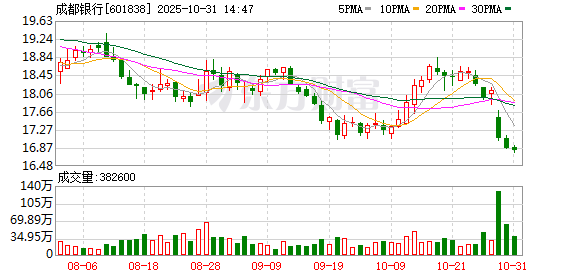
成都银行(601838):利息加速增长,做实资产质量指标
Changjiang Securities· 2025-10-31 05:12
Investment Rating - The investment rating for Chengdu Bank is "Buy" and is maintained [8]. Core Views - Chengdu Bank's revenue growth for the first three quarters is 3.0% year-on-year, with net profit growth of 5.0%. Net interest income has increased by 8.2%, reflecting rapid credit expansion and a narrowing interest margin. Non-interest income has decreased by 16.5% due to fluctuations in the bond market [2][6]. - The total assets have grown by 10.8% since the beginning of the year, with loans increasing by 14.2%, particularly in corporate loans. The non-performing loan ratio has risen by 2 basis points to 0.68%, while the attention rate has decreased by 7 basis points to 0.37%. The provision coverage ratio stands at 433%, down 20 percentage points but still at a high level [2][6]. - Looking ahead, the market share in credit is expected to continue rising in the medium to long term, and a stabilization and recovery in interest margins is anticipated to drive revenue growth upward [2]. Summary by Sections Financial Performance - Revenue growth for the first three quarters is 3.0% (H1: 5.9%, Q3: -2.9%), and net profit growth is 5.0% (H1: 7.3%, Q3: 0.2%). The non-performing loan ratio is 0.68%, with a provision coverage ratio of 433% [6][2]. Revenue Composition - Net interest income has accelerated by 8.2% (H1: 7.6%), driven by rapid credit expansion and a narrowing interest margin. Non-interest income has decreased by 16.5%, with investment income down by 13.0% due to bond market adjustments [11][2]. Asset Quality - The absolute levels of asset quality indicators remain excellent, with a non-performing loan ratio of 0.68% and a provision coverage ratio of 433%. The tightening of non-performing loan recognition standards is expected to stabilize asset quality metrics [11][2]. Investment Outlook - The bank's return on equity (ROE) remains competitive, and the dividend yield is attractive. The credit market share is expected to rise, and net interest margins are projected to stabilize, leading to improved revenue growth [11][2].
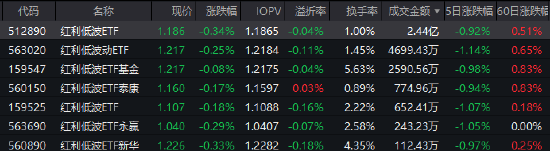
震荡市防御性更强!红利低波ETF(512890)近20个交易日资吸金超33亿
Xin Lang Ji Jin· 2025-10-31 04:09
Core Viewpoint - The three major indices experienced a decline, with the Shanghai Composite Index down by 0.63% and the ChiNext Index dropping over 1%, impacting the performance of the Dividend Low Volatility ETF (512890), which fell by 0.34% to 1.186 yuan [1][2]. Fund Performance - The Dividend Low Volatility ETF (512890) reported a trading volume of 2.44 billion yuan and a turnover rate of 1% [1][2]. - Over the past 10 trading days, the fund saw a net inflow of 1.15 billion yuan, with net inflows of 3.38 billion yuan over the past 20 days and 3 billion yuan over the past 60 days [2][3]. - As of October 30, 2025, the circulating scale of the Dividend Low Volatility ETF (512890) was 24.394 billion yuan [2]. Holdings and Market Trends - The top ten holdings of the Dividend Low Volatility ETF showed mixed performance, with notable declines in stocks like COFCO Sugar and Daqin Railway, while Nanjing Bank and Industrial Bank saw gains [3][4]. - The fund's strategy is positioned as a defensive measure amid changing market risk preferences, with a focus on infrastructure and stable growth sectors [5]. Investment Strategy - The Dividend Low Volatility ETF (512890) was established in December 2018 and has demonstrated stable historical performance, making it a potential tool for steady returns in asset allocation [5]. - Investors are encouraged to consider dollar-cost averaging and can access the fund through various share classes for those without stock accounts [5].
中国银行业 2025 年第三季度综述 - 第三季度核心经营趋势改善China Banks 3Q25 Wrap-3Q25 Improving Core Operating Trends
2025-10-31 01:53
Summary of China Banks 3Q25 Wrap Industry Overview - The report focuses on the banking sector in China, particularly the performance of state-owned enterprises (SOE) and shareholding banks in the third quarter of 2025 (3Q25) [1][6]. Key Points Core Operating Trends - Despite a decline in investment income, many banks reported improving net interest income (NII) growth and healthy fee income growth in 3Q25 [1][3]. - SOE banks experienced higher profit growth in 3Q25 compared to the first half of 2025, supported by stable credit quality [1][2]. - Ningbo and Agricultural Bank of China (ABC) outperformed peers with above-average trends in NII growth [1][2]. Net Interest Income (NII) and Net Interest Margin (NIM) - Most shareholding banks reported a rebound in NIM in 3Q25, aided by lower funding costs and prudent loan growth [2][11]. - Minsheng and SPDB achieved both quarter-on-quarter (QoQ) and year-on-year (YoY) NIM improvements, focusing on risk management rather than volume growth [2][12]. - Ningbo maintained the highest NII growth within the coverage, benefiting from market share gains and lower NIM pressure [2][11]. - SOE banks faced persistent NIM pressure due to increased growth in lower-yielding bond investments [2][12]. Fee Income Growth - Average fee income growth increased significantly from 1.4% YoY in 2Q25 to 11.1% in 3Q25, driven by capital market activities and strong insurance sales [3][16]. - Bank of Ningbo led with a remarkable 94% YoY growth in fee income, while ABC reported a 23.6% YoY increase [3][16]. - The overall fee income growth for SOE banks averaged 9.8% YoY, with several banks reporting double-digit growth [16][27]. Credit Quality and Non-Performing Loans (NPL) - Credit quality remained stable in 3Q25, with an average NPL ratio flat at 1.15% for covered banks [4][10]. - SOE banks reduced credit costs modestly to support profit growth, maintaining a high NPL coverage ratio of 263% on average [4][10]. Profit Growth - Covered banks reported modest profit growth of 1.9% YoY in 3Q25, with some banks exceeding consensus estimates [10][22]. - SPDB, Huaxia, and Citic led the profit rebounds among joint-stock banks (JSBs) with growth rates of 10.3%, 7.6%, and 3.5% YoY, respectively [22][23]. Investment Income and Revenue Trends - Revenue and pre-provision operating profit (PPOP) growth were affected by lower investment income due to higher bond yields [3][20]. - ABC and BoCom bucked the trend by reporting higher investment income, revenue, and PPOP, indicating strong investment capabilities [3][20]. Dividend Payouts - Several banks, including Minsheng, Citic, and regional banks like Ningbo, announced interim dividend payouts, reflecting confidence in their financial health [9]. Cost-Income Ratio - The average cost-income ratio increased modestly by 0.2 percentage points across banks, with some banks reporting improvements while others saw increases [21]. Future Outlook - Banks expect NIM pressure to moderate further, with ICBC guiding for a full-year NIM of 1.26%, down from 1.28% in 9M25 [13][15]. - Overall, banks are optimistic about continued profit growth and fee income performance in the upcoming quarters [17][18]. Conclusion - The banking sector in China showed signs of recovery in 3Q25, with improving core operating metrics, stable credit quality, and a rebound in fee income. However, challenges remain with NIM pressure and fluctuating investment income impacting overall revenue growth.