
上海家化

Search documents
化妆品板块9月17日跌0.24%,青松股份领跌,主力资金净流出1.05亿元
Zheng Xing Xing Ye Ri Bao· 2025-09-17 08:52
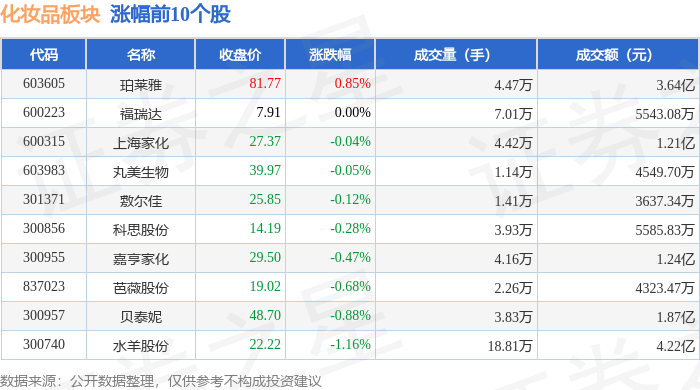
Market Overview - On September 17, the cosmetics sector declined by 0.24% compared to the previous trading day, with Qingsong Co. leading the decline [1] - The Shanghai Composite Index closed at 3876.34, up 0.37%, while the Shenzhen Component Index closed at 13215.46, up 1.16% [1] Individual Stock Performance - Notable stock performances in the cosmetics sector included: - Tian Cai Ya (603605) closed at 81.77, up 0.85% with a trading volume of 44,700 shares and a transaction value of 364 million [1] - Fu Rui Da (600223) remained unchanged at 7.91 with a trading volume of 70,100 shares [1] - Shanghai Jahwa (600315) closed at 27.37, down 0.04% with a trading volume of 44,200 shares [1] - Other stocks like Marubi (603983) and Beitaini (300957) also experienced slight declines of 0.05% and 0.88% respectively [1] Capital Flow Analysis - The cosmetics sector saw a net outflow of 105 million from institutional investors, while retail investors experienced a net inflow of 54.72 million [2] - The overall capital flow for individual stocks showed varied trends, with some stocks like Jia Heng Jia Hua (300955) experiencing significant net outflows from institutional investors [3] Detailed Capital Flow for Selected Stocks - Jia Heng Jia Hua (300955) had a net outflow of 13.34 million from institutional investors, while retail investors contributed a net inflow of 17.15 million [3] - Other stocks like Fu Rui Da (600223) and Shui Yang Co. (300740) also showed mixed capital flows, with institutional outflows and retail inflows [3]




化妆品板块9月16日涨0.03%,水羊股份领涨,主力资金净流出4320.22万元
Zheng Xing Xing Ye Ri Bao· 2025-09-16 08:52
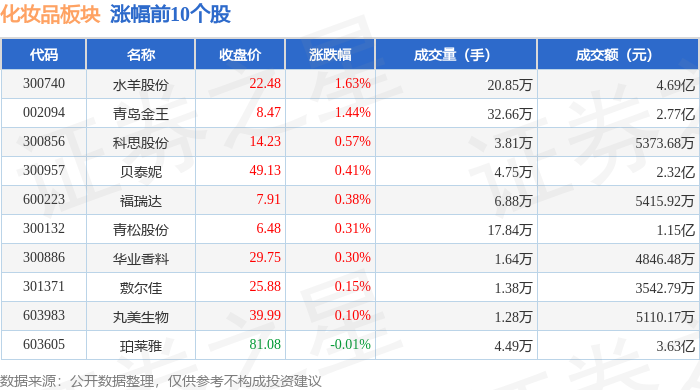
Market Overview - On September 16, the cosmetics sector rose by 0.03% compared to the previous trading day, with Shuiyang Co., Ltd. leading the gains [1] - The Shanghai Composite Index closed at 3861.87, up 0.04%, while the Shenzhen Component Index closed at 13063.97, up 0.45% [1] Individual Stock Performance - Shuiyang Co., Ltd. (300740) closed at 22.48, with a gain of 1.63% and a trading volume of 208,500 shares, amounting to a transaction value of 469 million yuan [1] - Qingdao Kingway (002094) closed at 8.47, up 1.44%, with a trading volume of 326,600 shares and a transaction value of 277 million yuan [1] - Other notable performers include: - Kezhou Co., Ltd. (300856) at 14.23, up 0.57% [1] - Beitaini (300957) at 49.13, up 0.41% [1] - Furuida (600223) at 7.91, up 0.38% [1] Fund Flow Analysis - The cosmetics sector experienced a net outflow of 43.2 million yuan from institutional investors, while retail investors saw a net outflow of 23.0 million yuan [2] - Conversely, speculative funds recorded a net inflow of 66.2 million yuan [2] Detailed Fund Flow for Key Stocks - Shuiyang Co., Ltd. (300740) had a net inflow of 41.1 million yuan from institutional investors, while retail investors faced a net outflow of 71.8 million yuan [3] - Qingdao Kingway (002094) saw a net inflow of 15.3 million yuan from institutional investors, but a net outflow of 7.2 million yuan from retail investors [3] - Other stocks with significant fund flow include: - Beitaini (300957) with a net inflow of 5.7 million yuan from institutional investors and a net outflow of 13.2 million yuan from retail investors [3] - Furuida (600223) faced a net outflow of 10.2 million yuan from institutional investors but a net inflow of 8.9 million yuan from retail investors [3]


被国产美妆集合店包围的丝芙兰
Bei Jing Shang Bao· 2025-09-15 13:25
Core Insights - The article highlights the contrasting growth trajectories of domestic beauty retail stores like HARMAY and the struggles of high-end beauty retailer Sephora in China, indicating a shift in consumer preferences towards affordable and experiential shopping options [1][5]. Company Performance - Sephora China reported a revenue decline, with total revenue for the first half of 2025 at 34.44 billion yuan, down 12.3% from 39.25 billion yuan in the same period of 2024, and a net loss of 1.2 billion yuan [3]. - In 2024, Sephora Shanghai generated 59.15 billion yuan in revenue with a net loss of 5.1 billion yuan, while Sephora Beijing had 12.25 billion yuan in revenue and a net loss of 1.36 billion yuan, leading to a combined revenue drop of 19% year-on-year [3][5]. Consumer Behavior - Young consumers are increasingly disinterested in shopping at Sephora, citing reasons such as poor service, aggressive sales tactics, and a preference for trying products before purchasing online [2][4]. - A survey on social media platform Xiaohongshu showed that 51% of respondents found it hard to say whether they liked shopping at Sephora, while 49% expressed a positive sentiment [2]. Market Competition - The decline of Sephora is attributed to external competition from emerging beauty retail stores that offer affordable prices and engaging shopping experiences, as well as internal challenges related to outdated business models [4][6]. - New beauty retail brands have gained popularity among young consumers, leading to a significant loss of market share for Sephora, which has seen nearly 30 brands exit its partnership in recent years [6]. Strategic Recommendations - Experts suggest that Sephora should balance its offerings by incorporating both international brands and local emerging brands to attract younger consumers seeking novelty and personalization [7]. - Sephora has initiated programs to support local high-end beauty brands, aiming to enhance its appeal and adapt to changing consumer preferences [7].
上海家化股东大会推行四个聚焦,重塑增长新动能
Hua Xia Shi Bao· 2025-09-15 09:32
Core Insights - Shanghai Jahwa held its 2024 annual shareholders' meeting, approving 14 proposals including the 2024 Board of Directors' work report and the 2025 employee stock ownership plan [1] - The company achieved a revenue of 5.679 billion yuan in 2024, with improvements in corporate governance and operational standards [1] - The meeting also approved a profit distribution plan for the first half of 2025, aiming to reward investors and enhance employee motivation through shared interests [1] Group 1: Strategic Focus and Brand Development - The company has completed four major tasks: defining direction, clarifying governance, boosting morale, and eliminating burdens, leading to a strategic transformation [2] - The focus is on core brands, brand building, online presence, and efficiency, with significant upgrades in product offerings across various brands [2] - The Yuze brand has strengthened collaborations with top hospitals, leading to comprehensive upgrades in brand image and product formulation [2] Group 2: Performance and Future Goals - The company's major brands achieved double-digit growth in online channels during the 618 shopping festival, attributed to strategic planning and operational efficiency [3] - The leadership emphasizes the importance of organizational capability and aims to create a high-performing team to drive future success [3] - The company plans to deepen reforms and focus on brand development, targeting double-digit revenue growth by 2025, which is seen as a pivotal year for the company [3]
化妆品板块9月15日跌0.18%,华业香料领跌,主力资金净流出8338.08万元
Zheng Xing Xing Ye Ri Bao· 2025-09-15 08:49
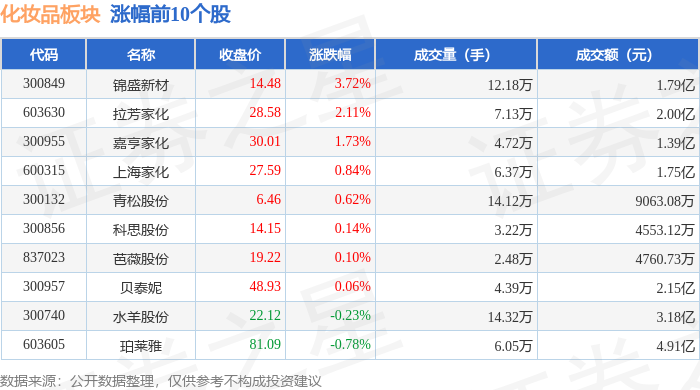
Market Overview - On September 15, the cosmetics sector declined by 0.18%, with Huaye Fragrance leading the drop [1] - The Shanghai Composite Index closed at 3860.5, down 0.26%, while the Shenzhen Component Index closed at 13005.77, up 0.63% [1] Individual Stock Performance - Notable gainers included: - Jinsong New Material (300849) with a closing price of 14.48, up 3.72% and a trading volume of 121,800 shares, totaling 179 million yuan [1] - Lafang Home (603630) closed at 28.58, up 2.11% with a trading volume of 71,300 shares, totaling 200 million yuan [1] - Notable decliners included: - Huaye Fragrance (300886) closed at 29.66, down 1.79% with a trading volume of 18,400 shares, totaling 55.05 million yuan [2] - Marubi Biological (603983) closed at 39.95, down 1.36% with a trading volume of 13,900 shares, totaling 55.49 million yuan [2] Capital Flow Analysis - The cosmetics sector experienced a net outflow of 83.38 million yuan from institutional investors, while retail investors saw a net inflow of 76.42 million yuan [2] - The overall capital flow for individual stocks showed: - Jinsong New Material had a net inflow of 18.50 million yuan from institutional investors, accounting for 10.31% of its total [3] - Huaye Fragrance had a net outflow of 4.23 million yuan from institutional investors, accounting for 6.58% of its total [3]


2025年中国功能性护肤品行业产品布局分析 “妆字号”产品矩阵不断拓展【组图】
Qian Zhan Wang· 2025-09-15 04:11
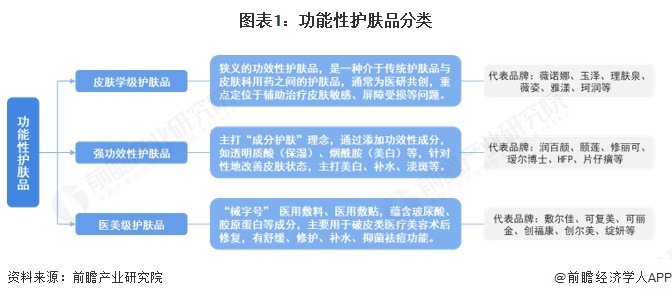
Core Viewpoint - The functional skincare industry in China is experiencing a rise of domestic brands, with products categorized into three main segments: dermatological skincare, high-efficacy skincare, and medical aesthetic skincare [1][2]. Group 1: Industry Overview - Functional skincare products are designed to alleviate or assist in treating specific skin issues, classified as either cosmetic (妆字号) or medical devices (械字号) [1]. - The industry is characterized by a growing presence of domestic brands, indicating a shift in market dynamics [1]. Group 2: Market Segmentation - The functional skincare market is divided into three segments: - Dermatological skincare, typically developed by cosmetic companies in collaboration with dermatologists, includes brands like Winona and La Roche-Posay [2]. - High-efficacy skincare, which emphasizes chemical ingredients, features brands such as WIS and HFP [2]. - Medical aesthetic skincare, developed by companies with a background in biomedicine or medical devices, includes brands like Fulejia and Kefu Mei [2]. Group 3: Product Composition - Dermatological skincare products focus on simplified and targeted ingredients, with examples like Winona's "Soothing Moisturizing Cream" containing ingredients such as sea buckthorn and hyaluronic acid [4]. - High-efficacy skincare products highlight active ingredients like niacinamide and salicylic acid [4]. - Medical aesthetic skincare products, such as those from Chuangfukang, contain fewer ingredients, focusing on essential components like collagen [4]. Group 4: Company Product Strategies - Companies in the functional skincare sector are diversifying their product lines, with many offering both cosmetic and medical device products [6]. - For instance, Betaini focuses on dermatological skincare while also extending into medical device products [6]. Group 5: Company Registration Data - Various companies have registered a significant number of products under both cosmetic and medical device categories, indicating a robust presence in the market: - Huaxi Biological has 1,766 cosmetic registrations and 27 medical device registrations [7]. - Fulejia has 3 cosmetic registrations and 110 medical device registrations [7].
美护行业2025年中报综述:化妆品行业增速企稳,盈利持续分化
Changjiang Securities· 2025-09-14 12:45
Investment Rating - The report maintains a "Positive" investment rating for the cosmetics industry [3] Core Insights - The cosmetics industry is experiencing stable growth with a slight improvement in growth rates, while profitability continues to show differentiation among companies [11][16] - The average revenue growth rate for the cosmetics industry in Q1 and Q2 of 2025 was -8.4% and -2.1%, respectively, indicating a slight improvement in the second quarter [16] - Online sales channels, particularly Tmall and Douyin, have shown a year-on-year growth of 13.1% in the first half of 2025, reflecting a recovery in consumer demand [11] Summary by Sections Cosmetics: Stable Growth and Business Adjustments - The cosmetics industry showed a year-on-year growth of 3.1% and 2.6% in Q1 and Q2 of 2025, respectively, with a significant improvement compared to the -1.1% growth in 2024 [11] - The industry is characterized by a slight improvement in growth rates, with the overall growth falling into a stable range [11] Revenue: Differentiation Among Brands - The average revenue growth for the brand segment was 0.4% and 6.5% in Q1 and Q2 of 2025, respectively, indicating stronger resilience compared to upstream and downstream segments [16] - Mid-sized brands like Maogeping and Shangmei have achieved good growth amidst a stable industry backdrop, while leading companies like Proya continue to grow steadily [16] Gross Margin Trends - The average gross margin for the brand segment increased by 1.6 percentage points in the first half of 2025, driven by improved business structures and effective price control by certain brands [21] - Specific brands like Water Sheep and Beitaini have seen significant improvements in gross margins due to product upgrades and price management strategies [21] Product Innovation: Focus on Core Series and Efficacy Expansion - Brands are focusing on upgrading core product lines and expanding efficacy categories, particularly in sunscreen and whitening, with increased competition expected [25] - New product launches include Proya's whitening series and Beitaini's anti-aging products, indicating a trend towards enhancing product offerings [25] Sales Expenses: Rising Industry Rates - The average sales expense ratio for brands in the first half of 2025 was 44.7%, reflecting a year-on-year increase of 1.7 percentage points, influenced by rising competition and platform costs [31] - The narrowing of gross sales margins indicates ongoing pressure on profitability across the industry [31]
锦盛新材:加强合规管理,促进公司健康、稳定和高质量发展
Zheng Quan Shi Bao Wang· 2025-09-12 12:49
Group 1 - The company received a warning letter from the Zhejiang Securities Regulatory Bureau due to issues related to the improper use of raised funds, failure to disclose related party transactions in a timely manner, and inaccuracies in periodic reports [1] - The company is committed to addressing the issues highlighted in the warning letter by enhancing internal compliance and improving the quality of information disclosure to protect shareholder interests [1] Group 2 - The company specializes in the research, production, and sales of cosmetic plastic packaging containers, with key products including cream jars and lotion bottles [2] - The company's IPO fundraising projects included a technical transformation project to increase production capacity by 15 million sets of cosmetic packaging containers and a new project to produce 45 million sets, utilizing funds of 92.22 million yuan and 200.63 million yuan respectively [2] - The company has fully utilized its IPO funds by the end of 2023, and all fundraising accounts have been closed [2] Group 3 - The company has established stable and long-term relationships with well-known cosmetic brands such as Estée Lauder and Shanghai Jahwa, leveraging its product quality and management capabilities to attract high-end clients [3] - The global cosmetic packaging market is projected to grow from 30.055 billion USD in 2024 to 36.206 billion USD by 2028, indicating strong growth potential driven by demand for personalized and high-end designs [3] - The rise of domestic brands through social e-commerce platforms like Douyin presents structural growth opportunities for domestic cosmetic packaging companies, which may further expand the company's development space as its fundraising projects come online [3]
美容护理行业今日跌1.52%,主力资金净流出2.28亿元
Zheng Quan Shi Bao Wang· 2025-09-12 11:57
Market Overview - The Shanghai Composite Index fell by 0.12% on September 12, with 9 out of the 28 sectors rising, led by non-ferrous metals and real estate, which increased by 1.96% and 1.51% respectively [1] - The communication and comprehensive sectors experienced the largest declines, down by 2.13% and 1.95% respectively [1] - Overall, there was a net outflow of 53.64 billion yuan in the main funds across the two markets, with 6 sectors seeing net inflows [1] Sector Performance - The non-ferrous metals sector had the highest net inflow of main funds, totaling 2.168 billion yuan, coinciding with its 1.96% increase [1] - The construction and decoration sector also saw a positive performance with a 0.96% rise and a net inflow of 721 million yuan [1] - In contrast, the non-bank financial sector had the largest net outflow, amounting to 8.138 billion yuan, followed by the electronics sector with a net outflow of 7.517 billion yuan [1] Beauty and Personal Care Industry - The beauty and personal care sector declined by 1.52% with a net outflow of 228 million yuan [2] - Out of 29 stocks in this sector, 5 rose while 24 fell [2] - The top three stocks with the highest net outflows included Aimeike, Shanghai Jahwa, and Proya, with outflows of 55.4558 million yuan, 51.6741 million yuan, and 38.7707 million yuan respectively [2][3] Fund Flow in Beauty and Personal Care - The top stock in terms of net inflow was Shuiyang Co., with an inflow of 12.3562 million yuan, followed by Zhongshun Jierou and Huaxi Biological, with inflows of 10.1629 million yuan and 7.6373 million yuan respectively [2][4] - The table of fund flow indicates that Aimeike had the largest outflow at -55.4558 million yuan, with a decline of 3.03% [3] - Other notable outflows included Shanghai Jahwa at -51.6741 million yuan and Proya at -38.7707 million yuan [3]



日化护肤半年报|华熙生物业绩双降存货周转效率下降、存货周转天数增至332天
Xin Lang Cai Jing· 2025-09-12 10:40
Core Insights - The skincare and daily chemical industry in A-share listed companies has shown improvement in inventory status as of the first half of 2025, with only 6 out of 14 selected companies experiencing an increase in inventory scale [1] - Among the selected companies, only 5 have inventory turnover days below 90 days, indicating potential inefficiencies in inventory management for the remaining 9 companies [1] - The inventory turnover efficiency indicators for the industry are concerning, with 6 companies showing prolonged inventory turnover days, which may suggest risks of product obsolescence or slow sales [1] Inventory Analysis - In the first half of 2025, the inventory situation improved for the skincare and daily chemical listed companies, with a notable increase in inventory scale for Jinbo Biological, which had the highest year-on-year growth [1] - Only 5 companies, including Jiaheng Home, Qingsong Co., Proya, Shanghai Jahwa, and Lafang, maintained inventory turnover days below 90, while the other 9 exceeded this threshold [1] - Companies such as Huaxi Biological and Jinbo Biological are among those with longer inventory turnover days, raising concerns about their inventory management practices [1] Market Implications - The prolonged inventory turnover days across several companies may indicate a longer time frame from production to sale, potentially leading to product expiration risks [1] - The overall inventory turnover efficiency in the skincare and daily chemical sector is not optimistic, highlighting a need for companies to improve their inventory management strategies [1]