
艾为电子

Search documents
显示芯片龙头,再闯科创板
3 6 Ke· 2025-08-07 01:45
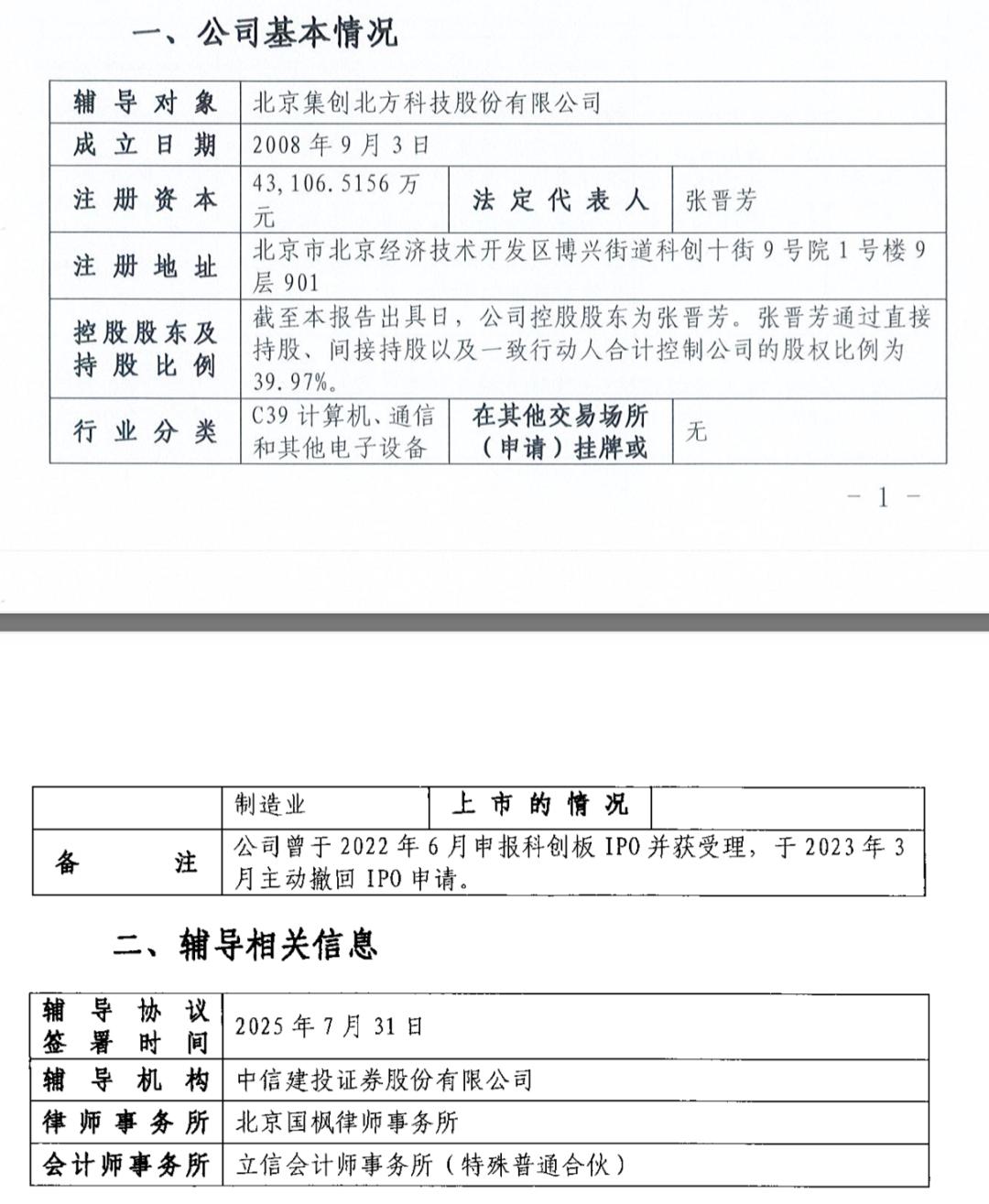
Core Viewpoint - Beijing Jichuang Beifang Technology Co., Ltd. (referred to as "Jichuang Beifang") has initiated the IPO counseling registration for the Sci-Tech Innovation Board on August 5, 2023, with CITIC Securities as the counseling institution. The company previously withdrew its IPO application in March 2023 after being accepted in June 2022, aiming to raise 60.10 billion yuan for various projects, including the development and industrialization of display touch integrated chips [1][3]. Company Overview - Jichuang Beifang was established on September 3, 2008, with a registered capital of 431.065156 million yuan. The company is primarily controlled by Zhang Jinfang, who holds a 39.97% stake through direct and indirect holdings [2][9]. - The company specializes in the research, design, and sales of display chips, having achieved leading market shares in various segments, including display driver chips and power management chips [5][6]. Market Position - Jichuang Beifang ranks first among Chinese manufacturers in the global smartphone LCD display driver chip and LCD/TDDI chip markets. It is also the second-largest in the large-size LCD panel display driver chip market in China [6]. - The company has been recognized as a national-level manufacturing champion and has participated in significant events such as the 70th anniversary of the victory in the War of Resistance, the 100th anniversary of the Communist Party, and the Beijing Winter Olympics [5][6]. Financial Performance - In 2021, Jichuang Beifang reported nearly 5.643 billion yuan in revenue and a net profit of 930 million yuan. The company's revenue has shown significant growth from 1.447 billion yuan in 2019 to 5.674 billion yuan in 2021 [8][7]. - The company's asset-liability ratio decreased from 39.40% in 2019 to 30.93% in 2021, indicating improved financial stability [8]. Investment and Shareholding - Jichuang Beifang has attracted investments from various notable institutions, including state-owned capital and private equity funds. Major shareholders include Beijing Yizhuang Strategic Emerging Industry Fund and other private equity firms [12][14]. - The company completed its E-round financing in 2021, raising 6.5 billion yuan, which significantly increased its valuation to 314.35 billion yuan [14]. Industry Comparison - Jichuang Beifang's peers in the A-share market, such as OmniVision Technologies and Geke Microelectronics, are also experiencing revenue and profit growth, indicating a positive trend in the display chip industry [16][17].

艾为电子: 艾为电子2025年第一次临时股东大会会议资料
Zheng Quan Zhi Xing· 2025-08-06 11:38
证券代码:688798 证券简称:艾为电子 上海艾为电子技术股份有限公司 2025 年第一次临时股东大会会议资料 上海艾为电子技术股份有限公司 Shanghai Awinic Technology Co., Ltd. 二〇二五年八月 上海艾为电子技术股份有限公司 2025 年第一次临时股东大会会议 资料 议案四:关于公司向不特定对象发行可转换公司债券方案论证分析报告的议案 ........ 20 议案五:关于公司向不特定对象发行可转换公司债券募集资金使用可行性分析报告的议案 议案六:关于公司截至 2025 年 6 月 30 日止前次募集资金使用情况报告的议案 ........ 22 议案七:关于公司向不特定对象发行可转换公司债券摊薄即期回报、采取填补措施及相关主 议案十一:关于提请股东大会授权董事会及其授权人士全权办理本次向不特定对象发行可转 上海艾为电子技术股份有限公司 2025 年第一次临时股东大会会议资料 上海艾为电子技术股份有限公司 为维护全体股东的合法权益,确保股东大会的正常秩序和议事效率,保证大 会的顺利进行,根据《中华人民共和国公司法》(以下简称"《公司法》")、 《中华人民共和国证券法》(以下 ...

艾为电子(688798) - 艾为电子2025年第一次临时股东大会会议资料
2025-08-06 11:15
上海艾为电子技术股份有限公司 2025 年第一次临时股东大会会议资料 证券代码:688798 证券简称:艾为电子 上海艾为电子技术股份有限公司 Shanghai Awinic Technology Co., Ltd. 2025 年第一次临时股东大会会议资料 二〇二五年八月 1 上海艾为电子技术股份有限公司 2025 年第一次临时股东大会会议资料 目录 | 上海艾为电子技术股份有限公司 2025 年第一次临时股东大会会议须知 3 | | --- | | 上海艾为电子技术股份有限公司 2025 年第一次临时股东大会会议议程 5 | | 议案一:关于公司符合向不特定对象发行可转换公司债券条件的议案 8 | | 议案二:关于公司向不特定对象发行可转换公司债券方案的议案 9 | | 议案三:关于公司向不特定对象发行可转换公司债券预案的议案 19 | | 议案四:关于公司向不特定对象发行可转换公司债券方案论证分析报告的议案 20 | | 议案五:关于公司向不特定对象发行可转换公司债券募集资金使用可行性分析报告的议案 | | 21 | | 议案六:关于公司截至 2025 年 6 月 30 日止前次募集资金使用情况报告的议案 ...
曾拟募资60亿,科创板IPO终止逾两年,京东方供应商重启上市辅导!中信建投担任辅导机构
Sou Hu Cai Jing· 2025-08-06 04:40
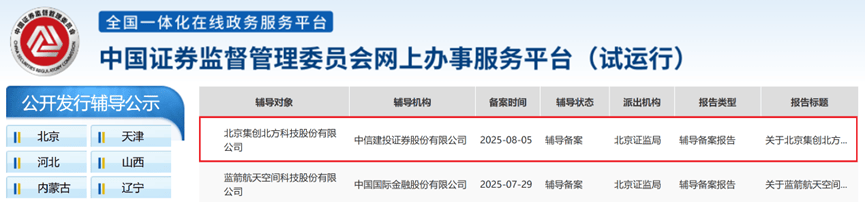
Core Viewpoint - Beijing Jichuang Beifang Technology Co., Ltd. has submitted its initial public offering (IPO) application for listing on the Sci-Tech Innovation Board, with the filing date recorded as August 5, 2025, and the advisory institution being CITIC Securities [1][2]. Group 1: Company Background - Beijing Jichuang Beifang was established in 2008 and focuses on the research, design, and sales of display chips, providing solutions for various display panels and screens [4]. - The company's main products include panel display driver chips, power management chips, LED display driver chips, control chips, and others [4]. - Major clients include BOE Technology Group, Huaxing Optoelectronics, HKC, Leyard, Absen, and LG Group [5]. Group 2: Financial Performance - The company's revenue for the years 2019, 2020, and 2021 was 144.74 million, 237.98 million, and 567.44 million yuan, respectively [4]. - The net profit attributable to the parent company for the same years was -15.38 million, 5.33 million, and 93.20 million yuan, showing a significant recovery in profitability [4]. - The company's operating cash flow for 2021 was 637.32 million yuan, indicating a strong cash generation capability [5]. Group 3: Previous IPO Attempt - In June 2022, the company had previously applied for an IPO on the Sci-Tech Innovation Board but withdrew its application in March 2023, leading to the termination of its review by the Shanghai Stock Exchange [4][6]. - The previous IPO fundraising plan included projects such as the development and industrialization of display touch integrated chips and OLED display driver chips, with a total intended fundraising amount of 6.01 billion yuan [6][7]. Group 4: Advisory and Support Institutions - The advisory agreement between CITIC Securities and Jichuang Beifang was signed on July 31, 2025, with additional support from Beijing Guofeng Law Firm and Lixin Certified Public Accountants [2][3].

散热革命:液冷吞噬风冷市场!华为微泵黑科技曝光,这些公司躺赢
材料汇· 2025-07-31 15:31
Core Viewpoint - The article emphasizes the critical role of thermal management in the performance and reliability of electronic devices, driven by increasing power density due to advancements in technologies like 5G, AI, and IoT. Effective heat dissipation solutions are essential to prevent device failures and ensure optimal operation [7][10][15]. Group 1: Thermal Density and Management - The rise in power density of electronic components necessitates advanced thermal management solutions, as temperature increases can significantly reduce system reliability [7][10]. - The failure rate of electronic components increases exponentially with temperature, with a 50% reduction in reliability for every 10°C increase [7][8]. - The thermal flow density has surged from under 10W/cm² to nearly 100W/cm², driven by both increased power and reduced chip sizes [11][15]. Group 2: Passive Cooling Solutions - Passive cooling methods, which do not use active components, include materials like metal heat sinks, graphite films, and heat pipes, relying on thermal interface materials (TIMs) to transfer heat away from components [23][26]. - Metal heat sinks are effective for low-power devices but face limitations in high-power applications due to their thermal transfer rates [28][31]. - Graphite films have been widely adopted in consumer electronics for their high thermal conductivity in the X-Y plane, although their Z-axis conductivity is limited [32][33]. Group 3: Active Cooling Solutions - Active cooling methods, such as forced air cooling and liquid cooling, are becoming necessary as device power levels increase beyond the capabilities of passive systems [68][69]. - Liquid cooling systems can achieve heat dissipation rates of 10-1000W/cm², significantly outperforming air cooling methods [73][74]. - Data centers are increasingly adopting liquid cooling solutions to manage the rising power density of servers, with some configurations exceeding 30kW per cabinet [80][81]. Group 4: Market Opportunities and Beneficiaries - Companies involved in the development of advanced thermal management solutions, such as VC (vapor chamber) technology and liquid cooling systems, are positioned to benefit from the growing demand for efficient heat dissipation in high-performance electronics [49][54]. - Key players in the market include companies like Feirongda, Suzhou Tianmai, and others that are innovating in thermal management technologies [5][6].




电子行业深度分析:被动散热材料持续迭代,液冷成为主动散热新增长点
Guotou Securities· 2025-07-31 05:06
Investment Rating - The report maintains an investment rating of "Outperform the Market - A" [7] Core Viewpoints - The report highlights that the increasing power density of electronic devices, driven by the proliferation of technologies such as 5G, AI, and IoT, is leading to significant thermal management challenges. The thermal flow density is approaching 100W/cm², necessitating advanced thermal management solutions to ensure system reliability [1][16][24]. Summary by Sections 1. Thermal Management Challenges - The report discusses the exponential increase in electronic component failure rates with rising temperatures, noting that a 10°C increase can lead to a 50% increase in failure rates [1][16]. - It emphasizes that traditional thermal management systems are nearing their physical limits, making the development of efficient thermal management solutions critical for the evolution of computing power [24]. 2. Passive Cooling Solutions - The report identifies limitations in traditional passive cooling methods, such as metal heat sinks and graphite materials, which struggle with heat transfer efficiency in high-density applications [2][33]. - Vapor Chamber (VC) technology is highlighted as a promising passive cooling solution due to its superior thermal conductivity and ability to meet the demands of increasingly compact electronic devices [2][33]. 3. Active Cooling Solutions - Liquid cooling is presented as a viable solution to overcome the limitations of forced air cooling, with applications in both cloud data centers and consumer electronics [3][4]. - The report notes that the liquid cooling market for data centers is projected to reach $9.231 billion by 2031, indicating significant growth potential [4]. 4. Market Size and Industry Chain - The global market size for VC technology is projected to be $1.089 billion in 2024, with substantial applications across consumer electronics and data centers [4]. - The report outlines the industry chain for VC technology, including upstream raw materials and production equipment, and downstream applications in various sectors [4]. 5. Beneficiary Companies - The report lists several companies that are expected to benefit from advancements in thermal management technologies, including Feirongda, Suzhou Tianmai, and others [5].
艾为电子拟募19亿加码芯片技术 五年投22.34亿研发抢占市场先机
Chang Jiang Shang Bao· 2025-07-31 00:05
Core Viewpoint - Aiwai Electronics (688798.SH) has announced a significant financing plan to raise up to 1.901 billion yuan through convertible bonds, primarily aimed at building a global R&D center and advancing research and industrialization in cutting-edge fields such as edge AI, automotive chips, and motion control chips [1][2]. Group 1: Financing and Investment Plans - The company plans to allocate 1.224 billion yuan, which is 64.39% of the total fundraising, to the global R&D center construction project [1][2]. - The R&D center will focus on specialized facilities such as reliability laboratories, haptic feedback laboratories, and optical anti-shake laboratories, covering three core product lines: high-performance mixed-signal chips, power management chips, and signal chain chips [2]. - The remaining funds will be directed towards projects for edge AI and supporting chip R&D (241 million yuan), automotive chip R&D (227 million yuan), and motion control chip R&D (209 million yuan) [2]. Group 2: R&D Investment and Personnel - Aiwai Electronics has committed a total of 2.234 billion yuan to R&D from 2020 to 2024, with a projected R&D personnel ratio of 64% and technical personnel ratio of 74% by the end of 2024 [1][3][6]. - The company has achieved significant technological advancements, including becoming the first domestic company to mass-produce optical image stabilization (OIS) technology [6]. - As of the end of 2024, Aiwai Electronics holds 412 invention patents, 232 utility model patents, and 5 design patents, along with 125 software copyrights and 595 integrated circuit layout registrations [6]. Group 3: Financial Performance - The company reported revenues of 2.327 billion yuan in 2021, 2.09 billion yuan in 2022, and 2.531 billion yuan in 2023, with a net profit of 288 million yuan, -53.38 million yuan, and 510.1 million yuan respectively [4]. - In 2024, Aiwai Electronics achieved a record revenue of 2.933 billion yuan, a year-on-year increase of 15.88%, and a net profit of 255 million yuan, a substantial increase of 400% [5]. - The gross margin for 2024 reached 30.43%, up by 5.58 percentage points compared to the previous year [5].
热管理之端侧行业深度:主动散热释放端侧AI无限潜力
NORTHEAST SECURITIES· 2025-07-30 07:55
Investment Rating - The report maintains an "Outperform" rating for the heat management industry, driven by the slowdown of Moore's Law and the rise of edge AI applications [1]. Core Insights - The heat management industry is undergoing significant upgrades due to the deceleration of Moore's Law and the explosive growth in cloud computing power demands, leading to increased pressure on thermal management solutions for edge AI applications [1][2]. - Passive cooling methods are nearing their physical limits, prompting a shift towards active cooling technologies in mobile devices [3][4]. Summary by Sections 1. Moore's Law Slowdown and Edge AI Iteration - The growth rate of transistor density has significantly slowed, with the compound annual growth rate (CAGR) dropping to single digits for processes below 5nm, indicating the gradual failure of Moore's Law [19][20]. - As performance demands increase, the power consumption per unit area of chips is rising, necessitating enhanced thermal management solutions [24][25]. - The limitations of passive cooling methods are becoming evident, as the area of vapor chambers (VC) is increasing while material iterations are slowing down [43][44]. 2. Transition to Active Cooling Technologies - The industry is expected to enter an active cooling era, with technologies like micro-pump liquid cooling and micro fans becoming more prevalent [3][4]. - By 2030, it is projected that the penetration rate of active cooling in smartphones will reach 30%, with a market size of approximately 20 billion yuan [3][4][75]. 3. Investment Highlights and Beneficiary Segments - Active cooling technologies are anticipated to unlock the full potential of edge AI applications, with significant benefits for companies involved in the thermal management supply chain [4][4]. - Key players in the thermal management module sector include Feirongda, Suzhou Tianmai, and Zhongshi Technology, while chip-related companies include Aiwei Electronics and Nanchip Technology [4][4].


艾为电子获融资买入0.29亿元,近三日累计买入0.74亿元
Jin Rong Jie· 2025-07-30 00:51
Core Viewpoint - The financing activities of Aiwei Electronics indicate a modest interest from investors, with a slight net buying position over recent trading days [1] Financing Summary - On July 29, Aiwei Electronics had a financing buy amount of 0.29 billion, ranking 708th in the market, with a financing repayment amount of 0.28 billion, resulting in a net buy of 29.66 thousand [1] - Over the last three trading days (July 25-29), the financing buy amounts were 0.21 billion, 0.24 billion, and 0.29 billion respectively, showing a gradual increase [1] Securities Lending Summary - On the same day, the company had a securities lending sell of 0.02 thousand shares and a net buy of 0.04 thousand shares, indicating a slight interest in short selling [1]
艾为电子发布2025-2027年股东分红回报规划
Jing Ji Guan Cha Wang· 2025-07-29 12:20
此外,公司可根据经营状况适时实施股票分红,并确保利润分配方案兼顾股东短期利益与长期发展。利 润分配决策需经董事会、审计委员会及股东大会审议,并充分听取中小股东意见。该规划自股东大会审 议通过后生效,后续调整需履行相应程序。(编辑胡群) 经济观察网上海艾为电子技术股份有限公司董事会7月27日发布未来三年(2025年—2027年)股东分红回 报规划。根据规划,公司将优先采用现金分红方式,在满足可分配利润为正、现金流充裕等条件下,每 年现金分红比例不低于可分配利润的10%。同时,公司将结合发展阶段、资金需求等因素,差异化设定 现金分红比例,成熟期企业现金分红占比最高可达80%。 ...