
芯源微

Search documents
解密主力资金出逃股 连续5日净流出490股





Zheng Quan Shi Bao Wang· 2025-10-29 09:03
Core Insights - A total of 490 stocks in the Shanghai and Shenzhen markets have experienced net outflows of main funds for five consecutive days or more as of October 29 [1] - The stock with the longest continuous net outflow is Zhongju Gaoxin, with 31 days of outflows, followed by Hengshen New Materials with 21 days [1] - The largest total net outflow amount is from China Merchants Bank, with a cumulative outflow of 3.093 billion yuan over 12 days [1] Group 1: Stocks with Longest Net Outflows - Zhongju Gaoxin has seen net outflows for 31 days, with a total outflow of 559 million yuan and a cumulative decline of 6.91% [1] - Hengshen New Materials has recorded net outflows for 21 days, totaling 197 million yuan, with a decline of 9.80% [3] - China Merchants Bank has the highest net outflow amount of 3.093 billion yuan over 12 days, with a net outflow ratio of 6.98% and a cumulative increase of 1.65% [1] Group 2: Other Notable Stocks - Guotai Junan has experienced net outflows for 10 days, amounting to 1.877 billion yuan, with a net outflow ratio of 7.89% and a cumulative increase of 2.70% [1] - Shengbang Co. has seen net outflows for 12 days, totaling 1.826 billion yuan, with a net outflow ratio of 9.52% and a cumulative decline of 10.65% [1] - Huajian Group has recorded net outflows for 6 days, with a total outflow of 1.713 billion yuan and a significant decline of 40.29% [1] Group 3: Stocks with Significant Outflow Ratios - Jianan Intelligent has the highest net outflow ratio at 14.74%, with a decline of 2.98% over the past 5 days [1] - Other notable stocks with high outflow ratios include Huayi Development at 11.91% and Pianzaihuang at 11.84% [1] - The overall trend indicates a significant outflow of funds from various sectors, reflecting investor sentiment and market conditions [1]
最高大涨15倍 “易主”题材火了(附股)
Zheng Quan Shi Bao Wang· 2025-10-28 05:30
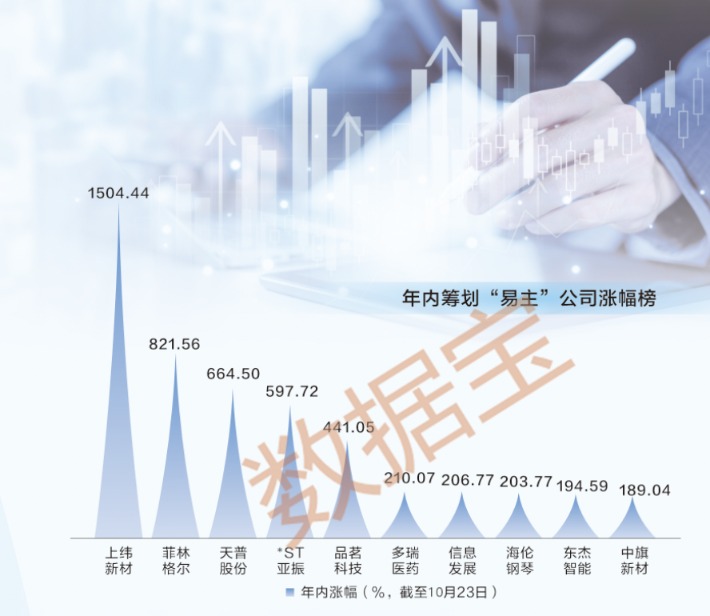
Core Viewpoint - The number of control right changes in A-share listed companies has significantly increased this year, reaching a record high, driven by policy support and market demand [1][2]. Group 1: Current Status of Control Right Transactions - As of October 23, 2025, 112 listed companies have announced control right changes, marking the highest number in history [2]. - The stock prices of companies involved in control right transactions have surged, with 22 companies doubling their stock prices this year [2]. - Notable examples include Shangwei New Materials, which saw its stock price increase over 13 times after announcing a control right change [4][5]. Group 2: Characteristics of Control Right Transactions - A significant proportion of companies involved in control right changes are small-cap firms, with nearly 70% having a market value below 5 billion [7]. - Many of these companies have poor performance and high debt levels, with approximately 52% expected to report losses in 2024 and a median debt ratio of around 42% [9]. - Private enterprises dominate the control right transactions, accounting for nearly 76% of the cases [9]. - The majority of control right changes are concentrated in economically developed regions, with Jiangsu, Guangdong, and Zhejiang being the hotspots [11]. Group 3: New Features of Control Right Transactions - The acquirers in this wave of control right changes are more diverse, including state-owned enterprises, private companies, and private equity [11]. - The methods of control right transfer have become more flexible, with over 60% of transactions in the first half of 2025 using innovative arrangements like voting rights delegation [12]. - Transactions aimed at industrial synergy are becoming mainstream, with many companies benefiting from new controlling shareholders' resources and expertise [12]. - The efficiency of control right changes has improved, with a median time of only 75 days from planning to completion [12]. Group 4: Investment Opportunities - Investors should focus on whether new controlling shareholders can transform the companies and enhance their operational performance through capital operations or industrial synergy [14]. - Successful examples include companies like Shangwei New Materials and *ST Yazhen, which have seen significant improvements in their fundamentals post-acquisition [14][15]. - The collaboration between new controlling shareholders and existing companies can lead to substantial growth in performance and valuation [15].


最高大涨15倍,“易主”题材火了(附股)
Zheng Quan Shi Bao Wang· 2025-10-28 05:09
Core Viewpoint - The number of control right changes in A-share listed companies has reached a record high in 2025, driven by policy support and market demand, with over 112 cases reported by October 23, 2025 [1][2]. Group 1: Control Right Change Statistics - The number of control right changes has significantly increased, with 112 companies involved, marking the highest annual total in history [2]. - In 2020, the number of control right changes reached 100, and since then, the annual count has consistently exceeded 60 [2]. - Among companies planning control right changes, 22 have seen their stock prices double this year, with five of the top ten gainers involved in such transactions [2]. Group 2: Characteristics of Control Right Changes - A majority of the companies involved in control right changes are small-cap firms, with nearly 70% having a market capitalization below 5 billion [4]. - Many of these companies have poor performance, with approximately 52% expected to report losses in 2024 and a median debt ratio of around 42% [5]. - Private enterprises dominate the control right changes, accounting for about 76% of the cases, with 85 private companies involved [6]. - The most active regions for these transactions are economically developed areas, particularly Jiangsu, Guangdong, and Zhejiang [6]. Group 3: New Features in Control Right Changes - The acquisition subjects have become more diverse, with private capital playing a significant role, participating in 65 cases (60.19%) compared to 43 cases (39.81%) by state-owned enterprises [7]. - The methods of control right changes have become more flexible, with over 60% of cases in 2025 utilizing "agreement transfer + voting rights waiver" [7]. - Control right changes aimed at industrial synergy are increasingly common, benefiting companies like Qidi Pharmaceutical and Sanjia Technology [7][8]. Group 4: Impact on Company Performance - New controlling shareholders often bring transformative changes, injecting new vitality into companies, as seen with companies like Upway New Materials [9]. - Companies like *ST Yazhen have successfully pivoted to new industries post-control change, leading to significant stock price increases [10]. - The collaboration between new shareholders and existing companies can enhance operational efficiency and drive long-term growth, as demonstrated by North China Huachuang's acquisition of Chip Source Micro [10]. Group 5: Future Considerations for Investors - Investors should focus on the operational plans of new controlling shareholders post-acquisition, as effective capital operations can lead to rapid performance improvements [11]. - Successful control right changes have historically resulted in sustained stock price increases and improved performance metrics for companies involved [11].
沐曦股份科创板正式过会,科创100指数ETF(588030)探底回升,唯捷创芯领涨
Xin Lang Cai Jing· 2025-10-28 02:23
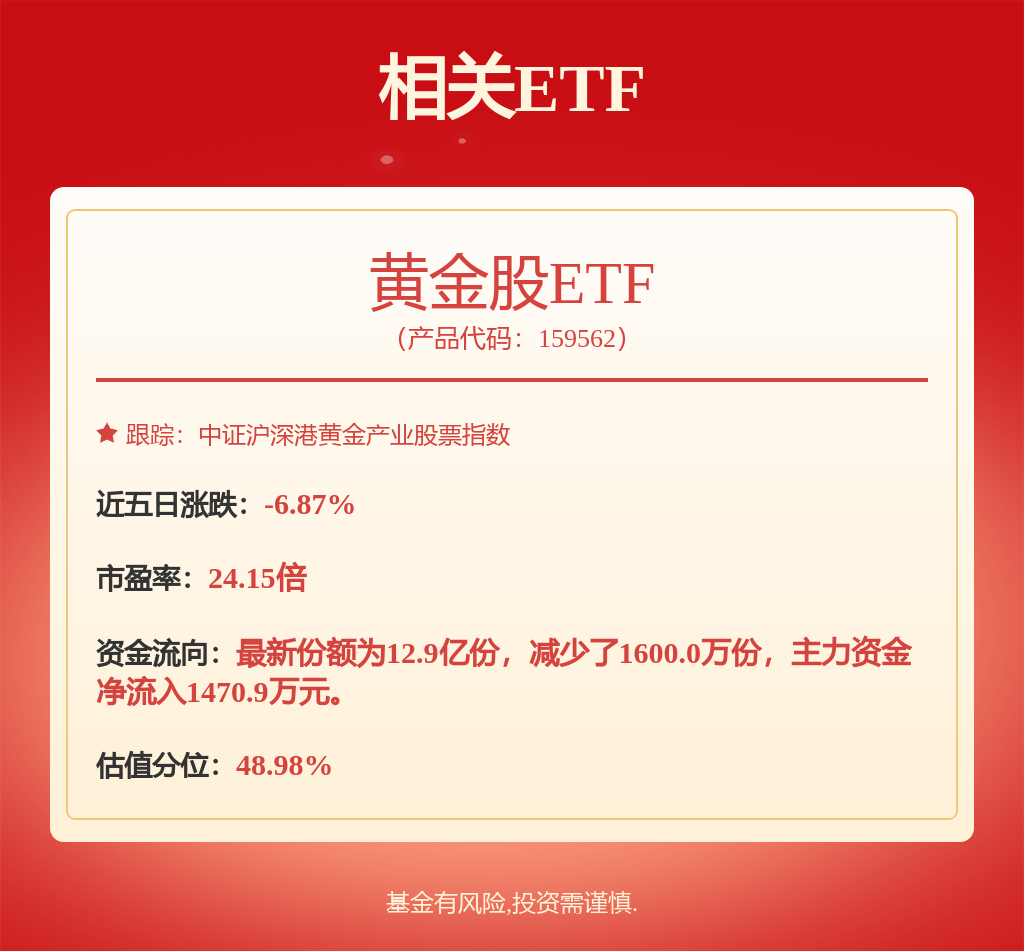
Group 1: Market Performance - The Shanghai Stock Exchange Sci-Tech Innovation Board 100 Index decreased by 0.02% as of October 28, 2025, with mixed performance among constituent stocks [3] - The leading stock, Weichuangxin, rose by 6.40%, while Huafeng Technology fell by 6.80% [3] - The Sci-Tech 100 Index ETF (588030) showed a recent price of 1.36 yuan, with a weekly increase of 5.58% as of October 27, 2025, ranking 2nd among comparable funds [3] Group 2: Industry Developments - Domestic GPU manufacturer Muxi Co., Ltd. has received approval for its IPO on the Sci-Tech Innovation Board [4] - A breakthrough in photoresist technology was achieved by a team from Peking University, enabling high-resolution lithography compatible with wafer fabs [4] - Samsung Electronics and SK Hynix have raised DRAM and NAND flash prices by up to 30%, indicating an acceleration of the storage chip "super cycle" [4] Group 3: Robotics Sector - Lingyi Zhizao has formed large-scale orders in the robotics field, providing mass production services and recently securing over a hundred assembly orders from leading clients [5] - The company’s "Linglong" robot won dual championships at the World Humanoid Robot Sports Competition, indicating successful technology commercialization [5] Group 4: Investment Insights - Investment focus in humanoid robotics should be on three areas: technological breakthroughs, application scenarios, and global layout [6] - The industry is expected to exhibit characteristics of hardware standardization, software intelligence, and fragmented scenarios, with companies capable of full-chain innovation leading growth [6] Group 5: ETF Information - The latest scale of the Sci-Tech 100 Index ETF reached 6.022 billion yuan, ranking 2nd among comparable funds [7] - The ETF closely tracks the Sci-Tech 100 Index, which selects 100 medium-sized and liquid securities from the Sci-Tech Innovation Board [8] - As of September 30, 2025, the top ten weighted stocks in the index accounted for 24.32% of the total [8]

筹划控制权易主数量创纪录 产业协同资本赋能 重构上市公司价值
Zheng Quan Shi Bao· 2025-10-27 22:14
Core Viewpoint - The number of control right transfers among listed companies in the A-share market has significantly increased this year, exceeding 100 cases, driven by policy support and market demand [1][2] Group 1: Current Status of Control Right Transactions - The number of control right transactions has reached a historical high, with 112 companies involved as of October 23, 2025 [2] - A significant portion of companies undergoing control right changes are small-cap firms, with nearly 70% having a market value below 5 billion [4] - Many companies involved in control right transactions have poor performance and high debt levels, with approximately 52% expected to report losses in 2024 [4] - Private enterprises dominate the control right transactions, accounting for nearly 76% of the cases [4] Group 2: Characteristics of Recent Transactions - The acquirers in recent control right transactions are more diverse, including state-owned enterprises, private companies, and private equity [5] - The methods of control right transfer have become more flexible, with over 60% of transactions in the first half of 2025 using innovative arrangements like voting rights delegation [5] - Transactions aimed at industrial synergy are becoming mainstream, with many companies expected to benefit from new controlling shareholders [5][6] Group 3: Impact on Company Performance - New controlling shareholders often bring significant transformation and revitalization to companies, leading to substantial stock price increases [7] - Successful examples include companies like Upwind New Materials and *ST Yazhen, which have seen dramatic stock price increases following control right changes [7][8] - The efficiency of control right transactions has improved, with the median time from planning to completion being only 75 days this year [6] Group 4: Investment Opportunities - Investors should focus on whether new controlling shareholders can change the company's situation and drive high-quality development through capital operations or industrial synergy [7] - Successful cases of control right transactions have led to sustained stock price increases and improved performance, indicating a potential win-win scenario for investors and companies [8][9]
筹划控制权易主数量创纪录产业协同资本赋能 重构上市公司价值
Zheng Quan Shi Bao· 2025-10-27 18:17
Core Viewpoint - The number of control right transfers among listed companies in the A-share market has significantly increased this year, exceeding 100 cases, driven by policy support and market demand [1][2] Group 1: Current Market Trends - The number of control right transactions has reached a historical high of 112 cases as of October 23, 2025, with a notable increase since 2020 [2] - 22 companies involved in control right transactions have seen their stock prices double this year, with five of the top ten gainers related to control right changes [2] - Small-cap companies dominate the control right transactions, with nearly 70% having a market value below 5 billion yuan before the announcements [4] Group 2: Company Characteristics - Companies undergoing control right changes generally exhibit poor performance, with approximately 52% expected to incur losses in 2024 and a median debt ratio of around 42% [4] - Private enterprises are the main players in control right transactions, accounting for nearly 76% of the cases, with 85 private companies involved [4] Group 3: Transaction Dynamics - The current wave of control right transactions features a more diverse range of acquirers, including state-owned enterprises, private companies, and private equity [5] - Innovative transaction methods are increasingly common, with over 60% of control right changes in the first half of 2025 utilizing "agreement transfer + voting rights waiver" models [5] Group 4: Impact on Company Development - New controlling shareholders often bring significant transformation and revitalization to companies, leading to substantial changes in fundamentals, as seen with companies like Upwind New Materials [7][8] - Successful control right changes can enhance operational performance and financial metrics, exemplified by companies like Zhaojin Mining and its improved revenue and profit figures [8]
科创半导体ETF鹏华(589020)涨超3.8%,光刻胶领域取得新突破
Xin Lang Cai Jing· 2025-10-27 02:29
Group 1 - The core viewpoint of the news highlights a significant advancement in the photolithography technology, which is crucial for the continuous miniaturization of integrated circuit chip manufacturing. A research team led by Professor Peng Hailin from Peking University has successfully utilized cryo-electron tomography to analyze the three-dimensional structure, interfacial distribution, and entanglement behavior of photoresist molecules in a liquid phase environment, leading to a new industrialization scheme that significantly reduces photolithography defects [1] - The current landscape of China's photoresist industry is characterized by a "multi-point blooming, tiered breakthrough" pattern, as noted by Changjiang Securities. The industry is supported by three main logics: continuous market expansion, vast potential for domestic substitution, and technological breakthroughs that address industrialization bottlenecks, alongside a dual drive from policy and demand, indicating the industry is entering a period of benefit release [1] - The Chinese photoresist industry is transitioning from a "technological breakthrough phase" to a "scale-up release phase" and a "profitability realization phase" [1] Group 2 - As of October 27, 2025, the Shanghai Stock Exchange Sci-Tech Innovation Board Semiconductor Materials and Equipment Theme Index (950125) has surged by 3.80%, with notable increases in constituent stocks such as Aisen Co., Ltd. (688720) rising by 11.45%, Tuojing Technology (688072) by 6.57%, and Zhongwei Company (688012) by 5.36% [1] - The Penghua Sci-Tech Semiconductor ETF closely tracks the performance of the Shanghai Stock Exchange Sci-Tech Innovation Board Semiconductor Materials and Equipment Theme Index, which includes listed companies involved in semiconductor materials and equipment [2] - As of September 30, 2025, the top ten weighted stocks in the Shanghai Stock Exchange Sci-Tech Innovation Board Semiconductor Materials and Equipment Theme Index account for 74.36% of the index, including companies like Zhongwei Company (688012) and Huahai Qingke (688120) [2]
鹏华基金苏俊杰旗下鹏华上证科创板100ETF三季报最新持仓,重仓华虹公司
Sou Hu Cai Jing· 2025-10-26 21:39
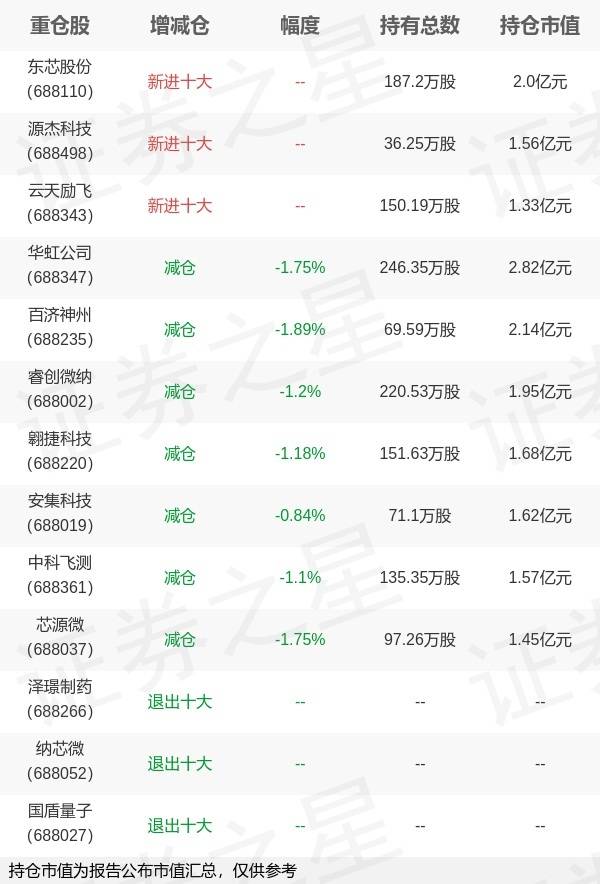
Group 1 - The core viewpoint of the article highlights the performance of the Penghua Science and Technology Innovation 100 ETF, which reported a net value growth rate of 49.82% over the past year [1] - The fund's top ten holdings have seen changes, with new additions including Dongxin Co., Ltd., Yuanjie Technology, and Yuntian Lefe [1] - Huahong Technology remains the largest holding at 3.74% of the fund's portfolio, while Zexing Pharmaceutical, Naxin Micro, and Guodun Quantum have exited the top ten holdings [1] Group 2 - Detailed data on the fund's top holdings shows that Dongxin Co., Ltd. has entered the top ten with 1.872 million shares valued at 200 million yuan, and Yuanjie Technology has also entered with 362,500 shares valued at 156 million yuan [1] - Other notable changes include a reduction in holdings for Huahong Technology by 1.75%, with 2.4635 million shares valued at 282 million yuan, and a decrease in holdings for Baijie Shenzhou by 1.89% [1] - The fund's overall strategy reflects a shift in focus towards emerging technology companies, as indicated by the new additions and reductions in existing holdings [1]




市场风格悄然切换基金重仓股“由小变大”
Zheng Quan Shi Bao· 2025-10-26 17:41
Core Viewpoint - The A-share market is experiencing a style shift from small-cap to large-cap stocks, driven by macroeconomic stabilization and a focus on performance certainty amid rising risk aversion [1][2][6]. Group 1: Market Performance - The Shanghai Stock Exchange 50 Index has risen by 4.33% in the past month, reaching a new high for the year, while the CSI 2000 Index and the North Exchange 50 Index have declined by 6.77% and 0.25%, respectively, indicating a market style switch [1][2]. - Since the "9·24 market" in 2024, the CSI 2000 Index had previously outperformed the SSE 50 Index by 109.65%, but recently it has underperformed by approximately 5 percentage points [2]. Group 2: Fund Manager Insights - Fund managers believe that the current market conditions are prompting a shift towards larger market capitalization stocks due to the pursuit of performance certainty and heightened risk aversion [1][3]. - Recent dividend announcements from several small-cap funds reflect fund managers' intentions to lock in profits, with notable distributions such as 0.87 yuan per 10 shares from the Jianxin CSI 1000 Index Enhanced A fund and 4 yuan per 10 shares from the Wanji North Exchange Selected fund [2]. Group 3: Liquidity and Market Dynamics - The liquidity cycle in the A-share market is characterized by four stages, with the current phase likely being the end of the initial expansion stage, suggesting a potential return to large-cap stocks as institutional funds enter the market [3][6]. - The market has seen a "dumbbell structure" where funds have concentrated on either low-valuation large-cap stocks or small-cap stocks, leaving mid-cap stocks under pressure [3]. Group 4: Fund Positioning - Many high-performing funds are transitioning their holdings from small-cap to large-cap stocks, reflecting a broader trend of "shifting from small to large" [4][5]. - For instance, the Yongying Technology Smart Selection fund has shifted its focus from small-cap growth stocks to larger growth stocks, indicating a significant change in investment strategy [4]. Group 5: Institutional Factors - Institutional changes, such as the upcoming new regulations on performance benchmarks for public funds, are expected to reinforce the trend towards large-cap stocks [6]. - The valuation of large-cap stocks, particularly the CSI 300 Index, shows that they are undervalued with a PE and PB rolling 5-year percentile of 42.85% and 40.12%, respectively, suggesting strong defensive characteristics [6].
科创100ETF基金(588220)上涨3%,政策全面实施“人工智能+”行动
Xin Lang Cai Jing· 2025-10-24 06:52
Core Insights - The Shanghai Stock Exchange Sci-Tech Innovation Board 100 Index (000698) has shown strong performance, with significant increases in constituent stocks such as Huahong Semiconductor (688347) up 15.16%, Zhongjuxin (688549) up 11.18%, and Zhuhai Guanyu (688772) up 9.27% [1] - The Ministry of Science and Technology has emphasized accelerating innovation in artificial intelligence and digital technologies, implementing the "AI+" initiative to empower various industries [1] - Guotai Junan Securities highlighted a strategic deployment for the 14th Five-Year Plan period, indicating a shift from "catching up" to "leading" in technology goals, with a focus on advanced manufacturing and quality services [1] Company and Industry Summary - The Sci-Tech Innovation Board 100 Index is composed of 100 medium-sized and liquid securities selected from the Sci-Tech Innovation Board, reflecting the overall performance of different market capitalization companies [2] - As of September 30, 2025, the top ten weighted stocks in the Sci-Tech Innovation Board 100 Index accounted for 24.32% of the index, including Huahong Semiconductor (688347), BeiGene (688235), and Dongxin Technology (688110) [2] - The Sci-Tech 100 ETF (588220) closely tracks the performance of the Sci-Tech Innovation Board 100 Index, along with other ETFs such as the Sci-Tech 50 ETF (588040) and the Sci-Tech 200 ETF (588240) [2]