青岛银行

Search documents
银行直售房,没那么吓人
Ge Long Hui· 2025-11-12 10:55
Core Insights - The recent surge in banks selling properties has raised concerns about the accumulation of non-performing assets within the banking sector [1][2][4] - Data indicates that the number of properties listed for sale by various rural credit systems is substantial, with Guangdong, Sichuan, and other provinces showing significant figures [1][2][6] - Despite the high number of properties being sold, they represent a small fraction of the overall housing inventory in major cities like Guangzhou, Shenzhen, and Chengdu [6][11][9] Summary by Sections Property Sales Data - Since August 2024, the Guangdong rural credit system has listed 12,386 properties for sale, while the Sichuan rural credit system has listed 24,821 properties since November 2024 [1] - Other provinces such as Liaoning, Guizhou, Jilin, and Fujian have also contributed to the total number of properties being sold [1] Market Reaction - The market has reacted with surprise, speculating that banks may be facing a significant amount of non-performing assets [2][4] - The perception is that the properties being sold are just the tip of the iceberg, indicating a larger issue with banks needing to liquidate assets [2] Non-Performing Loans and Asset Management - The sale of properties is often linked to borrowers' inability to repay loans, leading banks to reclaim and sell these assets [3] - The current data suggests that the number of properties being sold is relatively small compared to the total inventory of second-hand homes available in the market [6][11] Trends in Non-Performing Loan Rates - The overall non-performing loan rates for listed banks have been declining since 2020, indicating that banks have been effectively managing and disposing of non-performing assets [12][13] - As of November 2025, the non-performing loan rates for various banks show a downward trend compared to previous years, with many banks reporting lower rates than in 2020 [12][13] Industry Restructuring - The banking sector has undergone significant reforms and consolidations, with over 300 rural banks being merged or restructured in 2025 alone [15] - Major banks have also participated in these consolidations, indicating a strategic move to strengthen their positions and manage non-performing assets more effectively [15] Asset Disposal Efforts - Banks have been actively disposing of non-performing assets, with significant amounts being processed each year [18][20] - In 2025, banks disposed of 1.5 trillion yuan in non-performing assets, reflecting a proactive approach to managing risk [20] - The rural commercial banks have seen the highest non-performing loan rates but have also experienced the most significant reductions in these rates over the years [21][22]


青岛银行落地银行间标准债券远期和标准利率互换交易及清算业务
Xin Hua Cai Jing· 2025-11-12 10:00
"依托中国外汇交易中心的X-Swap交易系统和上海清算所的中央对手清算机制,标准化利率衍生品合约 高度标准化和交易清算一体化,显著提升交易与清算效率;中央对手清算模式大幅降低对手方风 险。"相关人士介绍称,结合两家金融市场基础设施的市场辐射力与优势,市场主体有望进一步提升标 准化利率衍生品的交易透明度与市场流动性。 编辑:王菁 据了解,青岛银行作为银行间本币市场活跃交易机构,此次业务落地对其运用利率衍生品进行风险管理 具有重要意义。一方面,助力精准管理利率债券及同业存单的利率风险,完善债券交易类业务产品体 系,同时与现券市场紧密联动,有效促进价格发现。另一方面,深化与上海清算所及中国外汇交易中心 等金融市场基础设施的合作,夯实市场参与根基,提高自身服务实体经济效能,为金融市场高质量发展 贡献力量。 新华财经北京11月12日电 近日,青岛银行落地银行间标准债券远期和标准利率互换交易及清算业务, 积极参与银行间利率衍生品创新业务,持续丰富其利率风险管理工具箱。 ...
西安银行青岛银行杭州银行南京银行逆银行板块飘绿
Zhong Guo Jing Ji Wang· 2025-11-12 09:14
Group 1 - The core viewpoint of the article highlights the performance of several banks in the market, specifically noting their stock prices and percentage declines for the day [1] - Xi'an Bank closed at 4.11 yuan, experiencing a decline of 0.72% [1] - Qingdao Bank closed at 5.08 yuan, with a decrease of 0.59% [1] - Hangzhou Bank's stock price was 16.15 yuan, down by 0.43% [1] - Nanjing Bank closed at 11.59 yuan, also seeing a drop of 0.43% [1] - The banking sector overall saw a slight increase of 0.28%, despite the declines of the mentioned banks [1]


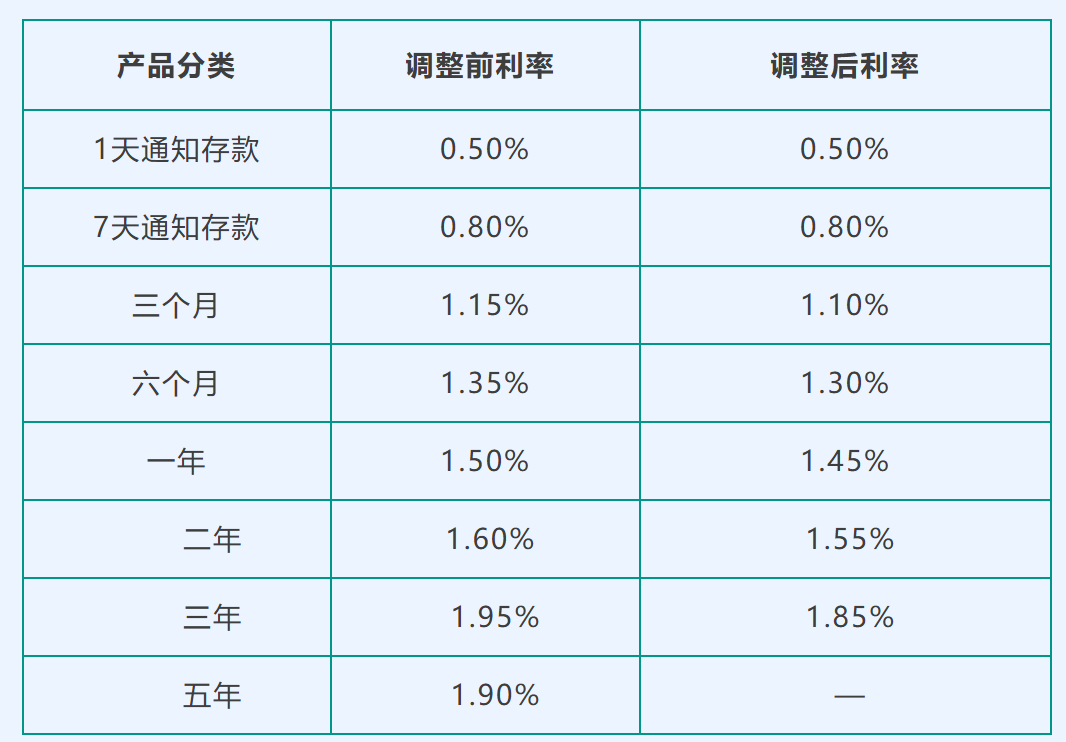
从下调利率到直接“退场” 有银行取消五年期定存产品
2 1 Shi Ji Jing Ji Bao Dao· 2025-11-12 09:09
Core Viewpoint - Recent adjustments in fixed deposit products by banks, particularly the cancellation of five-year fixed deposits by certain banks, highlight a broader trend of declining deposit rates among small and medium-sized banks in response to net interest margin pressures [1][5]. Summary by Category Deposit Rate Adjustments - The announcement from Tuyaqi Mengyin Village Bank and Kundu Lun Mengyin Village Bank indicates the cancellation of five-year fixed deposit options, marking them as the first commercial banks to do so [1]. - The adjusted deposit rates for various terms at Kundu Lun Mengyin Village Bank show a decrease in rates for three-month, six-month, one-year, two-year, and three-year deposits, with the five-year option being removed entirely [2][3]. Industry Trends - The trend of lowering deposit rates is not isolated, as numerous small and medium-sized banks, including Dalian Bank and Hubei Jingmen Rural Commercial Bank, have also reduced their deposit rates, with some products seeing declines exceeding 60 basis points [2]. - The phenomenon of "term inversion" in deposit rates is evident, where long-term deposit rates are lower than short-term rates, as seen with Xinjiang Manas Rural Commercial Bank's recent adjustments [5][6]. Strategic Responses - Banks are actively working to reduce liability costs to address the ongoing pressure on net interest margins, which have reached historical lows [5][7]. - The shift away from high-cost long-term liabilities has been observed, with major banks like China Construction Bank and others no longer offering five-year large denomination certificates of deposit [8][10]. Future Outlook - Analysts suggest that while commercial banks will continue to face pressure on interest income, the downward trend may ease due to factors such as improved capital market performance and the digital transformation of banks [11]. - The changing landscape of deposit rates necessitates a shift in investment strategies for ordinary depositors, encouraging diversification into lower-risk investment products [11].
东方铁塔(002545) - 002545东方铁塔投资者关系管理信息20251112
2025-11-12 09:00
Group 1: Market Supply and Demand - The overall supply of potassium chloride in 2025 is expected to be tight due to reduced production in Canada and escalating conflicts in the Middle East [2] - Despite improved relations between the US and Russia, transportation costs hinder Russian supply to China, limiting border trade [2] - Canadian products primarily serve North and South America, with limited supply to Asia, resulting in better market prices in China compared to Southeast Asia [2] Group 2: Project Progress - The mining rights review and ecological assessment for the Kunming Deyin Phosphate Mine project have been completed, with mining permit expected next year [2][3] - The project aims for an annual capacity of 2 million tons of raw ore and 1.1 million tons of concentrate, with a construction period of approximately 1.5 years [3] Group 3: Future Capacity Plans - The company plans to advance the second phase of the Laos Kaiyuan project, targeting an annual capacity of 1 million tons of potassium chloride, with a goal of reaching a total capacity of 3 million tons [3] - The phosphate project is also set to expand, with plans for a second phase of 2-3 million tons of raw ore after the first phase is operational [3] Group 4: Shareholding Information - The company holds 174 million shares of Qingdao Bank, with any potential reduction in holdings to be determined based on market conditions [3]

从下调利率到直接“退场”,有银行取消五年期定存产品
2 1 Shi Ji Jing Ji Bao Dao· 2025-11-12 08:45
Core Viewpoint - Recent adjustments in fixed deposit products by banks, particularly the cancellation of five-year fixed deposits by some banks, highlight a broader trend of declining deposit rates among small and medium-sized banks in response to net interest margin pressures [2][3][4]. Group 1: Bank Adjustments - The announcement from Tuoyang County Mengyin Village Bank and Kundu Lun Mengyin Village Bank to cancel five-year fixed deposits marks them as the first commercial banks in the industry to take this step [2]. - Several small and medium-sized banks have followed suit, with some deposit products seeing rate reductions exceeding 60 basis points [3]. - For instance, Hainan Baoting Rongxing Village Bank adjusted its one, two, three, and five-year fixed deposit rates to 1.2%, 1.25%, 1.6%, and 1.65%, reflecting decreases of 65BP, 55BP, 20BP, and 15BP respectively from August levels [3]. Group 2: Interest Rate Trends - The trend of declining deposit rates is a response to significant net interest margin pressures, with the net interest margin for commercial banks reported at 1.42% in Q2 2025, down 0.01 percentage points from Q1 [4]. - A notable "term inversion" phenomenon is occurring, where long-term deposit rates are lower than short-term rates, as seen with Xinjiang Manas Rural Commercial Bank's three-year rate at 1.35% and five-year rate at 1.30% [4]. - Major banks, including China Construction Bank, are also experiencing similar trends, with their three-year fixed deposit rates exceeding five-year rates by 25 basis points [5]. Group 3: Strategic Responses - Banks are actively seeking to lower their funding costs by reducing long-term liabilities and adjusting their product offerings, as indicated by the absence of five-year large denomination deposit products in many major banks [6][7]. - The banking sector is focusing on enhancing non-interest income through wealth management and custodial services while stabilizing net interest margins [7]. - Analysts suggest that the downward trend in interest income for commercial banks may ease due to factors such as improved loan pricing and risk matching, better performance in the capital market, and accelerated digital transformation [8]. Group 4: Implications for Investors - Traditional reliance on long-term fixed deposits for wealth preservation is being challenged, prompting financial advisors to recommend diversifying into government bonds, savings-type insurance, and low-risk bank wealth management products [8]. - Investors are encouraged to adapt their financial strategies in response to the declining interest rate environment to meet their wealth management needs effectively [8].
这些上市银行获增持
Sou Hu Cai Jing· 2025-11-12 08:18
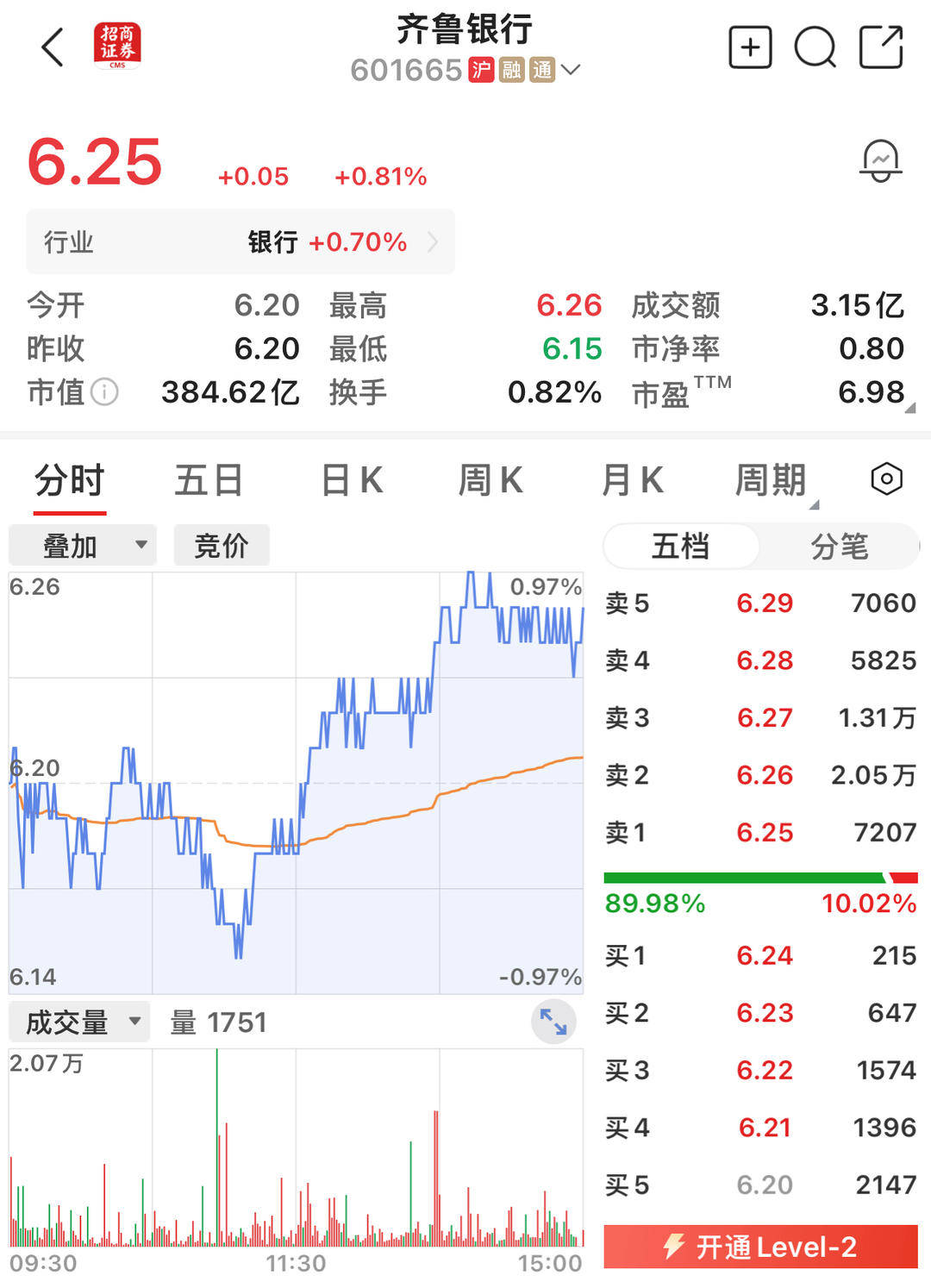
Core Insights - Multiple A-share listed banks have seen significant share purchases by executives and major shareholders since 2025, indicating confidence in the banking sector's long-term value [1][5] - Recent quarterly reports show that most city commercial banks have stabilized and improved their net interest margins compared to the end of the first half of the year [1] Group 1: Shareholder Activity - Over 10 banks have received share purchases from shareholders or executives, including Xiamen Bank, Suzhou Bank, Chengdu Bank, Chongqing Bank, Shanghai Bank, Everbright Bank, Lanzhou Bank, Postal Savings Bank, and Wuxi Bank, with city commercial banks being the majority [1] - On November 7, Qilu Bank reported that its directors, supervisors, and senior executives had collectively increased their holdings by approximately 3.15 million yuan, accounting for 90% of the planned increase [3] - Qingdao Bank's major shareholder, Guoxin Chanin Holdings, increased its stake through the Hong Kong Stock Connect, raising its total shareholding to 15.42%, making it the largest shareholder [5] Group 2: Financial Performance - Among the 42 listed banks, 35 reported a year-on-year increase in net profit for the first three quarters, with seven banks achieving double-digit growth, including Qingdao Bank, Qilu Bank, Hangzhou Bank, Jiangyin Bank, Changshu Bank, Shanghai Pudong Development Bank, and Chongqing Bank [5] - The recent quarterly reports reflect a positive performance for banks this year, contributing to market confidence [5]
智通港股通占比异动统计|11月12日
智通财经网· 2025-11-12 00:40
Core Insights - The article highlights the changes in the Hong Kong Stock Connect holdings, indicating significant increases and decreases in ownership percentages for various companies. Group 1: Increased Holdings - Haotian International Construction (01341) saw the largest increase in holdings, up by 1.72% to a total of 64.45% [1][2] - Ruipu Lanjun (00666) and China Duty Free Group (01880) also experienced notable increases of 1.13% and 1.08%, bringing their holdings to 7.34% and 39.40% respectively [1][2] - Over the last five trading days, Haotian International Construction (01341) led with a 12.27% increase, followed by Qingdao Bank (03866) at 8.03% and Anjuke Food (02648) at 4.30% [1][3] Group 2: Decreased Holdings - Longpan Technology (02465) faced the largest decrease in holdings, down by 7.59% to 39.67% [1][2] - Chalco International (02068) and Derlin Holdings (01709) also saw reductions of 1.04% and 0.94%, with holdings at 20.51% and 30.09% respectively [1][2] - In the last five trading days, New天绿色能源 (00956) had the most significant drop at 9.06%, followed by Zhongze Feng (01282) at 7.46% and Longpan Technology (02465) at 6.35% [1][3] Group 3: Summary of Top Changes - The top 20 companies with increased holdings include Haotian International Construction (01341), Ruipu Lanjun (00666), and China Duty Free Group (01880) [2] - The top 20 companies with decreased holdings include Longpan Technology (02465), Chalco International (02068), and Derlin Holdings (01709) [2] - The data reflects a dynamic shift in investor sentiment and market positioning among these companies [1][2][3]
重要股东、董监高齐出手!什么信号?
Shang Hai Zheng Quan Bao· 2025-11-11 15:17
Core Viewpoint - The frequent share buybacks by shareholders and executives of listed banks this year indicate confidence in future growth prospects and recognition of long-term investment value in the banking sector [1][2][4]. Group 1: Shareholder and Executive Buybacks - Su Nong Bank announced that three executives plan to increase their holdings by at least 1.8 million yuan in A-shares within six months from the announcement date [2]. - Qilu Bank reported that some directors and executives have already increased their holdings by approximately 3.15 million yuan, achieving 90% of their planned buyback amount [2]. - Qingdao Bank's major shareholder, Guoxin Chanquan Holdings, increased its H-share holdings by 2.43 billion shares, totaling 9.57 billion yuan, raising its stake to 19.17% [2][3]. Group 2: Market Signals and Investment Value - The concentrated buybacks from shareholders and executives signal that the banking sector's valuation is at historical lows, highlighting its long-term investment value [4][5]. - The overall profitability of listed banks has improved, with 35 out of 42 banks reporting year-on-year net profit growth in the first three quarters, and seven banks achieving double-digit growth [4]. - The banking sector's "high dividend, low valuation" characteristics have become more pronounced, making it attractive to institutional investors seeking stable returns [4][5]. Group 3: Institutional Investment Trends - Insurance funds have shown a strong preference for long-term investments in the banking sector, increasing their holdings by 8.36 billion shares in the third quarter [5]. - As of the end of September, insurance funds were invested in 23 banks, with 10 experiencing increased holdings, indicating a growing commitment to the sector [5]. - The outlook for insurance funds suggests continued investment in the banking sector due to stable dividends, low valuations, and the potential for improved profit margins through equity methods [5].
三季度公募含“银”量创五年新低,四季度银行股修复动能渐显
第一财经· 2025-11-11 14:59
Core Viewpoint - The article highlights the significant changes in the banking sector, particularly focusing on the increasing shareholding of local state-owned enterprises and insurance funds in various banks, while public funds and northbound capital are reducing their holdings. The overall market sentiment for bank stocks is showing signs of recovery in the fourth quarter after a challenging third quarter [3][10][12]. Group 1: Shareholding Changes - Action Person's total shareholding ratio has risen to 19.17%, making it the largest shareholder of Qingdao Bank [3]. - Many city commercial banks and national banks have disclosed shareholding increase plans or have already implemented them, including Chengdu Bank, Nanjing Bank, and Postal Savings Bank [3]. - The number of shareholders in banks like China Merchants Bank and Beijing Bank has increased significantly, indicating a rise in retail investor participation alongside a decline in institutional holdings [5][6]. Group 2: Fund Holdings and Market Performance - Public funds' exposure to bank stocks has dropped to a five-year low, with a decrease in their overall holdings [4][6]. - The banking sector saw a decline of 8.68% in the third quarter but rebounded with an increase of 8.23% in the fourth quarter as of November 11 [3]. - Northbound capital inflow into banks decreased by 31.66% in the third quarter, with only a few banks like Ningbo Bank and Chengdu Bank seeing net inflows [7]. Group 3: Institutional Investment Trends - Insurance funds and state-owned capital have maintained relatively stable holdings in bank stocks, with state-owned funds holding a total market value of 4.5 trillion yuan [8]. - The increase in local state-owned capital investments in city commercial banks reflects a strategy to strengthen regional financial resource control and capitalize on low valuations [9]. - The investment sentiment in the banking sector is expected to improve in the fourth quarter, with several banks announcing share buyback plans [10][11]. Group 4: Future Outlook - The article suggests that the banking sector may experience structural recovery opportunities in the fourth quarter, driven by high dividend yields and the resilience of regional banks [10][12]. - Analysts believe that the combination of increased institutional investment and favorable market conditions could lead to a stabilization phase for bank stocks [11][12].