中国铁建

Search documents
基础建设板块11月27日跌0.34%,北新路桥领跌,主力资金净流出1.91亿元
Zheng Xing Xing Ye Ri Bao· 2025-11-27 09:07
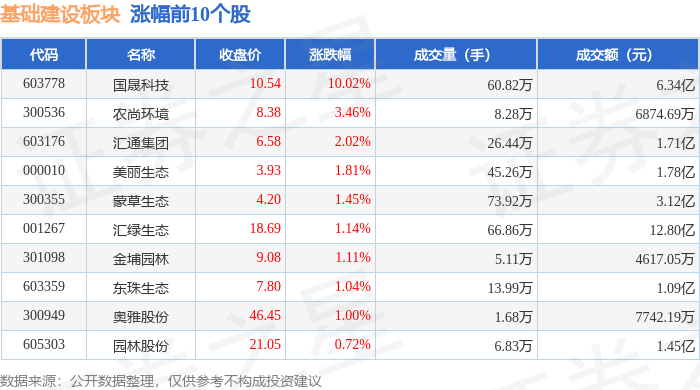
Market Overview - The infrastructure sector experienced a decline of 0.34% on November 27, with Beixin Road and Bridge leading the drop [1] - The Shanghai Composite Index closed at 3875.26, up 0.29%, while the Shenzhen Component Index closed at 12875.19, down 0.25% [1] Top Performers in Infrastructure Sector - Guosheng Technology (603778) saw a closing price of 10.54, with a significant increase of 10.02% and a trading volume of 608,200 shares, totaling a transaction value of 634 million [1] - Nongshang Environment (300536) closed at 8.38, up 3.46%, with a trading volume of 82,800 shares [1] - Huitong Group (603176) closed at 6.58, up 2.02%, with a trading volume of 264,400 shares [1] Underperformers in Infrastructure Sector - Beixin Road and Bridge (002307) closed at 5.33, down 7.14%, with a trading volume of 2,166,000 shares and a transaction value of 1.148 billion [2] - Xinjiang Jiaojian (002941) closed at 16.12, down 2.95%, with a trading volume of 255,500 shares [2] - ST Huawang (603007) closed at 5.46, down 2.15%, with a trading volume of 142,600 shares [2] Capital Flow Analysis - The infrastructure sector experienced a net outflow of 191 million from institutional investors, while retail investors saw a net inflow of 207 million [2] - The top three stocks with significant net inflows from retail investors include Mengcao Ecology (300355) with 49.19 million, Huitong Group (603176) with 28.90 million, and Meili Ecology (000010) with 21.63 million [3] - Conversely, Beixin Road and Bridge (002307) experienced a net outflow of 77.32 million from retail investors [3]


远洋集团7笔境内公司债重组方案获通过;许家印前妻丁玉梅2.2亿美元海外资产遭冻结|房产早参
Mei Ri Jing Ji Xin Wen· 2025-11-26 23:07
Group 1 - Ocean Group's restructuring plan for seven domestic corporate bonds, totaling 13.05 billion yuan, has been approved, significantly reducing short-term repayment pressure and optimizing debt structure [1] - The Hong Kong High Court has expanded the asset freeze on Ding Yumei, the ex-wife of Evergrande's founder Xu Jiayin, to include 220 million USD in assets located in Canada, Gibraltar, Jersey, and Singapore, reflecting a focused approach to global asset recovery [2] - China Railway Construction Corporation's public bond project of 30 billion yuan has updated its status to "submitted for registration," ensuring access to funds and demonstrating a standardized financing process [3] Group 2 - China Merchants Shekou has successfully issued 5.04 billion yuan in corporate bonds with a fixed interest rate of 1.77%, indicating strong market confidence in its financial stability and growth prospects [4] - Vanke's A-share price has dropped to 5.89 yuan, the lowest since 2015, with concerns over liquidity and upcoming debt maturities reaching a peak, particularly regarding support from Shenzhen Metro Group [5]
基础建设板块11月26日跌0.19%,园林股份领跌,主力资金净流出2.23亿元
Zheng Xing Xing Ye Ri Bao· 2025-11-26 09:12
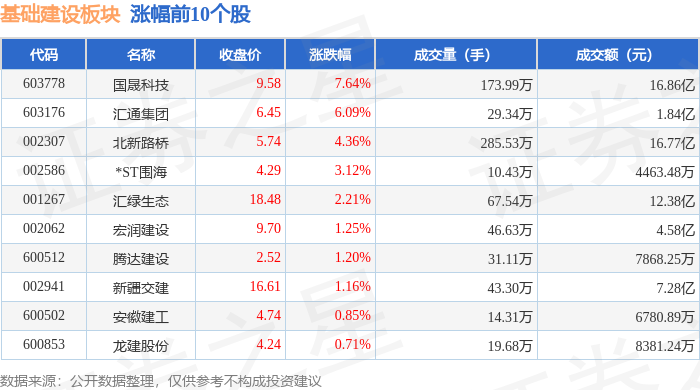
Core Viewpoint - The infrastructure sector experienced a slight decline of 0.19% on November 26, with notable losses in landscaping stocks, while the Shanghai Composite Index fell by 0.15% and the Shenzhen Component Index rose by 1.02% [1] Group 1: Market Performance - The infrastructure sector's performance was mixed, with individual stocks showing varied results, including significant gains for Guosheng Technology (up 7.64%) and Huitong Group (up 6.09%) [1] - The overall trading volume in the infrastructure sector was substantial, with Guosheng Technology achieving a transaction value of 1.686 billion yuan [1] Group 2: Stock Movements - The top gainers in the infrastructure sector included: - Guosheng Technology (603778) at 9.58 yuan, up 7.64% with a trading volume of 1.7399 million shares - Huitong Group (603176) at 6.45 yuan, up 6.09% with a trading volume of 293,400 shares [1] - Conversely, the top losers included: - Yuanlin Co. (605303) at 20.90 yuan, down 3.11% with a trading volume of 54,000 shares - Hangzhou Landscaping (300649) at 15.69 yuan, down 2.85% with a trading volume of 25,400 shares [2] Group 3: Capital Flow - The infrastructure sector saw a net outflow of 223 million yuan from major funds, while retail investors contributed a net inflow of 141 million yuan [2] - Notable capital movements included: - Huitong Group (603176) with a net inflow of 51.62 million yuan from major funds, but a net outflow of 4.77 million yuan from retail investors [3] - Huylv Ecology (001267) with a net inflow of 48.27 million yuan from major funds, but a net outflow of 2.73 million yuan from retail investors [3]

2025年1-9月中国铁路机车产量为625辆 累计增长16.6%
Chan Ye Xin Xi Wang· 2025-11-26 03:45
Core Insights - The article discusses the current state and future prospects of the Chinese railway locomotive industry, highlighting production statistics and growth trends [1]. Industry Overview - According to the National Bureau of Statistics, the production of railway locomotives in China reached 137 units in September 2025, representing a year-on-year increase of 4.6% [1]. - Cumulatively, from January to September 2025, the total production of railway locomotives was 625 units, showing a cumulative growth of 16.6% [1]. Companies Mentioned - Listed companies in the railway locomotive sector include China CNR Corporation (601766), China Railway Group (601390), China Railway Construction Corporation (601186), Jinxi Axle (600495), Taiyuan Heavy Industry (600169), Times New Material (600458), Shenzhou High-speed Railway (000008), Kanni Electromechanical (603111), Huihong Technology (002296), and Jin Yi Industrial (601002) [1]. Research Report - The article references a report by Zhiyan Consulting titled "Analysis of the Current Market Situation and Future Prospects of the Chinese Railway Locomotive Industry from 2025 to 2031" [1].

中国银河证券:建筑行业新旧动能加速切换 聚焦城市更新与新赛道机遇
Zhi Tong Cai Jing· 2025-11-26 02:37
Core Viewpoint - The construction industry in China is seeking structural growth opportunities amid traditional demand pressures, driven by national strategic infrastructure projects and emerging trends in urban renewal [1][3]. Group 1: Industry Overview - In the first three quarters of 2025, 152 listed companies in the construction sector reported a total revenue of 5.84 trillion yuan, a year-on-year decrease of 5.14%. The net profit attributable to shareholders was 123.62 billion yuan, down 9.76% [2]. - The urban development is shifting towards improving existing stock, with urban renewal actions expected to create a market worth trillions, particularly in underground pipeline investments exceeding 5 trillion yuan during the 14th Five-Year Plan [3]. Group 2: Major Projects and Trends - Significant projects such as the Yaxi Hydropower and the Sichuan-Tibet Railway are highlighted, with the Yaxi Hydropower project alone having an investment of 1.2 trillion yuan and the Sichuan-Tibet Railway segment costing approximately 319.8 billion yuan [4]. - The regulatory environment is becoming more favorable for mergers and acquisitions, which will benefit construction companies [4]. Group 3: Investment Recommendations - Investment focus areas include major projects like Yaxi Hydropower and Sichuan-Tibet Railway, with recommended companies such as China Power Construction and China Railway Construction [6]. - Urban renewal, high dividend stocks, and overseas expansion are also key investment themes, with companies like China State Construction and Shanghai Construction recommended [6]. - Growth sectors include low-altitude economy, welding robots, and computing infrastructure, with suggested companies like China Communications Construction and Shanghai Institute of Building Science [6]. - The coal chemical industry in Xinjiang and nuclear power projects are highlighted as areas of improvement, with recommendations for companies like China Chemical and China Nuclear Engineering [6].

柳梧铁路全线重点工程成功完成转体施工
Xin Hua Wang· 2025-11-25 17:39
Core Viewpoint - The successful completion of the rotation construction of the Baishan Village Super Bridge marks a significant breakthrough in the construction of the Liuzhou-Wuzhou Railway, which is crucial for enhancing transportation connectivity between Guangxi and the Guangdong-Hong Kong-Macao Greater Bay Area [1] Group 1: Project Details - The Baishan Village Super Bridge is the only rotating bridge along the entire Liuzhou-Wuzhou Railway, with the left and right beams weighing 7,480 tons and 6,745 tons respectively [1] - The bridge construction involved crossing busy railways and highways, necessitating advanced risk assessment and simulation techniques [1] Group 2: Construction Techniques - The construction team utilized 3D modeling technology for comprehensive simulation of the rotation process, accurately calculating the rotation angles, speeds, and stress conditions of the beams [1] - Real-time monitoring was implemented for critical aspects such as lifting equipment, temporary power supply, and high-altitude operations to ensure successful construction [1] Group 3: Economic and Regional Impact - The Liuzhou-Wuzhou Railway, with a total length of approximately 238 kilometers and a design speed of 160 km/h, is a vital component of the railway network connecting Liuzhou to Guangzhou [1] - The completion of this railway is expected to significantly enhance the regional transportation system and promote high-quality economic and social development in the surrounding areas [1]

成达万高铁渠江特大桥成功合龙
Xin Hua She· 2025-11-25 12:32
Core Viewpoint - The successful completion of the Quxiang Grand Bridge marks a significant milestone for the Chengdu-Dazhou-Wanzhou high-speed railway project, enhancing the infrastructure of China's high-speed rail network [1] Group 1: Project Details - The Quxiang Grand Bridge, constructed by China Railway Fifteenth Bureau, spans a total length of 1983.81 meters, with the main bridge being a prestressed concrete cable-stayed bridge measuring 557.5 meters [1] - The project team implemented a scientifically efficient construction plan, optimizing concrete pouring timing and mix design to achieve millimeter-level precision in the connection of the bridge segments [1] Group 2: Strategic Importance - The Chengdu-Dazhou-Wanzhou high-speed railway is a crucial part of the national "eight vertical and eight horizontal" high-speed rail network, with a total length of approximately 477 kilometers [1] - Once operational, the travel time from Chengdu to Chongqing via Dazhou will be reduced from around 5 hours to under 2 hours, significantly improving connectivity in the region [1]
中金 | 低空科技系列产业篇:基建巡检提效能
中金点睛· 2025-11-25 00:06
Core Viewpoint - Drones are reshaping the engineering operation and maintenance service ecosystem in China's infrastructure sector, addressing the significant operational needs and enhancing efficiency while reducing costs and safety risks [2][3]. Group 1: Infrastructure Market Overview - China's infrastructure investment continues to grow steadily, with a leading global position in fixed asset investment, particularly in electricity, transportation, oil and gas, and telecommunications [3][7]. - According to Deloitte, Chinese companies accounted for over 50% of the revenue among the top 100 global infrastructure firms in 2024, highlighting China's scale advantage and international competitiveness [7][9]. Group 2: Challenges of Traditional Inspection Methods - Traditional manual inspection methods face challenges such as low efficiency, high costs, and significant safety risks, making them inadequate for modern infrastructure maintenance needs [14][15]. - The demand for inspections is driven by the vast and complex infrastructure network in China, which requires timely detection of equipment anomalies to ensure stable operations and prevent accidents [14][15]. Group 3: Advantages of Drone Inspections - Drones offer significant advantages in efficiency, cost reduction, and safety over traditional methods, with AI capabilities enhancing standardization and reducing errors [18][23]. - For example, drone inspections can reduce the time required for tasks significantly, such as compressing a 4-hour manual inspection into just 10 minutes [18][21]. Group 4: Policy Support for Drone Technology - A multi-level policy framework is in place to support the deployment of drone technology in infrastructure inspection, with national and local governments encouraging the expansion of drone services [3][22]. - Key policies include the "14th Five-Year Plan" for civil aviation and various local initiatives aimed at promoting the use of drones in inspection and maintenance [22]. Group 5: Market Potential for Drone Inspections - The total potential market for infrastructure inspection drones is estimated to reach 4.9 billion yuan, with an annual potential market space of approximately 2.4 billion yuan after considering depreciation [34][37]. - The market is driven by the dual forces of accelerating new infrastructure projects and the upgrading of traditional maintenance practices [35][37]. Group 6: Industry Chain Development - The drone industry chain is evolving with decreasing hardware costs and rapid advancements in AI algorithms, facilitating large-scale applications in China's extensive infrastructure sector [39][40]. - Key players in the supply chain include core hardware suppliers, midstream manufacturers, and downstream service providers, all benefiting from the industry's growth [39][41]. Group 7: Applications Across Various Sectors - Drones are being utilized in multiple sectors, including electricity, oil and gas, water conservancy, transportation, and telecommunications, with specific adaptations for each field [44][45]. - The end users primarily consist of large state-owned enterprises and government agencies, which require high reliability and precision in drone operations [44].

太平人寿,一次落袋65亿
36氪· 2025-11-24 10:14
Core Viewpoint - China Taiping's subsidiary, Taiping Life, has sold equity stakes in four companies for 6.5 billion yuan, reflecting a strategic asset rotation amid a growing equity market for insurance capital [3][6][9]. Group 1: Asset Sale and Financial Impact - Taiping Life's sale of equity stakes will result in an influx of 6.5 billion yuan in cash, enhancing its liquidity for future investments [6][9]. - The investment in the four companies, made in December 2019, yielded a total return of approximately 2.35 billion yuan over nearly six years, indicating a successful exit strategy [9][10]. - The proceeds from the sale are intended for general operational funding, allowing for greater flexibility in future investments [11][12]. Group 2: Investment Performance and Strategy - In the first three quarters of 2025, Taiping Life reported a significant increase in investment income, totaling 16.71 billion yuan, up from 6.89 billion yuan in the same period the previous year, marking a 142.5% increase [13][14]. - The company has diversified its investments, appearing as a major shareholder in multiple stocks, with a focus on both traditional sectors and emerging technologies [14][15]. - The investment strategy has shifted from infrastructure-heavy allocations to a more balanced approach that includes equities, reflecting a response to changing market conditions and regulatory frameworks [28][29]. Group 3: Market Trends and Regulatory Environment - The insurance industry is experiencing a systemic trend towards increased equity market participation, driven by low interest rates and regulatory adjustments that allow for higher equity allocations [29][30]. - As of mid-2025, Taiping Life's equity investment weight was 13.6%, which is below the regulatory cap, indicating potential for further investment growth in equities [30][31]. - The shift in investment focus is seen as a rational response to market dynamics, aiming to enhance returns while managing risks effectively [28][29].

深江铁路致13死重大坍塌事故调查报告公布
中国基金报· 2025-11-24 09:33
Core Viewpoint - The investigation into the "12·4" major collapse accident of the Shenzhen-Jiangmen Railway revealed that the accident was caused by violations in construction practices and inadequate emergency response measures, leading to significant casualties and economic losses [2][3]. Group 1: Accident Details - The collapse occurred on December 4, 2024, resulting in 13 fatalities and direct economic losses of approximately 72.61 million yuan [2]. - The direct cause of the accident was identified as the failure to halt excavation when encountering a high-risk geological area, leading to a partial collapse of the tunnel face [2][3]. Group 2: Responsibility and Management Issues - The investigation found that multiple parties, including China Railway Fourth Engineering Group Co., Ltd. (中铁四局), Xiamen-Shenzhen Railway Guangdong Co., Ltd. (厦深公司), and others, failed in their management and risk control responsibilities [3][4]. - The supervising unit, Guangzhou Supervision Station, and the industry regulatory body, Guangzhou Railway Supervision Administration, were also found lacking in their oversight duties [3][4]. Group 3: Lessons Learned and Recommendations - Six major lessons were identified, including failures in risk prevention, monitoring, and emergency response systems, as well as the dangers of proceeding with construction before design changes [5]. - Six recommendations were proposed to improve safety, including enhancing risk prevention measures, strengthening construction safety protocols, and improving emergency response capabilities [5].