
重庆银行

Search documents
地方上市银行高管频频增持自家银行股份
Zheng Quan Shi Bao· 2025-11-18 18:13
Core Viewpoint - The announcement from Hu Nong Commercial Bank indicates significant insider buying by top executives, reflecting confidence in the bank's future performance and aligning with a broader trend of regional banks experiencing similar increases in executive and institutional shareholdings [1]. Group 1: Executive Purchases - Five senior executives of Hu Nong Commercial Bank, including the president and several vice presidents, purchased a total of 259,100 shares from November 13 to November 17, 2025, at prices ranging from 9.02 to 9.08 yuan [1]. - This trend of executive share purchases is not isolated, as other regional banks such as Nanjing Bank, Wuxi Bank, and Suzhou Bank have also seen similar actions from their management teams [1]. Group 2: Institutional Purchases - Qingdao Bank reported that its major shareholder, Qingdao Guoxin Financial Holdings Group Co., Ltd., increased its holdings through the Hong Kong Stock Connect, raising its total stake to 15.42%, making it the largest shareholder of the bank [1]. - In addition, Su Nong Bank's executives plan to purchase at least 1.8 million yuan worth of A-shares within six months starting from November 11, 2025 [1]. - Qilu Bank disclosed that its management has already purchased approximately 3.15 million yuan worth of shares, achieving 90% of its planned increase since announcing its buyback plan in mid-September [1].

地方上市银行高管 频频增持自家银行股份
Zheng Quan Shi Bao· 2025-11-18 18:08
在机构增持方面,青岛银行透露,该行股东青岛国信产融控股(集团)有限公司近期通过港股通渠道增持 该行H股股份,总持股比例增加至15.42%,跃升至该行第一大股东。 今年以来,区域银行频获高管人员和机构股东增持,包括南京银行(601009)、无锡银行(600908)、 苏州银行(002966)、兰州银行(001227)、成都银行(601838)、重庆银行(601963)、青岛银行 (002948)、厦门银行(601187)等。仅11月以来,就有常熟银行(601128)、苏农银行(603323)、 青岛银行、齐鲁银行(601665)等披露了股东和高管团队的增持计划或进展。 11月18日,沪农商行(601825)发布公告称,行长汪明、职工董事应长明、副行长张宏彪、副行长顾贤 斌、副行长兼首席信息官沈栋,共计5名高管人员于2025年11月13日至11月17日期间,以自有资金从二 级市场买入公司普通股股票,合计买入25.91万股股票,成交价格区间为9.02~9.08元。 在管理层增持方面,据苏农银行披露,该行行长王亮、副行长费海滨、耿植计划自2025年11月11日起6 个月内增持该行A股股份不少于180万元。此外,齐鲁银 ...
降息、降本、撤APP……银行降本增效大行动!
券商中国· 2025-11-18 11:15
Core Viewpoint - The article discusses how commercial banks are focusing on cost reduction and efficiency improvement in response to the ongoing pressure of narrowing net interest margins and declining asset yields [1][2]. Group 1: Liability Management - Commercial banks are actively reducing high-cost deposit products as a response to the central bank's interest rate cuts, leading to historically low deposit rates [3][4]. - A total of 42 listed banks in A-shares reported a decrease in interest expenses to 3.43 trillion yuan, an 11.36% decline compared to the same period last year, with some banks like Ping An Bank seeing a reduction of 21.61% [5]. - Banks are implementing strategies to clean up high-cost deposits and adjust deposit product structures to further lower overall liability costs [6]. Group 2: Operational Efficiency - Banks are adopting a "frugal" management approach to reduce operational expenses, with half of the listed banks reporting a decrease in their cost-to-income ratios compared to the previous year [7][8]. - Xi'an Bank showed a significant reduction in its cost-to-income ratio from 25.18% to 18.50%, well below the industry average of 31.82% [8]. - Major banks like Postal Savings Bank have also reported a decrease in operational expenses, attributing this to enhanced cost management and digital transformation efforts [9][10]. Group 3: Digital Integration - Banks are consolidating their mobile applications to reduce operational and maintenance costs, moving towards a "less but better" approach in app management [11][12]. - Several banks have closed independent credit card apps and integrated their functions into main banking apps, reflecting a shift from vertical management to localized operations [13][14].


申万宏源:险资密集增配银行已验证趋势 期待2026年行业基本面新变化
Zhi Tong Cai Jing· 2025-11-18 08:25
Core Viewpoint - The report from Shenwan Hongyuan indicates a significant trend of long-term capital, represented by insurance funds, increasingly allocating to the banking sector, with a potential inflow space of approximately 600 billion yuan if 40% of new funds are allocated to bank stocks [1][2]. Group 1: Capital Inflow and Allocation - The unprecedented low interest rate environment is driving incremental capital towards dividend sectors, with the banking sector offering superior value. The current banking index dividend yield is about 4.3%, significantly higher than the ten-year government bond yield, making it an attractive investment option [1]. - Assuming that 40% of the new capital is allocated to OCI and 40% to bank stocks, this could lead to a potential inflow of around 600 billion yuan. Additionally, public fund reforms are expected to increase capital allocation to underrepresented sectors, with bank stock holdings in public funds dropping to a near ten-year low of 1.74% in Q3 2025, suggesting an additional potential inflow of over 370 billion yuan if allocations align with the CSI 300 [2]. Group 2: Expected Changes in Banking Fundamentals - The central bank has explicitly stated its support for stabilizing net interest margins, linking this to the expansion of monetary policy's counter-cyclical adjustment space. It is anticipated that by 2026, bank interest margins may reverse their downward trend and show a slight year-on-year increase, with banks that can improve deposit costs expected to perform better than their peers [3]. - The importance of "high provisioning" is becoming more pronounced as banks' provisioning capacity is gradually consumed. While systemic risks from real estate and platforms may ease, risks in retail sectors still require provisioning. Focus should be on banks with low non-performing loans and high loan-to-deposit ratios, as well as those with clear asset quality improvements [3]. - Some small and medium-sized banks may face revenue growth challenges due to high base pressures in their capital market operations, with reduced non-interest income growth and declining financial investment yields [3]. Group 3: Capital Focus and Investment Recommendations - Bank capital is becoming a focal point, with banks that have strong internal capital generation or substantial reserves being better positioned for stable lending and dividends. External financing remains challenging, making convertible bonds a scarce resource [4]. - The banking sector is entering a new cycle of stable profitability, with long-term capital inflows ongoing. If the macro environment sees a gradual recovery in PPI and marginal increases in long-term interest rates, this will create favorable operating conditions for banks. Even under economic pressure, banks with clear risk thresholds and stable dividend expectations remain attractive dividend assets [5]. - The report recommends focusing on a dual strategy of "leading banks (state-owned and China Merchants Bank) as the foundation" and "bottom-tier joint-stock banks and quality city commercial banks as the performers." Leading banks are expected to see valuation recovery, while quality small and medium-sized banks with improving fundamentals are likely to exhibit stock price elasticity in response to economic recovery [5].



城商行板块11月18日跌0.75%,郑州银行领跌,主力资金净流出1.83亿元
Zheng Xing Xing Ye Ri Bao· 2025-11-18 08:11
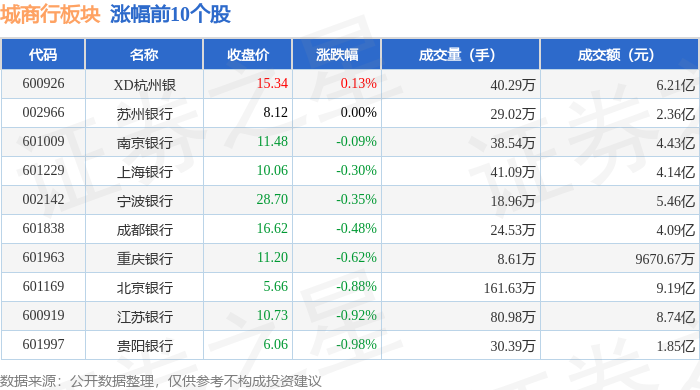
Market Overview - The city commercial bank sector experienced a decline of 0.75% on November 18, with Zhengzhou Bank leading the drop [1] - The Shanghai Composite Index closed at 3939.81, down 0.81%, while the Shenzhen Component Index closed at 13080.49, down 0.92% [1] Individual Stock Performance - Zhengzhou Bank's stock closed at 2.03, down 1.46% with a trading volume of 1.3032 million shares and a transaction value of 266 million [2] - Xiamen Bank closed at 7.13, down 1.38%, with a trading volume of 144,000 shares [2] - Nanjing Bank closed at 11.48, down 0.09%, with a trading volume of 385,400 shares [1] - The highest closing price was for Ningbo Bank at 28.70, down 0.35% [1] Capital Flow Analysis - The city commercial bank sector saw a net outflow of 183 million from institutional investors, while retail investors contributed a net inflow of 74.99 million [2] - The main capital inflow was observed in stocks like Nanjing Bank, which had a net inflow of 62.45 million from institutional investors [3] - Conversely, stocks like Xiamen Bank and Zhengzhou Bank experienced significant net outflows from institutional investors, amounting to 8.32 million and 4.80 million respectively [3]


银行业投资策略:中期分红抢筹行情尾声阶段如何布局?
Guoxin Securities· 2025-11-18 05:12
Core Viewpoints - The mid-term dividend rush in the banking sector is nearing its end but is not yet finished, potentially extending until the end of November [4][11][26] - The four major banks have announced mid-term dividends earlier this year compared to last year, with the record date for dividends set for mid-December, which is nearly one month earlier than last year [7][11] - The recent rise in the banking sector is primarily driven by changes in market investment style, with mid-term dividends acting as a catalyst [4][11][26] Investment Strategy Post-Dividend Rush - After the mid-term dividend rush, the banking sector may experience short-term fluctuations, but it is unlikely that the overall trend has ended [5][14][26] - There are expected investment opportunities in the banking sector before the main spring rally is identified, suggesting that investors should overlook short-term volatility [5][16][26] - The demand for insurance funds and the need for asset allocation in a low-interest-rate environment make stable bank stocks attractive [5][16][26] Stock Selection Recommendations - Focus on high-dividend, fundamentally strong stocks in the short term, while also considering quality stocks for potential upside [6][26] - Recommended stocks include Industrial and Commercial Bank of China and China Merchants Bank for their stability, as well as Ningbo Bank and Chongqing Bank for their upward momentum [6][26] - Low-valuation banks such as Changsha Bank and Chongqing Rural Commercial Bank are also suggested for consideration [6][26] Market Performance Insights - The banking index has shown a cumulative increase of 7.7% from October 14 to November 14, 2025, with individual banks like ICBC and ABC showing significant gains [11][26] - The cumulative gains of the four major banks from December 2024 were 12.5%, 11.0%, 10.2%, and 10.0%, respectively, indicating a strong performance leading into the new year [7][11] Fundamental Analysis - The banking sector's fundamentals are expected to stabilize, with net interest margins showing signs of improvement [23][26] - The asset quality of listed banks is at its best level in recent years, with retail non-performing loans gradually being cleared [23][26]


行业深度报告:2025Q4上市银行AC潜在兑现及回补债券评估
KAIYUAN SECURITIES· 2025-11-18 05:10
Investment Rating - The industry investment rating is optimistic (maintained) [1] Core Insights - The report highlights that listed banks have sold approximately 2 trillion yuan in bonds to realize floating profits from their available-for-sale (AC) accounts in the first three quarters of 2025 [13] - It is estimated that in Q4 2025, listed banks will need to sell about 900 billion yuan in bonds to support non-interest income [10] - The cumulative floating profit of listed banks' AC accounts is approximately 3.3 trillion yuan as of the end of H1 2025, accounting for 58.3% of the total revenue for the year 2024 [30] Summary by Sections Investment Growth - Since 2024, the investment growth rate of listed banks' AC accounts has consistently lagged behind the growth rate of financial investments, with a year-on-year growth of 11.5% in Q3 2025, which is 4.28 percentage points lower than that of financial investments [13][15] - The growth rates for different types of banks from Q2 2023 to Q2 2025 are as follows: state-owned banks 14.7%, joint-stock banks 2.8%, city commercial banks 9.7%, and rural commercial banks -3.8% [13] Bond Selling and Profit Realization - The report estimates that the floating profit realization ratio for listed banks' AC accounts in the first three quarters of 2025 is about 3.06%, with a bond selling scale of approximately 2.04 trillion yuan [36] - The selling proportions for different bank types are: state-owned banks 2.26%, joint-stock banks 5.29%, city commercial banks 5.57%, and rural commercial banks 9.65%, with rural commercial banks showing the highest selling intensity [36] Financial Performance - The floating profit from the sale of bonds in the first three quarters of 2025 is estimated to be 1,078 billion yuan, which represents 2.50% of the total revenue, an increase of 1.59 percentage points compared to 2024 [22][25] - The breakdown of floating profit realization ratios by bank type is as follows: state-owned banks 2.24%, joint-stock banks 2.44%, city commercial banks 3.79%, and rural commercial banks 5.52% [22] Investment Recommendations - The report suggests a bottom-line allocation to large state-owned banks, with beneficiaries including Agricultural Bank of China and Industrial and Commercial Bank of China [6] - Core allocations should focus on leading comprehensive banks such as China Merchants Bank, CITIC Bank, and Industrial Bank [6] - Flexible allocations can be made to banks like Jiangsu Bank, Chongqing Bank, and Chongqing Rural Commercial Bank [6]


2026年银行业投资策略:盈利新周期,估值新起点,迎银行长牛
Shenwan Hongyuan Securities· 2025-11-18 04:45
Core Viewpoints - The banking sector is at the beginning of a long-term recovery cycle, with current valuations around 0.7 times PB, significantly improved from the low of 0.49 times PB in 2018 [3][9] - The low interest rate environment is a key driver for capital inflow into dividend-paying stocks, with the banking sector offering a dividend yield of approximately 4.3%, which is over 250 basis points higher than the 10-year government bond yield [12][14] - The expectation for 2026 includes a stabilization and potential slight increase in net interest margins, driven by central bank policies aimed at supporting banks [3][4] Investment Highlights - The banking sector is expected to benefit from a new cycle of stable profitability, with long-term capital inflows continuing to support the sector [3][30] - The focus should be on leading banks and quality regional banks, as they are likely to outperform in terms of valuation recovery and profitability [3][30] - The report emphasizes the importance of high provisioning and capital adequacy for banks to navigate through economic challenges [4][30] Market Dynamics - The banking sector has seen a shift in risk perception, with systemic risks significantly alleviated, allowing for a more favorable outlook on bank valuations [27][28] - The report highlights that banks have actively managed their asset quality, with significant write-offs contributing to improved financial stability [27] - The structural changes in credit allocation are expected to resolve existing issues, with a focus on sectors that contribute positively to economic growth [25][27] Future Expectations - The banking sector is anticipated to enter a new phase of stable return on equity (ROE), with steady profit growth already being validated [30] - The report suggests that the valuation of banks is likely to trend towards 1 times PB, reflecting a return to more normalized risk assessments [23][28] - The potential for increased capital inflows from institutional investors, particularly insurance funds, is expected to further support the banking sector's recovery [3][12]
银行集体发力降本增效 三大维度破局
Zheng Quan Shi Bao· 2025-11-17 16:57
Core Viewpoint - The banking industry is focusing on cost reduction and efficiency improvement in response to narrowing net interest margins and declining asset yields, with strategies including managing high-cost deposits, optimizing operational expenses, and integrating digital ecosystems [1] Group 1: Cost Management Strategies - Commercial banks are actively reducing high-cost deposits as a response to the central bank's interest rate cuts, leading to historically low deposit rates and the withdrawal of long-term deposit products [2][3] - Effective management of liability costs can significantly alleviate interest expense pressures for banks, with 42 listed banks reporting a total interest expense of 3.43 trillion yuan in the first three quarters, an 11.36% decrease year-on-year [4] - Banks like Chongqing Bank are implementing strategies to clean up high-cost deposits and adjust deposit product structures to further lower overall liability costs [4] Group 2: Operational Cost Optimization - In a context of sluggish revenue growth, banks are adopting frugality in operations, with half of the listed banks reporting a decrease in their cost-to-income ratios compared to the previous year [5] - Among the 42 listed banks, 17 reported negative growth in business and management expenses, while those with positive growth kept it within 0% to 3% [5] - Postal Savings Bank reported a 2.66% decrease in business and management expenses, attributing this to enhanced cost management and accelerated digital transformation [6] Group 3: Digital Integration and Streamlining - Banks are engaging in a "declutter" initiative, closing down independent apps and consolidating functions into main banking apps to improve efficiency and reduce operational costs [8][9] - The trend includes shutting down independent credit card apps and merging their functions into main banking applications, reflecting a shift from vertical management to localized operations [9]
央行“红包”如何到了他们手里?
Jin Rong Shi Bao· 2025-11-17 14:06
Core Viewpoint - The article highlights the successful implementation of targeted monetary policy tools by the People's Bank of China in Chongqing, which has effectively supported the financing needs of various industries, particularly in green transformation and technological innovation. Group 1: Company Financing and Support - Yongwang Shipping's new energy cargo ship, costing 23 million yuan, is set to launch by the end of the year, showcasing the impact of Chongqing's financial system in supporting the real economy through re-lending policies [1][4] - The financing process for Yongwang Shipping faced challenges due to insufficient collateral and high traditional loan rates, which nearly halted their shipbuilding plans [2][4] - The People's Bank of Chongqing identified Yongwang Shipping's needs and facilitated a connection with Postal Savings Bank, leading to a tailored financing solution that included a "credit + collateral" model [3][4] Group 2: Policy Implementation and Impact - The Postal Savings Bank quickly developed a financing plan for Yongwang Shipping, resulting in a 12 million yuan loan approved in just 16 days at a favorable interest rate of 3.11%, significantly lower than the average rate for small enterprises in the region [4][11] - The re-lending policy has been designed to support key sectors such as technological innovation and green finance, with a comprehensive service system established to ensure effective policy implementation [5][11] - The Chongqing financial system has seen a 22.9% year-on-year increase in loans to technology companies, indicating a successful response to the financing challenges faced by these enterprises [11][12] Group 3: Broader Economic Implications - The re-lending policies have led to a significant increase in green loans, exceeding 1 trillion yuan, which supports the dual carbon goals and promotes sustainable development [11][12] - Small and micro enterprises have benefited from targeted financial support, with an 8.01% year-on-year increase in inclusive small micro loans, contributing to economic stability and job security [12] - The policies aimed at stabilizing foreign trade and boosting consumption have also shown positive results, with an 18.2% year-on-year increase in financing for logistics, enhancing Chongqing's role as an inland open highland [12]