
韵达股份

Search documents
交通运输行业周报:假期出货放缓原油运价下跌,2025年国庆中秋假期国际航线恢复-20251014
Bank of China Securities· 2025-10-14 03:08
Investment Rating - The report rates the transportation industry as "Outperform" [2] Core Views - The report highlights a slowdown in holiday shipments and a decline in crude oil shipping rates, while container shipping rates for long-distance routes have rebounded [3][14] - Shenzhen has introduced detailed policies to support low-altitude economic development, and international flight routes have resumed during the 2025 National Day and Mid-Autumn Festival holidays [3][16] - China's express delivery volume reached 150 billion packages ahead of schedule, with strategic cooperation agreements signed between YTO Express and Huizhou [3][23] Summary by Sections Industry Hotspot Events - Holiday shipments have slowed, leading to a drop in crude oil shipping rates, while container shipping rates for long-distance routes have rebounded. The China Import Crude Oil Comprehensive Index (CTFI) was reported at 1407.48 points, down 26.2% from September 25 [3][14] - Shenzhen's transportation bureau released measures to support low-altitude economic development, effective from October 9, 2025, to December 31, 2026. During the holiday, civil aviation transported 19.138 million passengers, with an average of 2.392 million passengers per day, a year-on-year increase of 3.2% [3][16][18] - As of October 11, 2025, China's express delivery volume surpassed 150 billion packages, achieving this goal 37 days ahead of schedule compared to 2024. A strategic cooperation agreement was signed between the Huizhou government and YTO Express [3][23][24] Industry High-Frequency Data Tracking - The Baltic Air Freight Price Index increased month-on-month but decreased year-on-year. The Shanghai outbound air freight price index was reported at 4621.00 points, down 5.3% year-on-year but up 1.3% month-on-month [28] - In September 2025, domestic cargo flights increased by 3.05% year-on-year, while international flights rose by 15.86% year-on-year [33] - The SCFI index for container shipping was reported at 1160.42 points, up 4.12% week-on-week but down 43.74% year-on-year [40] Investment Recommendations - The report suggests focusing on the equipment and manufacturing industrial product export chain, recommending companies such as COSCO Shipping, China Merchants Energy Shipping, and Huamao Logistics [4] - It also highlights investment opportunities in the low-altitude economy, recommending CITIC Offshore Helicopter [4] - The report advises attention to the road and rail sector, recommending companies like Gansu Expressway, Beijing-Shanghai High-Speed Railway, and Anhui Expressway [4][5]





大数据观察|无人配送车 迈向规模化
Ren Min Ri Bao· 2025-10-14 03:08
Core Viewpoint - The rapid adoption of unmanned delivery vehicles is transforming the logistics industry, enhancing efficiency and reducing costs while addressing the growing demand for delivery services in both urban and rural areas [1][4][10]. Group 1: Industry Transformation - Unmanned delivery vehicles have been deployed in over 6,000 units, delivering over 100 million orders across various scenarios by the end of last year [1]. - The integration of unmanned vehicles into logistics is leading to significant cost reductions, with operational costs potentially halved compared to traditional delivery methods [4]. - The collaboration between unmanned vehicles and human couriers is improving delivery speed and efficiency, with average monthly order deliveries by couriers increasing by 10% compared to last year [4]. Group 2: Supply and Demand Coordination - The supply side has seen companies like New Stone Technology achieving over 1,000 units delivered in a single month, reflecting a growing production capacity [5]. - On the demand side, Zhongtong Express has rapidly expanded its unmanned vehicle fleet to over 2,000 units, delivering more than 200,000 packages daily across 200 cities [5]. Group 3: Technological and Policy Developments - The cost of unmanned delivery vehicles has significantly decreased from 300,000-500,000 yuan to below 100,000 yuan, making them more accessible for companies [6]. - The regulatory environment is evolving, with over 100 cities in China opening road rights for unmanned delivery vehicles, covering more than 80% of major logistics nodes [6]. - The development of national policies and standards is crucial for the large-scale commercial application of unmanned delivery vehicles, with ongoing efforts to streamline regulations [8]. Group 4: Future Prospects - The future of unmanned delivery vehicles includes expanding their roles beyond last-mile delivery to encompass various logistics functions, including trunk line logistics [7]. - The diversity of operational scenarios is expected to lead to a wider range of vehicle types and applications, enhancing the overall efficiency and reliability of delivery services [7]. - The integration of artificial intelligence and data analytics will further improve the performance of unmanned delivery vehicles, making them a vital component of urban logistics [7].
无人配送车 迈向规模化
Ren Min Ri Bao· 2025-10-14 02:18
Core Insights - The rapid deployment of over 6,000 autonomous delivery vehicles has marked a significant step towards large-scale application in logistics, delivering over 100 million orders across various scenarios by the end of last year [1][5] Group 1: Industry Transformation - The integration of autonomous vehicles in logistics is driving cost reduction, with operational costs potentially halved compared to manual delivery [4] - Efficiency is enhanced through the collaboration of autonomous vehicles and human couriers, leading to a 10% increase in average monthly delivery volume for couriers this year [4] - Autonomous vehicles are freeing up couriers to engage in higher-value tasks, expanding both employee and company growth opportunities [4] Group 2: Supply and Demand Coordination - The supply side has seen significant growth, with New Stone Technology delivering over 1,000 autonomous vehicles last year and achieving over 1,000 units in a single month this year [5] - On the demand side, Zhongtong Express has rapidly expanded its fleet to over 2,000 autonomous vehicles, delivering over 200,000 packages daily across more than 200 cities [5] Group 3: Technological and Policy Developments - Collaborations between logistics companies and autonomous vehicle manufacturers are fostering rapid advancements in technology and application scenarios [6] - The cost of manufacturing autonomous delivery vehicles has decreased significantly, from 300,000-500,000 yuan to below 100,000 yuan, making them more accessible [6] - A supportive policy environment is crucial for the growth of autonomous delivery vehicles, with over 100 cities in China already opening road rights for these vehicles [6][8] Group 4: Future Prospects - The future of autonomous delivery vehicles includes expanding applications beyond last-mile delivery to encompass various logistics segments [7] - The diversity of operational scenarios will lead to a wider range of product types and specialized vehicles [7] - Increased operational efficiency is expected as more autonomous vehicles are deployed, improving their performance in meeting diverse logistics needs [7] Group 5: Challenges Ahead - The current policy landscape is inconsistent, with calls for a national framework to streamline regulations for autonomous delivery vehicles [8] - There remains room for technological upgrades to balance efficiency, safety, and cost, particularly in extreme weather conditions [8]
交通运输行业 10 月投资策略:快递“反内卷”有望带来业绩修复,中美互征港口费有望带动航运运价上行
Guoxin Securities· 2025-10-14 02:13
Investment Rating - The report maintains an "Outperform" rating for the transportation industry [3][5]. Core Views - The express delivery sector is expected to see performance recovery due to the "anti-involution" policies, while the mutual port fees imposed by China and the U.S. are likely to drive shipping rates upward [1][2]. - The shipping industry is facing mixed impacts from the U.S. port fee measures, with over 40% of shipping capacity affected by U.S. fees, while the impact on Chinese shipping capacity is significantly lower [1][20]. - The aviation sector is projected to experience a gradual recovery in ticket prices and profitability as the domestic passenger market continues to optimize supply and demand dynamics [2][34]. - The express delivery industry is witnessing a significant price increase across major production areas, with expectations for this trend to continue through the end of the year [2][43]. Shipping Sector Summary - The implementation of mutual port fees between China and the U.S. is expected to create short-term price volatility, particularly affecting oil and dry bulk shipping more than container shipping [1][20]. - The oil shipping rates have shown a significant increase recently, with VLCC shipping rates rising due to concerns over port congestion and supply chain efficiency [1][20]. - The overall impact of the mutual port fees on shipping rates is limited, but initial chaos from policy implementation may lead to fluctuations [20][21]. Aviation Sector Summary - Domestic passenger flight volumes have decreased slightly post-holiday, but overall traffic remains above 2019 levels [2][33]. - The average domestic ticket price has remained stable, with a slight year-on-year increase [2][34]. - The aviation market is expected to see continued improvement in profitability as supply-demand gaps narrow [34]. Express Delivery Sector Summary - The "anti-involution" policy has led to price increases across approximately 90% of the express delivery volume in China, with expectations for sustained price stability [2][43]. - The report highlights the potential for improved profitability in the express delivery sector during the fourth quarter due to seasonal demand [2][43]. - Major express companies are expected to benefit from the "anti-involution" policies, with specific recommendations for companies like SF Express and ZTO Express [5][54]. Key Company Ratings and Predictions - COSCO Shipping Energy: Outperform, 2025E PE of 12.2 [6]. - SF Express: Outperform, 2025E PE of 17.4, with expected growth of 15-20% in 2026 [6][54]. - ZTO Express: Outperform, with a focus on long-term value and stable returns [5][54].




截至去年底已有超6000台投用 无人配送车迈向规模化
Bei Jing Ri Bao Ke Hu Duan· 2025-10-14 02:04
转自:北京日报客户端 没有驾驶员,却能在复杂路况中精准避障;不需要休息,就能实现全天候不间断配送——身形小巧、行 动灵活的无人配送车已走入日常生活,或穿梭城市街巷,或服务边远乡村,成为快递物流供应链的新兴 力量。 数据显示,截至去年底,已有超6000台无人配送车投入规模化应用,为100多个细分场景用户交付上亿 件订单。无人配送车,为何能批量上岗?加速迈向规模化应用,还需解决哪些问题?近日,记者在产业 一线进行了探访。 随着智能技术与现代物流深度融合,在城乡经济循环中,无人配送车有了更多打开方式。 上新场景,带动产业变革 在北京市顺义区,美团无人车推出了骑手+无人车组合配送模式,用户下单后,先由无人车将批量订单 运送至中转驻点,再由骑手完成"最后一百米"的上门配送;在安徽合肥市,一家大型连锁零食品牌的门 店提交补货需求后,菜鸟无人配送车即可自主完成从仓库到门店的补货工作。 应用场景不断上新,带来的是多方面的产业变革—— "无人车行驶中,请保持车距。"上午8点半,韵达快递湖南岳阳市云溪网点,无人配送车准时上岗。约 10分钟后,它稳稳驶达一处小区里的快递驿站。 降成本。"相较人工配送,使用无人车的运营成本能降低近一 ...
无人配送车迈向规模化 截至去年底已有超6000台投用
Xin Hua Wang· 2025-10-13 23:57
Core Viewpoint - The rapid adoption of unmanned delivery vehicles is transforming the logistics industry, enhancing efficiency, reducing costs, and expanding operational capabilities across various scenarios [1][4][6]. Group 1: Industry Transformation - Unmanned delivery vehicles have been deployed in over 6,000 units, delivering over 100 million orders across various scenarios by the end of last year [1]. - The integration of unmanned vehicles in logistics is leading to significant cost reductions, with operational costs potentially halved compared to manual delivery [4]. - The collaboration between unmanned vehicles and human couriers is improving delivery speed and efficiency, with average monthly order deliveries by couriers increasing by 10% compared to last year [4]. Group 2: Technological and Operational Developments - The cost of manufacturing unmanned delivery vehicles has decreased significantly, from 300,000 to 500,000 yuan to below 100,000 yuan, making them more accessible for companies [6]. - The operational framework for unmanned vehicles is evolving, with companies like Meituan and Cainiao implementing innovative delivery models that combine human and unmanned resources [3][4]. - The number of unmanned delivery vehicles in operation is rapidly increasing, with Zhongtong Express operating over 2,000 vehicles daily, delivering more than 200,000 packages [5]. Group 3: Future Prospects and Challenges - The future of unmanned delivery vehicles includes expanding their roles from last-mile delivery to broader logistics functions, integrating with new business models and technologies [7]. - There is a need for a more unified policy framework to support the growth of unmanned delivery vehicles, as current regulations vary significantly across regions [8]. - Continuous technological advancements are necessary to enhance the efficiency and safety of unmanned delivery vehicles, addressing challenges such as extreme weather and unexpected situations [8].
无人配送车 迈向规模化(大数据观察)
Ren Min Ri Bao· 2025-10-13 22:20
Core Insights - The article discusses the rapid adoption and integration of unmanned delivery vehicles in logistics, highlighting their efficiency and cost-effectiveness in urban and rural settings [2][4][5]. Group 1: Industry Adoption - As of the end of last year, over 6,000 unmanned delivery vehicles have been deployed, delivering over 100 million orders across various scenarios [2]. - In Hunan, a local delivery point has successfully integrated six unmanned vehicles, covering over 50 communities and achieving daily delivery volumes exceeding 10,000 packages [3]. - The collaboration between logistics companies and unmanned vehicle manufacturers has led to significant growth, with Zhongtong Express operating over 2,000 unmanned vehicles daily, transporting over 200,000 packages [6]. Group 2: Cost and Efficiency - The operational costs of using unmanned vehicles can be reduced by nearly 50% compared to traditional human delivery methods [4]. - The integration of unmanned vehicles with human delivery personnel has resulted in a 10% increase in the average monthly order volume for delivery personnel, enhancing their income [5]. - Unmanned vehicles allow delivery personnel to focus on higher-value tasks, such as management and operations, thereby increasing overall productivity [5]. Group 3: Technological and Policy Developments - The hardware cost of unmanned delivery vehicles has significantly decreased from 300,000-500,000 yuan to below 100,000 yuan, making them more accessible [7]. - Over 100 cities in China have opened road rights for unmanned delivery vehicles, covering more than 80% of major logistics nodes [8]. - The government is expected to issue more comprehensive policies to support the development and integration of unmanned delivery vehicles in logistics [10][11]. Group 4: Future Prospects - The future of unmanned delivery vehicles includes expanding their roles beyond last-mile delivery to encompass various logistics functions, including trunk line logistics [9]. - The diversity of application scenarios will lead to the emergence of more specialized unmanned vehicle models tailored to specific logistics needs [9]. - Continuous improvements in data models and algorithms will enhance the efficiency, safety, and reliability of unmanned delivery vehicles, making them a vital component of urban logistics [9].


截至去年底已有超6000台投用 无人配送车 迈向规模化(大数据观察)
Ren Min Ri Bao· 2025-10-13 22:10
数据显示,截至去年底,已有超6000台无人配送车投入规模化应用,为100多个细分场景用户交付上亿 件订单。无人配送车,为何能批量上岗?加速迈向规模化应用,还需解决哪些问题?近日,记者在产业 一线进行了探访。 上新场景,带动产业变革 "无人车行驶中,请保持车距。"上午8点半,韵达快递湖南岳阳市云溪网点,无人配送车准时上岗。约 10分钟后,它稳稳驶达一处小区里的快递驿站。 远程解锁、快速卸货、一键启动,驿站工作人员一番熟练操作后,无人车顺利踏上返程。经过半年的本 地化测试,目前云溪网点已投用6台无人车,覆盖周边50多个社区,单日配送量上万件。 这边,配送用上新设备;那头,揽收迎来新运力。在江苏无锡市的阳山水蜜桃采摘季,20多台顺丰无人 配送车穿梭果园田间,沿着既定线路完成揽收点之间的串联接驳。"这些车通过云端平台进行高精度定 位,精准往返于揽收点与网点。"顺丰快递无锡中转场负责人李奕文介绍。 随着智能技术与现代物流深度融合,在城乡经济循环中,无人配送车有了更多打开方式。 没有驾驶员,却能在复杂路况中精准避障;不需要休息,就能实现全天候不间断配送——身形小巧、行 动灵活的无人配送车已走入日常生活,或穿梭城市街巷,或 ...
韵达股份:关于申请注册发行超短期融资券的公告
Zheng Quan Ri Bao· 2025-10-13 14:09
Core Viewpoint - Yunda Holdings announced plans to apply for the registration and issuance of short-term financing bonds not exceeding 2 billion yuan, with a phased issuance approach [2] Group 1 - The company will hold the 22nd meeting of the 8th Board of Directors and the 16th meeting of the 8th Supervisory Board on October 13, 2025, to review the proposal [2] - The registration for the issuance will be submitted to the National Association of Financial Market Institutional Investors [2] - The specific registration scale will depend on the approval from the association [2]

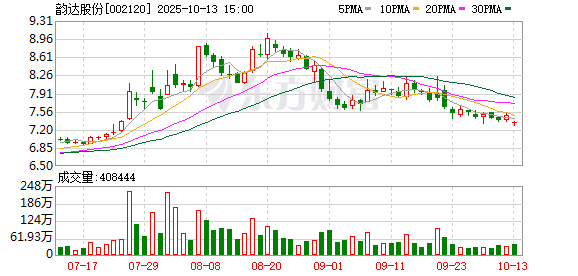
韵达股份:关于拟注册发行公司债券的公告
Zheng Quan Ri Bao· 2025-10-13 14:09
Core Viewpoint - Yunda Holdings announced plans to issue corporate bonds not exceeding RMB 2 billion, pending approval from the China Securities Regulatory Commission and the company's shareholders [2] Group 1 - The company will hold the 22nd meeting of the 8th Board of Directors and the 16th meeting of the 8th Supervisory Board on October 13, 2025, to review the proposal for bond issuance [2] - The bond issuance is subject to market interest rates and the company's funding needs at the time of issuance [2] - The registration for the bond issuance requires approval from the company's first extraordinary general meeting in 2025 [2]