上海银行

Search documents
上海融资租赁资产流转中心线上服务平台正式启动
Xin Lang Cai Jing· 2026-02-14 14:36
Core Viewpoint - The Shanghai Financing Leasing Asset Circulation Center online service platform was successfully launched on February 13, marking a significant step in supporting industrial upgrades and empowering technological innovation in the Lingang New Area [1][3]. Group 1: Platform Launch and Objectives - The platform aims to enhance digital service capabilities in the industry and create a more open and convenient leasing asset trading system, contributing to the construction of Shanghai as an international financial center [1][3]. - The initiative is a collaboration between the Lingang New Area Administrative Committee and the Shanghai Trading Group, focusing on "digitalization, marketization, and specialization" [1][3]. Group 2: Strategic Cooperation - A strategic cooperation agreement was signed between the Lingang New Area Administrative Committee and the Shanghai Trading Group to deepen collaborative efforts and improve platform functionalities [2][4]. - Key representatives from various financial institutions and regulatory bodies attended the launch ceremony, indicating strong support from the financial sector [2][4]. Group 3: Key Participants - Several major financial institutions, including Bank of Communications, Agricultural Bank of China, and Shanghai Rural Commercial Bank, completed significant project signings during the launch event [1][3].
21家系统重要性银行名单出炉!钱未存在这些银行里,有危险吗?
Sou Hu Cai Jing· 2026-02-14 09:50
央行正式公布了最新的全国系统性重要银行名单,共计21家商业银行入选。需特别说明的是,该名单明确排除了中国人民银行以及三家政策性银行,唯有具 备商业性质的银行方能入围。 21家银行按重要性程度被划分为四组:第一组包含11家银行,如民生银行、上海银行等,属于级别最低的梯队;第二组有兴业银行、中信银行、浦发银行和 邮储银行4家;第三组则纳入交通银行与招商银行;第四组作为最高级别,仅包含中国工商银行、中国农业银行、中国银行、中国建设银行四大国有银行。 值得注意的是,第五组目前暂无银行入选。 从整体规模看,截至2024年6月,我国银行业金融机构法人总数达4425家,而系统重要性银行仅占21席,占比不足0.5%。 这种稀缺性恰恰印证了它们的特殊性——入选银行不仅品牌响亮,更以庞大体量形成"大而不能倒"的市场认知,任何一家若出现经营风险,至少会对区域金 融系统产生重大冲击,其资产规模与业务辐射范围均属行业顶尖。 对于普通储户而言,将资金存入这21家系统重要性银行堪称"安心之选"。即便是第一组银行,也因获得央行隐性背书而具备极高安全性,储户无需过度担忧 单一账户存款规模限制,可放心进行大额储蓄。 那么未入选的4000多家存款 ...

我国系统重要性银行名单发布,共计21家
Xin Lang Cai Jing· 2026-02-14 07:12
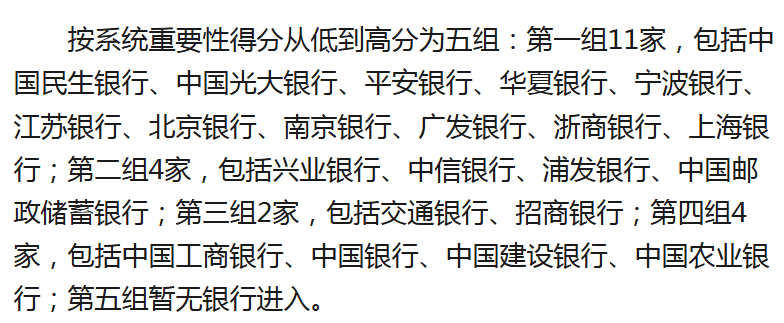
第五组,暂无银行进入。 记者2月13日从中国人民银行了解到,近期中国人民银行、国家金融监督管理总局开展了2025年度我国 系统重要性银行评估,认定21家国内系统重要性银行,其中国有商业银行6家、股份制商业银行10家、 城市商业银行5家。 中国人民银行表示,下一步将持续夯实系统重要性银行附加监管,促进系统重要性银行安全稳健经营和 健康发展,更好服务实体经济高质量发展。 按系统重要性得分从低到高分为五组: 第三组2家,包括:交通银行、招商银行; 第四组4家,包括:中国工商银行、中国银行、中国建设银行、中国农业银行; 第一组11家,包括:中国民生银行、中国光大银行、平安银行、华夏银行、宁波银行、江苏银行、北京 银行、南京银行、广发银行、浙商银行、上海银行; 第二组4家,包括:兴业银行、中信银行、浦发银行、中国邮政储蓄银行; 来源:央视新闻 ...
我国系统重要性银行上新
Zhong Guo Xin Wen Wang· 2026-02-14 05:45
中新网北京2月14日电2月13日,我国系统重要性银行名单公布。 21家国内系统重要性银行入选其中,包括6家国有商业银行、10家股份制商业银行和5家城市商业银行。 按系统重要性得分从低到高分为五组:第一组11家,包括中国民生银行、中国光大银行、平安银行、华 夏银行、宁波银行、江苏银行、北京银行、南京银行、广发银行、浙商银行、上海银行;第二组4家, 包括兴业银行、中信银行、浦发银行、中国邮政储蓄银行;第三组2家,包括交通银行、招商银行;第 四组4家,包括中国工商银行、中国银行、中国建设银行、中国农业银行;第五组暂无银行进入。 什么是系统重要性银行?入选意味着什么? 按照《系统重要性银行评估办法》,系统重要性是指金融机构因规模较大、结构和业务复杂度较高、与 其他金融机构关联性较强,在金融体系中提供难以替代的关键服务,一旦发生重大风险事件而无法持续 经营,可能对金融体系和实体经济产生不利影响的程度。 二是兴业银行被调整至第二组。 自2021年系统重要性银行名单披露以来,兴业银行一直属于第三组。 对于此次位次调整,董希淼认为,系统重要性银行评估基于规模、关联度、可替代性、复杂性等维度, 组别下调通常反映其在这些维度的综 ...
1月信贷社融点评:温和开门红
ZHESHANG SECURITIES· 2026-02-14 05:23
Investment Rating - The industry investment rating is "Positive" (maintained) [4] Core Insights - The report highlights a "strong deposit, weak loan" characteristic in the opening month of the year [4] - In January 2026, new social financing increased by 7.2 trillion yuan, a year-on-year increase of 166.2 billion yuan, with a balance growth of 8.2% [4][5] - New RMB loans in January 2026 amounted to 4.7 trillion yuan, a year-on-year decrease of 420 billion yuan, with a balance growth of 6.1% [4][5] - The report indicates that consumer demand has shown some recovery, particularly in short-term loans, but overall consumer credit demand may remain pessimistic throughout the year [1][2] Summary by Sections Credit Overview - Entity credit remained stable, with a significant reduction in bill financing [1] - Retail loans saw an increase of 456.5 billion yuan in January, with short-term loans contributing 109.7 billion yuan [1] - Corporate loans totaled 4.5 trillion yuan, a year-on-year decrease of 330 billion yuan, influenced by a substitution effect between short-term loans and bill financing [2] Social Financing - Government bonds contributed significantly to social financing, with new issuance of 976.4 billion yuan in January, a year-on-year increase of 283.1 billion yuan [5] - The report notes a trend of "deposit migration," with non-bank deposits reaching 36 trillion yuan, accounting for 10.7% of total deposits [5] Investment Recommendations - The report recommends a "New Momentum Portfolio" including banks like Nanjing Bank, Shanghai Bank, and others, highlighting their potential for value recovery [3][5] - It emphasizes the importance of high-dividend bank stocks in the current environment, suggesting that banks with new growth drivers may achieve greater value restoration [5]




最新21家系统重要性银行名单公布
Jing Ji Ri Bao· 2026-02-14 04:21
Group 1 - The People's Bank of China and the National Financial Regulatory Administration have conducted an assessment for the 2025 systemically important banks, identifying 21 domestic banks as systemically important, including 6 state-owned commercial banks, 10 joint-stock commercial banks, and 5 city commercial banks [1][3] - The list aims to establish a comprehensive macro-prudential management system and strengthen the regulation of systemically important financial institutions [2] Group 2 - Systemically important banks in China are categorized into five groups based on their importance scores, with the first group consisting of 11 banks, the second group having 4 banks, the third group with 2 banks, the fourth group containing 4 banks, and no banks in the fifth group [3] - The People's Bank of China plans to enhance the combined effect of macro-prudential management and micro-prudential regulation, continuing to solidify additional supervision for systemically important banks to promote their safe and sound operation and better serve the high-quality development of the real economy [3]




银行1月信贷社融点评:温和开门红
ZHESHANG SECURITIES· 2026-02-14 03:24
Investment Rating - The industry investment rating is "Positive" (maintained) [4] Core Insights - The report highlights a "strong deposit, weak loan" characteristic in the opening month of the year [4] - In January 2026, new social financing increased by 7.2 trillion yuan, a year-on-year increase of 166.2 billion yuan, with a balance growth of 8.2% [4][5] - New RMB loans in January 2026 amounted to 4.7 trillion yuan, a year-on-year decrease of 420 billion yuan, with a balance growth of 6.1% [4][5] - The report indicates that consumer demand has shown some recovery, particularly in short-term loans, but overall consumer credit demand may remain pessimistic throughout the year [1][2] Summary by Sections Credit Overview - Entity credit remained stable, with a significant reduction in bill financing [1] - Retail loans added 456.5 billion yuan in January, a year-on-year increase of 12.7 billion yuan [1] - Corporate loans added 4.5 trillion yuan, a year-on-year decrease of 330 billion yuan, primarily due to a reduction in bill financing [2] Social Financing - Government bonds contributed significantly to social financing, with new issuance of 976.4 billion yuan, a year-on-year increase of 283.1 billion yuan [5] - The report notes a trend of "deposit migration," with non-bank deposits reaching 36 trillion yuan, accounting for 10.7% of total deposits [5] Investment Recommendations - The report recommends a "New Momentum Portfolio" including banks such as Nanjing Bank, Shanghai Bank, and Industrial and Commercial Bank of China, highlighting their potential for value recovery [3][5] - It emphasizes the importance of high-dividend bank stocks as having allocation value amid steady declines in credit growth [5]
国有大行首次“上岗”这一职位,由行长兼任!中小银行早已跟进,有何影响?
券商中国· 2026-02-14 03:12
Core Viewpoint - The establishment of Chief Compliance Officers (CCOs) in major state-owned banks marks a significant shift in compliance management, emphasizing the importance of compliance at the highest management level [1][2][6]. Group 1: Establishment of Chief Compliance Officers - On February 13, Agricultural Bank of China and Bank of China announced the appointment of their respective CCOs, with the positions held by the banks' presidents [1][2]. - This move signifies the formal establishment of CCOs in major state-owned banks, replacing the previous supervisory board system that has been in place for over 20 years [2]. - The appointment of CCOs by bank presidents is seen as a way to elevate compliance responsibilities to the highest management level, fostering a culture of compliance within the organization [2][8]. Group 2: Regulatory Background - The "Compliance Management Measures" issued by the Financial Regulatory Authority came into effect on March 1, 2025, with a one-year transition period that is nearing its end [4][5]. - As of February 13, 21 out of 42 A-share listed banks have appointed CCOs, while half of the banks have yet to finalize their appointments [7]. Group 3: Industry Trends and Practices - Many listed banks are following suit in appointing CCOs, with recent announcements from Qilu Bank, Shanghai Bank, and Everbright Bank regarding their CCO appointments [3]. - Approximately half of the banks have adopted a model where senior executives, particularly bank presidents, serve as CCOs, which is prevalent among state-owned banks and some city commercial banks [7][8]. - The practice of having senior executives serve as CCOs is recommended to enhance the importance of compliance management and reduce operational costs associated with appointing separate compliance officers [8].



国内系统重要性银行名单发布 21家银行入选
Cai Jing Wang· 2026-02-14 02:03
Core Viewpoint - The People's Bank of China has conducted an assessment of systemically important banks for 2025, identifying 21 domestic banks categorized into five groups based on their systemic importance scores [1] Group 1: Assessment Overview - The assessment is part of a broader effort to establish a comprehensive macro-prudential management system and strengthen the regulation of systemically important financial institutions [1] - The evaluation was carried out in collaboration with the National Financial Regulatory Administration [1] Group 2: Classification of Banks - A total of 21 banks were recognized as systemically important, including 6 state-owned commercial banks, 10 joint-stock commercial banks, and 5 city commercial banks [1] - The banks are divided into five groups based on their systemic importance scores: - Group 1: 11 banks including China Minsheng Bank, China Everbright Bank, Ping An Bank, Huaxia Bank, Ningbo Bank, Jiangsu Bank, Beijing Bank, Nanjing Bank, Guangfa Bank, Zheshang Bank, and Shanghai Bank [1] - Group 2: 4 banks including Industrial Bank, China CITIC Bank, Shanghai Pudong Development Bank, and China Postal Savings Bank [1] - Group 3: 2 banks including Bank of Communications and China Merchants Bank [1] - Group 4: 4 banks including Industrial and Commercial Bank of China, Bank of China, China Construction Bank, and Agricultural Bank of China [1] - Group 5: No banks were classified in this group [1]

央行重要发布!名单公布
Sou Hu Cai Jing· 2026-02-14 01:14
Core Viewpoint - The People's Bank of China and the National Financial Regulatory Administration have conducted an assessment of systemically important banks for 2025, identifying 21 domestic banks categorized into five groups based on their systemic importance scores [1]. Group 1: Assessment of Systemically Important Banks - A total of 21 banks have been recognized as systemically important, including 6 state-owned commercial banks, 10 joint-stock commercial banks, and 5 city commercial banks [1]. - The banks are divided into five groups based on their systemic importance scores, with the first group containing 11 banks, the second group 4 banks, the third group 2 banks, the fourth group 4 banks, and the fifth group having no banks [1]. Group 2: Breakdown of Banks by Group - **First Group (11 banks)**: Includes China Minsheng Bank, China Everbright Bank, Ping An Bank, Huaxia Bank, Ningbo Bank, Jiangsu Bank, Beijing Bank, Nanjing Bank, Guangfa Bank, Zheshang Bank, and Shanghai Bank [1]. - **Second Group (4 banks)**: Includes Industrial Bank, China CITIC Bank, Shanghai Pudong Development Bank, and China Postal Savings Bank [1]. - **Third Group (2 banks)**: Includes Bank of Communications and China Merchants Bank [1]. - **Fourth Group (4 banks)**: Includes Industrial and Commercial Bank of China, Bank of China, China Construction Bank, and Agricultural Bank of China [1]. - **Fifth Group**: No banks are included in this group [1]. Group 3: Future Regulatory Actions - The People's Bank of China and the National Financial Regulatory Administration will implement additional regulatory measures for systemically important banks according to the "Regulations on Additional Supervision of Systemically Important Banks (Trial)" [1]. - The aim is to enhance the synergy between macro-prudential management and micro-prudential supervision, ensuring the safe and sound operation of systemically important banks and better supporting the high-quality development of the real economy [1].