老板电器

Search documents
年销170亿,方太超过老板电器一半多?
Xin Lang Cai Jing· 2026-01-27 02:28
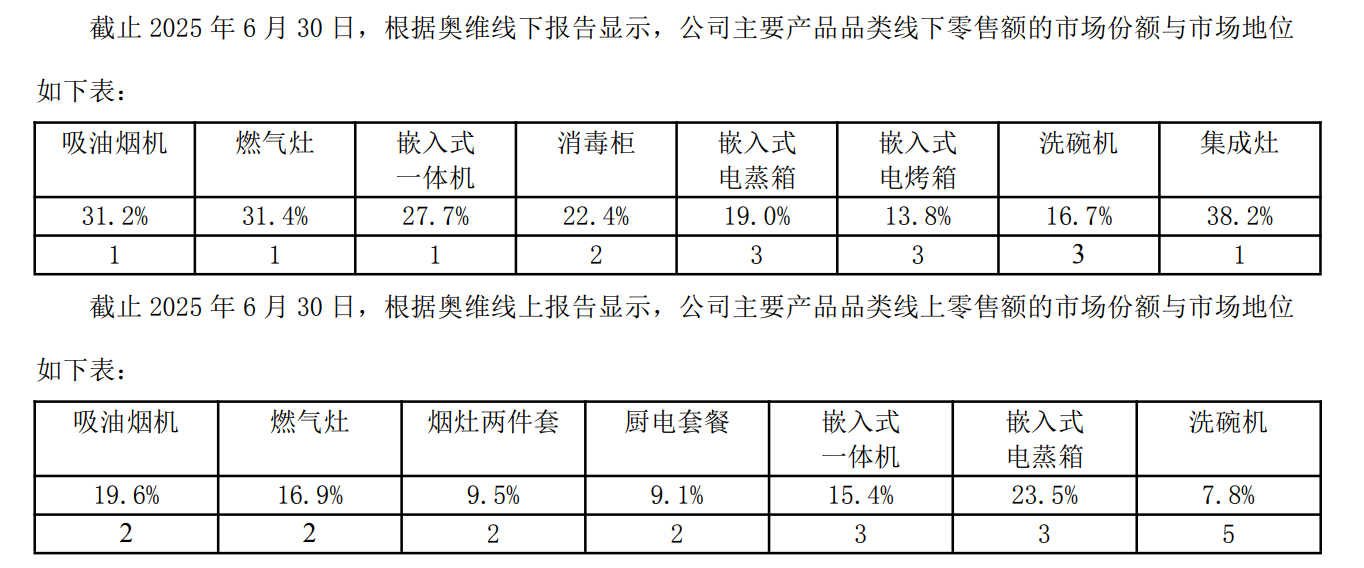
Core Viewpoint - The competition between Fotile and Boss Electric in the kitchen appliance sector is highlighted, with Fotile's revenue surpassing Boss Electric's by a significant margin, indicating a shift in market dynamics and strategies between the two companies [1][2][10]. Revenue Performance - Fotile reported a revenue of over 17 billion yuan in 2025, showing a slight increase compared to previous years, while Boss Electric's revenue for the same period is projected to be around 11.2 billion yuan, indicating that Fotile's revenue is 1.5 times that of Boss Electric [1][2][7]. - Boss Electric's revenue from 2019 to 2024 shows a gradual increase, but the first three quarters of 2024 saw a decline of 1.14% year-on-year, suggesting challenges in maintaining growth [2][6]. Market Share Insights - In the first half of 2025, Boss Electric held a market share of 31.2% for range hoods and 31.4% for gas stoves, while Fotile led the online market for range hoods with a 17.28% share, closely followed by Boss Electric at 17.27% [3][4]. - The overall market for integrated stoves has declined significantly, with Boss Electric's integrated stove revenue dropping by 45% year-on-year in the first half of 2025 [2][3]. Strategic Directions - Fotile is focusing on brand enhancement and high-end product offerings, aiming for a "professional, high-end, and boutique" strategy, while Boss Electric is adopting a channel-driven approach, targeting younger demographics and diversifying its product range [10][11][15]. - Both companies are navigating a challenging market environment, with Fotile emphasizing brand value and Boss Electric exploring new channels and product lines to attract consumers [12][16]. Future Outlook - The introduction of national subsidies in late 2024 is expected to provide temporary relief to the kitchen appliance market, but the long-term trend indicates continued challenges, especially with certain product categories excluded from future subsidies [7][8][9]. - The differing strategies of Fotile and Boss Electric will determine their ability to adapt and thrive in the evolving kitchen appliance landscape [17].


家电业共探供需适配新路径
Zhong Guo Jing Ji Wang· 2026-01-27 00:16
挖掘潜在需求 实现供需同频共振 在大会"行业趋势"环节,多位企业家达成共识,随着人口结构、居住形态和数字技术的变化,家电消费 呈现场景化、集成化、健康化特征,供给端创新须走在消费认知变化前列。行业的确定性机会,不再源 于简单模仿和价格竞争,而是来自对潜在需求的精准挖掘和满足。 转自:国际商报 □ 本报记者 何晓曦 1月22日,由中国家用电器商业协会主办的2026第十二届中国家电流通创新发展大会在北京召开。本次 大会以"供需适配与确定性机会"为主题,吸引了全国多地家电制造商、流通企业代表及行业专家、青年 企业家等参会,共同探讨新形势下家电产业转型升级与创新发展的路径。 产业升级的核心:解决供需错配问题 商务部原副部长张志刚在讲话中指出,家电产业是国民经济的重要组成部分,应顺应消费升级趋势,依 靠技术创新和模式创新双轮驱动,深化供给侧结构性改革,在智能、绿色、健康等领域挖掘新增长点, 为构建新发展格局贡献力量。他强调,产业升级的核心是解决供需结构性错配问题,通过技术与商业模 式的协同创新,在复杂市场环境中开辟可持续的增长路径。 中国家用电器商业协会党支部书记、理事长董芝表示,当前中国家电产业正处于从规模扩张向质量 ...
厨卫电器板块1月26日跌1.42%,帅丰电器领跌,主力资金净流入7289.5万元
Zheng Xing Xing Ye Ri Bao· 2026-01-26 09:37
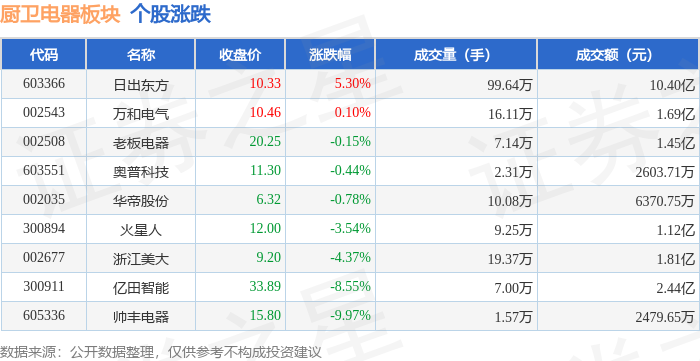
Group 1 - The kitchen and bathroom appliance sector experienced a decline of 1.42% on January 26, with Shuaifeng Electric leading the drop [1] - The Shanghai Composite Index closed at 4132.61, down 0.09%, while the Shenzhen Component Index closed at 14316.64, down 0.85% [1] - Notable stock performances included Rising Sun Oriental with a gain of 5.30% and Shuaifeng Electric with a loss of 9.97% [1] Group 2 - The kitchen and bathroom appliance sector saw a net inflow of 72.895 million yuan from main funds, while retail investors experienced a net outflow of 51.9875 million yuan [1] - Main fund inflows and outflows for specific stocks showed that Rising Sun Oriental had a net inflow of 1.3 billion yuan, while Shuaifeng Electric had a significant outflow of 8.7112 million yuan [2] - The overall trading volume for the sector was highlighted, with Shuaifeng Electric's trading volume at 15,700 shares and a transaction amount of approximately 24.7965 million yuan [1]



中国消费行业:2026 年 GCC 会议要点 -估值仍具吸引力,消费复苏迹象显现-China Consumer Sector_ 2026 GCC takeaways_ Sector valuation remains attractive with signs of consumption recovery
2026-01-26 02:50
Summary of Key Points from the Conference Call Industry Overview - **Sector**: China Consumer Sector - **Key Insights**: The sector shows signs of consumption recovery despite a near-term property market downturn. Valuation remains attractive, approximately 1 standard deviation below 10-year averages, indicating that a consumption recovery is not yet priced in [2][21]. Consumer Staples - **Baijiu**: Anticipated demand support for mid-end baijiu due to easing alcohol bans and private consumption growth. Companies are expected to accelerate channel transformations for sustainable EPS growth [3][8]. - **Beer**: Premiumization continues through product diversification and in-home channel expansion, despite on-trade softness. CR Beer expects low-single-digit volume growth in 2025, with Heineken volumes projected to grow by 20% YoY [3][8]. - **Dairy**: Liquid milk sales are expected to recover modestly in 2026, driven by marketing and innovation, despite a weak 2025. Fresh milk shows resilience with double-digit growth [3][8]. - **Freshly-Made Beverages (FMB)**: Guming is expected to maintain steady SSSG in 2026 through category expansion and dine-in growth, despite the phase-out of delivery subsidies [3][8][19]. - **Condiments**: Sequentially improving demand is expected, with Haitian focusing on multi-product categories and Jonjee anticipating a cleaner 2026 after a weak 4Q25 [3][8]. Consumer Discretionary - **Home Appliances**: Companies like Midea and Haier expect higher overseas growth compared to domestic markets in 2026. Strategies include price hikes and operational efficiencies [4][10]. - **Jewelry**: Brands with unique designs may consolidate post-VAT reform. Laopu is expected to achieve strong sales growth due to increased focus on value-added services [4][10]. - **Restaurants**: Intense competition leads to divergent strategies, with some companies lowering prices while others upgrade offerings. DPC Dash is on track for expansion despite market uncertainties [4][10]. Stock Implications - **Most Preferred Stocks**: CR Beer, Guming, MIXUE, China Foods, YUM China, among others, are highlighted as preferred investments due to their growth potential [5]. - **Least Preferred Stocks**: Companies like Swellfun, Nongfu, and Gree are noted as less favorable due to various challenges [5]. Key Risks - Risks include demand recovery uncertainties, cost inflation or deflation, and changes in the competitive landscape. These factors could significantly impact the consumer sector's performance [21]. Additional Insights - **Pet Food**: The industry is shifting towards online sales, with over 85% of sales occurring digitally. Competition is intensifying, pushing brands towards innovation and product differentiation [13]. - **Snack Sector**: Rapid category diversification and channel restructuring are creating growth opportunities, particularly through snack discounters [9][12]. This summary encapsulates the essential insights and projections from the conference call, providing a comprehensive overview of the current state and future outlook of the China consumer sector.




家电行业双周报(26/1/12-26/1/23):AI+智能硬件快速落地,国货加速出海抢占全球份额-20260125
Hua Yuan Zheng Quan· 2026-01-25 11:47
Investment Rating - The investment rating for the home appliance industry is "Positive" (maintained) [1] Core Insights - The report emphasizes the rapid implementation of AI and smart hardware, highlighting the transition of domestic brands from followers to leaders in the global market. Companies like YingShi Innovation, Anker Innovation, and XGIMI are identified as key players [4][8] - AI technology is reshaping product definitions in the home appliance and smart hardware sectors, enhancing product performance and user experience while accelerating global expansion [8] Summary by Sections AI + Smart Hardware - The report focuses on the "redefining products" direction of AI + smart hardware, with domestic brands making significant strides in global markets. Companies such as YingShi Innovation, Anker Innovation, and XGIMI are highlighted as representatives of this trend [4][8] AI + Photography - YingShi's "YingLing" panoramic drone launched in December 2025 achieved over 30,000 units shipped in its first month, confirming its potential as a blockbuster product. AI technology is expected to lower creative barriers and optimize effects, driving growth in the smart imaging sector [9] AI + Office and Audio - Anker's collaboration with Feishu to launch the AI recording device aims to penetrate the business market by leveraging Feishu's enterprise customer resources. Additionally, Anker's Soundcore Sleep A30 headphones utilize AI to generate personalized sleep soundscapes, enhancing their practical performance [12] AI + Security and Energy Storage - Anker's Eufy Security system has achieved multi-dimensional recognition capabilities for humans, pets, and vehicles, enhancing home security management efficiency. The SOLIX V1 Smart EV Charger optimizes energy efficiency through AI-driven scheduling and gesture recognition [17] AI + Glasses - The report notes a surge in AI glasses products from companies like XGIMI and TCL, with a focus on lightweight and practical designs. The market is in a penetration acceleration phase, with diverse product definitions emerging [19] Market Performance - The home appliance sector saw a 2.0% increase in January 2026, outperforming the CSI 300 index by 0.4%. Sub-sectors such as black appliances and kitchen appliances showed notable monthly gains of 13.4% and 5.4%, respectively [21][22] Key Data Tracking - As of January 23, 2026, the Chinese yuan appreciated by 149 basis points against the US dollar, continuing its upward trend. The LME copper spot price was $12,921 per ton, reflecting a week-on-week decrease of 0.6% but remaining at a high level [24][28]



家电行业 2026W04 周报:家电基金持仓略有下降,欧盟对割草机进口展开登记-20260125
GUOTAI HAITONG SECURITIES· 2026-01-25 07:47
Investment Rating - The report assigns an "Accumulate" rating for the home appliance industry [4]. Core Insights - The report highlights a slight decline in fund holdings in the home appliance sector, with a 2.6% allocation in actively managed equity funds for Q4 2025, down 0.2 percentage points from Q3 [2][4]. - The report notes that the production of household air conditioners in December 2025 was 14.782 million units, a year-on-year decrease of 18.7%, with domestic sales down 26.7% and exports down 13.2% [2][4]. - The report mentions that the EU has mandated registration for imports of robotic lawn mowers from China, with potential anti-dumping duties estimated between 21.4% and 57.4% [2][4]. Summary by Sections Investment Recommendations - The report suggests that national subsidies are expected to transition smoothly, and recommends several companies for investment based on their stable operations and high dividends, including Midea Group (13.1X), Haier Smart Home (11.4X), TCL Electronics (12.7X), and Hisense Visual (12.7X) [4]. - It highlights the core drivers for smart home appliances' overseas expansion, recommending leading robotic vacuum companies Roborock (20.3X) and Ecovacs (22.5X) [4]. - The report also recommends companies with stable performance and upward potential, such as Ninebot (19.9X), Anfu Technology (56.8X), Hailong Cold Chain (15.9X), and Beiding Co. (35.3X) [4]. - Additionally, it points out companies expanding into new business lines, recommending Rongtai Health (21.3X) and Wanlong Magnetic Plastic (21.9X) [4]. Market Data - The report provides data on the top five holdings in the home appliance sector, with Midea Group valued at 19.9 billion, Haier Smart Home at 6 billion, and others showing varying changes in market value [4]. - It notes that the overall retail sales of home appliances in December 2025 were 97.1 billion, a year-on-year decrease of 18.7% [2][4]. - The report indicates that the total domestic sales volume for the air conditioning industry in 2025 was 10.521 million units, a slight increase of 0.7% year-on-year, while total exports were 9.318 million units, down 3.4% [2][4].




厨卫电器板块1月23日涨1.18%,浙江美大领涨,主力资金净流入3799.74万元
Zheng Xing Xing Ye Ri Bao· 2026-01-23 09:04
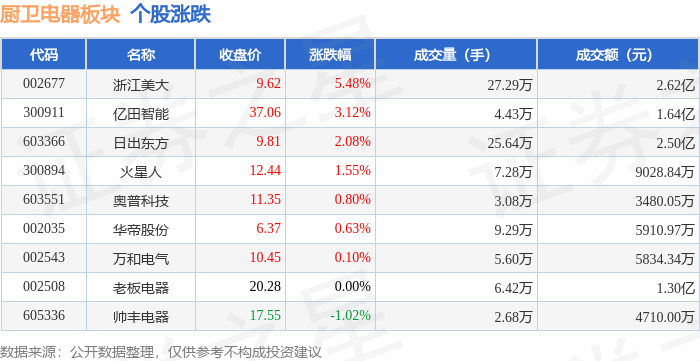
Group 1 - The kitchen and bathroom appliance sector increased by 1.18% on January 23, with Zhejiang Meida leading the gains [1] - The Shanghai Composite Index closed at 4136.16, up 0.33%, while the Shenzhen Component Index closed at 14439.66, up 0.79% [1] - Key stocks in the kitchen and bathroom appliance sector showed varied performance, with Zhejiang Meida rising by 5.48% to a closing price of 9.62 [1] Group 2 - The main capital inflow in the kitchen and bathroom appliance sector was 37.9974 million yuan, while retail investors saw a net outflow of 11.0005 million yuan [1] - Individual stock capital flows indicated that Sunrise Oriental had a main capital inflow of 28.7176 million yuan, but retail investors experienced a net outflow of 18.2127 million yuan [2] - Zhejiang Meida had a main capital inflow of 11.5743 million yuan, with retail investors also seeing a net outflow of 2.9917 million yuan [2]
老板电器(002508) - 关于使用部分自有闲置资金进行投资理财的公告
2026-01-23 08:30
关于使用部分自有闲置资金进行投资理财的公告 本公司及董事会全体成员保证信息披露内容的真实、准确和完整,没有虚 假记载、误导性陈述或重大遗漏。 杭州老板电器股份有限公司(以下简称"公司")分别于 2025 年 4 月 28 日、2025 年 5 月 19 日召开第六届董事会第十三次会议及第六届监事会第十二次 会议和 2024 年年度股东大会审议通过了《关于使用自有闲置资金进行投资理财 的议案》,同意公司使用自有闲置资金不超过 65 亿元人民币购买安全性高、流 动性好的理财产品,在额度内资金可以循环滚动使用。同时,授权公司管理层具 体实施上述投资理财,授权期限自 2024 年年度股东大会通过之日起至 2025 年年 度股东大会召开之日止。 具体内容详见 2025 年 4 月 29 日、2025 年 5 月 20 日刊登于《证券时报》、 《 中 国 证 券 报 》 、 《 证 券 日 报 》 、 《 上 海 证 券 报 》 及 巨 潮 资 讯 网 (http://www.cninfo.com.cn)上的《第六届董事会第十三次会议决议公告》(公 告编号 2025-003)、《第六届监事会第十二次会议决议公告》(公告编 ...
小红日报 | 奥特维收涨14.41%,标普A股红利ETF华宝(562060)标的指数上涨0.83%创新高
Xin Lang Cai Jing· 2026-01-23 01:16
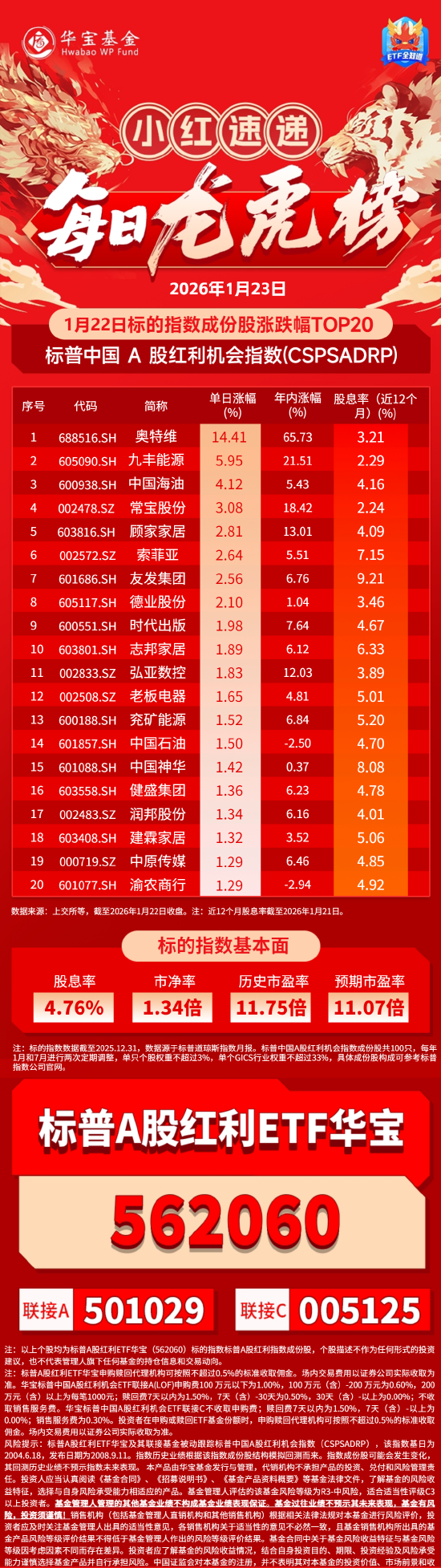
Group 1 - The article highlights the top 20 stocks in the S&P China A-Share Dividend Opportunity Index (CSPSADRP) based on their daily and year-to-date performance as of January 22, 2026 [1][5] - The stock "奥特维" (code: 688516.SH) leads with a daily increase of 14.41% and a year-to-date increase of 65.73%, with a dividend yield of 3.21% [1][5] - Other notable performers include "九丰能源" (code: 605090.SH) with a daily increase of 5.95% and a year-to-date increase of 21.51%, and "中国海滩" (code: 600938.SH) with a daily increase of 4.12% and a year-to-date increase of 5.43% [1][5] Group 2 - The overall dividend yield for the index is reported at 4.76%, with a historical price-to-earnings (P/E) ratio of 11.75 times and an expected P/E ratio of 11.07 times [2] - The data indicates a positive trend in stock performance, with several companies showing significant year-to-date gains, suggesting a favorable investment environment [4][8]





当AI走进后厨:商用厨房正在发生的一次系统性升级
Di Yi Cai Jing· 2026-01-22 10:56
Core Insights - The restaurant industry is experiencing a dichotomy where consumer interest in cooking processes is rising, emphasizing "freshly cooked" and "wok flavor," while operators face increasing pressures related to costs, labor, and efficiency [3] - The kitchen, particularly the back-of-house operations, is under strain from conflicting demands for consumer experience and operational profitability, leading to a transformation in how kitchens are managed and operated [3] Industry Overview - The commercial kitchen market is substantial, with a projected revenue of 57,982 billion yuan by 2025, yet the penetration of smart technology remains below 10% [4] - The operational logic of commercial kitchens has traditionally relied on human experience, which becomes problematic as restaurants scale up, leading to challenges in consistency and rising labor costs [4][5] Technological Integration - Cooking robots are emerging as essential operational tools, addressing the most challenging aspects of kitchen standardization, such as timing and experience [5] - Companies like Boss Electric are integrating AI and systematic capabilities into their long-term strategies to address efficiency and stability issues in the restaurant industry [5][8] Strategic Moves - Boss Electric's investment in Youte Smart Kitchen signifies a shift towards a more data-driven approach in kitchen operations, allowing for the collection and calibration of cooking processes [8][11] - The focus is shifting from individual equipment to system capabilities, with the potential for significant competitive advantages for those who can create a closed loop of "equipment-data-system" [11][12] Future Directions - The commercial kitchen sector is moving towards a systematic competition phase, where understanding the entire cooking process becomes crucial for success [13][16] - The integration of AI into kitchens is not merely about automation but about creating a comprehensive management system that enhances overall kitchen efficiency and collaboration [15][18] Conclusion - The evolution of commercial kitchens is driven by the need for efficiency and consumer expectations for authentic cooking experiences, with AI technology playing a pivotal role in this transformation [18][19]