
Tokyo Electron

Search documents
日本科技_半导体资本设备_亚洲科技考察行 - 重申整体 AI 相关需求强劲-Japan Technology_ Semiconductor Capital Equipment_ Asia Tech Tour_ Reaffirming strong AI-related demand as a whole
2025-12-16 03:30
Summary of Key Points from the Conference Call Industry Overview - The conference focused on the semiconductor capital equipment industry, particularly highlighting strong demand for AI-related products across various companies involved in this sector [1] Company-Specific Insights HOYA - **Demand and Growth**: HOYA expects over 10% growth in HDD glass substrates due to high visibility in nearline-related demand, despite supply chain constraints [2] - **Operational Adjustments**: The company plans to ramp up operations in Laos to meet current demand [2] - **EUV Blanks**: HOYA is experiencing a steady flow of EUV blank orders, anticipating stable annual growth of over 10%, driven by expanding demand for GPUs and ASICs due to generative AI [3] Advantest - **Current Demand**: Advantest reported firm demand for both SoC testers and memory testers, with current-generation GPUs driving the strength in SoC testers and HBM4 driving memory testers [4] - **Production Capacity**: The company is actively expanding production capacity and has strategically procured components to avoid bottlenecks [4] - **Future Demand**: Management expects demand for ASIC testers to ramp up as early as Q4 FY3/26, with a significant scale anticipated due to the need for test data accumulation [5] Tokyo Electron - **Market Outlook**: Tokyo Electron expects growth to outpace the wafer fabrication equipment (WFE) market, particularly in CY26, with double-digit growth in DRAM continuing into CY27 [9] - **Earnings Drivers**: The company highlighted opportunities in gas chemical etching for the 2nm logic process and cryogenic etching in 3D-NAND as key drivers for earnings growth [10] Additional Insights - **Investment Ratings**: - HOYA is rated as a "Buy" with a target price of ¥26,500 based on a sum-of-the-parts valuation [11] - Advantest is rated "Neutral" with a target price of ¥18,000, influenced by fluctuations in customer capex and market share [11] - Tokyo Electron is also rated "Buy" with a target price of ¥38,000, with risks including prolonged inventory adjustments and export restrictions [11] Risks and Considerations - **Market Risks**: The semiconductor industry faces risks such as fluctuations in customer capex appetite, changes in competitive landscapes, and potential shifts in interest rates [11] - **Operational Risks**: Companies are navigating supply chain constraints and the need for strategic procurement to maintain production capacity [4][5] This summary encapsulates the key points discussed during the conference call, providing insights into the semiconductor capital equipment industry and specific company performances and expectations.
Asian Shares Decline On Tech Concerns
RTTNews· 2025-12-15 08:37
Market Overview - Asian stocks experienced a decline as investors expressed concerns over technology valuations and reacted to disappointing economic data from China [1] - Chinese shares fell due to bondholders of distressed developer China Vanke rejecting a bond payment extension proposal, highlighting structural weaknesses in the economy [2] - The Japanese market also tumbled, with tech shares following their U.S. counterparts lower amid valuation concerns [4] Economic Data - China's industrial production grew by 4.8 percent year-on-year in November, missing forecasts of 5.0 percent and down from 4.9 percent in October [2] - Retail sales in China rose by 1.3 percent annually, falling short of the expected 3.0 percent increase and down from 2.9 percent in the previous month [3] - Fixed asset investment in China decreased by 2.6 percent year-on-year, missing forecasts for a loss of 2.4 percent [3] Sector Performance - In Japan, the Nikkei average dropped by 1.31 percent, while the broader Topix index saw a slight increase of 0.22 percent [4] - Major decliners included Advantest, which plunged by 6.4 percent, and SoftBank Group, which lost 6 percent [4] - In South Korea, the Kospi average fell by 1.84 percent, with Samsung Electronics and SK Hynix losing 3.8 percent and 3 percent, respectively, due to concerns over AI margins [5] Commodity and Currency Movements - Gold prices surged nearly 1 percent to a seven-week high as the U.S. dollar struggled ahead of key economic data releases [1] - Oil prices increased slightly due to supply disruptions in Venezuela, despite concerns over oversupply in the new year [1] Investor Sentiment - U.S. stocks ended significantly lower as investors took profits from high-flying AI-related stocks amid valuation concerns [7] - Higher Treasury yields negatively impacted market sentiment, with the tech-heavy Nasdaq Composite dropping by 1.7 percent [8]


Asian Shares Rally As Investors Ponder Fed Outlook
RTTNews· 2025-12-12 08:36
Market Overview - Asian stocks experienced a rally following a less hawkish outlook from the U.S. Federal Reserve, with the U.S. dollar remaining stable and gold prices near a seven-week peak [1] - Oil prices increased due to concerns over potential supply disruptions from Venezuela [1] Chinese Market - Chinese shares mostly rose, with the Shanghai Composite increasing by 0.41% to 3,889.35, supported by a commitment from Beijing to maintain a "proactive" fiscal policy aimed at stimulating consumption and investment [2] - The Hang Seng index in Hong Kong surged by 1.75% to 25,976.79, driven by expectations of further growth initiatives from Chinese authorities [2] Japanese Market - Japanese stocks rallied, with the Nikkei average climbing 1.37% to 50,836.55, influenced by reports of SoftBank Group and Nvidia discussing a $1 billion investment in Skild AI [3] - The broader Topix index rose by 1.98% to 3,423.83, while SoftBank shares increased by 3.9% [4] South Korean Market - Seoul stocks rebounded with the Kospi average surging 1.38% to 4,167.16, following strong earnings from Broadcom [5] - SK Hynix's shares rose by 1.1% despite a warning advisory from the Korea Exchange [5] Australian and New Zealand Markets - The S&P/ASX 200 index in Australia rose by 1.23% to 8,697.30, led by gains in financials and mining sectors [6] - New Zealand's S&P/NZX 50 index finished slightly higher at 13,406.91, following a survey indicating slight expansion in the manufacturing sector [6] U.S. Market - U.S. stocks ended a volatile session mostly higher, with the Dow increasing by 1.3% and the S&P 500 rising by 0.2%, both reaching new records [7][8] - The Nasdaq Composite, however, slipped by 0.3% due to Oracle's disappointing revenue and guidance, raising concerns about AI overspending [8]
MKS Instruments (NasdaqGS:MKSI) FY Conference Transcript
2025-12-09 12:02
Summary of MKS Instruments FY Conference Call Company Overview - **Company**: MKS Instruments (NasdaqGS: MKSI) - **Industry**: Semiconductor Equipment and Advanced Electronics - **History**: Founded 65 years ago, initially focused on vacuum pressure measurement, expanded into semiconductor equipment, and has maintained a leading market share in vacuum equipment for semiconductors for over 55 years [2][56] Key Points and Arguments Market Position and Strategy - MKS has developed a comprehensive strategy surrounding semiconductor equipment, acquiring Newport Corporation in 2015, which added critical components like lithography, metrology, and inspection, allowing MKS to address 85% of equipment in semiconductor fabs globally [3][56] - The company has expanded into new markets, including laser applications for PCB manufacturing through acquisitions like Electro Scientific Industries and Atotech, aiming to be foundational to advanced electronics beyond just semiconductors [4][57] Growth Drivers - **Electronics and Packaging (E&P)**: MKS expects about 20% growth for the full year, driven by strong demand for chemistry products in the PCB industry, particularly from AI applications [8][61] - **Chemistry and Equipment**: The E&P segment consists of two-thirds chemistry and one-third equipment, with chemistry growing at approximately 10% year-over-year, supported by increased complexity in AI server PCBs [12][65] - **Equipment Orders**: MKS has seen strong bookings for chemistry equipment, with orders booked through the first half of 2026, indicating robust growth potential [16][69] Financial Performance - **Gross Margins**: Current gross margins are impacted by a mix of equipment sales and tariffs, with a target to return to over 47% as the mix normalizes and operational efficiencies improve [19][71] - **Tariff Impact**: Tariffs have negatively affected gross margins by approximately 50 basis points, but MKS is confident in offsetting this through operational excellence [36][71] Semiconductor Market Outlook - MKS anticipates a 10% growth in the semiconductor segment for the year, driven by inventory burn-off in NAND and upgrades in logic, DRAM, and HBM [22][75] - The company is addressing concerns about cleanroom capacity, which could constrain growth, but sees potential upside from NAND upgrades and new greenfield projects [26][78] R&D and Competitive Advantage - MKS emphasizes the importance of R&D investment to maintain a competitive edge, particularly in complex technologies like atomic layer deposition (ALD) and RF power systems [28][32] - The company has doubled its revenue in the optics segment from $150 million to $300 million over five years, indicating successful growth in this area [20][72] Future Expectations - MKS is optimistic about 2026, expecting continued growth driven by strong demand across various semiconductor applications, with a focus on maintaining close communication with major customers to anticipate needs [24][77] - The company aims to achieve a net leverage of 2 to 2.5 times in the next couple of years, focusing on debt repayment and capital allocation strategies [42][43] Additional Important Insights - MKS's unique position in the market allows it to benefit from various semiconductor trends, including the shift towards more complex chip packaging and the integration of AI technologies [5][6] - The company’s strategy of managing a broad portfolio of critical subsystems positions it well to adapt to changing market demands and technological advancements [30][31]

Asian Shares Slide Amid Anxiety Before Fed Decision
RTTNews· 2025-12-09 08:42
Market Overview - Asian stocks declined ahead of the Federal Reserve's interest-rate decision, with expectations of a 25 basis-point rate cut despite divisions within the committee [1] - The U.S. dollar faced pressure in Asian trade, while gold traded below $4,200 per ounce and oil prices remained steady after a 2 percent drop in the previous sessions [2] Regional Indices - China's Shanghai Composite index fell by 0.37 percent to 3,909.52, following the Politburo's announcement of plans to enhance domestic demand for 2026 through proactive fiscal and loose monetary policies [2] - Hong Kong's Hang Seng index dropped 1.29 percent to 25,434.23, primarily due to declines in tech stocks [3] - Japan's Nikkei average increased by 0.14 percent to 50,655.10, while the broader Topix index remained relatively unchanged at 3,384.92 ahead of the Bank of Japan's policy decision [3] - Seoul's Kospi average decreased by 0.27 percent to 4,143.55, ending a two-session winning streak amid uncertainty regarding the Federal Reserve's policy direction [4] Sector Performance - Tech shares, including SoftBank Group, Advantest, and Tokyo Electron, saw gains after Nvidia received permission to ship its H200 AI chip to China, leading to a 25 percent cut of sales [4] - Semiconductor and auto shares experienced declines due to profit-taking after recent strong gains, with Samsung Electronics down 1 percent, SK Hynix down 1.9 percent, and Hyundai Motor down 2.7 percent [5] - Australian markets fell as the Reserve Bank of Australia maintained interest rates, citing inflation risks, with the S&P/ASX 200 dropping 0.45 percent to 8,585.90 [5] - New Zealand's S&P/NZX-50 index decreased by 0.23 percent to 13,454.78, reversing earlier gains [6] U.S. Market Impact - U.S. stocks ended lower as Treasury yields rose due to inflation concerns, with the Dow down 0.5 percent, the Nasdaq Composite down 0.1 percent, and the S&P 500 down 0.4 percent [6]

日本突发7.6级地震,对半导体产业影响几何?
Sou Hu Cai Jing· 2025-12-09 02:17
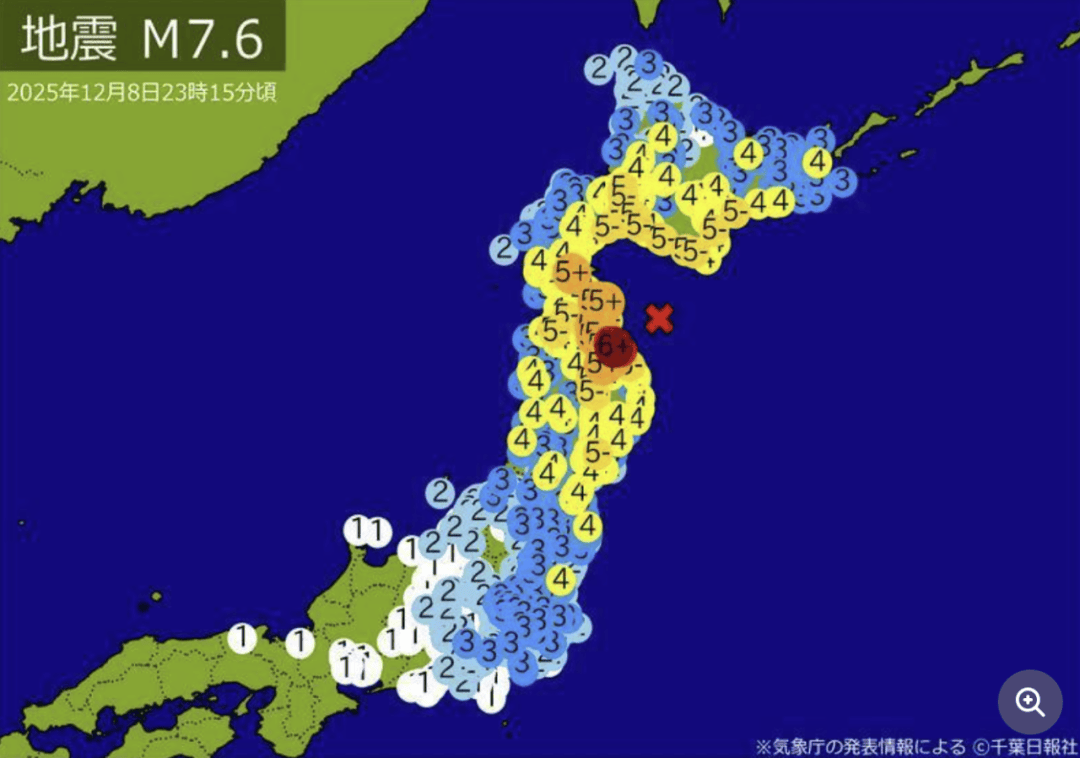
Group 1 - A 7.6 magnitude earthquake struck the eastern sea area of Aomori Prefecture, Japan, on December 8, causing significant tremors and tsunami warnings in Aomori, Iwate, and Hokkaido [1][5] - The earthquake resulted in tsunami waves reaching up to 70 cm in Iwate, 50 cm in Hokkaido, and 40 cm in Aomori, with Aomori experiencing intense shaking classified as "upper six" on the Japanese seismic intensity scale [5] - Approximately 2,700 households in Aomori experienced power outages due to the earthquake, while nuclear power plants in the affected regions reported no abnormalities [5] Group 2 - The earthquake's impact on Japan's semiconductor industry is a concern, as the affected areas include regions critical to semiconductor manufacturing [5] - Major semiconductor companies located in Iwate Prefecture include Kioxia's Fab 1 and Fab 2, Toshiba Semiconductor, and Japan Semiconductor Corporation, all of which are situated in areas with a seismic intensity of "4" [6][8] - In Aomori, semiconductor testing equipment manufacturer MJC and PVD equipment manufacturer ULVAC have facilities in areas with seismic intensities of "4" and "6+" respectively, while the only semiconductor manufacturer in Hokkaido, Rapidus, is constructing a 2nm wafer plant in an area with a seismic intensity of "5-" [8] - While some semiconductor companies near the epicenter may face operational disruptions, the overall impact on the global semiconductor supply chain is expected to be limited, although any disruption at Kioxia's NAND Flash facility could exacerbate current shortages and price increases [8]
日本股票策略市场探索_2026 展望_牛市延续,日经指数冲击 60000 点高位-Japan Equity Strategy Market Explorer_ 2026 outlook_ 2026 outlook_ Bull market continues, 60,000 high for the Nikkei
2025-12-08 15:36
Summary of Japanese Equity Strategy Market Explorer Industry Overview - The report focuses on the Japanese equity market, specifically the performance and outlook for the Nikkei 225 and TOPIX indices. Core Insights and Arguments 1. **Bullish Outlook for 2026** - Japanese equities are expected to continue rising in 2026, with forecasted annual highs of 4,000 for TOPIX and 60,000 for the Nikkei 225 [1][2][29] 2. **Strong Corporate Earnings** - Anticipated strong corporate earnings in an inflationary environment, with a positive surprise ratio consistently above 50% since 2023 [36][37] - Earnings growth is particularly expected in sectors dependent on domestic demand, despite potential negative impacts from yen appreciation [3][36] 3. **Investment Themes and Sector Recommendations** - Key investment themes for 2026 include government economic policy, corporate governance code amendments, and sustained inflation [4] - Overweight positions are recommended in energy, capital goods/services, and real estate sectors, while underweight positions are suggested for ICT, consumer staples, and communication services [4] 4. **Market Characteristics in 2025** - The Japanese equity market has shown decoupling from forex rates, with significant polarization in sector performance [17][18] - Stock selection has been theme-focused, particularly on AI, data centers, and other high-growth sectors [25] 5. **Performance Metrics** - As of December 4, 2025, the year-to-date returns for Japanese equities were 27.9% for the Nikkei 225 and 22.0% for TOPIX, marking the third consecutive year of double-digit returns [9][12] 6. **Foreign Investment Trends** - There has been a notable increase in foreign investment in Japanese equities, which is less correlated with forex rates than in previous years [18][20] 7. **Sector Performance Disparities** - Significant disparities exist between sector performances, with steel & nonferrous metals leading gains at 57.8%, while sectors like pharmaceuticals and raw materials lagged behind [22][23] 8. **Macroeconomic Forecasts** - The macroeconomic outlook includes stable growth rates, potential rate cuts by the Federal Reserve and ECB, and a modest hike by the Bank of Japan [29][30] Additional Important Content - **Government Economic Stimulus** - Continued government economic stimulus is expected to support household budgets and drive domestic demand [37][56] - **Valuation Concerns** - Despite high price-to-earnings ratios nearing historical upper limits, strong underlying fundamentals suggest further upside potential for Japanese equities [2][29] - **Sector-Specific Recommendations** - Specific companies highlighted for investment include Sumitomo Rubber Industries, Shin-Etsu Chemical, and Nintendo, among others, with respective buy ratings [5] This comprehensive analysis provides a detailed outlook on the Japanese equity market, emphasizing the potential for continued growth and the importance of sector selection in investment strategies.
2026 全球股票展望:涨势延续-Global Equity 2026 Outlook_ The rally rolls on
2025-12-08 00:41
Summary of Key Points from the Conference Call Industry Overview - The report focuses on the global equity market outlook for 2026, emphasizing the impact of AI, fiscal stimulus, and regional market preferences. Core Themes and Arguments 1. **AI Trade Expansion**: The next phase of the AI trade is expected to broaden beyond major players, with software infrastructure and non-US companies capturing more economic benefits [2][8][76]. 2. **US Earnings Growth**: Earnings growth is anticipated to broaden, with the "Magnificent 7" slowing to 18% year-over-year by Q4 2026, while the S&P 493 is expected to increase EPS growth to 17% from 9% [3][25]. 3. **Cyclicals Outperforming**: Cyclical sectors are projected to lead as the economy remains resilient, supported by AI investments and fiscal stimulus across major economies [3][42]. 4. **International Equities**: A weaker USD is expected to favor international equities, particularly in Emerging Markets (EM) and Europe excluding the UK [4][59]. 5. **Global Investor Shift**: There is a notable shift towards non-US AI stocks, with EM and Japan offering attractive growth opportunities at lower valuations [5][76][78]. 6. **Valuation Support**: Despite elevated equity valuations, they are supported by rising return on equity (ROE) and lower cost of equity (COE) [6][97]. 7. **Retail Investor Demand**: Retail investors are expected to remain significant buyers, with potential inflows from time deposits into equities if the Federal Reserve eases [5][112][113]. Important but Overlooked Content - **AI Adoption Metrics**: AI adoption among US companies is increasing, with 45% of firms having paid AI model subscriptions, indicating a growing trend that may not yet be fully priced into the market [9][19]. - **Cost Control Strategies**: Companies are expected to leverage operating leverage and cost control to enhance earnings, as evidenced by a rise in WARN notices indicating targeted layoffs rather than acute stress [26][27]. - **Cyclicals and Consumer Discretionary**: The consumer discretionary sector may show resilience despite mixed signals, supported by fiscal measures and lower interest rates [44][45]. - **European Banks**: European banks are positioned for growth with strong earnings revisions and attractive valuations compared to US peers [45][101]. - **Emerging Market Dynamics**: EM equities are becoming more growth-oriented, with regulatory changes in markets like China promoting buybacks and reducing dilution [61]. Regional Preferences - **Overweight**: Emerging Markets (prefer China and South Africa), Europe excluding the UK (favoring Germany, banks, and industrials). - **Neutral**: US (favoring cyclicals over defensives, avoiding small caps). - **Underweight**: Japan (cautious on banks, preferring materials) [5][59]. This summary encapsulates the key insights and themes discussed in the conference call, providing a comprehensive overview of the anticipated trends and dynamics in the global equity market for 2026.
Asian shares are mixed after Wall Street inches closer to its all-time high
ABC News· 2025-12-05 07:02
Market Overview - Asian shares exhibited mixed performance, with Japan's Nikkei 225 declining by 1.2% to 50,408.70, influenced by a 3.0% year-on-year drop in household spending for October, marking the sharpest decline since January 2024 [2][4] - The S&P 500 inched up by 0.1% to 6,857.12, remaining just 0.5% below its all-time high, while the Dow Jones Industrial Average dipped 0.1% to 47,850.94 [6][7] - South Korea's Kospi index rose by 1.1% to 4,074.00, with notable gains from LG Electronics (up 5.6%) and Hyundai Motors (up 7.2%) [4] Economic Indicators - U.S. futures were higher, while oil prices fell, with U.S. benchmark crude decreasing by 17 cents to $59.50 per barrel and Brent crude slipping by 11 cents to $63.15 per barrel [5][9] - The Reserve Bank of India cut its repo rate to 5.25% from 5.5%, citing weak price pressures and expectations for slowing economic growth [5] Federal Reserve and Interest Rates - Traders are cautious ahead of a key U.S. inflation report that could influence Federal Reserve policy, with expectations for a potential interest rate cut next week [3][7] - Recent reports indicated a stronger job market than expected, with fewer workers filing for unemployment, the lowest in over three years, and layoffs announced last month falling by more than half from October's surge [8][9]

Asian Shares Mixed; Japan's Nikkei Closes At 3-week High
RTTNews· 2025-12-04 08:35
Group 1: Market Overview - Asian stocks ended mixed, with concerns over AI demand and margins following Microsoft's lowered sales targets [1] - Investors are cautious ahead of upcoming rate decisions by the Federal Reserve and the Bank of Japan [1] - The dollar faced pressure due to weak U.S. data, increasing expectations for a Fed rate cut [1] Group 2: Regional Market Performance - China's Shanghai Composite index fell slightly to 3,875.79 amid worries over slowing services growth and a prolonged property slump [2] - Hong Kong's Hang Seng index rose by 0.68 percent to 25,935.90 [2] - The Nikkei average surged 2.33 percent to 51,028.42, reaching a three-week closing high [3] - The broader Topix index increased by 1.92 percent to 3,398.21, with notable gains in Tokyo Electron and SoftBank Group [3] - Seoul's Kospi average slipped 0.19 percent to 4,028.51, led by losses in chipmakers [4] - Australian markets saw modest gains, with the S&P/ASX 200 up 0.27 percent to 8,618.40, driven by strong copper prices [5] - New Zealand's S&P/NX-50 index declined by 0.49 percent to 13,515.62, ending a two-day winning streak [6] Group 3: Economic Indicators - U.S. private sector employment unexpectedly declined by 32,000 in November, contrary to expectations of a 10,000 job increase [6] - U.S. services activity expanded at a slightly faster pace in November, with the Dow rising by 0.9 percent and the S&P 500 adding 0.3 percent [7]