Trilogy Metals Inc.

Search documents
Why Trilogy Metals Stock Crashed Today
Yahoo Finance· 2025-10-27 15:21
Core Viewpoint - Trilogy Metals' stock experienced significant volatility following the announcement of a 10% stake acquisition by the Trump administration, aimed at countering Chinese export restrictions on rare-earth metals, leading to a tripling of its stock price in a single day [1] Group 1: Stock Performance - After the initial surge, Trilogy Metals' stock saw a sell-off but remained nearly double its previous value [2] - As of the latest reports, Trilogy's stock has declined by 18.9% [2] Group 2: Trade Developments - Recent trade negotiations between the U.S. and China have resulted in a framework that includes China increasing its rare-earth metal exports to the U.S. and the U.S. retracting tariff threats [4][9] - This agreement poses challenges for Trilogy Metals, which relies on a U.S. market that is currently in need of rare-earth supplies [5] Group 3: Future Prospects - The fear of a rare-earth supply crunch had previously driven Trilogy's stock up nearly 800% over the past year, but the potential for increased Chinese and Malaysian supplies could diminish these gains [6][7] - The development of rare-earth supplies in Malaysia, which has significant reserves, could further reduce the demand for Trilogy's products in the U.S. market [6][7] Group 4: Investment Considerations - Analysts have suggested that Trilogy Metals may not be a favorable investment at this time, with other stocks being recommended as better options for potential returns [10]

Government-Backed Stocks Have Exploded 80%–Here’s How Small Investors Can Benefit
Investing· 2025-10-27 08:39
Group 1: Company Analysis - Intel Corporation is highlighted for its ongoing efforts in innovation and market positioning within the semiconductor industry [1] - Trilogy Metals Inc is noted for its strategic focus on mining and exploration in the resource sector, particularly in relation to copper and zinc [1] - VanEck Rare Earth and Strategic Metals ETF is discussed in the context of its investment strategy targeting rare earth elements and strategic metals, which are critical for various technologies [1] - Global X Lithium & Battery Tech ETF is emphasized for its role in the growing lithium market, driven by the demand for electric vehicles and battery technologies [1] Group 2: Market Trends - The analysis covers the increasing demand for semiconductors, driven by technological advancements and consumer electronics [1] - There is a notable trend towards sustainable mining practices and the importance of rare earth elements in the transition to green energy [1] - The lithium market is experiencing significant growth, influenced by the rise of electric vehicles and renewable energy storage solutions [1]


Jim Cramer on Trilogy Metals: “Has Been Losing Money Year After Year After Year’
Yahoo Finance· 2025-10-25 04:44
Group 1 - Trilogy Metals Inc. (NYSE:TMQ) has experienced a significant increase of approximately 345% for the year, despite a recent decline from $11 to $5 within eight days [1][2] - The company focuses on exploring and developing mineral properties, particularly in copper, cobalt, zinc, gold, and silver [2] - The stock is currently viewed as having a parabolic move that is now declining, leading to recommendations to sell [2]
Jim Cramer on Trilogy Metals: “You Gotta Sell That”
Yahoo Finance· 2025-10-24 12:12
Group 1 - Trilogy Metals Inc. (NYSE:TMQ) is focused on exploring and developing mineral properties, particularly in copper, cobalt, zinc, gold, silver, and lead [1] - On October 10, BMO Capital downgraded TMQ's stock from Outperform to Market Perform, raising its price target from $3 to $5.50 due to valuation concerns after a recent re-rating following U.S. federal government investment [1] - Cormark also downgraded TMQ from Buy to Market Perform on October 8, setting a price target of C$5.25 [1] Group 2 - Jim Cramer advised selling TMQ stock, indicating it has experienced a parabolic move that is now declining [1] - The stock is currently trading above typical multiples for development-stage projects, raising concerns about its valuation [1]
美国政府要入股量子计算企业?知情人士:报道不实!
Zhi Tong Cai Jing· 2025-10-23 22:25
Group 1 - Several quantum computing companies, including IonQ Inc, Rigetti Computing, and D-Wave Quantum, are in discussions with the U.S. government for federal funding in exchange for equity, although these negotiations are not confirmed as a definitive plan by the Trump administration [1] - The U.S. Department of Commerce stated that it is not currently negotiating equity stakes with quantum computing companies, but multiple firms have proposed government equity investment options, which are under evaluation [1] - The potential funding could come from the remaining balance of the CHIPS Act expenditures during the Biden administration, with the president seeking to ensure a good return for taxpayers, possibly through warrants or loans rather than direct equity investments [1] Group 2 - The backdrop of these discussions is the U.S. government's previous direct equity investments in strategic industries, including a 10% stake in Intel and investments in rare earth and lithium mining companies, indicating a trend towards supporting critical sectors [2] - Quantum computing is regarded as a strategic industry, receiving federal funding since the National Quantum Initiative Act of 2018, and is seen as a next-generation foundational technology with potential applications in pharmaceuticals, materials, and chemistry [2] - Following the rumors, quantum computing stocks experienced significant gains, with IonQ rising by 7.07%, Rigetti by 9.8%, and D-Wave by 13.81%, reflecting a strong short-term trading sentiment despite ongoing policy uncertainties [2]



特朗普政府要入股量子计算公司?美商务部官员:没有此类磋商
Hua Er Jie Jian Wen· 2025-10-23 18:40
Core Insights - The U.S. Department of Commerce denied reports that the Trump administration was negotiating equity stakes in quantum computing companies [1][2] - The initial report suggested discussions with companies like IonQ, Rigetti Computing, and D-Wave Quantum, with a minimum investment of $10 million per company [1][2] Group 1: Government Position - The Commerce Department spokesperson clarified that there are currently no negotiations regarding equity stakes with quantum computing firms [1][2] - The Trump administration is considering alternative forms of investment, such as warrants or loans, rather than direct equity stakes [2] - The interest from companies in equity investments stems from previous government actions, including acquiring a 10% stake in Intel and "golden share" rights in other transactions [2] Group 2: Quantum Computing Industry - Quantum computing is viewed as a strategic industry, similar to rare earth minerals, with significant government funding committed [3] - The U.S. government has pledged $1.2 billion for quantum research under the National Quantum Initiative Act signed in December 2018 [3] - Major tech companies, including IBM and Microsoft, are heavily investing in quantum computing, with Google claiming its quantum computer is 13,000 times faster than classical supercomputers [3] - Companies like Quantum Computing, Rigetti, and D-Wave have expressed interest in potential government funding opportunities [3]

U.S. Funds Tighten Grip on Canada’s Oil Patch
Yahoo Finance· 2025-10-23 18:00
分组1 - The Trump administration is taking steps to counter Beijing's dominance in the rare earths sector by acquiring stakes in Canadian companies like Trilogy Metals, which saw its stock triple after the U.S. government purchased a 10% stake with warrants for an additional 7.5% [1] - The U.S. Department of Energy has also engaged with Canadian Lithium Americas, while the Department of Defense invested in MP Materials to establish a domestic magnet supply chain for critical alloys [2] - Private U.S. investors are increasingly purchasing Canadian Oil & Gas companies, with U.S. ownership rising to 59% from 56% at the end of 2024, while Canadian investments have decreased to 34% from 37% [3][4] 分组2 - U.S. ownership in specific Canadian companies has surged, with Tamarack Valley Energy's U.S. ownership doubling to 40% and nearly two-thirds of Whitecap Resources owned by Americans [4] - The shift in investment is attributed to Canada's leadership being more open to fossil fuel investments, contrasting with the previous administration's focus on clean energy initiatives [5]
Quantum Computing Stocks Surge As Trump Administration Reportedly Wants Stakes
Forbes· 2025-10-23 15:05
Core Viewpoint - Shares of quantum computing firms experienced significant increases following reports that the Trump administration may acquire stakes in these companies in exchange for federal funding, similar to previous arrangements with Intel and rare earth mining companies [1][2]. Group 1: Government Involvement - The U.S. Commerce Department is in discussions with at least three quantum computing firms—IonQ, Rigetti Computing, and D-Wave Quantum—regarding equity stakes in exchange for government funding awards [1][3]. - Two additional companies, Quantum Computing and Atom Computing, are also exploring similar arrangements [2]. - Companies that agree to the deal could receive federal funding awards of at least $10 million each, although the specifics of the equity exchange remain unclear [3]. Group 2: Previous Equity Stakes - The Trump administration has previously taken equity stakes in various companies, including a 10% stake in Intel, valued at approximately $10 billion, making the government a significant shareholder [4]. - The administration also acquired a $400 million equity stake in MP Materials and has stakes in other mining companies [4]. Group 3: Strategic Industry Focus - The administration's approach to acquiring equity stakes is part of a broader strategy to ensure self-sufficiency in strategic industries, particularly in response to geopolitical pressures, such as China's rare earth export policies [5]. Group 4: Quantum Computing Landscape - Quantum computing is viewed as a transformative technology that could outperform current supercomputers significantly, with companies like Google, Microsoft, and IBM making notable advancements [6][7].

Two companies and one sector Team Trump could invest in next
Yahoo Finance· 2025-10-23 14:15
Group 1 - The Trump administration has taken ownership stakes in five publicly-traded companies, including Intel (10%), MP Materials (15%), Lithium America (10%), Trilogy Metals (10%), and U.S. Steel Corp. (golden share partnership) [1] - At least five quantum computing funds are in discussions for federal funding in exchange for equity stakes, with companies like IonQ, Rigetti Computing, and D-Wave Quantum being potential targets [2] - The U.S. government's direct equity investment in private critical mineral companies signifies a shift in industrial policy, moving away from traditional methods like grants and loans [4] Group 2 - The motivation behind the government's equity stakes is to accelerate domestic mineral production, reduce reliance on China, and rebuild critical supply chains [5] - Lockheed Martin is identified as a potential candidate for government equity investment due to its alignment with national interests and reliance on federal budgets [6]



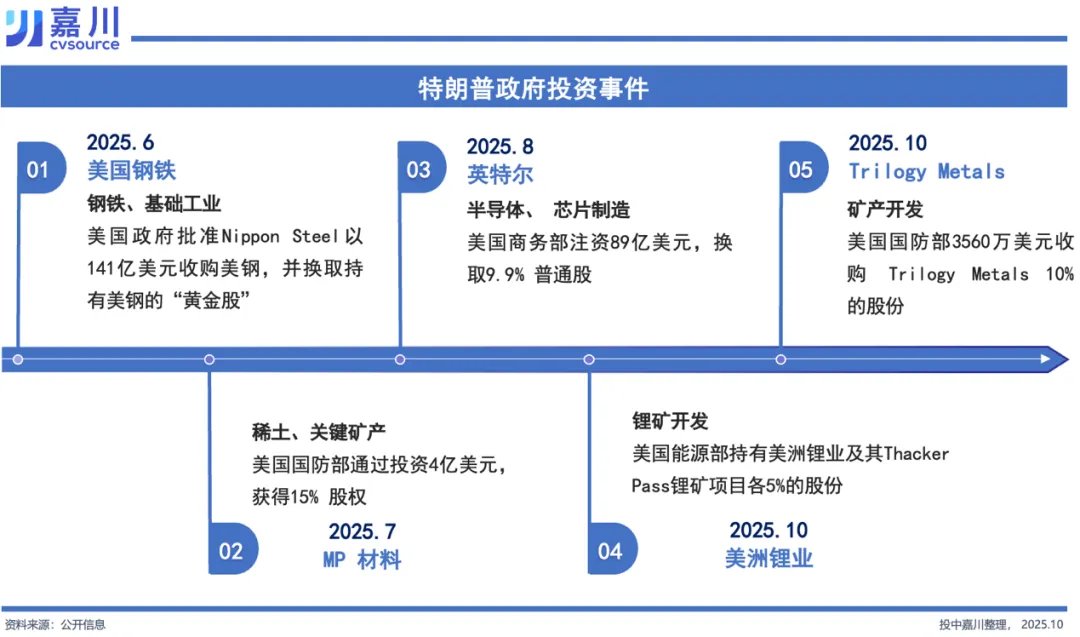
半年出手5次,美国国资到底投了啥?
Hu Xiu· 2025-10-21 23:15
Core Viewpoint - The U.S. government, under Trump's administration, has shifted its approach to industrial policy by directly acquiring equity stakes in private companies, particularly in critical sectors like semiconductors, rare earths, and steel, as a strategic response to geopolitical challenges [2][4][17]. Group 1: Government Investments - Since January, the Trump administration has made five significant investments in key manufacturing sectors, marking a transition from traditional subsidies to direct equity stakes [4][13]. - The first transaction occurred in June, where the U.S. government approved Nippon Steel's $14.1 billion acquisition of U.S. Steel, gaining "golden shares" that provide control over critical decisions [8]. - In July, the government invested $400 million in MP Materials, acquiring 15% of the company, which is the only U.S. firm capable of rare earth mining and processing [9][14]. - In August, the government invested $8.9 billion in Intel for a 9.9% stake, aiming to bolster domestic chip production [10][11]. - In October, the government acquired 5% stakes in Lithium Americas and Trilogy Metals, focusing on lithium mining to support the electric vehicle industry [12][13]. Group 2: Funding Sources - The funding for these investments primarily comes from previously approved budgets, such as the $400 billion Inflation Reduction Act, which allocated $53 billion for semiconductor support [14][16]. - The Department of Commerce, Department of Energy, and Department of Defense have emerged as the main federal agencies facilitating these equity investments [16]. - The funds utilized are not new but rather reallocated from existing congressional appropriations, indicating a strategic shift in how government support is structured [16]. Group 3: Strategic Implications - The investments reflect a broader strategy to reduce reliance on foreign supply chains, particularly from China, by securing domestic production capabilities in critical materials and technologies [17][20]. - The U.S. aims to establish a complete supply chain for rare earths and lithium, which are essential for defense and clean energy technologies, thereby enhancing national security [18][19]. - The investment in Intel is particularly significant as it seeks to ensure that the U.S. retains control over advanced semiconductor manufacturing, which is currently heavily reliant on foreign production [19].