
天弘基金

Search documents
越跌越买!抄底来了
中国基金报· 2025-12-16 06:14
Core Viewpoint - The stock ETF market experienced a net inflow of nearly 7.5 billion yuan on December 15, despite a general market downturn, indicating strong investor interest in ETFs as a preferred investment vehicle during market fluctuations [2][4]. Group 1: Market Performance - On December 15, the A-share market saw a decline, with the Shenzhen Composite Index and the ChiNext Index both dropping over 1%. However, the consumer sector showed resilience, and commercial aerospace stocks remained active [2]. - Over the past three trading days, the net buying in the stock market has exceeded 18.5 billion yuan [3]. Group 2: ETF Inflows - The total net inflow into the stock ETF market on December 15 was approximately 7.457 billion yuan, with significant contributions from broad-based ETFs and Hong Kong market ETFs, which saw inflows of 4.318 billion yuan and 2.685 billion yuan, respectively [6]. - The CSI A500 Index ETF led the inflows with 4.942 billion yuan, with the Southern A500 ETF and Huatai-PB A500 ETF contributing over 3.9 billion yuan and 0.92 billion yuan, respectively [6][9]. Group 3: Fund Company Performance - Leading fund companies like E Fund and Huaxia Fund saw substantial inflows into their ETFs. E Fund's ETFs had a total scale of 818.24 billion yuan, with a net inflow of 1.19 billion yuan on December 15 [9]. - Huaxia Fund's A500 ETF and Sci-Tech 50 ETF also attracted significant inflows of 0.712 billion yuan and 0.462 billion yuan, respectively [9]. Group 4: Outflows from Specific ETFs - The CSI 300 Index ETF experienced the largest outflow, with a net outflow of 1.071 billion yuan, followed by the Securities ETF and Wine ETF, which saw outflows of 0.618 billion yuan and 0.420 billion yuan, respectively [11][12]. - Despite some broad-based and thematic ETFs experiencing outflows, institutional investors remain optimistic about the market outlook [15].


近一个月公告上市股票型ETF平均仓位18.34%
Zheng Quan Shi Bao Wang· 2025-12-16 03:40
Group 1 - Two stock ETFs have released listing announcements, with the Guangfa CSI All Share Food ETF having a stock position of 29.94% and the Huatai-PineBridge AI ETF at 9.69% [1] - In the past month, 20 stock ETFs have announced listings, with an average position of only 18.34%. The highest position is held by the Huitianfu Hang Seng Index ETF at 69.53% [1] - The average number of shares raised for the newly announced ETFs is 519 million, with the largest being the E Fund CSI AI ETF at 1.336 billion shares [1] Group 2 - Institutional investors hold an average of 13.22% of the shares, with the highest proportions in the Jiao Yin CSI Selected Technology ETF at 48.92% and the Huatai-PineBridge AI ETF at 34.43% [2] - The newly established stock ETFs have varying positions during their construction period, with the Guangfa CSI All Share Food ETF set to list on December 19, 2025, and the Huatai-PineBridge AI ETF on the same date [2][3] - The lowest institutional holding ratios are found in the E Fund CSI A500 Dividend Low Volatility ETF and the Penghua Hang Seng Biotechnology ETF, both below 3% [2]
跟随基金经理实盘:天弘基金推出创业板智能定投的“买卖刻度尺”
Sou Hu Cai Jing· 2025-12-16 03:18
Group 1 - The core viewpoint of the articles highlights the strong performance of the ChiNext Index in 2023, with a peak increase of 90%, but a recent pullback of nearly 8% in November due to a rotation in technology themes [2][3] - Analysts suggest that the adjustment in the computing power sector post-Q3 reports is common, and the ongoing strong demand driven by AI presents opportunities during these adjustments [3] - The ChiNext Index maintains a relatively low valuation, with a dynamic price-to-earnings (PE) ratio around 40 times, significantly lower than the 80% and 70% percentiles of the CSI 300 and CSI 500 indices, respectively [4] Group 2 - The article discusses the challenges investors face in achieving wealth growth through traditional fund investment strategies, which can sometimes lead to losses if not executed properly [5] - Tianhong Fund has introduced a new strategy for ChiNext index investment that focuses on price-to-book (PB) ratios to optimize buying and selling timing, addressing the limitations of traditional investment methods [5][6] - The strategy suggests increasing investment when the PB ratio is below the historical 50% level and decreasing it when above, with a simple formula for calculating investment amounts based on current PB [5][6] Group 3 - The Tianhong valuation investment strategy aims to transform the "buy low, sell high" logic into a quantifiable discipline, helping investors navigate market volatility by focusing on valuation levels [6][9] - Historical data indicates that even during market downturns, the strategy can yield positive annualized returns, with the best results seen from investments initiated during prolonged market declines [8][9] - The strategy's implementation has shown that it can maintain an upward asset curve despite market fluctuations, providing a smoother investment experience compared to fixed monthly investments [9] Group 4 - Tianhong Fund provides a systematic approach for investors to engage in ChiNext index investment through a monthly calculation of the PB ratio, with specific investment amounts based on this ratio [11][12] - The fund's strategy includes a dual condition for profit-taking, which helps avoid premature selling during early bull markets while ensuring timely exits during market reversals [5][11] - The ChiNext ETF from Tianhong has gained significant popularity, with over 850,000 holders, indicating strong investor interest in the ChiNext index [13]


含航量最高的航空航天ETF天弘(159241)最新规模创新高!民航局编制两类航空器适航标准,现征求公众意见
Sou Hu Cai Jing· 2025-12-16 02:39
Core Viewpoint - The aerospace ETF Tianhong (159241) has seen significant trading activity and growth, with a recent increase in scale reaching 606 million yuan, marking a new high since its inception [1][2]. Group 1: Market Performance - As of December 16, 2025, the aerospace ETF Tianhong (159241) had a turnover of 8.58% and a transaction volume of 50.78 million yuan, while the tracked CN5082 aerospace industry index fell by 2.36% [1]. - Over the past week, the aerospace ETF Tianhong (159241) experienced a substantial increase of 64 million shares, indicating strong demand [1]. Group 2: Fund Flows - In the last five trading days, the aerospace ETF Tianhong (159241) recorded net inflows of 75.25 million yuan on three occasions, reflecting positive investor sentiment [2]. Group 3: Industry Highlights - The aerospace industry has shown explosive growth in revenue and net profit in the third quarter, indicating a heightened level of industry prosperity [2]. - The Civil Aviation Administration of China is seeking public opinion on two types of airworthiness standards for limited-use unmanned aerial systems and powered aircraft, which may impact industry regulations [2]. Group 4: Institutional Insights - Open Source Securities emphasizes the importance of the recent establishment of a commercial space administration and the introduction of a three-year development plan for commercial space, highlighting the full-chain ecosystem in China's commercial space sector [2].
年内138家公募机构积极自购传递信心
Zheng Quan Ri Bao· 2025-12-15 16:12
Group 1 - Public fund institutions have shown strong confidence through self-purchases, with 138 institutions conducting 8,546 self-purchases totaling 255.09 billion yuan, a 1,733.71% increase compared to 13.91 billion yuan in the same period last year [1] - The enthusiasm for self-purchases is driven by five main factors: positive policy environment, improved industry mechanisms, stable market performance, emerging structural opportunities, and increased trust in products amid bond fund yield volatility [2] - Equity funds, particularly mixed funds, have seen a significant turnaround with a net purchase of 2.155 billion yuan this year, compared to a net redemption of 512 million yuan last year [3] Group 2 - Bond funds have also performed well, with a net purchase of 4.211 billion yuan, a 272.65% increase from 1.13 billion yuan last year [4] - Index funds have become a key focus for self-purchases, with passive index products attracting 2.709 billion yuan, accounting for 64.33% of net purchases in bond funds [4] - In stock funds, index and enhanced index products have garnered 2.483 billion yuan, representing 94.55% of net purchases in stock funds [4]
绩效新规|易方达近十年分121亿分红率47%,广发证券获28亿,实行股权激励后分红率上升,员工持股累计获9.7亿
Xin Lang Cai Jing· 2025-12-15 09:44
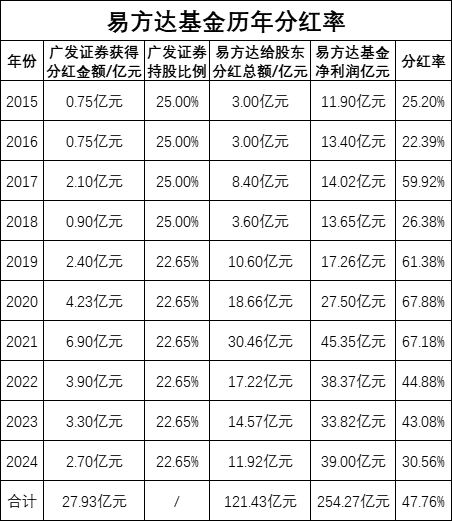
Core Viewpoint - The recent draft of the "Guidelines for Performance Assessment of Fund Management Companies" has sparked discussions in the industry, particularly regarding the constraints on dividend distributions to shareholders based on fund performance and investor losses [1] Group 1: Dividend Distribution - The guidelines require fund companies to prudently determine the frequency and proportion of dividends based on the long-term performance of fund products and the profit and loss situation of investors [1] - In the past decade, E Fund has distributed a total of 12.143 billion yuan in dividends to shareholders, with a dividend rate of 30.56% for 2024 [2][3] - E Fund's average dividend rate over the past ten years is 47.76%, ranking it fourth among leading funds, lower than some competitors but higher than others [4] Group 2: Employee Stock Ownership and Incentives - Following the approval of employee stock incentives in December 2019, E Fund's dividend rate has generally increased, with the employee stock platform receiving a total of 970 million yuan in dividends from 2019 to 2024 [5][6] - The implementation of stock incentives led to a significant increase in the dividend rate, with an average of 51% from 2019 to 2024, compared to an average of 34% from 2015 to 2018 [6] Group 3: Fund Performance - From 2022 to 2024, 52.75% of E Fund's 273 fund products experienced losses, with 47.99% underperforming their benchmarks, resulting in a total loss of 48.8 billion yuan for investors [7][8] - In a more recent analysis from December 2022 to November 2025, only 6% of 307 products reported losses, indicating a significant improvement in performance [8]

英诺特接待1家机构调研,包括天弘基金
Jin Rong Jie· 2025-12-15 08:34
Core Viewpoint - Innotech is actively developing home testing business to meet the emerging market demand for respiratory and digestive applications, enhancing its online marketing efforts through official flagship stores and other platforms [2] Group 1: Company Overview - Innotech received an institutional research visit from Tianhong Fund on December 9, 2025, with the meeting conducted online [1] - The company’s board secretary, Chen Fukan, represented Innotech during the research meeting [2] Group 2: Product Development - Innotech's new products cater to both B-end and C-end markets, suitable for professional medical personnel and consumer self-testing [2][5] - The product lineup includes respiratory series products (e.g., combined antigen test kits for respiratory syncytial virus, adenovirus, etc.) and digestive-related products (e.g., fecal occult blood test kits, Helicobacter pylori antigen test kits) [2][6] Group 3: Sales Channels and Competitive Advantage - The C-end sales channels are primarily online, including authorized stores and self-operated flagship stores on platforms like JD.com, Taobao, and Meituan [4] - The company has established a certain level of brand recognition in the domestic respiratory pathogen detection field due to years of technical accumulation and market expansion [4] Group 4: Investment Strategy - Innotech focuses its external investments on areas that are highly synergistic with its main business, including new products, new technology platforms, and new testing fields [7] - The company conducts careful assessments and decision-making regarding related projects, with progress updates to be disclosed in accordance with regulatory requirements [7]

年内公募自购热情高涨,净申购规模同比增长逾163%
Xin Hua Cai Jing· 2025-12-15 06:12
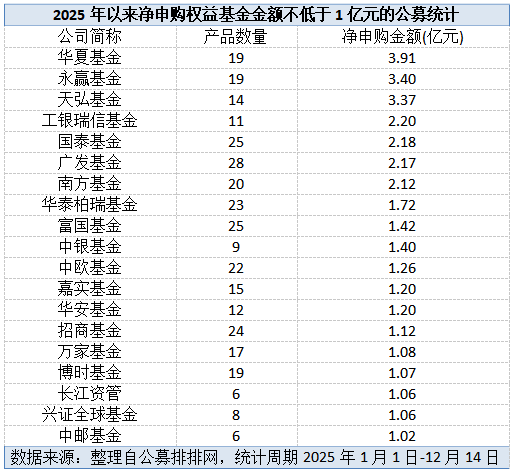
Core Insights - In 2025, public funds in China experienced a significant surge in self-purchase activity, with net subscription amounts reaching 9.876 billion yuan, a 163.08% increase compared to 3.754 billion yuan in the same period of 2024 [1] Group 1: Fund Types - Bond funds remained the primary focus for self-purchases, with net subscriptions amounting to 4.211 billion yuan, representing 42.65% of total net subscriptions, and a remarkable increase of 272.65% from 1.130 billion yuan in 2024 [1] - Mixed funds showed a notable recovery, achieving net subscriptions of 2.155 billion yuan, a significant turnaround from a net redemption of 0.512 billion yuan in 2024 [1] - Equity funds also saw substantial growth, with net subscriptions reaching 5.072 billion yuan, accounting for 51.36% of total net subscriptions, and a 90.79% increase from 2.692 billion yuan in 2024 [1] Group 2: Index Funds and Institutional Activity - Index funds emerged as a key focus for self-purchases, with passive index bond products netting 2.709 billion yuan, making up 64.33% of bond fund self-purchases [2] - In the stock fund category, combined net subscriptions for passive and enhanced index products reached 2.483 billion yuan, representing a high 94.55% of total stock fund self-purchases, indicating a strong preference for index-based investment tools among institutions [2] - Leading public fund institutions were particularly active in self-purchases, with 19 firms reporting net subscriptions exceeding 100 million yuan in equity funds, including Huaxia Fund at 391 million yuan, followed by Yongying Fund and Tianhong Fund at 340 million yuan and 337 million yuan respectively [2][3]
近一个月公告上市股票型ETF平均仓位18.18%
Zheng Quan Shi Bao Wang· 2025-12-15 05:41
Group 1 - Two stock ETFs have released listing announcements, with the latest positions showing that the Jiao Yin CSI Selected Hong Kong and Shanghai Technology 50 ETF has a stock position of 0.00%, while the E Fund CSI Innovation and Entrepreneurship Artificial Intelligence ETF has a stock position of 9.87% [1] - In the past month, a total of 18 stock ETFs have announced their listings, with an average position of only 18.18%. The ETF with the highest position is the Huatai-PineBridge Hang Seng Index Hong Kong Stock Connect ETF at 69.53%, followed by the Morgan Stanley Hang Seng Hong Kong Stock Connect 50 ETF at 54.00% and the Bosera National Certificate Industrial Software Theme ETF at 46.74% [1] - Generally, ETFs must meet the position requirements specified in the fund contract before listing. The time between the announcement and the actual listing is a few trading days, during which low positions are expected to be built up before listing [1] Group 2 - The average proportion of shares held by institutional investors is 12.10%. The ETFs with the highest institutional ownership are the Jiao Yin CSI Selected Hong Kong and Shanghai Technology 50 ETF at 48.92%, the E Fund CSI Innovation and Entrepreneurship Artificial Intelligence ETF at 34.43%, and the Bosera National Certificate Bank ETF at 22.72% [2] - The recently established stock ETFs have an average fundraising scale of 540 million shares, with the largest being the E Fund CSI Innovation and Entrepreneurship Artificial Intelligence ETF at 1.336 billion shares, followed by the E Fund CSI Innovation and Entrepreneurship Artificial Intelligence ETF at 933 million shares and the Penghua Hang Seng Biotechnology ETF at 758 million shares [1][2]
黄金连涨五日,后市如何?
Sou Hu Cai Jing· 2025-12-15 03:02
Core Viewpoint - The article emphasizes the ongoing investment opportunities in gold due to long-term upward trends, geopolitical uncertainties, and economic weaknesses in major economies, suggesting gold as a long-term asset allocation rather than frequent trading [1]. Group 1: Federal Reserve Divergence - Divergent views among Federal Reserve officials are noted, with some advocating for caution on interest rate cuts, while others express concerns about inflation and employment risks, contributing to uncertainty that supports gold prices [1]. Group 2: Global Geopolitical Risks - Continued geopolitical tensions are highlighted, including Japan's anticipated interest rate hikes, the EU's agreement to freeze Russian central bank assets, and ongoing military actions in Thailand, all of which enhance the demand for gold as a safe-haven asset [2]. Group 3: Economic Weakness in the UK - The UK's GDP unexpectedly contracted by 0.1% in October, marking the fourth consecutive month of economic decline, which has led to increased expectations for interest rate cuts by the Bank of England, further bolstering the appeal of gold investments [3].