包钢股份

Search documents
兴业证券:如何看待A股本轮开门红的结构与延续性?
智通财经网· 2026-01-11 10:36
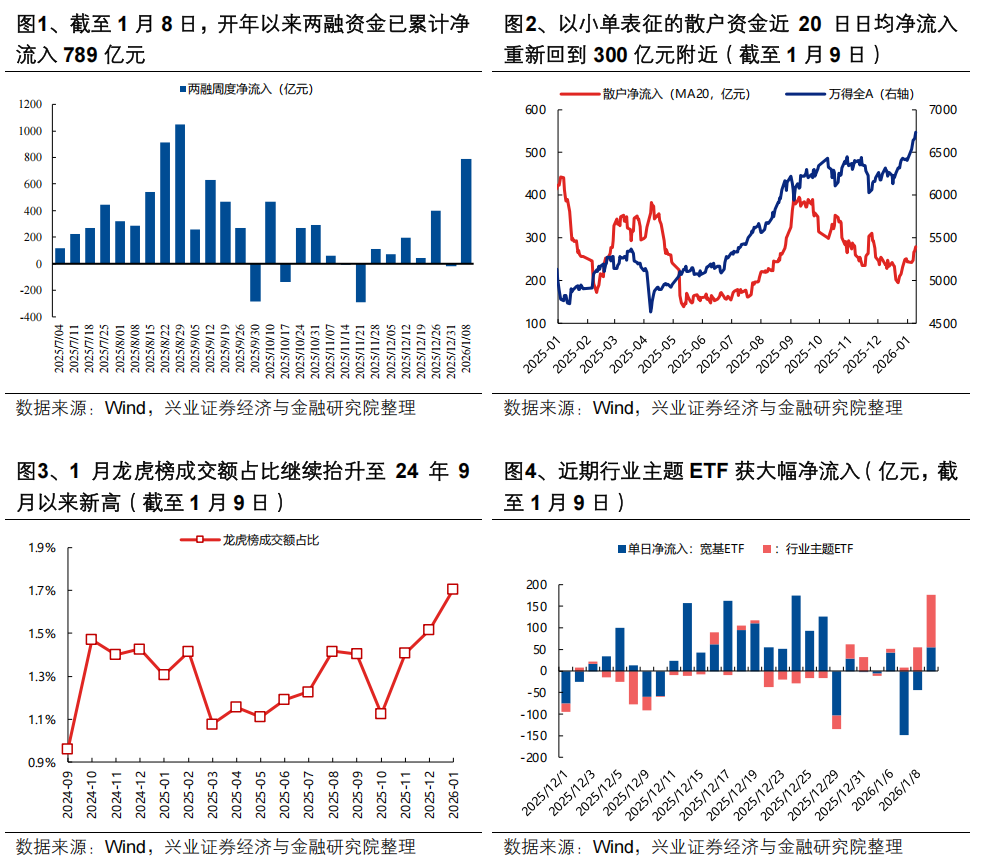
Core Viewpoint - The recent "opening red" in the A-share market reflects a favorable macroeconomic environment and abundant liquidity, which supports market risk appetite and attracts incremental capital inflow, creating a positive feedback loop between capital inflow and market rise [2][18]. Group 1: Market Dynamics - The A-share market has experienced a strong start with the Shanghai Composite Index breaking key levels and achieving a "sixteen consecutive days" rise, exceeding many investors' expectations [1][19]. - Historical data indicates that after a single-day trading volume exceeds 3 trillion yuan, there is typically at least a monthly-level market rally [19]. - Various types of trading funds have shown signs of accelerated entry, including a net inflow of 78.9 billion yuan in margin financing since the beginning of the year and a return of retail investor net inflow to around 30 billion yuan daily [2][5]. Group 2: Structural Characteristics - The inflow structure of different funds shows a strong consensus on key themes, primarily focusing on TMT (storage, AI applications), military industry (commercial aerospace), non-ferrous metals, new energy (controlled nuclear fusion), machinery (robots), and pharmaceuticals (innovative drugs, brain-machine interfaces) [5][36]. - The global stock market has also seen a strong start in 2026, driven by macroeconomic and industrial narratives, with A-shares reflecting similar trends [13][18]. Group 3: Future Directions - As companies begin to disclose annual reports, earnings will become a key factor driving market dynamics, leading to a structural adjustment where previously hot sectors face performance validation, while some low-performing sectors may attract new capital inflows [36]. - Industries with significant upward revisions in profit forecasts since November include technology (consumer electronics, computing), advanced manufacturing (new energy, military), cyclical sectors (building materials, non-ferrous metals), and consumer sectors (food processing, retail) [37][38].


稀土价格指数正式上线!
新华网财经· 2026-01-11 08:18
Core Viewpoint - The Baotou Rare Earth Products Exchange (referred to as "Rare Exchange") has officially launched a rare earth price index on multiple platforms, aiming to serve as a price "barometer" and "guideline" in China's rare earth product circulation sector [1]. Group 1 - The Rare Exchange is established by 13 major rare earth enterprises and related institutions, including Northern Rare Earth, China Rare Earth, and others [1]. - The index is based on the Rare Exchange's trading data and compliant trade data, utilizing a rigorous index model developed by research institutions, covering mainstream rare earth products like lanthanum, cerium, praseodymium, and neodymium [1]. - Future plans for the Rare Exchange include optimizing index content, enriching the index system, expanding index platform releases, and promoting index applications [1]. Group 2 - As of January 9, the average price of praseodymium-neodymium oxide is 624,900 yuan/ton, and metallic praseodymium-neodymium is 760,700 yuan/ton, showing a slight increase compared to the first trading day of 2026 [2]. - On January 9, Northern Rare Earth and Baotou Steel announced an adjustment of the rare earth concentrate transaction price for the first quarter of 2026 to 26,834 yuan/ton (dry weight, REO=50%), reflecting a 2.4% increase [2]. - Since the third quarter of 2024, the transaction price of rare earth concentrates has been raised consecutively six times, with a price change of 536.68 yuan/ton for every 1% change in REO [2].

稀土指数,正式上线
Zheng Quan Shi Bao· 2026-01-11 08:05
Core Viewpoint - The Baotou Rare Earth Products Exchange (referred to as "Rare Exchange") has officially launched a rare earth price index, which aims to provide timely, accurate, and transparent price references for the rare earth industry, reflecting overall price trends and specific product variations in the market [1] Group 1: Price Index Launch - The rare earth price index is based on the exchange's trading data and extensive collection of compliant trade data, developed using a rigorous index model from research institutions [1] - The index covers mainstream rare earth products such as lanthanum, cerium, praseodymium, and neodymium, and aims to support the healthy and orderly development of the rare earth market [1] - The index was launched on December 5, 2025, during the 2025 Entrepreneurs Forum in Boao, and has garnered significant attention from the rare earth industry [1] Group 2: Future Developments - The Rare Exchange plans to continuously optimize the index content, enrich the index system, expand the index platform, and enhance the promotion of index applications [1] - The goal is to create an indispensable price "barometer" and "weather vane" in the rare earth product circulation field, contributing to the establishment of a unified national market for rare earths [1] Group 3: Company Background - The Rare Exchange was established with contributions from 13 major rare earth enterprises and related institutions, including Northern Rare Earth and China Rare Earth [2] - The exchange was officially launched on August 8, 2012, and has since passed various national reviews and received high-tech enterprise certification in 2022 [2] Group 4: Price Adjustments - On January 9, 2026, Baogang Co. and Northern Rare Earth announced an increase in the associated transaction price for rare earth concentrates for the first quarter of 2026 to 26,834 yuan/ton (excluding tax, dry weight, REO=50%) [2] - The price adjustment mechanism indicates that for every 1% change in REO, the price will increase or decrease by 536.68 yuan/ton [2][3] - The previous quarter's price was adjusted to 26,205 yuan/ton, reflecting a 37% increase [3] Group 5: Market Context - Since 2024, the trading prices of rare earth concentrates have been on the rise, highlighting the strategic importance of rare earth elements, which are non-renewable resources [4] - Rare earths are categorized into light and heavy rare earths, with heavy rare earths being rarer and more unevenly distributed, primarily concentrated in China [4]


稀土价格指数在多家平台正式上线!
Xin Lang Cai Jing· 2026-01-11 07:56
Core Viewpoint - The Baotou Rare Earth Products Exchange (referred to as "Rare Exchange") has officially launched a rare earth price index, which aims to provide timely, accurate, and transparent price references for the rare earth industry in China [1]. Group 1: Price Index Launch - The rare earth price index is based on the exchange's trading data and extensive collection of compliant trade data, utilizing a rigorous index model developed by research institutions [1]. - The index covers mainstream rare earth products such as lanthanum, cerium, praseodymium, and neodymium, reflecting the overall price trends and market changes of rare earth products in China [1]. - The index was announced on December 5, 2025, during the 2025 Entrepreneurs Forum in Boao, and has garnered significant attention from the rare earth industry [1]. Group 2: Future Developments - The Rare Exchange plans to continuously optimize the index content, enrich the index system, expand the index platform, and enhance the promotion of index applications [1]. - The goal is to establish the index as an indispensable "barometer" and "weather vane" for the circulation of rare earth products in China, contributing to the development of a unified national market for the rare earth industry [1]. Group 3: Company Background - The Rare Exchange was established with contributions from 13 major rare earth enterprises and related institutions, including Northern Rare Earth and China Rare Earth [2]. - The exchange was officially launched on March 28, 2014, after passing national inspections and has since received recognition as a national high-tech enterprise in 2022 [2]. Group 4: Price Adjustments - On January 9, 2026, Baogang Co. and Northern Rare Earth announced an increase in the associated transaction price for rare earth concentrates for the first quarter of 2026 to 26,834 yuan/ton (excluding tax, dry weight, REO=50%) [2][3]. - The price adjustment mechanism indicates that for every 1% change in REO, the price will increase or decrease by 536.68 yuan/ton [3]. - The previous quarter's price was set at 26,205 yuan/ton, reflecting a 37% increase compared to the prior quarter [3]. Group 5: Market Trends - Since the beginning of 2024, the trading prices of rare earth concentrates have been on the rise [4]. - Rare earth elements are classified into light and heavy rare earths, with heavy rare earths being rarer and more unevenly distributed, primarily concentrated in China [4].


稀土价格指数正式上线
财联社· 2026-01-11 07:36
Core Viewpoint - The Baotou Rare Earth Products Exchange (referred to as "Rare Exchange") has officially launched a rare earth price index, which utilizes its own trading data and widely collected compliant trade data, aiming to serve as a price "barometer" and "guideline" for the rare earth market in China [1]. Group 1 - The rare earth price index covers mainstream products such as lanthanum, cerium, praseodymium, and neodymium [1]. - The Rare Exchange plans to continuously optimize the index content, enrich the index system, and expand the index platform's publication to contribute to the establishment of a unified national market for rare earths [1]. - Baotou Steel and Northern Rare Earth announced an adjustment of the rare earth concentrate transaction price to 26,834 yuan/ton (excluding tax, REO=50%) for Q1 2026, marking a 2.4% increase [1]. Group 2 - The pricing trend for rare earth concentrates shows a significant increase from 19,109 yuan/ton in Q3 2025 to 26,834 yuan/ton in Q1 2026, reflecting a 37.13% increase from Q4 2025 [3]. - The price adjustments have been consistent, with six consecutive increases since Q3 2024, indicating a strong upward trend in the rare earth market [1][3].
稀土指数,正式上线!
Zheng Quan Shi Bao· 2026-01-11 07:10
Core Viewpoint - The Baotou Rare Earth Products Exchange (referred to as "Rare Exchange") has officially launched a rare earth price index, which aims to provide timely, accurate, and transparent price references for the rare earth industry, reflecting overall price trends and specific product variations in the market [1]. Group 1: Price Index Launch - The rare earth price index is based on the exchange's trading data and extensive collection of compliant trade data, developed using rigorous index models from research institutions [1]. - The index covers mainstream rare earth products such as lanthanum, cerium, praseodymium, and neodymium, and aims to support the healthy and orderly development of the rare earth market [1]. - The index was first announced on December 5, 2025, during the 2025 Entrepreneurs Forum in Boao, and has garnered significant attention from the rare earth industry [1]. Group 2: Future Plans - The Rare Exchange plans to continuously optimize the index content, enrich the index system, expand the index platform's publication, and enhance the promotion of index applications [1]. - The goal is to establish the index as an indispensable price "barometer" and "weather vane" in the rare earth product circulation sector, contributing to the construction of a unified national market for rare earths [1]. Group 3: Company Background - The Rare Exchange was established with contributions from 13 major rare earth enterprises and related institutions, including Northern Rare Earth, China Rare Earth, and others [2]. - The exchange was officially launched on August 8, 2012, and has since passed various national reviews and received high-tech enterprise certification in 2022 [2]. Group 4: Price Adjustments - On January 9, Baogang Co. and Northern Rare Earth announced an increase in the associated transaction price for rare earth concentrates for the first quarter of 2026 to 26,834 yuan/ton (excluding tax, dry weight, REO=50%) [2]. - Northern Rare Earth also confirmed that the price for the first quarter of 2026 would be adjusted to the same figure, reflecting a 37% increase from the previous quarter's price of 26,205 yuan/ton [3]. Group 5: Market Dynamics - Since 2024, the trading price of rare earth concentrates has been on the rise, indicating a growing demand and potential supply constraints in the market [4]. - Rare earth elements are classified into light and heavy rare earths, with heavy rare earths being rarer and more unevenly distributed, primarily concentrated in China [4].
稀土指数,正式上线!
证券时报· 2026-01-11 07:05
Core Viewpoint - The Baotou Rare Earth Products Exchange (referred to as "Rare Exchange") has officially launched a rare earth price index, which aims to provide timely, accurate, and transparent price references for the rare earth industry in China [1]. Group 1: Price Index Launch - The rare earth price index is based on the exchange's trading data and extensive collection of compliant trade data, reflecting the overall price trends and market changes of mainstream rare earth products such as lanthanum, cerium, praseodymium, and neodymium [1]. - The index was announced on December 5, 2025, during the 2025 Entrepreneurs Forum in Boao, and has garnered significant attention from the rare earth industry [1]. - The exchange is committed to continuously optimizing the index content, expanding the index system, and enhancing the promotion of index applications to serve the development of a unified national market for rare earths [1]. Group 2: Exchange Background - The Rare Exchange was established with contributions from 13 major rare earth enterprises and related institutions, including Northern Rare Earth, China Rare Earth, and others [2]. - The exchange was officially unveiled on August 8, 2012, and has since passed various national inspections and received high-tech enterprise certification in 2022 [2]. Group 3: Price Adjustments - On January 9, 2026, Baogang Co. and Northern Rare Earth announced an increase in the associated transaction price for rare earth concentrate for the first quarter of 2026 to 26,834 yuan/ton (excluding tax, dry weight, REO=50%) [2][3]. - The price adjustment mechanism indicates that for every 1% change in REO, the price will increase or decrease by 536.68 yuan/ton [3]. - The previous quarter's price was adjusted to 26,205 yuan/ton, reflecting a 37% increase compared to the prior quarter [3]. Group 4: Market Dynamics - Since the beginning of 2024, the trading prices of rare earth concentrates have been on the rise, indicating a growing demand and tightening supply in the market [4]. - Rare earth elements are classified into light and heavy rare earths, with heavy rare earths being rarer and more unevenly distributed, primarily concentrated in regions such as Jiangxi, Fujian, Guangdong, and Yunnan [5].
稀土价格指数正式上线!
Shang Hai Zheng Quan Bao· 2026-01-11 06:28
Group 1 - The Baotou Rare Earth Products Exchange (referred to as "Rare Exchange") has officially launched a rare earth price index on multiple platforms, including its official website and various financial information services [1] - The Rare Exchange is established by 13 major rare earth enterprises and related institutions, including Northern Rare Earth, China Rare Earth, and others, aiming to create a reliable pricing benchmark for the rare earth market [1] - The index is based on the Rare Exchange's trading data and compliant trade data, covering mainstream rare earth products such as lanthanum, cerium, praseodymium, and neodymium [1] Group 2 - On January 9, Northern Rare Earth and Baotou Steel announced an adjustment of the associated transaction price for rare earth concentrate to 26,834 yuan/ton (excluding tax), reflecting a 2.4% increase [2] - The price of rare earth concentrate has been raised consecutively six times since the third quarter of 2024, indicating a trend of increasing prices in the sector [2] - The adjustment indicates that for every 1% change in REO (Rare Earth Oxide), the price will increase or decrease by 536.68 yuan/ton [2]
国盛证券量价关系
GOLDEN SUN SECURITIES· 2026-01-11 05:44
Investment Rating - The report maintains a "Buy" rating for several key companies in the steel industry, including Hualing Steel, Nanjing Steel, Baosteel, and New Steel [8]. Core Insights - The steel market is experiencing a recovery phase, with the national average daily pig iron production increasing by 21,000 tons to 2,296,000 tons, and overall steel production showing a slight increase [11]. - Total steel inventory has shifted from a decrease to an increase, with a week-on-week rise of 1.8%, indicating a change in market dynamics [23]. - Apparent consumption of steel has weakened on a month-on-month basis, particularly in rebar, which saw a significant drop in demand [38]. - The report highlights that while steel prices are stable with slight increases, the immediate profit margins are declining, suggesting a need for caution in pricing strategies [67]. Supply and Demand Analysis - **Supply**: The average daily pig iron production has increased, indicating a rise in production capacity utilization, which is currently at 86.1%, up by 0.8 percentage points from the previous week [17]. - **Inventory**: The total inventory of five major steel products has increased to 8.652 million tons, reflecting a 1.7% week-on-week rise and a 10.7% year-on-year increase [25]. - **Demand**: Apparent consumption of five major steel products decreased by 5.3% week-on-week, with rebar consumption dropping by 12.7% [48]. Price and Profitability - The report notes that the current steel price index is 122.5, reflecting a week-on-week increase of 0.4% but a year-on-year decrease of 2.4% [67]. - The immediate profit margins for long-process rebar and hot-rolled coils are negative, indicating that production costs are exceeding sales prices [69]. Key Companies and Recommendations - The report recommends focusing on companies that are expected to benefit from the energy sector's growth, such as Jiu Li Special Materials and Changbao Steel, as well as those involved in pipeline construction and steel production [8].
特朗普顾问摊牌:美国在用时间换稀土,目的是废除中国稀土王牌
Sou Hu Cai Jing· 2026-01-11 02:42
Group 1 - The core viewpoint is that the U.S. is strategically engaging with China regarding rare earths to buy time while working on alternative supply chains and innovations to reduce dependency on China [1][3] - Navarro's comments suggest that the U.S. is not genuinely softening its stance but is instead using diplomacy to stabilize rare earth supplies from China while preparing to break free from this reliance [3][5] - The U.S. is facing a significant challenge as it currently imports 75% of its rare earths from China, and rebuilding a domestic supply chain could take at least 15 years and require substantial financial investment [8][10] Group 2 - The U.S. is attempting to form a coalition with allies to create a supply chain that does not rely on China, indicating a shift towards international collaboration in rare earth sourcing [11][13] - Despite these efforts, the U.S. remains heavily dependent on Chinese supplies, and any disruption could severely impact its industries [13][16] - China's recent price increases for rare earths signal its awareness of the geopolitical dynamics and its control over the market, reinforcing its strategic position [16][18] Group 3 - The competition over rare earths is not just a resource battle but also encompasses technology and strategic positioning, highlighting the complexity of U.S.-China relations [18] - Both countries are in a state of interdependence, where U.S. high-tech industries rely on Chinese supply chains, while China needs Western technology for its industrial upgrades [18]