
稀土价格指数

Search documents
2025年大宗商品现货市场大事记
Qi Huo Ri Bao Wang· 2026-01-12 13:54
Group 1: Policy and Market Developments - The commodity spot market is experiencing favorable policies, strengthening the foundation for "spot market-based and enhancing futures-spot linkage" [1] - The Ministry of Commerce and other departments issued a plan to cultivate around 100 leading digital supply chain enterprises by 2030, integrating AI and big data into the supply chain [2] - The national carbon emissions trading market expanded to include steel, cement, and aluminum industries, marking a strategic shift towards multi-industry regulation [3] - The Ministry of Commerce encouraged the development of capacity pre-sale and order trading models to innovate trading practices in the commodity market [4] Group 2: Strategic Industry Focus - Rare earths have become a focal point in international competition, with export controls implemented on several rare earth items as a countermeasure against U.S. trade policies [5] - The establishment of the Zhejiang International Commodity Trading Center aims to integrate various trading resources and expand from oil and gas to multiple commodity categories [6][7] - Zhejiang's government issued a plan to create an integrated off-market for commodity futures and spot trading, enhancing resource allocation capabilities [8] Group 3: Regional Initiatives and Innovations - Hangzhou's government launched a three-year action plan to enhance the quality and scale of commodity trade, aiming to position the city as a national commodity trade center [9] - Tianjin has created a favorable policy environment for local commodity trading platforms, facilitating rapid approval for new models and products [10] - The Hainan Free Trade Port's full island closure operation is expected to provide unprecedented opportunities for commodity flow, with a significant expansion of zero-tariff items [11] - Hong Kong is accelerating the development of a commodity trading ecosystem, with initiatives including tax incentives and the establishment of delivery points for global trading [13]
【正式上线】稀土指数,正式上线!
Sou Hu Cai Jing· 2026-01-12 11:53
Group 1 - The Rare Earth Price Index has officially launched on various platforms, including the Rare Earth Exchange's official website and financial information networks [1][5] - The index utilizes trading data from the Rare Earth Exchange and compliant trade data, reflecting the overall price trends of rare earth products in China, including lanthanum, cerium, praseodymium, and neodymium [5] - The index aims to provide timely, accurate, and transparent price references for the rare earth industry, contributing to the healthy development of the market [5] Group 2 - Baotou Steel and Northern Rare Earth announced an adjustment of the rare earth concentrate transaction price for Q1 2026 to 26,834 yuan/ton (dry weight, REO=50%), marking a 2.4% increase [6] - This adjustment represents the sixth consecutive price increase since Q3 2024, indicating a positive trend in rare earth concentrate pricing [6][8] - The pricing trend shows significant fluctuations, with a notable increase of 37.13% from Q4 2025 to Q1 2026, compared to previous quarters [8]


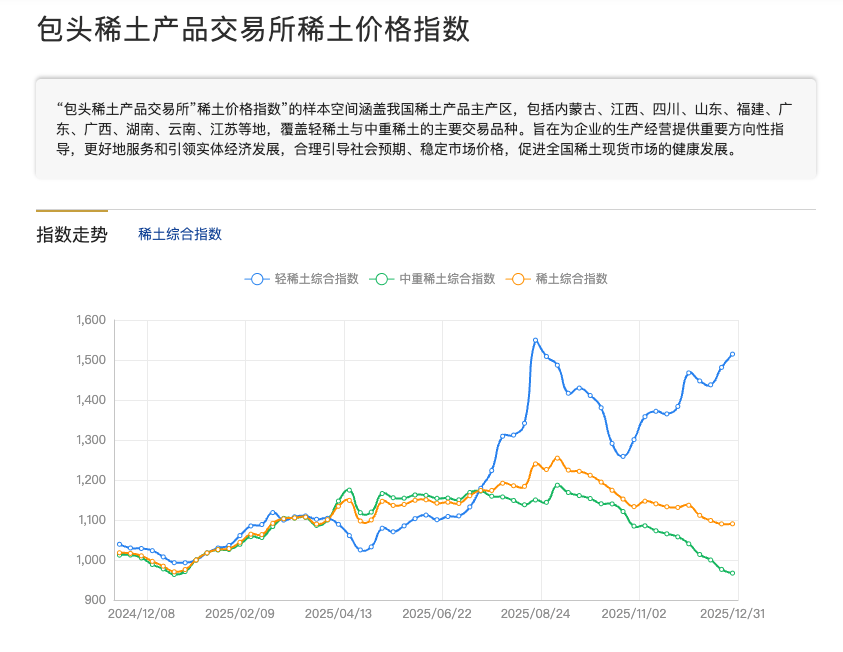
稀土价格指数正式上线,价格中枢有望抬升
Jin Rong Jie· 2026-01-12 00:44
Group 1 - The Baotou Rare Earth Products Exchange (referred to as "Rare Exchange") has officially launched a rare earth price index on its official website and various platforms [1] - The index is based on the exchange's trading data and extensive collection of compliant trade data, combined with rigorous index models from research institutions, covering mainstream rare earth products such as lanthanum, cerium, praseodymium, and neodymium [1] - The Rare Exchange aims to continuously optimize the index content, enrich the index system, expand the index platform's release, and strengthen the promotion of index applications, positioning itself as a price "barometer" and "weather vane" in China's rare earth product circulation field [1] Group 2 - As of January 9, the average price of praseodymium-neodymium oxide was 624,900 yuan/ton, and metallic praseodymium-neodymium was 760,700 yuan/ton, showing a slight increase compared to the first trading day of 2026 [1] - Dongfang Securities expresses optimism about the continuous rise in both supply and demand for rare earths in 2026, reaffirming the judgment that rare earths are at the starting point of a major cycle [1] - The optimization of the supply structure in the rare earth industry is expected to benefit upstream smelting and processing enterprises, which may dominate profit distribution in the industry chain due to the scarcity of quotas, leading to a high-quality development pattern with controllable product quantities, moderate price increases, and steady profit growth [1]

新华财经早报:1月12日
Xin Hua Cai Jing· 2026-01-11 23:59
Group 1 - The Ministry of Commerce has outlined eight key areas of focus for the national business system in 2026, with a primary emphasis on implementing consumption promotion initiatives and building a unified national market [1][1][1] - The National Healthcare Security Administration is piloting the "Personal Medical Insurance Cloud" project to create a comprehensive smart healthcare management model by aggregating and utilizing personal health data [1][1][1] - The China Securities Regulatory Commission aims to enhance the institutional environment for long-term investments and improve services for technology innovation enterprises, focusing on risk prevention and high-quality development during the 14th Five-Year Plan period [1][1][1] Group 2 - The "Tianma-1000" unmanned transport aircraft has successfully completed its first flight test, designed for logistics, emergency rescue, and material delivery, capable of autonomously loading and unloading tons of goods within five minutes [1][1][1] - The Baotou Rare Earth Products Exchange has launched a rare earth price index, which will serve as a price "barometer" and "guideline" for the rare earth market, utilizing transaction data and a rigorous index model [1][1][1]

稀土指数正式上线!覆盖镧、铈、镨等稀土主流产品
Zheng Quan Shi Bao· 2026-01-11 23:49
Core Viewpoint - The Baotou Rare Earth Products Exchange (referred to as "Rare Exchange") has officially launched a rare earth price index, which aims to provide timely, accurate, and transparent price references for the rare earth industry, reflecting overall price trends and specific product variations in the market [1] Group 1: Rare Earth Price Index - The index is based on the Rare Exchange's trading data and extensive collection of compliant trade data, utilizing a rigorous index model developed by research institutions [1] - It covers mainstream rare earth products such as lanthanum, cerium, praseodymium, and neodymium, and is designed to support the healthy and orderly development of the rare earth market [1] - The index system includes daily transaction prices, weekly rare earth price indices, and monthly rare earth price expectation indices, which are continuously being improved [1] Group 2: Background of the Rare Exchange - The Rare Exchange was established by 13 major rare earth enterprises and related institutions, including Northern Rare Earth and China Rare Earth [2] - It was officially launched on August 8, 2012, and has since passed various national inspections and received high-tech enterprise certification in 2022 [2] Group 3: Price Adjustments - On January 9, Baogang Co. and Northern Rare Earth announced an increase in the associated transaction price for rare earth concentrate for the first quarter of 2026 to 26,834 yuan/ton (excluding tax, dry weight, REO=50%) [2] - The price adjustment mechanism indicates that for every 1% change in REO, the price will increase or decrease by 536.68 yuan/ton [2][3] - The previous quarter's price was adjusted to 26,205 yuan/ton, reflecting a 37% increase compared to the prior quarter [3] Group 4: Rare Earth Resource Overview - Rare earth elements consist of 17 elements and are classified into light and heavy rare earths based on their physical and chemical properties [4] - Light rare earths are more abundant and widely distributed, while heavy rare earths are rarer and unevenly distributed, with most reserves concentrated in China [4] - Ion-type rare earths (heavy rare earths) are primarily found in Jiangxi, Fujian, Guangdong, and Yunnan, accounting for over 80% of global heavy rare earth reserves [4]
稀土价格指数正式上线
21世纪经济报道· 2026-01-11 12:16
Core Viewpoint - The Baotou Rare Earth Products Exchange (referred to as "Rare Exchange") has officially launched its rare earth price index on multiple platforms, aiming to serve as a price "barometer" and "guideline" for the rare earth product circulation sector in China [1][5]. Group 1: Rare Earth Price Index - The Rare Exchange was established by 13 major rare earth enterprises and related institutions, including Northern Rare Earth and China Rare Earth, to create a reliable price index based on trading data and rigorous index models [5]. - The index covers mainstream rare earth products such as lanthanum, cerium, praseodymium, and neodymium, with plans to optimize and expand its content and applications [5]. Group 2: Price Data and Trends - As of January 9, the average price of praseodymium-neodymium oxide was 624,900 yuan/ton, and metallic praseodymium-neodymium was 760,700 yuan/ton, showing a slight increase compared to the first trading day of 2026 [5]. - The price of rare earth concentrate for the first quarter of 2026 has been adjusted to 26,834 yuan/ton (excluding tax), reflecting a 2.4% increase from the previous quarter [5][7]. - The price adjustments for rare earth concentrate have seen six consecutive increases since the third quarter of 2024, indicating a positive trend in the market [5].

稀土指数,正式上线
券商中国· 2026-01-11 11:51
Core Viewpoint - The Baotou Rare Earth Products Exchange (referred to as "Rare Exchange") has officially launched a rare earth price index, which aims to provide timely, accurate, and transparent price references for the rare earth industry, reflecting overall price trends and changes in specific varieties [1]. Group 1: Price Index Launch - The rare earth price index is based on the exchange's trading data and extensive collection of compliant trade data, developed using rigorous index models from research institutions [1]. - The index covers mainstream rare earth products such as lanthanum, cerium, praseodymium, and neodymium, and has gained significant attention since its announcement [1]. - The exchange plans to continuously optimize the index content, enrich the index system, and expand its application to serve the development of a unified national market for rare earths [1]. Group 2: Historical Context and Company Information - The Rare Exchange was established with contributions from 13 major rare earth enterprises and institutions, officially opening in March 2014 after passing national inspections [2]. - In January 2026, Baogang Co. and Northern Rare Earth both announced an increase in the associated transaction price for rare earth concentrates to 26,834 yuan/ton (excluding tax) [2][3]. - The price adjustment mechanism indicates that for every 1% change in REO (Rare Earth Oxide), the price will increase or decrease by 536.68 yuan/ton [3]. Group 3: Price Trends - The price of rare earth concentrates has been on the rise since 2024, with the fourth quarter of 2025 seeing a 37% increase from the previous quarter, adjusting to 26,205 yuan/ton [4][5]. - Rare earths are classified into light and heavy rare earths, with heavy rare earths being rarer and more unevenly distributed, primarily concentrated in China [5].



稀土价格指数正式上线!
新华网财经· 2026-01-11 08:18
Core Viewpoint - The Baotou Rare Earth Products Exchange (referred to as "Rare Exchange") has officially launched a rare earth price index on multiple platforms, aiming to serve as a price "barometer" and "guideline" in China's rare earth product circulation sector [1]. Group 1 - The Rare Exchange is established by 13 major rare earth enterprises and related institutions, including Northern Rare Earth, China Rare Earth, and others [1]. - The index is based on the Rare Exchange's trading data and compliant trade data, utilizing a rigorous index model developed by research institutions, covering mainstream rare earth products like lanthanum, cerium, praseodymium, and neodymium [1]. - Future plans for the Rare Exchange include optimizing index content, enriching the index system, expanding index platform releases, and promoting index applications [1]. Group 2 - As of January 9, the average price of praseodymium-neodymium oxide is 624,900 yuan/ton, and metallic praseodymium-neodymium is 760,700 yuan/ton, showing a slight increase compared to the first trading day of 2026 [2]. - On January 9, Northern Rare Earth and Baotou Steel announced an adjustment of the rare earth concentrate transaction price for the first quarter of 2026 to 26,834 yuan/ton (dry weight, REO=50%), reflecting a 2.4% increase [2]. - Since the third quarter of 2024, the transaction price of rare earth concentrates has been raised consecutively six times, with a price change of 536.68 yuan/ton for every 1% change in REO [2].

稀土指数,正式上线
Zheng Quan Shi Bao· 2026-01-11 08:05
Core Viewpoint - The Baotou Rare Earth Products Exchange (referred to as "Rare Exchange") has officially launched a rare earth price index, which aims to provide timely, accurate, and transparent price references for the rare earth industry, reflecting overall price trends and specific product variations in the market [1] Group 1: Price Index Launch - The rare earth price index is based on the exchange's trading data and extensive collection of compliant trade data, developed using a rigorous index model from research institutions [1] - The index covers mainstream rare earth products such as lanthanum, cerium, praseodymium, and neodymium, and aims to support the healthy and orderly development of the rare earth market [1] - The index was launched on December 5, 2025, during the 2025 Entrepreneurs Forum in Boao, and has garnered significant attention from the rare earth industry [1] Group 2: Future Developments - The Rare Exchange plans to continuously optimize the index content, enrich the index system, expand the index platform, and enhance the promotion of index applications [1] - The goal is to create an indispensable price "barometer" and "weather vane" in the rare earth product circulation field, contributing to the establishment of a unified national market for rare earths [1] Group 3: Company Background - The Rare Exchange was established with contributions from 13 major rare earth enterprises and related institutions, including Northern Rare Earth and China Rare Earth [2] - The exchange was officially launched on August 8, 2012, and has since passed various national reviews and received high-tech enterprise certification in 2022 [2] Group 4: Price Adjustments - On January 9, 2026, Baogang Co. and Northern Rare Earth announced an increase in the associated transaction price for rare earth concentrates for the first quarter of 2026 to 26,834 yuan/ton (excluding tax, dry weight, REO=50%) [2] - The price adjustment mechanism indicates that for every 1% change in REO, the price will increase or decrease by 536.68 yuan/ton [2][3] - The previous quarter's price was adjusted to 26,205 yuan/ton, reflecting a 37% increase [3] Group 5: Market Context - Since 2024, the trading prices of rare earth concentrates have been on the rise, highlighting the strategic importance of rare earth elements, which are non-renewable resources [4] - Rare earths are categorized into light and heavy rare earths, with heavy rare earths being rarer and more unevenly distributed, primarily concentrated in China [4]
稀土价格指数在多家平台正式上线!
Xin Lang Cai Jing· 2026-01-11 07:56
Core Viewpoint - The Baotou Rare Earth Products Exchange (referred to as "Rare Exchange") has officially launched a rare earth price index, which aims to provide timely, accurate, and transparent price references for the rare earth industry in China [1]. Group 1: Price Index Launch - The rare earth price index is based on the exchange's trading data and extensive collection of compliant trade data, utilizing a rigorous index model developed by research institutions [1]. - The index covers mainstream rare earth products such as lanthanum, cerium, praseodymium, and neodymium, reflecting the overall price trends and market changes of rare earth products in China [1]. - The index was announced on December 5, 2025, during the 2025 Entrepreneurs Forum in Boao, and has garnered significant attention from the rare earth industry [1]. Group 2: Future Developments - The Rare Exchange plans to continuously optimize the index content, enrich the index system, expand the index platform, and enhance the promotion of index applications [1]. - The goal is to establish the index as an indispensable "barometer" and "weather vane" for the circulation of rare earth products in China, contributing to the development of a unified national market for the rare earth industry [1]. Group 3: Company Background - The Rare Exchange was established with contributions from 13 major rare earth enterprises and related institutions, including Northern Rare Earth and China Rare Earth [2]. - The exchange was officially launched on March 28, 2014, after passing national inspections and has since received recognition as a national high-tech enterprise in 2022 [2]. Group 4: Price Adjustments - On January 9, 2026, Baogang Co. and Northern Rare Earth announced an increase in the associated transaction price for rare earth concentrates for the first quarter of 2026 to 26,834 yuan/ton (excluding tax, dry weight, REO=50%) [2][3]. - The price adjustment mechanism indicates that for every 1% change in REO, the price will increase or decrease by 536.68 yuan/ton [3]. - The previous quarter's price was set at 26,205 yuan/ton, reflecting a 37% increase compared to the prior quarter [3]. Group 5: Market Trends - Since the beginning of 2024, the trading prices of rare earth concentrates have been on the rise [4]. - Rare earth elements are classified into light and heavy rare earths, with heavy rare earths being rarer and more unevenly distributed, primarily concentrated in China [4].