华熙生物

Search documents
利好!多只A股、港股被纳入MSCI全球标准指数
Zheng Quan Shi Bao· 2025-11-06 05:04
Group 1 - MSCI announced the results of its index review for November 2025, with adjustments effective after market close on November 24 [1][2] - A total of 69 stocks were added to the MSCI Global Standard Index, while 64 stocks were removed, with CoreWeave, Nebius Group, and Insmed being the largest additions by market capitalization [1] - In the MSCI China Index, 26 Chinese stocks were added and 20 were removed, including significant resource and technology companies such as China Gold International and Huahong Semiconductor [2][3] Group 2 - The MSCI China A-share Index saw 17 new additions and 16 removals, with notable new entries like Qianli Technology and Huahong Semiconductor [2] - The MSCI China A-share onshore Index added 18 stocks while removing 24, with new additions including Baiwei Storage and Shengtun Mining [2] - The adjustments in MSCI indices are expected to lead to increased fund allocations to newly added companies, while those removed will face passive selling from index funds [3] Group 3 - Historical trends indicate that passive funds typically adjust their holdings on the last trading day to minimize tracking error, leading to significant trading volume changes for affected stocks [3] - Fidelity Investments expressed a preference for emerging markets over developed markets, anticipating more consumer stimulus measures in China to boost demand [3][4] - Despite mixed views on the Chinese stock market, there is recognition of its growth potential, with a call for a more rational perspective on investment opportunities in the second-largest economy [4]
利好!多只A股、港股被纳入
Zheng Quan Shi Bao· 2025-11-06 05:00
Group 1 - MSCI announced the results of its index review for November 2025, with adjustments effective after market close on November 24 [1] - A total of 69 stocks were added to the MSCI Global Standard Index, while 64 stocks were removed, with CoreWeave, Nebius Group, and Insmed being the largest additions by market capitalization [1] - In the MSCI Emerging Markets Index, Barito Renewables Energy, Zijin Mining International, and GF Securities H-shares were the largest new additions by market capitalization [1] Group 2 - The MSCI China Index saw the addition of 26 Chinese stocks and the removal of 20, including resource stocks and technology companies such as China Gold International and Huahong Semiconductor [2] - The MSCI China A-shares Index added 17 stocks and removed 16, with notable additions including Qianli Technology and Huahong Semiconductor [2] - The MSCI China A-shares Onshore Index added 18 stocks while removing 24, with new additions like Baiwei Storage and Shengtun Mining [2] Group 3 - The adjustments in MSCI indices will lead to rebalancing in related index funds, resulting in increased capital allocation to newly added companies and passive selling of removed companies [3] - Historical trends indicate that passive funds typically adjust their holdings on the last trading day to minimize tracking error, leading to significant trading volume changes in affected stocks [3] - Recent insights from foreign institutions, such as Fidelity, indicate a preference for emerging markets over developed markets, with expectations of more consumer stimulus measures in China [3] Group 4 - Despite mixed views on the Chinese stock market due to geopolitical risks and economic slowdown, some investors see significant growth potential in the Chinese equity market [4] - The ongoing strength of the Chinese stock market necessitates a rational assessment of attractive investment opportunities within the world's second-largest economy [4]
从盖楼到卖精华,珂谧能否捡到重组胶原蛋白的余热?
Tai Mei Ti A P P· 2025-11-06 01:46
Core Viewpoint - The emergence of the new skincare brand Key C (珂谧) by the company Furuida (福瑞达) marks a strategic shift from its traditional real estate and hyaluronic acid business to the collagen protein skincare market, aiming to differentiate itself through innovative technology and competitive pricing [1][2][4]. Company Transformation - Furuida, originally focused on real estate, has transitioned to the cosmetics sector, with its two existing brands, Yilian and Aier Doctor, contributing significantly to its revenue [4][5]. - In 2023, Furuida officially established a cosmetics-led business direction as its brands became the main revenue contributors [4][5]. Market Context - The beauty industry is experiencing a slowdown, and the competition in the collagen protein segment is intensifying, making Key C's entry particularly noteworthy [2][6]. - The overall revenue for Furuida's cosmetics segment in 2024 was 2.475 billion yuan, showing only a slight increase of 2.46% year-on-year, with Yilian's revenue at 963 million yuan (up 12.36%) and Aier Doctor's at 1.301 billion yuan (down 3.48%) [4][6]. Product Differentiation - Key C focuses on affordable medical beauty, utilizing transdermal penetration technology to compete against high-end anti-aging products priced in the thousands [2][6]. - The brand has achieved seven Class II medical device certifications and is developing additional Class III medical device projects, enhancing its credibility in the medical beauty space [7][8]. Pricing Strategy - Key C's pricing strategy is aimed at capturing market share through high cost-performance products, with its best-selling transdermal collagen essence priced at 600 yuan for 56 units, which can drop to 332 yuan during promotional events [8][10]. - This pricing approach disrupts the long-standing premium pricing of collagen products while maintaining a focus on effective ingredients [10][12]. Technological Innovation - Key C's transdermal penetration technology claims to improve skin absorption rates by 27.5 times compared to standard collagen products, addressing a significant industry challenge [11][12]. - The technology involves embedding transdermal peptide segments into the collagen sequence, allowing for effective penetration without compromising the integrity of the collagen [11][12]. Industry Challenges - The collagen protein market has faced scrutiny, with previous market leaders experiencing significant declines in market value, averaging over 40% from their peak [16][17]. - Consumer skepticism regarding the efficacy of collagen products has increased, leading to a more cautious approach from investors and the market [19][20]. Strategic Opportunities - Key C's entry into the collagen protein market represents a potential opportunity for differentiated competition amid industry challenges, contingent on its ability to innovate, educate consumers, and balance online and offline operations [19][20].


“口红效应”失灵?2025美妆行业迎来艰难时刻
3 6 Ke· 2025-11-05 12:11
Core Insights - The domestic beauty industry in China, once thriving due to traffic dividends, is showing signs of fatigue as evidenced by the financial reports for the first three quarters of 2025, with major brands experiencing significant declines in revenue and profit [2][3][8] Financial Performance - Proya's revenue for the first three quarters reached 7.098 billion yuan, a year-on-year increase of 1.89%, while net profit was 1.026 billion yuan, up 2.65%. However, in Q3 alone, revenue fell to 1.736 billion yuan, a decrease of 11.63%, and net profit dropped to 227 million yuan, down 23.64% [2][8] - Other domestic brands like Fulejia, Betaini, Huaxi Biological, and Aimeike reported declines in both revenue and net profit, with Fulejia's revenue down 11.54% and net profit plummeting 36.73% [2][8] Market Trends - The beauty market in China has grown from 131.8 billion yuan in 2014 to 420.3 billion yuan in 2024, with domestic brands achieving a compound annual growth rate of 13.18%, surpassing foreign brands for the first time in 2023 [4][5] - The "lipstick effect" is failing as consumer confidence and willingness to spend among young people have significantly decreased, impacting sales in the beauty sector [3][9] Consumer Behavior - Young consumers are increasingly opting not to wear makeup due to busy lifestyles and a shift in priorities, with many expressing a preference for sleep over makeup application [9][10] - The perception of makeup as a necessary tool for professional success is changing, with more women focusing on their professional abilities rather than appearance [10] Industry Challenges - Many domestic beauty brands are facing a "path dependence" issue, relying heavily on established marketing strategies that are becoming less effective as the market matures [11][12] - The over-reliance on social media marketing and influencer partnerships is leading to diminishing returns, with brands struggling to maintain growth in a saturated market [11][12] R&D and Innovation - There is a growing need for product innovation as consumers become more discerning and demand transparency regarding product ingredients and efficacy [15][16] - Proya's R&D expenditure was only 2.1 billion yuan in 2024, significantly lower than its sales expenses, highlighting a trend of prioritizing marketing over innovation [16][17] Strategic Shifts - Proya is shifting its focus towards digitalization and technological innovation, appointing experienced executives to enhance its product development and marketing strategies [17][18] - The company aims to leverage digital tools for better product iteration and to integrate AI into various business functions, indicating a strategic pivot towards long-term sustainability [18][19]


业绩承压之际,华熙生物再遭原始股东减持
Huan Qiu Lao Hu Cai Jing· 2025-11-05 10:39
Core Viewpoint - Guoshou Chengda, a major shareholder of Huaxi Biological, plans to reduce its stake by up to 9.63 million shares, representing no more than 2.00% of the total share capital, following a previous reduction of 5,496,782 shares [1][2] Group 1: Shareholder Actions - Guoshou Chengda currently holds 28.94 million shares, accounting for 6.01% of Huaxi Biological, making it the second-largest shareholder [1] - This marks the second reduction by Guoshou Chengda, which previously sold shares between October 31 and November 12, 2024, at prices ranging from 59.28 to 68.10 yuan per share [1] - Huaxi Biological's controlling shareholder, Huaxi Xinyu, recently completed its first share buyback since the company's listing, acquiring approximately 4.52 million shares for about 257 million yuan, increasing its stake to 60.11% [2] Group 2: Financial Performance - Huaxi Biological's revenue has declined from 6.36 billion yuan in 2022 to 5.37 billion yuan in 2024, with a year-on-year decrease of 18.36% to 3.16 billion yuan in the first three quarters of this year [2] - Net profit for the first three quarters was 252 million yuan, down 30.29% year-on-year [2] - Despite a decline in overall performance, net profit showed improvement in the second and third quarters, increasing by 20.89% and 55.63% respectively, primarily due to effective control of sales expenses [2] Group 3: Strategic Adjustments - In response to ongoing challenges, Huaxi Biological's chairman announced a return to operational management and implemented systematic adjustments in business direction and organizational structure [3] - The company plans to invest 138 million Hong Kong dollars to acquire 11.57 million shares of Saint Pharma, aiming to expand into the small nucleic acid innovative drug sector [3]
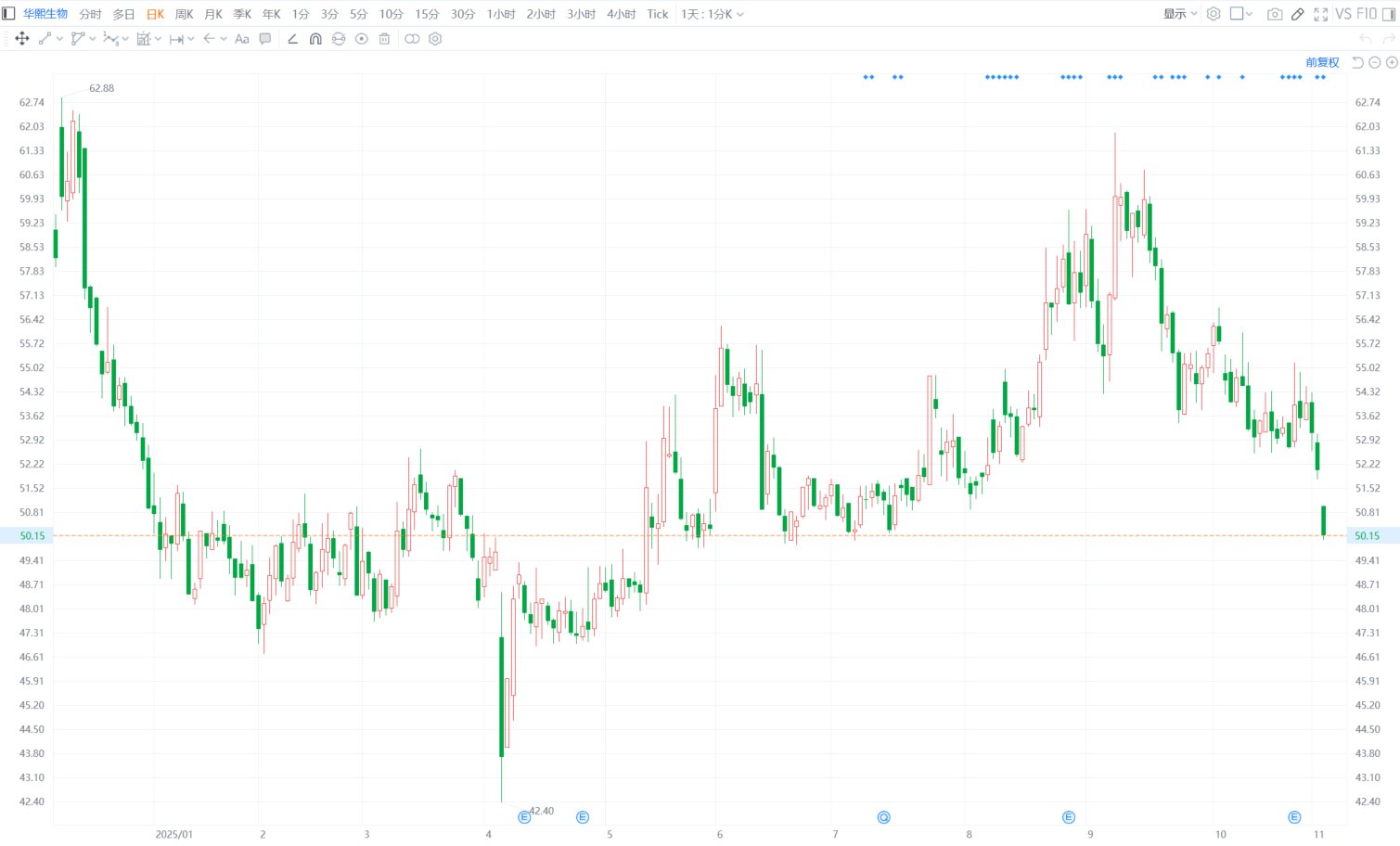
华熙生物跌3.82% 东吴证券3天前下调其评级至增持

Zhong Guo Jing Ji Wang· 2025-11-05 09:10
Group 1 - The core point of the article is that Huaxi Bio (688363.SH) reported a decline in stock price, closing at 50.06 yuan with a drop of 3.82% [1] - Dongwu Securities analysts have downgraded Huaxi Bio to a "hold" rating after their report on the company's Q3 2025 performance, which showed a year-on-year increase of 10.5% in net profit attributable to the parent company after deducting non-recurring gains and losses [1]
重组蛋白概念下跌1.06%,主力资金净流出33股
Zheng Quan Shi Bao Wang· 2025-11-05 08:50
Group 1 - The restructuring protein concept declined by 1.06%, ranking among the top declines in concept sectors, with *ST WanFang hitting the limit down [1] - Within the restructuring protein sector, major declines were seen in He Yuan Bio, San Sheng Guo Jian, and Hua Xi Bio, while 15 stocks experienced price increases, with InnoTech, Dezheng Health, and Ao Pu Mai leading the gains at 1.72%, 1.36%, and 1.33% respectively [1][2] Group 2 - The restructuring protein sector saw a net outflow of 542 million yuan from main funds, with 33 stocks experiencing outflows, and 13 stocks seeing outflows exceeding 10 million yuan [2] - He Yuan Bio had the highest net outflow of 277 million yuan, followed by Rejing Bio, Hua Xi Bio, and Hua Lan Bio with net outflows of 38.27 million yuan, 34.39 million yuan, and 32.92 million yuan respectively [2][3] Group 3 - The top stocks with net inflows in the restructuring protein sector included Jianyou Co., Xilong Science, and Borui Pharmaceutical, with net inflows of 17.18 million yuan, 13.67 million yuan, and 8.93 million yuan respectively [4]



A股异动丨华熙生物跌约4% 股价创近4个月新低
Ge Long Hui A P P· 2025-11-05 07:30
华熙生物(688363.SH)盘中跌3.9%至50.02元,股价创7月8日以来近4个月新低。华熙生物公告称,股东国寿成达(上海)健康产业股权投资中心(有限合伙)计划 通过集中竞价或大宗交易方式减持公司股份合计不超过963.36万股,占公司总股本比例不超过2%。减持原因为自身资金需求,减持期间为2025年11月26日 至2026年2月23日。上述股份来源于公司首次公开发行前取得的股份。(格隆汇) ...
短线防风险 80只个股短期均线现死叉
Zheng Quan Shi Bao Wang· 2025-11-05 06:30
Core Points - The Shanghai Composite Index is at 3970.29 points with a change of 0.26%, and the total trading volume of A-shares is 1,534.396 billion yuan [1] - A total of 80 A-shares have seen their 5-day moving average cross below the 10-day moving average, indicating potential bearish trends [1] Summary of Companies - **Beifang Copper (000737)**: Today's change is +0.41%, with a 5-day moving average of 15.35 yuan, which is -1.96% lower than the 10-day moving average of 15.66 yuan [1] - **Huali Co., Ltd. (603038)**: Today's change is +2.30%, with a 5-day moving average of 20.29 yuan, which is -1.81% lower than the 10-day moving average of 20.67 yuan [1] - **Suotong Development (603612)**: Today's change is +2.12%, with a 5-day moving average of 24.45 yuan, which is -1.61% lower than the 10-day moving average of 24.85 yuan [1] - **New Lai Materials (300260)**: Today's change is +0.34%, with a 5-day moving average of 58.73 yuan, which is -1.55% lower than the 10-day moving average of 59.65 yuan [1] - **Lianchuang Optoelectronics (600363)**: Today's change is -0.29%, with a 5-day moving average of 61.53 yuan, which is -1.33% lower than the 10-day moving average of 62.36 yuan [1] - **Guangfa Securities (000776)**: Today's change is +0.27%, with a 5-day moving average of 22.61 yuan, which is -1.26% lower than the 10-day moving average of 22.90 yuan [1] - **China Electric Research (688128)**: Today's change is +0.77%, with a 5-day moving average of 31.90 yuan, which is -1.20% lower than the 10-day moving average of 32.29 yuan [1] - **StarNet (002396)**: Today's change is -0.73%, with a 5-day moving average of 26.52 yuan, which is -1.01% lower than the 10-day moving average of 26.79 yuan [1] - **Shan Zi Gaoke (000981)**: Today's change is +1.84%, with a 5-day moving average of 3.94 yuan, which is -0.93% lower than the 10-day moving average of 3.98 yuan [1] - **ST Weier (002058)**: Today's change is +1.78%, with a 5-day moving average of 25.25 yuan, which is -0.92% lower than the 10-day moving average of 25.49 yuan [1] - **Titan Chemical (002145)**: Today's change is +2.80%, with a 5-day moving average of 5.51 yuan, which is -0.85% lower than the 10-day moving average of 5.56 yuan [1] - **Hank Technology (688006)**: Today's change is +2.84%, with a 5-day moving average of 31.95 yuan, which is -0.82% lower than the 10-day moving average of 32.21 yuan [1] - **Inner Mongolia First Machinery (600967)**: Today's change is +0.60%, with a 5-day moving average of 18.61 yuan, which is -0.80% lower than the 10-day moving average of 18.76 yuan [1] - **Liangjiu 12 (301592)**: Today's change is -0.24%, with a 5-day moving average of 124.73 yuan, which is -0.77% lower than the 10-day moving average of 125.69 yuan [1] - **Zhongwu Robotics (688297)**: Today's change is +0.06%, with a 5-day moving average of 47.82 yuan, which is -0.77% lower than the 10-day moving average of 48.19 yuan [1] - **Chihong Zn & Ge (600497)**: Today's change is +0.62%, with a 5-day moving average of 6.63 yuan, which is -0.76% lower than the 10-day moving average of 6.68 yuan [1] - **Dadi (688077)**: Today's change is -0.27%, with a 5-day moving average of 34.01 yuan, which is -0.74% lower than the 10-day moving average of 34.26 yuan [1]




技术新突破 基因编辑概念股出炉(附名单)
Zheng Quan Shi Bao Wang· 2025-11-05 05:48
Group 1 - The core viewpoint of the news is the initiation of large-scale clinical trials for gene-edited pig kidneys for human transplantation, marking a significant advancement in biotechnology and organ transplantation [1] - The first clinical trial was completed at NYU Langone Medical Center, approved by the FDA, aiming to evaluate the safety and efficacy of gene-edited pig kidneys for patients with end-stage kidney disease [1] - Global advancements in gene editing technology have been reported, including successful transplantation of gene-edited pig lungs in China and new treatment approaches for Down syndrome in Japan [1] Group 2 - Huazhong Securities highlights that breakthroughs in gene editing technology have significantly lowered the technical barriers for genetic modification, enabling large-scale industrial production of drugs [2] - In the A-share market, there are 22 listed companies with gene editing technology reserves, with mixed performance in stock prices; only 7 out of 22 companies saw gains on November 5 [4] - Among gene editing concept stocks, Shuanglu Pharmaceutical reported the highest net profit of 141 million yuan in the first three quarters, while Mengcao Ecological achieved a year-on-year profit increase of 48.73% [5][6] Group 3 - Eight gene editing concept stocks received attention from five or more institutions, with companies like Sturdy Medical and Huaxi Biological leading in institutional ratings [7] - Sturdy Medical announced a collaboration with Huazhong Agricultural University to establish a cotton research institute, focusing on gene editing and hybridization techniques for cotton seed improvement [7]