
国家开发银行

Search documents
货币市场日报:6月3日
Xin Hua Cai Jing· 2025-06-03 13:47
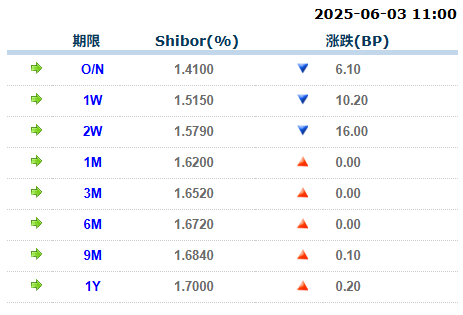
Group 1 - The People's Bank of China conducted a 454.5 billion yuan 7-day reverse repurchase operation at an interest rate of 1.40%, maintaining the previous rate, resulting in a net withdrawal of 375.5 billion yuan due to 830 billion yuan of reverse repos maturing on the same day [1] - The Shanghai Interbank Offered Rate (Shibor) for 7-day and 14-day tenors significantly declined to around 1.5%, with overnight Shibor dropping by 6.10 basis points to 1.4100%, 7-day Shibor down by 10.20 basis points to 1.5150%, and 14-day Shibor down by 16.00 basis points to 1.5790% [1][2] - In the interbank pledged repo market, short-term funding prices fell across the board, with R007 transaction volume rising to 13%. The weighted average rates for DR001 and R001 decreased by 6.9 basis points and 10.3 basis points, respectively, while DR007 and R007 rates fell by 11.5 basis points and 11.0 basis points [6] Group 2 - The funding environment on June 3 was characterized by a loose stance, with overnight rates stabilizing around 1.55% and 7-day repo rates also falling to approximately 1.55%. By the end of the day, some major banks offered overnight rates as low as 1.45% [10] - On the interbank certificate of deposit front, 19 certificates were issued on June 3, with a total issuance amount of 3.67 billion yuan. The secondary market saw a relatively quiet trading day, with yields rising compared to the pre-holiday period [11] - The People's Bank of China reported that during the Dragon Boat Festival holiday, UnionPay and NetUnion processed 14.05 billion transactions worth 4.8 trillion yuan, marking a year-on-year increase of 13% and 3.4%, respectively [13]

中国央行:2025年5月,国家开发银行、中国进出口银行、中国农业发展银行净归还抵押补充贷款2700亿元。5月末,抵押补充贷款余额为17939亿元。
news flash· 2025-06-03 10:04
Core Points - The People's Bank of China reported that by May 2025, the National Development Bank, China Export-Import Bank, and Agricultural Development Bank of China will have net repaid collateral supplementary loans amounting to 270 billion yuan [1] - As of the end of May, the balance of collateral supplementary loans stood at 1.7939 trillion yuan [1]
国家开发银行持续优化完善助学贷款服务
Zheng Quan Ri Bao· 2025-06-03 01:00
Core Viewpoint - The National Development Bank is actively supporting students through its student loan programs, ensuring that no student is deprived of education due to financial difficulties, while continuously optimizing its services and policies to meet the needs of borrowers [1][3]. Group 1: Loan Policy Enhancements - The maximum loan amount for undergraduate students has been increased from 16,000 yuan to 20,000 yuan per year, and for graduate students from 20,000 yuan to 25,000 yuan [2]. - The bank announced the refund of interest for loans that should have been exempted in 2025, demonstrating its commitment to reducing the financial burden on students [2]. - The bank allows students who graduated in 2025 or earlier to apply for a one-year extension on their loan repayments, providing additional financial relief [2]. Group 2: Service Improvements - The National Development Bank has implemented an online system since 2010, allowing students to complete part of their loan application process without needing to be physically present [2]. - Loan funds are directly transferred to the universities for tuition and accommodation, while the remaining amount is sent to students' personal bank accounts for daily expenses, enhancing efficiency and reducing the risk of fund misappropriation [2]. - The bank has launched a mobile application to upgrade its student loan services from desktop to mobile platforms, improving accessibility for students [2]. Group 3: Outreach and Awareness - The National Development Bank is collaborating with local education departments and universities to conduct outreach activities, ensuring that students are fully informed about the student loan policies [3]. - The bank aims to continuously improve its financial services related to student loans, reinforcing its role as a strong support system for students pursuing their dreams [3].
金融机构加大技术改造和设备更新支持力度
Zheng Quan Ri Bao Zhi Sheng· 2025-06-03 00:44
Group 1 - A leading private petrochemical company in Zhejiang Zhoushan is accelerating the transformation of production lines and equipment for circular economy and low-carbon transition, applying for inclusion in the technical renovation re-loan project list [1] - Agricultural Bank of China (ABC) Zhejiang Xiaoshan Branch has formed a project team to provide 2.8 billion yuan in loans for equipment renewal and transformation, aiming to optimize resource allocation, reduce costs, and improve production efficiency [1] - Since the State Council issued the action plan for large-scale equipment renewal in March last year, financial institutions have increased support for key areas of technical renovation and equipment renewal projects [1] Group 2 - The National Development Bank (NDB) has established a special loan for technological innovation and renovation, providing long-term preferential credit support for equipment renewal projects in various sectors, including energy and logistics [2] - The NDB has issued over 50 billion yuan in special loans to the technical renovation and equipment renewal sectors by the end of April this year, significantly supporting advanced equipment production and capacity construction [3] - Rural financial institutions, such as Qingdao Rural Commercial Bank, have launched innovative financial products like "Technological Renovation Loans" to support key projects in traditional industries, with a loan balance exceeding 24 billion yuan [4] Group 3 - The NDB plans to enhance product models and service mechanisms to continue increasing financing support for technical renovation and equipment renewal, contributing to the high-end, intelligent, and green development of industries [4] - ABC aims to optimize credit resource allocation and improve efficiency in meeting financing needs for key sectors, further supporting the implementation of relevant policies [5]
绿色金融工具箱扩容提效
Jing Ji Ri Bao· 2025-06-02 22:04
Group 1: Core Concept of Green Finance - Green finance is becoming a key lever for sustainable development in the global response to climate change and low-carbon transition [1] - The expansion of financial tools, including ESG investment principles and green credit innovations, injects strong momentum into the green economy [1] Group 2: ESG Integration in Banking - The core of green finance is to direct financial resources towards green industries, supporting the low-carbon transition of traditional industries and the development of strategic emerging industries [2] - ESG principles are increasingly integrated into banking credit processes, aiming to incentivize companies to improve their performance in environmental protection, social responsibility, and corporate governance [2] - Several banks have established personalized ESG evaluation systems to transform green credit business processes [2] Group 3: Impact of ESG Ratings on Credit Business - ESG ratings significantly influence banks' credit operations, serving as a basis for credit entry management and exit [3] - ESG ratings are dynamic and linked to credit management, with annual updates affecting credit ratings and limits [3] - Banks implement differentiated management measures based on ESG ratings in loan checks, pricing, and economic capital allocation [3] Group 4: Innovation in Green Financial Products - Financial authorities emphasize the importance of developing diverse green financial products and services [4] - The China Development Bank has issued sustainable development-linked loans to support high-standard farmland construction, linking water-saving rates to loan interest rates [4] - In the first four months of the year, the China Development Bank issued over 250 billion yuan in green loans, focusing on green infrastructure, clean energy, ecological protection, and pollution prevention [4] Group 5: Balancing Innovation and Risk in Green Finance - The rapid development of green finance is accompanied by increased ESG risks, necessitating a balance between innovation and risk control [5] - The enhancement of green service capabilities in the banking and insurance sectors will contribute to the maturity of China's green finance system in the long term [5] Group 6: Ecological Industry Planning - A significant challenge in developing green finance is the difficulty in converting environmental benefits from ecological projects into economic returns [7] - The EOD (Ecological Environment-Oriented Development) model integrates ecological governance projects with resource and industrial development to enhance the sustainability of the environmental industry [7] - Financial institutions are innovating financing models to support the realization of ecological product values, with some projects already showing initial success [7] Group 7: Case Study of EOD Project in Dongtou District - Dongtou District is implementing the "Dongtou Zhuwan: Common Prosperity Marine Garden" EOD project, integrating ecological governance with industrial development [8] - The China Development Bank's Zhejiang branch has provided 170 million yuan in syndicate loans to support this project [8] - Ongoing projects in the district are improving environmental quality and promoting traditional aquaculture transformation, leading to increased local income [9]
创新金融服务模式 释放文旅消费潜力
Sou Hu Cai Jing· 2025-06-02 01:04
Group 1 - The innovation in financial support models is beneficial for guiding more social capital into the cultural and tourism industry, focusing on key areas and enriching the supply of quality cultural and tourism products [1][5] - Recently, the Bank of China launched a series of measures to promote cultural and tourism consumption, including over 100 million yuan in tourism consumption subsidies, covering various aspects of the consumption chain [1][2] - Major state-owned banks and policy banks have been increasing their collaboration with the Ministry of Culture and Tourism to enhance financial support for the high-quality development of the cultural and tourism industry [1][2] Group 2 - The cultural and tourism industry has significant development potential and resilience, playing an increasingly important role in expanding domestic demand and stabilizing growth [2][4] - A series of financial policies have been introduced to optimize financial services for tourism, including lowering policy interest rates and establishing a 500 billion yuan fund for service consumption and elderly care [2][4] - The relationship between financial support and cultural tourism consumption is evolving from a supply-driven model to a demand-driven model, emphasizing the need for comprehensive financial services [2][3] Group 3 - The support from the Bank of China includes traditional financial methods as well as innovative approaches like AI itinerary planning and promotional activities, reflecting a shift towards integrated financial services in tourism consumption [3][4] - Financial institutions are increasingly taking proactive roles in supporting cultural tourism consumption, aligning with changing consumer demands and creating new opportunities for growth [3][4] - The government is promoting various financial initiatives, including technology finance and green finance, to further enhance support for the cultural and tourism sector [4][5] Group 4 - The year 2025 is seen as a pivotal year for the "14th Five-Year Plan," with favorable policies and development environments for cultural tourism consumption [5] - The continuous innovation of financial support models is expected to improve the accessibility and convenience of financial services in the cultural tourism sector, meeting the growing consumer demand [5] - Collaboration among government, financial institutions, and tourism market operators is essential to effectively release the potential of cultural tourism consumption and enhance its quality [5]
国开行:贷款超4000亿元 支持长江经济带绿色低碳高质量发展
Ren Min Wang· 2025-05-30 02:12
Group 1: Financial Support for Green Development - The National Development Bank (NDB) has issued over 400 billion yuan in loans to the Yangtze River Economic Belt from January to April this year, with a significant year-on-year increase, focusing on ecological governance, infrastructure connectivity, and green energy transition [1] - The NDB is actively exploring market-oriented financing models to support key projects in lake and river ecological restoration, particularly around Taihu Lake, enhancing environmental quality and promoting sustainable development [2][3] Group 2: Urban Environmental Improvement Initiatives - The NDB is promoting integrated sewage treatment projects in cities like Nanchang, with a loan of 220 million yuan allocated for the upgrade of sewage treatment plants and main sewage pipeline construction, aiming for a sewage treatment rate exceeding 95% by the end of the year [4] - The initiative aims to transform urban areas from polluted environments to eco-friendly spaces, contributing to the overall improvement of urban living conditions [4] Group 3: Infrastructure Development and Regional Coordination - The NDB is supporting the construction of green transportation infrastructure, including the renovation of the Longhuang Railway, which is expected to enhance regional connectivity and facilitate a freight capacity of 7.8 million tons annually [5][6] - The project incorporates ecological measures such as animal migration corridors and carbon sink forest planting, promoting sustainable development in the region [6] Group 4: Energy Transition and Low-Carbon Initiatives - The NDB is backing the expansion of the Huaneng Taicang power plant, providing 330 million yuan in loans for the construction of two ultra-supercritical coal-fired units, which are expected to reduce coal consumption by approximately 10% compared to conventional units [7] - The project is anticipated to generate 9.78 billion kilowatt-hours of electricity annually, leading to a carbon reduction of about 690,000 tons, thus supporting the green transition of the manufacturing sector in the Yangtze River Delta [7] Group 5: Future Financial Strategies - The NDB plans to continue enhancing its financial services in key areas such as ecological governance, green industries, infrastructure, and improving living standards, utilizing long-term loans and green bonds to contribute to high-quality development in the Yangtze River Economic Belt [7]
国开行发行3年期债券,规模85亿元,发行利率1.6136%,预期1.6000%,投标倍数2.15倍,边际倍数33.00倍;国开行发行7年期债券,规模30亿元,发行利率1.7043%,预期1.7300%,投标倍数3.82倍,边际倍数2.17倍。
news flash· 2025-05-29 02:39
Group 1 - The China Development Bank issued a 3-year bond with a scale of 8.5 billion, an issuance rate of 1.6136%, and a bid-to-cover ratio of 2.15 times, with a marginal ratio of 33.00 times [1] - The China Development Bank also issued a 7-year bond with a scale of 3 billion, an issuance rate of 1.7043%, and a bid-to-cover ratio of 3.82 times, with a marginal ratio of 2.17 times [1]
1至4月国开行向长江经济带沿江省市放贷超4000亿元
news flash· 2025-05-29 01:59
Core Viewpoint - In the first four months of this year, the China Development Bank (CDB) issued loans exceeding 400 billion yuan to provinces and cities along the Yangtze River Economic Belt, showing a significant year-on-year increase [1] Group 1: Financial Performance - The total loans issued by CDB to the Yangtze River Economic Belt reached over 400 billion yuan in the first four months of the year [1] - There is a notable year-on-year growth in the loan issuance compared to the same period last year [1] Group 2: Future Strategy - CDB plans to continue strengthening its functional positioning and focus on its main responsibilities and businesses [1] - The bank will concentrate on key areas such as ecological governance, green industries, infrastructure, and improving people's livelihoods [1] - CDB aims to effectively utilize financial products like medium to long-term loans and green bonds to enhance the quality and efficiency of financial services [1]
财政部今年将在港发行680亿元国债;光大信托原董事长闫桂军受审丨金融早参
Mei Ri Jing Ji Xin Wen· 2025-05-28 22:59
Group 1 - The Ministry of Finance plans to issue 68 billion RMB in government bonds in Hong Kong in 2025, continuing the strategy of RMB internationalization [1] - The issuance of bonds is expected to benefit large banks involved, enhancing their cross-border business activity and increasing the attractiveness of RMB assets [1] - The overall stock market is anticipated to benefit from policy consistency, deepening financial connectivity between mainland China and Hong Kong, and boosting market stability and investor confidence [1] Group 2 - CIPS has signed a memorandum of understanding with the Central Bank of the UAE to enhance cross-border payment efficiency and infrastructure [2] - This collaboration is expected to benefit financial institutions participating in the CIPS system, strengthening their global service capabilities [2] - The capital market is likely to gain stability from improved risk compliance and security, supporting the long-term confidence of investors and capital flow resilience [2] Group 3 - Yunnan Province has increased the credit limit for individual special loans aimed at stabilizing and expanding employment to a maximum of 10 million RMB [3] - This policy is expected to provide a business growth opportunity for local banks and financial institutions, expanding their market share in credit [3] - The overall stock market is projected to be boosted by policy consistency, enhancing economic recovery expectations and investor confidence [3] Group 4 - The China Development Bank has issued over 400 billion RMB in loans to provinces along the Yangtze River Economic Belt in the first four months of the year, focusing on ecological governance and infrastructure [4] - This support is expected to provide business growth for environmental engineering and infrastructure construction companies, particularly those involved in the Yangtze River protection projects [4] - The overall stock market is likely to be strengthened by targeted financial policies, enhancing confidence in the stability of the real economy and injecting long-term development momentum into related sectors [4] Group 5 - The trial of the former chairman of Everbright Trust for corruption and abuse of power is expected to lead to increased internal monitoring demands within the trust industry [5] - The stock market may experience a boost from anti-corruption actions, enhancing regulatory transparency and market stability [5] - However, short-term emotional fluctuations may be a concern for investors as the industry undergoes self-regulation upgrades [5]