
国睿科技

Search documents
2025年军工行业订单有望迎来拐点,高端装备ETF(159638)最新规模创今年以来新高!
Xin Lang Cai Jing· 2025-05-09 02:55
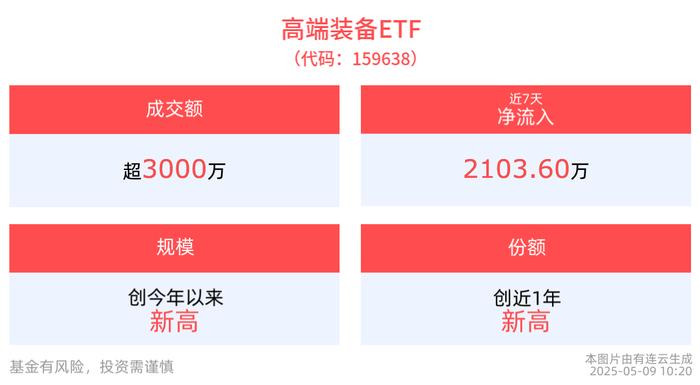
Group 1 - The China Securities High-end Equipment Sub-index 50 has decreased by 2.46% as of May 9, 2025, with mixed performance among constituent stocks, led by Aerospace Nanhai up 1.50% [1] - The High-end Equipment ETF (159638) has seen a cumulative increase of 8.55% over the past two weeks as of May 8, 2025 [1] - The High-end Equipment ETF recorded a turnover of 3.05% and a transaction volume of 36.1554 million yuan, with an average daily transaction volume of 97.8379 million yuan over the past week [3] Group 2 - The latest scale of the High-end Equipment ETF reached 1.237 billion yuan, marking a new high for the year, with the latest share count at 1.547 billion, also a new high for the past year [3] - The net inflow of funds into the High-end Equipment ETF was 30.633 million yuan [3] - The top ten weighted stocks in the China Securities High-end Equipment Sub-index 50 account for 45.74% of the index, including companies like AVIC Optoelectronics and AVIC Shenyang Aircraft [3] Group 3 - Institutions forecast a turning point in military industry orders by 2025, driven by new technologies aimed at enhancing equipment performance or reducing costs, and new markets from military trade and technology conversion [3] - Huatai Securities indicates that China has entered a phase of "self-research equipment as the main" military trade net surplus, with significant growth expected in domestic demand from 2025 to 2027 [3] - Investors can consider the China Securities High-end Equipment Sub-index 50 ETF linked fund (018028) to capitalize on industry rotation opportunities [3]


军工行业2024年年报及2025年一季报业绩回顾:收入和利润“非线性”变化,行业“业绩底”基本确立
Minsheng Securities· 2025-05-08 11:18
Investment Rating - The report maintains a positive outlook on the military industry, suggesting that the "performance bottom" has been established and that the sector may enter a new growth cycle from 2025 to 2027 [6] Core Insights - In 2024, the military industry experienced a decline in total revenue and net profit, with a year-on-year decrease of 5% and 48% respectively. The first quarter of 2025 continued this trend with a 5% year-on-year decline in revenue and a 34% decline in net profit [1][11] - The report indicates that the decline in revenue and profit is "non-linear," with profits dropping significantly despite only a slight decrease in revenue. This is attributed to factors such as price declines and increased impairment losses [2][19] - The shipbuilding sector showed the best performance, with net profit increasing by 88% in 2024, while other sectors like aerospace and weapons faced significant losses [4][48] Summary by Sections Performance Review - In 2024, the military industry (excluding shipbuilding) achieved total revenue of 458 billion yuan, down 5.3% year-on-year, and a net profit of 187 billion yuan, down 48.4% year-on-year. Including shipbuilding, total revenue was 683.1 billion yuan, down 1.3%, and net profit was 263 billion yuan, down 34.7% [11][12] - The first quarter of 2025 saw total revenue of 858 billion yuan, down 4.8% year-on-year, and a net profit of 44 billion yuan, down 34.2% year-on-year [61][63] Trend Analysis - The industry has faced continuous profit declines over seven consecutive quarters, with the fourth quarter of 2024 marking the first historical quarterly loss [2][19] - The gross profit margin decreased by 2.1 percentage points to 21.6%, and the net profit margin decreased by 3.4 percentage points to 4.4% in 2024 [19][60] Balance Sheet Insights - As of the end of 2024, the industry had inventory totaling 225.8 billion yuan, accounting for 49% of total revenue, indicating inventory buildup and preparation for order recovery [3][23] - Accounts receivable increased to 319.7 billion yuan, representing 70% of total revenue, highlighting ongoing collection pressures [3][25] Sector Performance - The shipbuilding sector was the only segment to achieve positive growth in 2024, with a net profit increase of 88% [4][48] - The aerospace and weapons sectors experienced significant losses, with expectations for recovery in 2025 [4][37] Recommendations - The report suggests focusing on specific companies within the military sector, including guided equipment and new combat capabilities, as well as military trade and commercial aviation [5]
国防ETF(512670)涨近2%冲击4连涨,中航成飞20cm涨停
Xin Lang Cai Jing· 2025-05-08 07:40
Group 1 - The defense sector is experiencing upward momentum due to increased military spending and geopolitical tensions, indicating a potential upward cycle in the military trade market [2] - The National Defense ETF (512670) has risen by 1.68%, reaching a new high of 3.808 billion yuan, reflecting strong investor interest in the defense industry [2] - Major companies in the defense sector, such as AVIC Chengfei, are expected to maintain high-quality development during the current equipment upgrade phase [2] Group 2 - As of April 30, 2025, the top ten weighted stocks in the CSI National Defense Index (399973) account for 43.61% of the index, indicating concentrated investment in key players [3] - The defense sector is entering a phase of net surplus in military trade, with significant opportunities for the export of domestically developed equipment [2] - Analysts predict that the performance of the defense sector is nearing its bottom, with expectations of recovery starting in 2025, supported by a series of order announcements since late 2024 [2]
印巴冲突下,关注军贸市场投资机会
China Post Securities· 2025-05-08 05:07
Industry Investment Rating - The investment rating for the defense and military industry is "Outperform the Market" and is maintained [1]. Core Viewpoints - The report highlights the recent escalation of conflict between India and Pakistan, which has implications for military trade opportunities [4][5]. - Pakistan is identified as a significant market for Chinese military exports, accounting for approximately 60% of China's military trade exports from 2019 to 2023 [5]. - The report emphasizes the need for state-owned military enterprises to enhance their international competitiveness, suggesting that there is substantial room for growth in revenue and profit margins compared to international military giants [6]. - Key listed companies in the defense sector include Guorui Technology, AVIC Chengfei, Aerospace Nanhua, Guobo Electronics, Leidian Weili, Zhong无人机, and Aerospace Rainbow [6]. Summary by Relevant Sections Industry Basic Situation - Closing point: 1439.46 - 52-week high: 1712.48 - 52-week low: 1113.62 [1]. Recent Research Reports - The report references a recent publication indicating that 20 out of 62 military listed companies reported year-on-year growth in their Q1 2025 earnings [4].


内外兼修,左右逢源——论印巴冲突对军工行业的影响
AVIC Securities· 2025-05-08 03:54
Investment Rating - The report maintains an "Accumulate" investment rating for the defense industry [3]. Core Viewpoints - The intensification of the India-Pakistan conflict has drawn significant attention to the military industry, with defense stocks rising by 3.70% on May 7, 2025, marking the highest increase among 31 sectors [1][6]. - The report highlights that geopolitical events can have a short-term impact on military stock performance, influenced by the relevance of the event to China, market risk appetite, and the duration of the event [2][6]. - In the medium to long term, the India-Pakistan conflict is expected to strengthen global military trade logic, with China being a key supplier to Pakistan, which has a high dependency on Chinese military imports [7][8]. Summary by Sections Short-term Impact of the India-Pakistan Conflict - The conflict is likely to provide ongoing support for military stock performance due to its proximity to China and the heightened geopolitical tensions [6][7]. - The market's risk appetite has been somewhat restored following recent financial policy adjustments, which may further bolster military stocks [6]. Medium to Long-term Impact on Military Trade - Pakistan is a significant importer of Chinese military products, with 63.02% of China's military exports going to Pakistan from 2020 to 2024, and 81.15% of Pakistan's military imports coming from China [7][8]. - The report anticipates that the military trade market will continue to grow, driven by China's competitive advantages and the evolving global security landscape [17][25]. Investment Trends and Directions - The military industry is expected to remain in a favorable cycle, with a focus on unmanned equipment, military intelligence, satellite internet, and electronic countermeasures as key investment opportunities [13]. - The report emphasizes the importance of military trade in the context of the "Belt and Road" initiative, suggesting that it will serve as a new growth driver for China's military industry [25][30]. Global Military Trade Development - The global military trade market is projected to maintain a high level of activity, with increased military spending across various nations due to ongoing geopolitical conflicts [20][21]. - China's military exports are expected to shift from a recovery phase to a supply-demand resonance-driven growth phase by the end of the 14th Five-Year Plan [30][32]. Military Product Focus - The report indicates that military products will continue to concentrate on aviation, aerospace, and new domain weaponry, reflecting China's growing capabilities in these areas [49][50].
大飞机板块持续拉升,通达股份、润贝航科涨停
news flash· 2025-05-08 02:24
暗盘资金正涌入这些股票,点击速看>>> 大飞机板块持续拉升,通达股份(002560)、润贝航科(001316)涨停,西菱动力(300733)、日发精 机(002520)、国睿科技(600562)、四创电子(600990)跟涨。 ...

未知机构:广发军工新专题欧盟自主化战略下军贸价值链迁移与产能价值重估的思考-20250508
未知机构· 2025-05-08 02:20
全球军贸交易需求保持活跃,欧洲主流防务企业新增订单及积压订单均创新高,欧盟产能优先供给自身需求的背 景下,类比俄乌冲突后俄罗斯武器装备出口出现的空缺,#原采购欧盟防务产品的国家的军贸需求有望显著外溢。 #军贸推动企业穿越价格及需求周期,重视本轮我国军工企业内外需双轮驱动的#产能价值重估。 【广发军工|新专题】欧盟自主化战略下,#军贸价值链迁移与产能价值重估的思考 现象:部分#海外军工股近期股价表现亮眼,被动加费到主动武装,当前欧洲核心在于#建设自主化的国防体制, 提出到2030年,成员国在EDTIB的国防装备采购达到50%,欧盟内部国防贸易额至少占欧盟国防市场份额的35%。 #欧防务企业订单饱满、产能紧张,全球军贸需求外溢可期。 全球军贸交易需求保持活跃,欧洲主流防务企业新 【广发军工|新专题】欧盟自主化战略下,#军贸价值链迁移与产能价值重估的思考 现象:部分#海外军工股近期股价表现亮眼,被动加费到主动武装,当前欧洲核心在于#建设自主化的国防体制, 提出到2030年,成员国在EDTIB的国防装备采购达到50%,欧盟内部国防贸易额至少占欧盟国防市场份额的35%。 #欧防务企业订单饱满、产能紧张,全球军贸需求外溢 ...


再次提示军贸投资机会
2025-05-07 15:20
Summary of Key Points from the Conference Call Industry Overview - The conference call focuses on the military trade (military trade) industry, particularly China's military exports and the implications of geopolitical conflicts, especially between India and Pakistan [1][3][4][6][11]. Core Insights and Arguments - **Stock Market Performance**: Chengfei's stock price volatility reached ±20% after its backdoor listing through AVIC Electromechanical, indicating high market interest in its military assets [1][2]. - **Geopolitical Context**: The India-Pakistan conflict highlighted the complex relationship between Chinese military trade and international geopolitics, with Pakistan utilizing Chinese-made J-10 and JF-17 fighter jets during the conflict [1][4][5][7]. - **Export Strategy Shift**: China's military export strategy has evolved to focus on advanced equipment rather than downgraded versions, aiming for practical testing to enhance overall military capabilities [1][18]. - **Major Export Markets**: Pakistan is the largest recipient of Chinese military equipment, accounting for approximately 42% of China's military exports, which includes advanced systems like the J-10CE and JF-17 [1][8][9]. - **International Orders**: During the 2024 Zhuhai Airshow, China secured around $40 billion in orders, showcasing significant progress in military equipment exports [1][16]. Additional Important Content - **Market Dynamics**: The military industry is currently experiencing strong performance, with the CITIC Military Industry Index ranking first among all sectors, driven by strong reactions from companies in the Chengfei and military trade supply chains [2]. - **Future Opportunities**: The military trade market has potential for growth, especially if the U.S. experiences a significant decline in its military trade dominance, which could create a critical point for Chinese military exports [3]. - **Technological Developments**: The 2024 Zhuhai Airshow featured advanced military equipment like the J-35, indicating a push towards international markets [1][12][20]. - **Investment Recommendations**: Companies to watch include those in radar products (Aerospace Nanhu and Guorui Technology), missile sectors (Philihua, New Power, etc.), and fighter jets (Chengfei, AVIC Shenyang, etc.) due to their strategic importance and potential for market share growth [21][24]. Conclusion - The military trade industry is at a pivotal moment, influenced by geopolitical tensions and evolving export strategies. The focus on advanced military technology and significant international orders positions China favorably in the global military trade landscape.
局部冲突升级下的军贸投资前景
2025-05-07 15:20
Summary of Key Points from Conference Call Industry Overview - The conference call discusses the military trade (military trade) industry, particularly focusing on the implications of regional conflicts such as the India-Pakistan conflict and the Russia-Ukraine war on military equipment and trade dynamics [1][2][3]. Core Insights and Arguments - **Performance of Chinese Equipment**: Chinese military equipment has demonstrated superior performance in the India-Pakistan conflict, enhancing its recognition and competitiveness in the international military trade market, especially in geopolitically complex regions [1][3]. - **Impact of Russia-Ukraine War**: The Russia-Ukraine war has exposed deficiencies in some Russian equipment, leading to a decline in its market share. In contrast, China's cost-effectiveness and continuous technological innovation position it to capture a larger share of the global military trade market [1][5][10]. - **Increased Military Spending**: Global geopolitical instability has led to increased military spending across various nations, particularly in Europe, the U.S., and countries surrounding China, positively impacting the military industry investment outlook [1][6]. - **Shift in Chinese Military Trade Strategy**: China's military trade strategy is evolving from "having what others do not" to "refining what others have," aiming to provide differentiated and high-cost-performance equipment to expand its international market share [1][11]. - **Opportunities from Russia's Decline**: The decline of Russia's market share in military trade presents new opportunities for China, particularly in sectors like medium and large drones, armored vehicles, ammunition, and long-range rockets [1][12][11]. Additional Important Insights - **Short-term Investment Focus**: Investors are advised to focus on military equipment that performed well during the India-Pakistan conflict, such as the J-10C fighter jets and PL-15 air-to-air missiles, along with related core companies that are likely to become investment hotspots [1][15][16]. - **Growth Potential for Chinese Military Equipment**: The future of Chinese military equipment in the international market looks promising, with the potential for increased market share due to superior performance and cost advantages [7][17]. - **Global Military Trade Demand Trends**: The demand for military trade is on a continuous upward trend, driven by a limited number of countries capable of providing independent and complete equipment systems, including China, Russia, the U.S., and some European nations [9][19]. - **Valuation Discrepancies in the Military Sector**: Discrepancies in valuations within the military sector stem from uncertainties regarding industry ceilings and future profitability, despite strong performance in early 2025 [18]. - **Regulatory Changes in Military Trade**: Future adjustments in domestic military trade regulations are anticipated to adapt to global military demand changes, with a focus on promoting current active products [21]. Conclusion - The conference call highlights the evolving landscape of the military trade industry, emphasizing the strategic advantages for Chinese military equipment in light of recent conflicts and the shifting dynamics of global military spending and trade. Investors are encouraged to identify key players and sectors that are likely to benefit from these trends.
多重因素叠加,军工今日领涨。央企科技引领ETF(562380)领涨2.36%。中航成飞,航天彩虹,国睿科技领涨
Xin Lang Cai Jing· 2025-05-07 05:43
Group 1 - The Central State-Owned Enterprises Technology Leading Index (932038) has seen a strong increase of 2.05%, with notable gains in constituent stocks such as AVIC Chengfei (302132) up 19.31%, Aerospace Rainbow (002389) up 10.02%, and Guobo Electronics (688375) up 8.53% [1] - The Central State-Owned Enterprises Technology Leading ETF (562380) has also risen by 2.36%, marking its third consecutive increase, with the latest price reported at 0.87 yuan [1] - Over the past year, the Central State-Owned Enterprises Technology Leading ETF has accumulated a total increase of 9.14%, with an average daily trading volume of 709.56 million yuan [1] Group 2 - China's defense budget has maintained an increase of around 7%, with defense spending accounting for less than 1.5% of GDP, which is below the average level of major military powers [2] - There is significant growth potential for China's defense spending, which is expected to outpace GDP growth in the long term [2] - The military industry is anticipated to emerge from a two-year period of stagnation, entering a phase of performance improvement and valuation enhancement, particularly in advanced fighter jets, low-altitude economy, domestic large aircraft, satellite internet, and deep-sea technology sectors [2]
