沪农商行

Search documents
A股银行股拉升,重庆银行涨超4%
Ge Long Hui· 2025-10-14 02:48
Core Viewpoint - The A-share market's banking sector experienced a significant rally, with multiple banks showing notable increases in their stock prices [1] Group 1: Stock Performance - Chongqing Bank saw an increase of over 4% in its stock price [1] - Jiangsu Bank's stock rose by more than 3% [1] - Other banks including China Merchants Bank, Everbright Bank, Xiamen Bank, Agricultural Bank of China, CITIC Bank, Industrial Bank, Shanghai Pudong Development Bank, and Shanghai Rural Commercial Bank all experienced stock price increases of over 2% [1]




资配如何应对新变化——总量创辩第113期:资产配置快评
Huachuang Securities· 2025-10-14 02:45
Economic Indicators - Manufacturing investment growth is expected to be 4.0% for January to September, the first time since 2021 that it falls below GDP growth of approximately 5.1%[2] - September PPI is expected to narrow year-on-year to -2.5%, with a month-on-month decline of around -0.2%[15] - Retail sales growth for September is projected at 3.2%, while fixed asset investment growth for January to September is estimated at -0.2%[15] Policy Adjustments - Recent policy adjustments include the acceleration of 500 billion yuan in new policy financial tools and changes to real estate purchase restrictions in first-tier cities[3][13] - The government plans to enhance economic monitoring and timely policy adjustments based on economic conditions, as stated in a press conference on September 29[2] Trade Relations - The recent escalation in US-China trade tensions includes a proposed 100% additional tariff on Chinese goods starting November 1, which has led to a short-term market reaction[5][24] - Historical data suggests that trade tensions have limited long-term impacts on market pricing, primarily affecting risk preferences rather than fundamental economic growth[4][19] Market Trends - The bond market has shown a quick decline in yields following the announcement of new tariffs, with a focus on the 1.7%-1.75% yield range for future movements[5][26] - The dollar index has rebounded by 2.3% since the Federal Reserve's September meeting, driven by a decrease in short positions and increased foreign investment in US Treasury bonds[6][28] Fund Performance - The total equity fund position increased to 96.02%, up by 118 bps from the previous week, while mixed funds rose to 93.86%, an increase of 70 bps[9][35] - The average return for equity ETFs was -0.66%, while mixed bond funds performed slightly better with an average return of -0.08%[9][37]
银行板块延续强势 重庆银行涨超6%
2 1 Shi Ji Jing Ji Bao Dao· 2025-10-14 02:41
Core Viewpoint - The banking sector continues its strong performance, with city commercial banks leading the gains, particularly notable increases in stock prices for several banks [1] Group 1: Stock Performance - City commercial banks are showing significant gains, with Chongqing Bank rising over 6% [1] - Other banks such as Jiangsu Bank, Xiamen Bank, Shanghai Rural Commercial Bank, Agricultural Bank of China, Nanjing Bank, and CITIC Bank all experienced increases of over 2% [1]

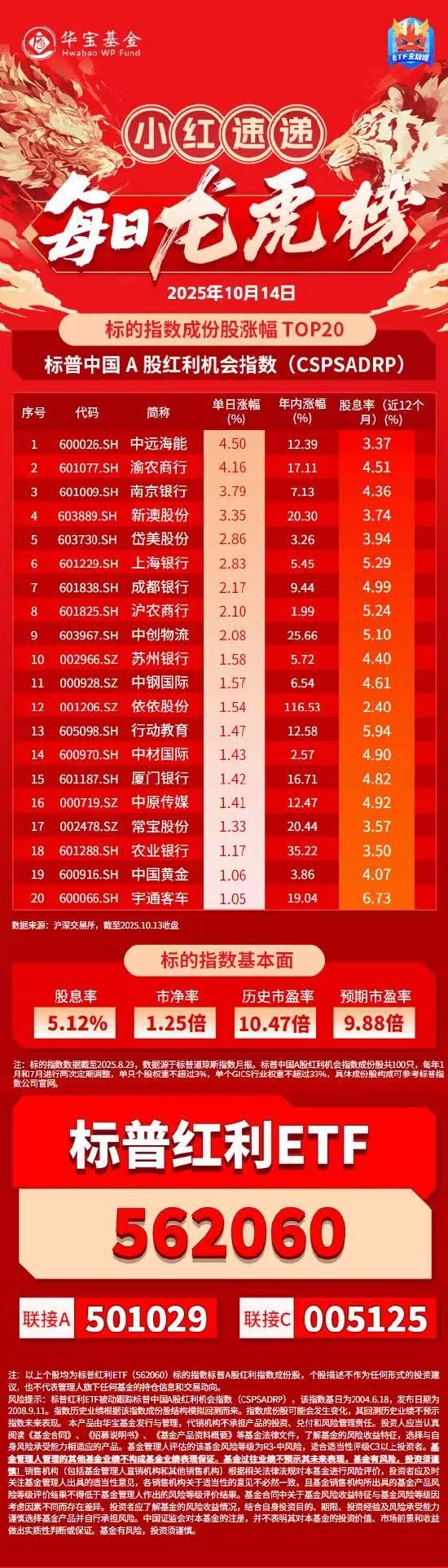
小红日报|标普红利ETF(562060)标的指数收跌0.46%,中远海能领涨成份股
Xin Lang Ji Jin· 2025-10-14 02:25
Core Insights - The article highlights the top-performing stocks in the S&P China A-Share Dividend Opportunity Index, showcasing significant daily and year-to-date gains along with dividend yields [1]. Group 1: Stock Performance - The top stock, 中江海能 (600026.SH), experienced a daily increase of 4.50% and a year-to-date increase of 12.39%, with a dividend yield of 3.37% [1]. - 渝农商行 (601077.SH) saw a daily rise of 4.16% and a year-to-date rise of 17.11%, offering a dividend yield of 4.51% [1]. - 南京银行 (601009.SH) reported a daily increase of 3.79% and a year-to-date increase of 7.13%, with a dividend yield of 4.36% [1]. Group 2: Additional Notable Stocks - 新澳股份 (6038888 CH) had a daily gain of 3.35% and a year-to-date gain of 20.30%, with a dividend yield of 3.74% [1]. - 岱美股份 (603730.SH) increased by 2.86% daily and 3.26% year-to-date, with a dividend yield of 3.94% [1]. - 上海银行 (601229.SH) saw a daily rise of 2.83% and a year-to-date rise of 5.45%, with a dividend yield of 5.29% [1].



银行App“瘦身”进行时
Jing Ji Wang· 2025-10-14 01:49
Core Viewpoint - The banking industry is increasingly integrating various functionalities of their standalone apps into mobile banking apps to enhance user experience and reduce operational costs [1][4]. Group 1: App Integration Trends - Several banks, including Beijing Bank and China Bank, are shutting down their standalone direct banking and credit card apps, migrating functionalities to their main mobile banking apps [2][3]. - The trend of app integration is not limited to direct banking and credit card apps; many banks are also applying for the cancellation of their enterprise banking and lifestyle service apps due to low user engagement [2][3]. Group 2: User Engagement Issues - The primary reasons for the "app slimming" trend include low user engagement, poor user experience, and redundant functionalities [3]. - Initially, the banking sector believed that lightweight, focused apps would better meet customer needs, but the proliferation of apps has instead burdened consumers [3]. Group 3: Regulatory Influence - Recent regulatory guidance from the National Financial Regulatory Administration emphasizes the need for banks to manage mobile applications more effectively, including optimizing or terminating low-performing apps [3]. Group 4: Benefits of Integration - By consolidating apps into a unified "super app," banks can significantly enhance user experience, lower operational maintenance costs, and improve risk monitoring and management [4].
银行App“瘦身”进行时:直销银行、信用卡等独立应用持续整合
Zhong Guo Zheng Quan Bao· 2025-10-13 23:28
Core Viewpoint - The banking industry is increasingly integrating various app functionalities into mobile banking apps to enhance user experience, reduce operational costs, and improve risk management [1][4]. Group 1: App Integration Trends - Several banks, including Beijing Bank and China Bank, are shutting down their standalone direct banking and credit card apps, migrating functionalities to their main mobile banking apps [2]. - The trend of app integration is not limited to direct banking and credit card apps; many banks are also consolidating their corporate banking and lifestyle service apps [2]. - The integration is driven by the need to address low user engagement, poor experience, and redundant functionalities associated with multiple apps [3]. Group 2: User Experience and Operational Efficiency - The initial focus on lightweight, specialized apps has led to an overwhelming number of applications for consumers, creating a burden rather than enhancing service [3]. - Users have expressed a preference for fewer, more comprehensive apps that can meet their needs without cluttering their devices [3]. - Regulatory guidance has emphasized the need for banks to manage mobile applications effectively, leading to the optimization and potential termination of underperforming apps [3]. Group 3: Risk Management and Cost Reduction - By consolidating apps into a "super app," banks can significantly enhance user experience while lowering the costs associated with maintaining multiple applications [4]. - A unified app approach allows for centralized monitoring of transactions, improving the ability to identify and mitigate risks [4].
银行App“瘦身”进行时:直销银行、信用卡等 独立应用持续整合
Zhong Guo Zheng Quan Bao· 2025-10-13 23:27
Core Viewpoint - The banking industry is increasingly integrating various app functionalities into mobile banking apps to enhance user experience, reduce operational costs, and improve risk management [1][4]. Group 1: App Integration Trends - Several banks, including Beijing Bank and China Bank, are shutting down their standalone direct banking and credit card apps, migrating functionalities to their main mobile banking apps [2]. - The trend of app integration is not limited to direct banking and credit card apps; many banks are also consolidating their corporate banking and lifestyle service apps due to low user engagement and operational inefficiencies [2][3]. Group 2: User Engagement Challenges - The primary reasons for the app consolidation include low user activity, poor user experience, and redundant functionalities across multiple apps [3]. - Users have expressed frustration over the number of banking apps, indicating that they prefer to have fewer, more comprehensive apps to manage their banking needs [3]. Group 3: Regulatory and Strategic Support - Regulatory guidance from the National Financial Regulatory Administration emphasizes the need for banks to manage mobile applications effectively, encouraging the reduction of low-activity and redundant apps [3]. - By creating a unified "super app," banks can enhance user experience, lower maintenance costs, and improve risk monitoring and management [4].
直销银行、信用卡等 独立应用持续整合
Zhong Guo Zheng Quan Bao· 2025-10-13 23:24
Core Viewpoint - The banking industry is increasingly integrating various functionalities of their standalone apps into mobile banking apps to enhance user experience and reduce operational costs [1][4]. Group 1: App Integration Trends - Several banks, including Beijing Bank and China Bank, are shutting down their standalone direct banking and credit card apps, migrating functionalities to their main mobile banking apps [2][3]. - The trend of app integration is not limited to direct banking and credit card apps; many banks are also consolidating their corporate banking and lifestyle service apps [2][3]. Group 2: User Experience Challenges - The primary reasons for the app consolidation include low user engagement, poor user experience, and redundant functionalities [3][4]. - Initial strategies focused on lightweight, specialized apps to meet customer needs, but the proliferation of apps has become burdensome for users [3]. Group 3: Regulatory Influence - Recent regulations from the National Financial Regulatory Administration emphasize the need for banks to manage mobile applications effectively, including optimizing or terminating underperforming apps [3]. Group 4: Benefits of Integration - By creating a unified "super app," banks can significantly enhance user experience, lower operational maintenance costs, and improve risk monitoring and management [4].
直销银行、信用卡等独立应用持续整合
Zhong Guo Zheng Quan Bao· 2025-10-13 20:56
Core Viewpoint - The banking industry is increasingly integrating various app functionalities into mobile banking apps to enhance user experience, reduce operational costs, and improve risk management [1][4]. Group 1: App Integration Trends - Several banks, including Beijing Bank and China Bank, are shutting down their standalone apps for direct banking and credit card services, migrating functionalities to their main mobile banking apps [1][2]. - This trend is not limited to direct banking and credit card apps; many banks are also consolidating their corporate banking and lifestyle service apps due to low user engagement and redundancy [2][3]. Group 2: User Experience Challenges - The proliferation of multiple banking apps has created a burden for consumers, leading to low user activity and dissatisfaction with the overall experience [3]. - Users have expressed a preference for fewer, more integrated apps, indicating a desire for a streamlined banking experience [3]. Group 3: Regulatory Influence - Recent regulations from the National Financial Regulatory Administration emphasize the need for banks to manage mobile applications effectively, encouraging the consolidation of apps with low user engagement and high operational risks [3]. Group 4: Benefits of Integration - By creating a unified "super app," banks can significantly enhance user experience while lowering the costs associated with maintaining multiple apps [4]. - Consolidation allows for centralized monitoring of transactions, improving risk identification and management [4].
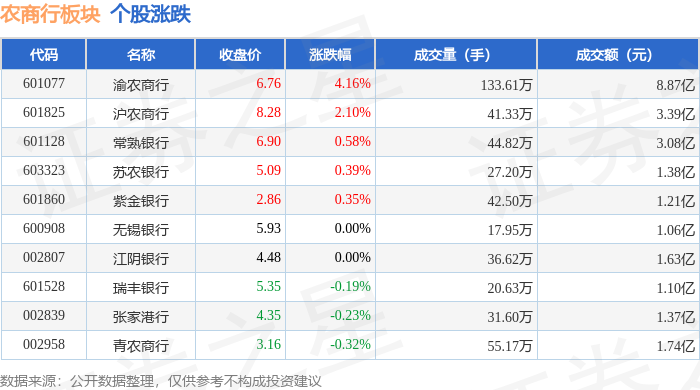
农商行板块10月13日涨2.42%,渝农商行领涨,主力资金净流入5644.17万元
Zheng Xing Xing Ye Ri Bao· 2025-10-13 12:45
Market Performance - The rural commercial bank sector increased by 2.42% on October 13, with Yunnan Rural Commercial Bank leading the gains [1] - The Shanghai Composite Index closed at 3889.5, down 0.19%, while the Shenzhen Component Index closed at 13231.47, down 0.93% [1] Individual Stock Performance - Yunnan Rural Commercial Bank (601077) closed at 6.76, up 4.16% with a trading volume of 1.3361 million shares and a transaction value of 887 million [1] - Shanghai Rural Commercial Bank (601825) closed at 8.28, up 2.10% with a trading volume of 413,300 shares and a transaction value of 339 million [1] - Jiangyin Bank (002807) and Zijin Bank (601860) showed minimal gains of 0.00% and 0.35% respectively, with transaction values of 163 million and 121 million [1] Capital Flow Analysis - The rural commercial bank sector saw a net inflow of 56.4417 million from main funds, while retail funds experienced a net outflow of 42.047 million [1] - Yunnan Rural Commercial Bank had a main fund net inflow of 47.1867 million, but retail funds saw a net outflow of 24.1221 million [2] - Zijin Bank experienced a main fund net inflow of 10.8185 million, with retail funds showing a net outflow of 1.1618 million [2]