
博时基金

Search documents
大部分基金公司都是陪跑
Xin Lang Cai Jing· 2025-12-23 01:44
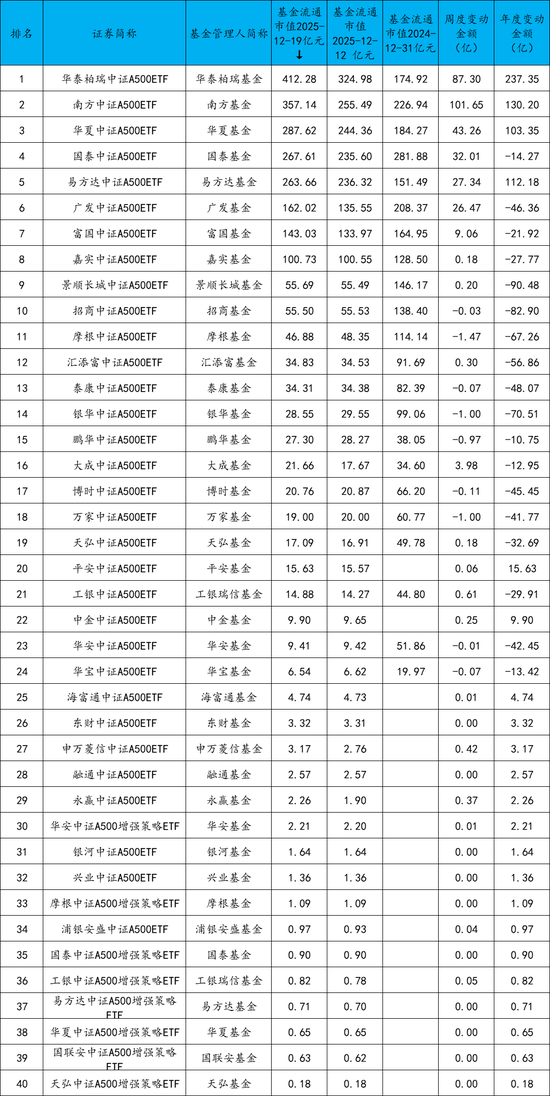
Core Viewpoint - The launch of the CSI A500 index has created a competitive landscape in the ETF market, where only a few major players dominate, while many smaller firms end up as "also-rans" [1][2][10]. Group 1: Market Dynamics - The CSI A500 index was launched in September 2024 and is considered a significant opportunity for public funds, leading to a rush of product submissions from various fund companies [2][17]. - By mid-December 2025, the total market size of A500 ETFs approached 250 billion yuan, indicating a rapid growth in this segment [2][17]. - The market has shown a clear "head effect," where a few leading funds capture the majority of the assets, leaving smaller firms struggling to compete [3][18]. Group 2: Fund Performance - The top five A500 ETFs, including Huatai-PB, Southern, and Huaxia, have assets ranging from 260 billion to 412 billion yuan, collectively dominating the market with nearly 1.6 trillion yuan [6][22]. - Recent inflows have been substantial, with Huatai-PB and Southern ETFs attracting 87.30 billion and 101.65 billion yuan, respectively, in just one week [7][22]. - The performance of smaller funds has been lackluster, with many experiencing significant redemptions and struggling to maintain their market presence [7][22]. Group 3: Challenges for Smaller Firms - Smaller public funds face significant challenges due to resource constraints, making it difficult to compete with larger firms that have established marketing and distribution channels [11][12]. - The cost of marketing and maintaining sales channels is high, with management fees for A500 ETFs around 0.15%, making it hard for smaller firms to achieve profitability without substantial scale [11][12]. - Some smaller firms have opted to withdraw from the competition, adopting a strategy of waiting rather than engaging in a costly race for market share [12][13]. Group 4: Future Outlook - The competitive landscape suggests that the development of index funds should be gradual, focusing on building differentiated competitive advantages rather than following trends blindly [13]. - Smaller firms may need to explore niche markets such as thematic, strategy-based, QDII, bond, or actively managed ETFs to find sustainable growth opportunities [13]. - The prevailing trend indicates that a few giants will continue to dominate the market, while many participants may remain on the sidelines [14].

基金早班车丨公募基金新发数量创近4年新高,QDII高溢价警报不断
Jin Rong Jie· 2025-12-23 00:45
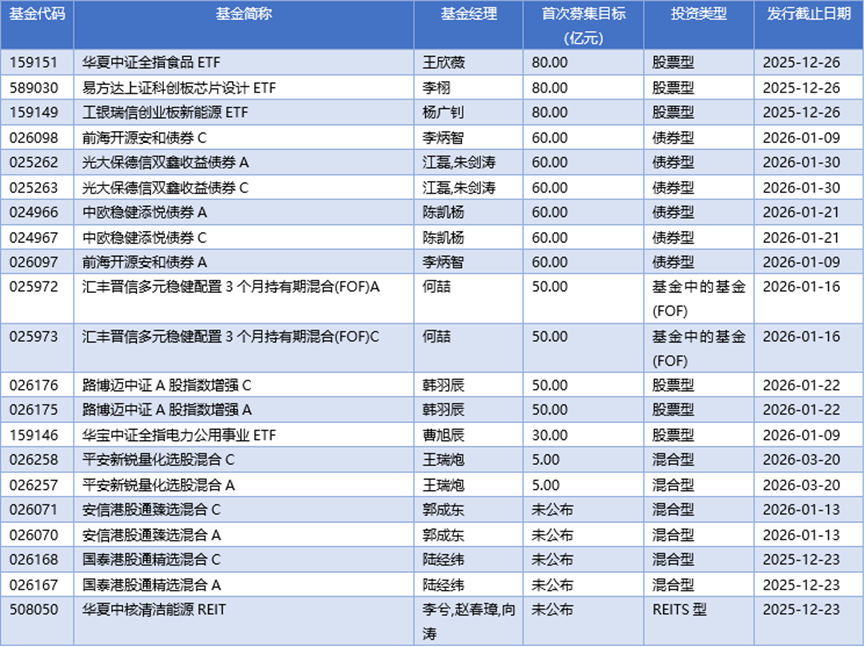
Group 1 - The core point of the article highlights a significant increase in the establishment of new public funds, with 1,468 funds launched in 2024, marking a 29.3% growth compared to the previous year, setting a record for the past four years [1] - The A-share market showed positive performance on December 22, with major indices rising: Shanghai Composite Index up 0.69% to 3,917.36 points, Shenzhen Component Index up 1.47% to 13,332.73 points, and ChiNext Index up 2.23% to 3,191.98 points, with total trading volume reaching 1.86 trillion yuan [1] - The tightening of QDII quotas has led to several products reducing the RMB subscription limit to 10 yuan, with some market premiums exceeding 20%, indicating potential risks for investors [1] Group 2 - On December 22, 21 new funds were launched, primarily focusing on bond and equity funds, with the Huaxia CSI All-Share Food ETF aiming to raise 8 billion yuan [2] - Public funds have invested a total of 34.088 billion yuan in 85 A-share companies in 2025, reflecting a year-on-year increase of over 14%, with the electronics sector being a key focus [2] - The public fund management scale is expected to reach new records in 2025, with a shift towards quality over quantity, driven by fee reforms and a diverse range of ETF offerings [2] Group 3 - A detailed list of new funds launched on December 22 includes various ETFs and bond funds, with several funds targeting 6 billion yuan or more [3] - The list of funds also includes specific details such as fund codes, managers, and investment types, indicating a broad range of investment strategies being employed [3] Group 4 - A summary of fund dividends on December 22 shows that 38 funds distributed dividends, with the highest payout being 3.1 yuan per 10 shares for the Huabao CSI 300 Index Enhanced Fund [4] - The dividend distribution reflects a growing trend in fund payouts, enhancing the perceived value for fund holders [4]
上证科创板100指数ETF今日合计成交额11.61亿元,环比增加43.62%
Zheng Quan Shi Bao Wang· 2025-12-22 09:43
Core Viewpoint - The trading volume of the Shanghai Stock Exchange Science and Technology Innovation Board 100 Index ETF reached 1.161 billion yuan today, showing a significant increase of 353 million yuan or 43.62% compared to the previous trading day [1] Trading Volume Summary - The Kexin 100 ETF Fund (588220) had a trading volume of 469 million yuan, an increase of 263 million yuan or 128.08% from the previous day [1] - The Bosera Kexin 100 ETF (588030) recorded a trading volume of 182 million yuan, up by 53.48 million yuan or 41.76% [1] - The Huaxia Shanghai Stock Exchange Science and Technology Innovation Board 100 ETF (588800) saw a trading volume of 308 million yuan, increasing by 16.67 million yuan or 5.73% [1] - The Fuguo Shanghai Stock Exchange Science and Technology Innovation Board 100 ETF (589950) and the E Fund Shanghai Stock Exchange Science and Technology Innovation Board 100 ETF (588210) had the highest increases in trading volume, with rises of 230.96% and 171.52% respectively [1] Market Performance Summary - As of market close, the Shanghai Stock Exchange Science and Technology Innovation Board 100 Index (000698) rose by 1.43%, with related ETFs averaging an increase of 1.42% [1] - The top-performing ETFs included the Huatai-PineBridge Shanghai Stock Exchange Science and Technology Innovation Board 100 ETF (589980) and the E Fund Shanghai Stock Exchange Science and Technology Innovation Board 100 Enhanced Strategy ETF (588500), which increased by 1.65% and 1.54% respectively [1]
ETF收评 | A股全线上扬,美股ETF领涨,标普生物科技ETF涨5%
Ge Long Hui· 2025-12-22 08:17
Market Performance - The A-share market returned to 3900 points, with the Shanghai Composite Index rising by 0.69%, the Shenzhen Component Index increasing by 1.47%, and the ChiNext Index up by 2.23% [1] - The total market turnover reached 186.5 billion yuan, an increase of 11.63 billion yuan compared to the previous day [1] Sector Performance - Active sectors included Hainan, storage chips, and precious metals, while the pharmaceutical commercial and film industry sectors experienced adjustments [1] - In the ETF market, the US biotechnology sector saw gains, with the Harvest Fund S&P Biotechnology ETF and the Huatai-PineBridge Fund NASDAQ Biotechnology ETF rising by 5.01% and 4.88%, respectively [1] - The semiconductor sector experienced a broad increase, with the Guotai Fund Semiconductor Equipment ETF, GF Fund Chip Equipment ETF, and Wanji Fund Semiconductor Equipment ETF rising by 4.93%, 4.92%, and 4.82%, respectively [1] - The CPO sector rebounded strongly, with the Guotai Fund Communication ETF and Bosera Fund 5G50 ETF both increasing by 4% [1] - Gold reached a new historical high, with the Huaxia Fund Gold Stock ETF and Ping An Fund Gold Stock ETF rising by 3.7% [1] Hong Kong Market - The Hong Kong medical sector declined, with the Hong Kong Innovative Drug 50 ETF, Hang Seng Biotechnology ETF, Hong Kong Medical ETF, and Hong Kong Stock Connect Medical ETF all falling by 1% [1] - The film sector also weakened, with the film ETF dropping by 1.29% [1]
两市ETF两融余额减少4.53亿元丨ETF融资融券日报
2 1 Shi Ji Jing Ji Bao Dao· 2025-12-22 06:49
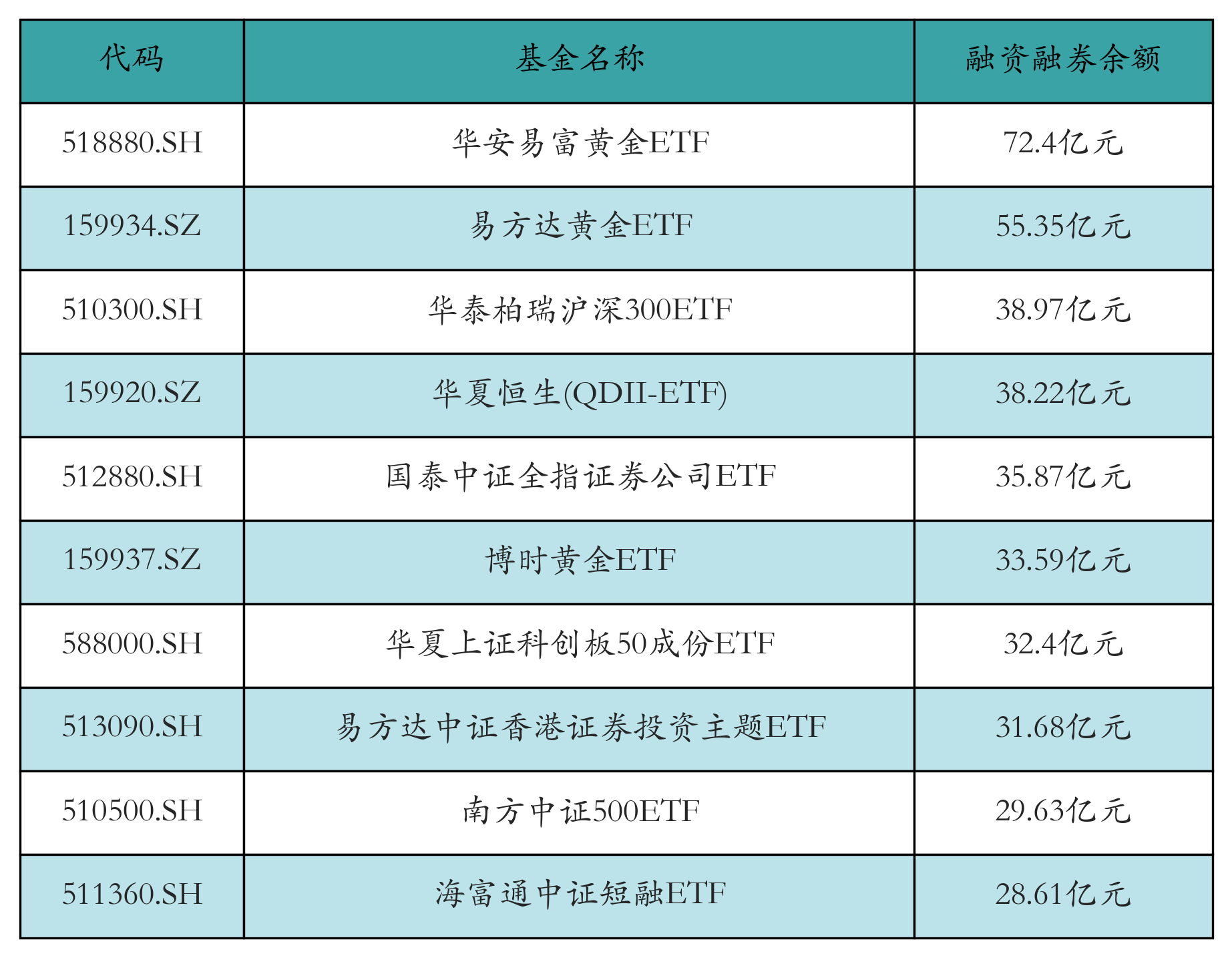
Market Overview - As of December 19, the total ETF margin balance in the two markets is 119.13 billion yuan, a decrease of 0.453 billion yuan from the previous trading day [1] - The financing balance is 111.87 billion yuan, down by 0.37 billion yuan, while the securities lending balance is 7.26 billion yuan, reduced by 83.13 million yuan [1] - In the Shanghai market, the ETF margin balance is 83.61 billion yuan, a decrease of 0.28 billion yuan, with a financing balance of 77.25 billion yuan, down by 0.213 billion yuan [1] - In the Shenzhen market, the ETF margin balance is 35.53 billion yuan, a decrease of 0.173 billion yuan, with a financing balance of 34.62 billion yuan, down by 0.157 billion yuan [1] ETF Margin Financing Balances - The top three ETFs by margin financing balance on December 19 are: - Huaan Yifu Gold ETF (7.24 billion yuan) - E Fund Gold ETF (5.535 billion yuan) - Huatai-PB CSI 300 ETF (3.897 billion yuan) [2] ETF Financing Buy Amounts - The top three ETFs by financing buy amounts on December 19 are: - Hai Futong CSI Short Bond ETF (1.465 billion yuan) - E Fund CSI Hong Kong Securities Investment Theme ETF (1.31 billion yuan) - Huatai-PB Southbound Hang Seng Technology Index (0.869 billion yuan) [4] ETF Financing Net Buy Amounts - The top three ETFs by financing net buy amounts on December 19 are: - Huabao CSI Bank ETF (178 million yuan) - Huaxia Shanghai Stock Exchange Sci-Tech Innovation Board 50 ETF (70.336 million yuan) - E Fund CSI Hong Kong Securities Investment Theme ETF (58.834 million yuan) [6] ETF Securities Lending Sell Amounts - The top three ETFs by securities lending sell amounts on December 19 are: - Southern CSI 500 ETF (18.5254 million yuan) - Huatai-PB CSI 300 ETF (16.5763 million yuan) - GF CSI 1000 ETF (9.4158 million yuan) [8]
基金早班车丨股基十年最强回归C位,公募新发1468只创四年新高
Jin Rong Jie· 2025-12-22 01:04
Group 1: Market Overview - The bond fund market is retreating, while equity funds are expanding at an unprecedented rate not seen in nearly a decade, with 1,468 new public funds established in 2025, marking a peak in four years, and total fundraising remaining stable compared to the past two years, indicating a shift to a new phase dominated by equities and innovative segmentation [1] - On December 19, the Shanghai Composite Index rose by 0.36% to 3,890.45 points, the Shenzhen Component Index increased by 0.66% to 13,140.21 points, and the ChiNext Index gained 0.49% to 3,122.24 points, with a total trading volume of 17,259.15 billion yuan across both markets [1] Group 2: Fund News - On December 19, two new funds were launched, primarily mixed funds, while 28 funds distributed dividends, mostly bond funds, with the highest dividend payout from the Huatai Zijin Jiangsu Expressway Closed-End Infrastructure Securities Investment Fund at 1.3895 yuan per 10 shares [2] - As of December 12, the stock private equity position index reached 83.59%, increasing by 0.61 percentage points, with over 70% of products holding more than 80% positions, indicating strong bullish sentiment; the total scale of private equity products reached a historical high of 22.09 trillion yuan [2] - By the end of 2025, public funds are expected to distribute nearly 230 billion yuan, with leading companies distributing over 10 billion yuan; bond funds contributed 73% of the total dividend amount, although this represents a 10 percentage point decrease from the previous year, while equity funds have become the "dark horse" in dividend distribution due to market recovery and policy support [2] Group 3: Investment Trends - The hard technology theme has been a consistent focus throughout the year, with public funds concentrating their incremental investments in emerging industries; as of December 21, 39 public funds participated in 85 stock placements, with a total allocation of 34.088 billion yuan, a year-on-year increase of 13.85%, and an overall floating profit of 10.742 billion yuan, representing a floating profit ratio of 31.51% [3]

公募基金行业发展十大展望:明年规模将冲击40万亿元大关
Zhong Guo Jing Ji Wang· 2025-12-22 00:48
Core Viewpoint - The public fund industry in China is expected to continue its growth trajectory, with projections indicating that the total scale may surpass 40 trillion yuan in 2026, driven by long-term capital inflows and favorable policy reforms [3][4][6]. Group 1: Industry Growth and Trends - The public fund scale is projected to exceed 40 trillion yuan in 2026, supported by long-term funds such as insurance and pension funds entering the market [3][4]. - The public fund industry has seen its net asset value grow from approximately 9.1 trillion yuan in 2016 to about 36 trillion yuan in 2025, with an average annual growth rate of around 16% [4]. - The low interest rate environment is driving a shift of savings into public funds, with equity and "fixed income plus" products expected to be the main growth drivers [3][4]. Group 2: Investor-Centric Approach - The industry is shifting towards an investor-centric model, emphasizing the importance of investor returns and experience in fund management [5][6]. - Regulatory changes are reinforcing the principle of prioritizing investor interests, which is expected to reshape the public fund ecosystem and operational models [6][11]. - The focus on long-term performance and investor satisfaction is anticipated to lead to a healthier industry environment, fostering a virtuous cycle of returns and growth [6][11]. Group 3: Product Innovation - There is a growing trend towards product innovation in the public fund sector, with new offerings such as REITs and thematic funds emerging to meet market demands [7][8]. - Future innovations are expected to focus on technology-driven products, low-volatility options, and diversified asset allocation strategies [7][8]. - The introduction of more diversified ETFs and thematic funds is anticipated, catering to specific industry sectors and investment themes [9][10]. Group 4: ETF Development - The ETF market is expected to enter a new phase of differentiated competition, with a focus on thematic and sector-specific ETFs [9][10]. - The demand for passive investment products is increasing, driven by a structural shift towards low-cost, high-transparency options [10][11]. - The competitive landscape for ETFs will focus on tracking accuracy, fee structures, and niche market offerings [10][11]. Group 5: Active Equity Funds - Active equity funds are moving towards a value investment approach, with a reduction in style drift and a focus on long-term performance [11][12]. - Regulatory frameworks are expected to enforce stricter performance benchmarks, promoting a return to fundamental research and value discovery [11][12]. - The emphasis on long-term performance metrics is likely to reshape the competitive dynamics within the active fund management space [12][13]. Group 6: Sales and Distribution Transformation - The sales model in the fund industry is transitioning towards a focus on maintaining existing client relationships rather than solely on new product launches [16][17]. - Fund sales strategies will increasingly prioritize client service and long-term investment experiences, moving away from a purely transactional approach [16][17]. - The revenue model for fund sales is expected to shift from transaction-based fees to advisory service fees, aligning more closely with client outcomes [17][18]. Group 7: AI and Digital Transformation - The integration of AI technology is becoming crucial for the asset management industry, enhancing efficiency and redefining service delivery [18][19]. - AI applications are expected to permeate various aspects of fund management, including product development, risk management, and customer service [19][20]. - The future of the industry will likely see a collaborative approach between human expertise and AI capabilities, optimizing operational processes and client interactions [20][21]. Group 8: Long-Term Focus and Specialization - The public fund industry is anticipated to return to a long-term investment philosophy, aligning more closely with wealth management and pension fund strategies [21][22]. - The industry is expected to see increased specialization, with firms focusing on niche markets and tailored investment solutions [22][23]. - The trend towards floating fee structures is likely to gain traction, linking fees more closely to fund performance and investor returns [22][23].
机构研究周报:港股迎交易窗口,政策利好消费板块
Wind万得· 2025-12-21 22:35
Core Viewpoint - The article highlights the potential investment opportunities in the Hong Kong stock market as it approaches a year-end trading window, with favorable policy support for the consumer sector and low valuation levels in various sub-sectors [1][5][11]. Group 1: Market Insights - Hong Kong stocks are experiencing a year-end trading window, with quality assets entering a high cost-performance zone due to macroeconomic improvements and profit expectations [5]. - The Japanese central bank's recent interest rate hike to 0.75% is expected to improve overseas liquidity expectations, which may positively impact global markets [3]. - The U.S. stock market is anticipated to remain volatile, particularly high-valuation assets, as it navigates between revaluation and sentiment recovery [7]. Group 2: Sector Analysis - The consumer sector is positioned for recovery, with multiple sub-sectors currently at historically low valuation levels, benefiting from policy support aimed at enhancing corporate profitability [11]. - Strong cyclical sectors such as non-ferrous metals, aluminum, chemicals, and machinery are expected to be key trading catalysts in the first quarter of 2026 [6]. - Industrial metals are projected to maintain a long-term positive trend despite short-term price pressures due to uncertainties in interest rates and the dollar [12]. Group 3: Economic Outlook - The overall economic growth in 2026 is expected to remain under pressure, but investment may stabilize at low levels, with gradual improvements in consumption and resilient exports [10]. - The market is likely to transition from a valuation-driven rally to one supported by corporate earnings, with a focus on modernization and capacity expansion as key trends [10]. - The trust in the U.S. dollar is declining, which may influence global economic dynamics and investment strategies [15].

申购额度骤降 QDII基金溢价率居高不下
Zhong Guo Zheng Quan Bao· 2025-12-21 22:02
Core Insights - The core viewpoint of the articles highlights the tightening of subscription limits for QDII funds in response to increasing demand for overseas asset allocation, leading to high trading premiums in the secondary market [1][2][4]. Group 1: Subscription Limit Adjustments - Morgan Fund has significantly reduced the subscription limit for its QDII funds, with the limit for the Morgan Nasdaq 100 Index dropping from 100,000 yuan to 10 yuan within a week, indicating a trend of tightening subscription limits across multiple funds [2][4]. - Other funds, such as Huatai-PB Nasdaq 100 ETF and Southern Nasdaq 100, have also implemented similar reductions in subscription limits, reflecting a broader strategy to manage fund stability amid rising investor demand for overseas investments [2][4]. Group 2: Premium Trends in Secondary Market - The trading premium for QDII funds has surged, with some funds experiencing premiums exceeding 20%, driven by strong investor demand in the secondary market [1][2][3]. - Data shows that from December 1 to 19, the average proportion of QDII passive index equity funds with a daily premium rate exceeding 10% reached 15.10%, with a peak of 18.97% [3][7]. Group 3: Global Allocation Demand - There is a persistent global demand for asset allocation, with QDII fund net asset value increasing by 43.52% from May to October, and the number of shares rising by 24.90% [4]. - The total approved QDII investment quota has reached 1,708.69 billion USD, with a slight increase of 2.30% in the quota for securities and fund institutions, indicating a mismatch between supply and rapidly growing market demand [4]. Group 4: Risks Associated with High Premiums - The high premiums in the secondary market are attributed to a supply-demand imbalance, where limited QDII quotas lead investors to seek alternatives in the secondary market, driving prices above the net asset value [5][6]. - Analysts warn that high premium funds carry significant risks, including potential price corrections and liquidity issues, which could adversely affect investors if market conditions change [5][6].
申购额度骤降QDII基金溢价率居高不下
Zhong Guo Zheng Quan Bao· 2025-12-21 20:12
Core Insights - The core viewpoint of the articles highlights the tightening of subscription limits for QDII funds in response to increasing demand for overseas asset allocation, leading to high trading premiums in the secondary market [1][2][3] Subscription Limit Adjustments - Morgan Fund has significantly reduced the subscription limit for its QDII funds, with the limit for the Morgan Nasdaq 100 Index dropping from 100,000 yuan to 10 yuan within a week, indicating a trend of tightening subscription limits across multiple funds [1][2] - Other funds, such as Huatai-PB Nasdaq 100 ETF and Southern Nasdaq 100, have also implemented similar reductions in subscription limits, reflecting a broader market response to heightened overseas investment demand [2] Premium Trends in QDII Funds - The trading premiums for QDII funds have surged, with some funds experiencing premiums exceeding 20%, driven by strong investor demand in the secondary market [2][3] - Data from Wind indicates that from December 1 to 19, the average proportion of QDII passive index equity funds with daily premiums over 10% reached 15.10%, with a peak of 18.97% [4] Global Asset Allocation Demand - There is a persistent and growing demand for global asset allocation, as evidenced by a 43.52% increase in the net asset value of QDII funds from May to October, alongside a 24.90% increase in shares [3] - The total approved QDII investment quota has reached 1,708.69 billion USD, with a slight increase of 2.30% in the quota for securities and fund institutions, indicating a mismatch between supply and rapidly growing market demand [2] Risks Associated with High Premiums - The tightening of subscription limits has led investors to seek QDII funds in the secondary market, resulting in significant premiums over the funds' net asset values, which may pose risks if market sentiment shifts or subscription limits are eased [3] - Analysts warn that high premiums can lead to a disconnect between QDII funds and their underlying indices, potentially affecting investment outcomes and increasing liquidity risks for investors [3]