苏州银行

Search documents
多家银行下调存款利率!应对零售存款流失,加码“固收+”
券商中国· 2025-09-26 03:20
Core Viewpoint - Since September, local small and medium-sized banks have been continuously lowering deposit interest rates to alleviate net interest margin pressure and follow the lead of larger banks [1][3]. Group 1: Deposit Rate Adjustments - On September 25, several banks in Henan, including Luoyang Rural Commercial Bank, announced reductions in RMB deposit rates, with the highest cut reaching 35 basis points [2][3]. - The new rates for fixed-term deposits at Luoyang Rural Commercial Bank are now 0.75% for three months, 1.00% for six months, 1.30% for one year, and 1.35% for two years, reflecting a reduction of 15 basis points [3]. - Other banks, such as Jieyang Rural Commercial Bank and Shanghai Huarui Bank, have also lowered rates across various deposit products, indicating a broader trend among local banks to adjust rates following national banks [3]. Group 2: Retail Deposit Trends - There is a noticeable outflow of retail deposits as customers shift to investment products with higher returns, such as cash management and fixed-income bank wealth management products, which offer annual yields of 2% to 3% [2][5]. - Retail deposit growth has significantly slowed, with banks facing challenges in attracting new customers and retaining existing deposits [5][6]. - Data shows that major banks like China Merchants Bank and Ping An Bank experienced a decline in retail deposit growth rates in the first half of 2025 compared to the same period in 2024, with decreases of 3.43 and 3.73 percentage points, respectively [8]. Group 3: Wealth Management Strategies - In response to declining retail deposits, banks are focusing on expanding their wealth management services, leveraging the recent bullish trends in capital markets [9][10]. - Wealth management products, particularly those linked to equity funds, are becoming key revenue drivers for banks as they seek to retain customer assets [9]. - The "fixed income plus" product category is seen as a new pathway for banks to attract deposits in a low-interest-rate environment, highlighting the need for diversified investment options [10].





热度不减!城商行成科创债发行主力
Guo Ji Jin Rong Bao· 2025-09-26 03:03
Core Viewpoint - The issuance of technology innovation bonds (科创债) has gained momentum among city commercial banks, with a total issuance amount of 12.9 billion yuan in September alone, indicating strong market demand and support from policies [1][2][3]. Group 1: Issuance Details - Ten banks, primarily city commercial banks, have issued a total of 12.9 billion yuan in technology innovation bonds as of September 25, with maturities of five years and coupon rates ranging from 1.84% to 2.03% [2][3]. - Qingdao Bank successfully issued 1 billion yuan in technology innovation bonds with a coupon rate of 1.87%, aimed at supporting technology innovation businesses [2][3]. - Chongqing Three Gorges Bank's technology innovation bond saw a subscription multiple of 2.87, leading to a total issuance of 2.5 billion yuan, exceeding its initial plan [2][3]. Group 2: Market Dynamics - The primary market for technology innovation bonds is characterized by strong policy support, rapid expansion, high credit ratings of issuers, and favorable coupon rates compared to traditional bonds [3][4]. - Since the announcement by the central bank and the securities regulatory authority in May, the issuance of technology innovation bonds by financial institutions has surged, with commercial banks issuing a total of 261.5 billion yuan [3][4]. Group 3: Benefits for Banks - Issuing technology innovation bonds allows small and medium-sized banks to lower financing costs and improve their liability duration structure, reducing reliance on short-term funding [4][5]. - These banks can provide flexible and targeted financial support for local technology projects, enhancing the efficiency of fund utilization in the technology sector [4][5].
15载相伴成长:做服务实体经济与百姓民生的“舒心伙伴” 访苏州银行党委书记、董事长崔庆军
Jin Rong Shi Bao· 2025-09-26 02:07
Core Viewpoint - The article highlights the significant achievements of Suzhou Bank over its 15-year journey, emphasizing its alignment with national economic strategies and its role in supporting regional economic development, particularly in the Yangtze River Delta region [1][9]. Group 1: Strategic Development - Suzhou Bank has focused on local economic needs and has adapted to the changing market environment, achieving an asset scale of 754.974 billion yuan, which is 15 times its initial size [2]. - The bank's deposits and loans have also seen substantial growth, with deposits reaching 462.752 billion yuan and loans at 363.497 billion yuan, marking increases of 14.04 times and 15.38 times respectively since its inception [2]. - The bank maintains a low non-performing loan ratio of 0.83%, positioning it among the top tier of listed banks in terms of asset quality [2]. Group 2: Value Creation and Ecosystem - Suzhou Bank aims to be an "ecological enabler" for regional economic growth, enhancing its service capabilities and focusing on high-end manufacturing and specialized sectors [2]. - The bank has developed a comprehensive service network through institutional layout and rural bank reforms, which has facilitated its growth and service delivery [2]. Group 3: Innovation and Policy Alignment - The bank integrates financial services into key industrial upgrades, aligning with local industrial development strategies and national consumption enhancement initiatives [3]. - Suzhou Bank has introduced specialized service plans to support local employment and economic development, demonstrating its commitment to policy resonance [3]. Group 4: Cultural and Organizational Strength - The bank's core values emphasize trust and reliability, which are essential for its relationship with clients and the community [3][7]. - Suzhou Bank has established a culture of long-termism and innovation, focusing on customer needs and maintaining a commitment to serving the real economy [4][7]. Group 5: Party and Governance Integration - The bank integrates party leadership into its governance structure, ensuring that political advantages translate into effective service delivery [6]. - It has launched various initiatives to enhance party-building efforts, which support its operational goals and community engagement [6]. Group 6: Future Outlook - As Suzhou Bank celebrates its 15th anniversary, it aims to continue its journey towards higher quality development while fulfilling its mission to support the real economy and regional growth [9].
中证500ETF华夏(512500)开盘跌0.44%
Xin Lang Cai Jing· 2025-09-26 01:38
Core Viewpoint - The China Securities 500 ETF (华夏, 512500) opened at a decline of 0.44%, priced at 4.068 yuan, reflecting market volatility and performance of its underlying assets [1] Group 1: ETF Performance - The ETF's performance benchmark is the CSI 500 Index, managed by Huaxia Fund Management Co., Ltd. [1] - Since its inception on May 5, 2015, the fund has recorded a return of -10.68%, while the return over the past month is 5.70% [1] Group 2: Top Holdings Performance - Among the top holdings, Shenghong Technology opened with a slight increase of 0.01%, while Huagong Technology rose by 0.33% [1] - Other notable movements include Chifeng Gold declining by 0.11%, Sichuan Changhong down by 0.83%, and Chip Origin Technology falling by 2.70% [1] - The performance of securities such as Tianfeng Securities and Dongwu Securities also showed declines of 0.57% and 0.43% respectively [1]
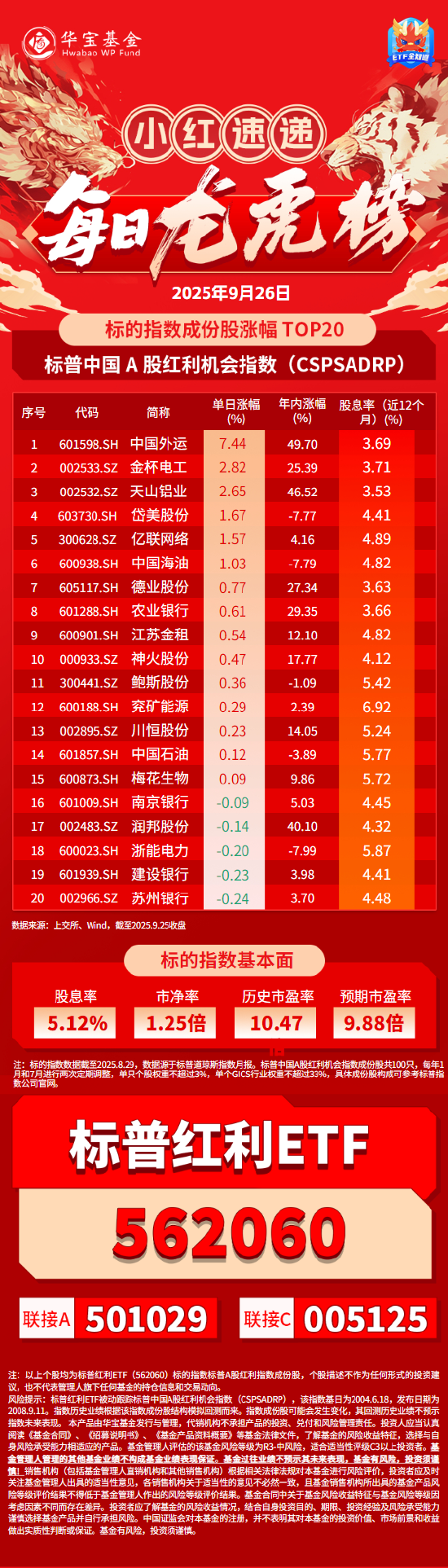
小红日报|标普红利ETF(562060)9月25日龙虎榜
Xin Lang Ji Jin· 2025-09-26 01:09
Group 1 - The article highlights the top 20 performing stocks in the S&P China A-Share Dividend Opportunities Index (CSPSADRP), with China National Foreign Trade Transportation Group (601598.SH) leading with a 7.44% increase and a year-to-date gain of 49.70% [1] - Other notable performers include Jinbei Electric (002533.SZ) with a 2.82% increase and a year-to-date gain of 25.39%, and Tianshan Aluminum (002532.SZ) with a 2.65% increase and a year-to-date gain of 46.52% [1] - The average dividend yield for the index constituents is reported at 5.12%, with the expected price-to-earnings ratio at 10.47 [2] Group 2 - The index consists of 100 stocks, and the data is sourced from the S&P Dow Jones Indices monthly report as of August 29, 2025 [2] - The article notes that the S&P Dividend ETF (562060) tracks the S&P China A-Share Dividend Opportunities Index, which was established on June 18, 2004, and published on September 11, 2008 [2]





中小银行密集下调存款利率 发力财富管理承接客户资产“调仓”
Zheng Quan Shi Bao· 2025-09-25 18:25
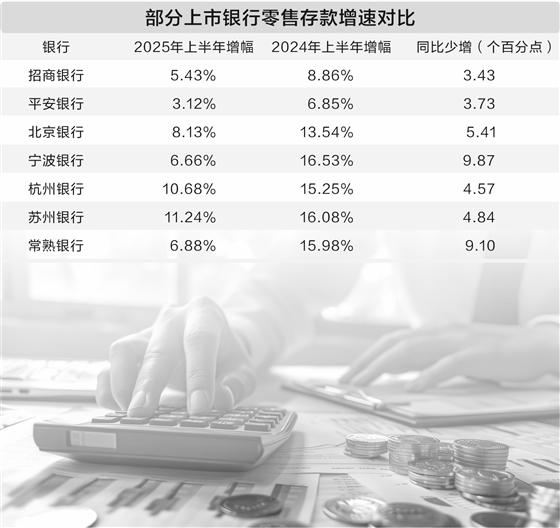
Core Viewpoint - The retail deposit growth of several listed banks has slowed down significantly, prompting banks to adjust their strategies towards wealth management to mitigate the impact of deposit outflows [1][2][5][6]. Group 1: Retail Deposit Growth Comparison - In the first half of 2025, several banks experienced a notable decline in retail deposit growth compared to the same period in 2024, with specific decreases of 3.43 percentage points for China Merchants Bank and 3.73 percentage points for Ping An Bank [1][6]. - Other banks such as Beijing Bank, Ningbo Bank, Hangzhou Bank, and Suzhou Bank also saw significant reductions in their retail deposit growth rates, with declines ranging from 4.57 to 9.88 percentage points [1][6]. Group 2: Interest Rate Adjustments - Since September, a growing number of local small and medium-sized banks have lowered their deposit interest rates, with some banks announcing reductions of up to 35 basis points [1][3]. - This trend follows a broader "rate cut wave" initiated by large state-owned banks earlier in the year, aimed at alleviating pressure on net interest margins [3][4]. Group 3: Wealth Management Strategies - In response to the noticeable outflow of retail deposits, banks are increasingly focusing on wealth management to grow their assets under management (AUM) [2][7]. - The performance of cash management and fixed-income bank wealth management products, with annual yields between 2% and 3%, has led many customers to shift their investment strategies [2][7]. - Banks are also expanding their offerings in public funds and cash management products, which are perceived as lower risk and more cost-effective compared to traditional fixed-term deposits [7].
9月再添10家银行入场!银行科创债发行规模已超2600亿元
Mei Ri Jing Ji Xin Wen· 2025-09-25 13:27
Core Insights - Chongqing Three Gorges Bank has issued its first technology innovation bond, marking the 10th bank to do so this month, all of which are small and medium-sized banks [1] - Since the launch of the "technology board" in the bond market in May, financial institutions have shown strong enthusiasm for issuing technology innovation bonds, with banks leading in issuance scale [1][2] - A total of over 50 technology innovation bonds have been issued by banks, with a cumulative issuance scale exceeding 260 billion yuan, where policy banks, state-owned banks, and joint-stock banks account for about 70% of the total [1][3] Group 1: Market Participation - In May, the central bank and the CSRC jointly announced support for the issuance of technology innovation bonds, leading to a surge in issuance, with 19 bonds totaling 198 billion yuan issued that month [2] - The majority of city commercial banks and rural commercial banks have issued bonds in the range of 1 billion to 5 billion yuan, with some local banks issuing between 300 million to 600 million yuan [2] - In September, local small and medium-sized banks significantly accelerated their issuance, with 10 banks issuing bonds totaling over 10 billion yuan [2] Group 2: Regulatory and Structural Support - Regulatory bodies have included technology innovation bonds in the evaluation system for financial institutions' technology financial services, which is expected to encourage mainstream banks to increase their issuance efforts [3] - The interest rates for these bonds vary, with policy banks offering rates between 1.17% and 1.65%, while state-owned and joint-stock banks offer rates between 1.65% and 1.82%, and city and rural commercial banks between 1.67% and 2.03% [3] Group 3: Financial Service Expansion - Funds raised from technology innovation bonds will be directed towards specified technology sectors, including technology loans and investments in technology innovation enterprises [4] - Commercial banks are extending their financial service chains through the issuance of technology innovation bonds, enhancing support for technology enterprises throughout their lifecycle [4][5] - Banks are encouraged to explore a comprehensive financial service model that integrates debt, loans, equity, and supply chains to improve service capabilities for technology enterprises [5]
9月再添10家银行入场! 银行科创债发行规模已超2600亿元
Mei Ri Jing Ji Xin Wen· 2025-09-25 13:26
Core Viewpoint - The issuance of technology innovation bonds (科创债) by banks, particularly small and medium-sized banks, has significantly increased since the launch of the "technology board" in the bond market, with over 50 bonds issued and a total scale exceeding 260 billion yuan [1][2][3]. Group 1: Issuance Trends - Chongqing Three Gorges Bank recently issued its first technology innovation bond, marking the 10th bank to do so this month, all of which are small and medium-sized banks [1]. - Since May, banks have issued over 50 technology innovation bonds, totaling more than 260 billion yuan, with policy banks, state-owned banks, and joint-stock banks accounting for about 70% of the issuance [1][2]. - In September alone, 10 local banks issued technology innovation bonds, with a total issuance exceeding 10 billion yuan [2]. Group 2: Regulatory Support - The People's Bank of China and the China Securities Regulatory Commission jointly announced support for the issuance of technology innovation bonds, leading to a surge in participation from various banks [2][3]. - The evaluation mechanism for financial institutions' technology financial services will encourage mainstream banks to increase their issuance of technology innovation bonds, while small and medium-sized banks will also accelerate their participation [3]. Group 3: Financial Service Extension - Funds raised from technology innovation bonds will be directed towards specified technology sectors, including technology loans and investments in technology innovation enterprises [4]. - Commercial banks can effectively extend their financial service chain through the issuance of technology innovation bonds, enhancing support for technology enterprises throughout their lifecycle [4][5]. Group 4: Competitive Strategies - Banks are exploring a comprehensive financial service model through the issuance of technology innovation bonds, which enhances their service capabilities for technology enterprises [5]. - Different types of banks are encouraged to develop differentiated competitive advantages based on their positioning and resources, focusing on various segments such as national projects, niche technology sectors, local technology SMEs, and county-level innovations [5].
“融聚十五载・智绘新征程” ——苏州银行科创金融白皮书发布暨金融同业交流会成功举办
Zhong Guo Jing Ji Wang· 2025-09-25 13:03
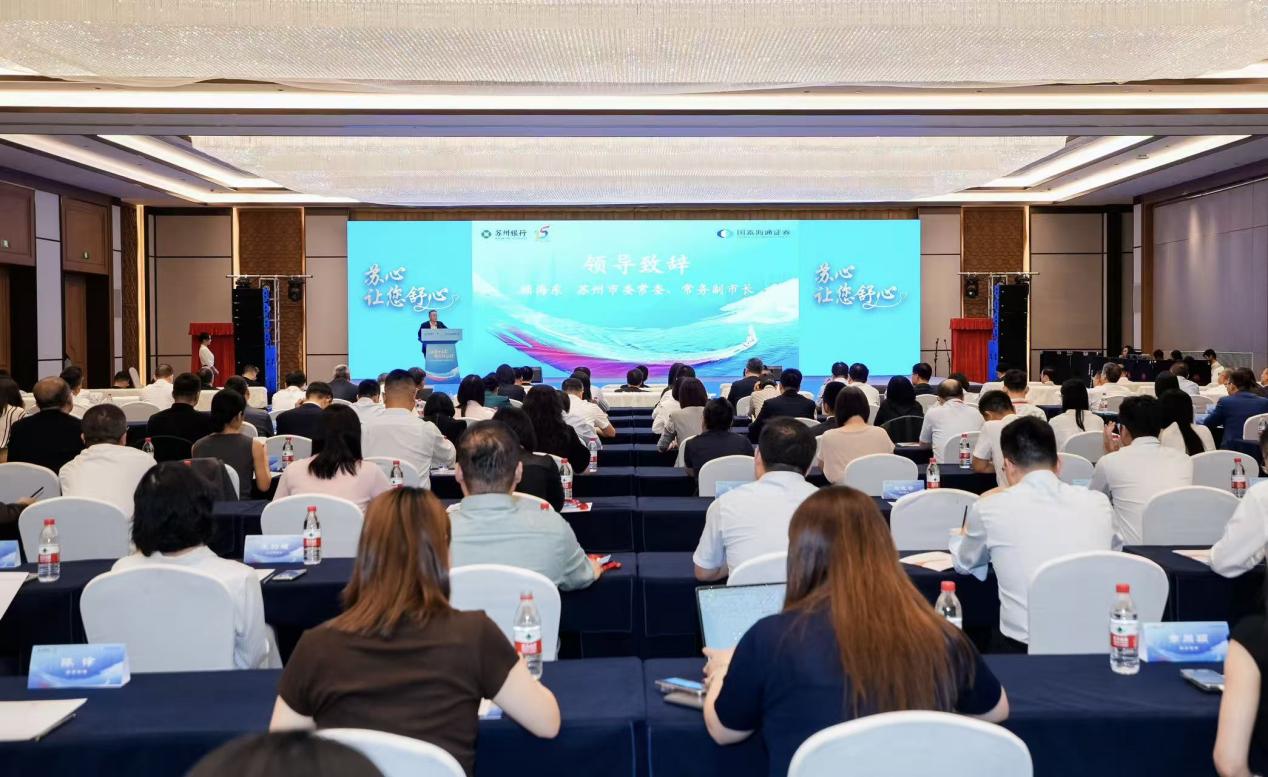
Core Insights - The event "融聚十五载・智绘新征程" focused on the release of the Suzhou Bank Innovation Financial White Paper and aimed to enhance collaboration between financial institutions and technology innovation enterprises [1][4][6] Group 1: Event Overview - The event was attended by nearly 200 representatives from over 60 institutions, including banks, securities, insurance, and fund companies [1] - Key figures such as Suzhou's Deputy Mayor Gu Haidong and Suzhou Bank's Chairman Cui Qingjun delivered speeches emphasizing the importance of financial support for innovation [4][6] Group 2: Financial Strategies and Initiatives - Suzhou Bank aims to deepen cooperation with financial institutions to achieve resource sharing and capability building, contributing to the modernization of Jiangsu and Suzhou [6] - The bank has established a comprehensive "2+4+N" innovation financial system, including a financial committee and specialized centers for listed companies and mergers [16] - By June 2025, Suzhou Bank plans to serve over 13,000 innovation enterprises with a total credit exceeding 130 billion yuan, with innovation loans accounting for over 20% of corporate loans [16] Group 3: Future Directions - Suzhou Bank will continue to leverage a dual-engine strategy of "Innovation + Cross-border" and "Livelihood + Wealth" to expand its financial innovation and collaboration [18] - The bank aims to position Suzhou as a leading hub for innovation finance in China, contributing to the broader goals of Jiangsu's modernization [18]
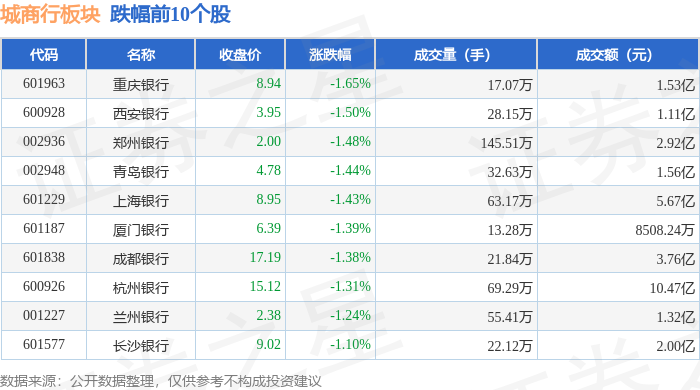
城商行板块9月25日跌0.94%,重庆银行领跌,主力资金净流出2.78亿元
Zheng Xing Xing Ye Ri Bao· 2025-09-25 08:37
Market Performance - The city commercial bank sector declined by 0.94% on September 25, with Chongqing Bank leading the decline [1] - The Shanghai Composite Index closed at 3853.3, down 0.01%, while the Shenzhen Component Index closed at 13445.9, up 0.67% [1] Individual Stock Performance - Chongqing Bank closed at 8.94, down 1.65% with a trading volume of 170,700 shares and a transaction value of 153 million [1] - Other notable declines include Xi'an Bank down 1.50% to 3.95, Zhengzhou Bank down 1.48% to 2.00, and Qingdao Bank down 1.44% to 4.78 [1] - Shanghai Bank and Xiamen Bank also saw declines of 1.43% and 1.39%, respectively [1] Capital Flow Analysis - The city commercial bank sector experienced a net outflow of 278 million from institutional investors, while retail investors saw a net inflow of 152 million [1] - The table indicates that Suzhou Bank had a significant net outflow from institutional investors of 48.08 million, while Qilu Bank had a net inflow of 25.86 million [2] - Chongqing Bank specifically had a net outflow of 5.68 million from institutional investors but a net inflow of 10.91 million from retail investors [2]