华夏航空

Search documents
上市航司多维发力破解“旺丁不旺财”困境
Zheng Quan Ri Bao Zhi Sheng· 2025-09-02 16:37
Core Viewpoint - The overall performance of listed airlines in the first half of 2025 shows that state-owned airlines are still in a loss state, while private airlines demonstrate stronger performance recovery due to better operational flexibility [1][2]. Group 1: State-Owned Airlines Performance - In the first half of 2025, three state-owned airlines achieved revenue growth: China International Airlines reported revenue of 80.757 billion yuan, a 1.56% increase, with a net loss of 1.806 billion yuan, a reduction in loss [2] - China Eastern Airlines reported revenue of 66.822 billion yuan, a 4.09% increase, with a net loss of 1.431 billion yuan, also a reduction in loss [2] - China Southern Airlines reported revenue of 86.291 billion yuan, a 1.77% increase, with a net loss of 1.533 billion yuan [2]. Group 2: Private Airlines Performance - Private airlines achieved profitability in the first half of 2025, with Hainan Airlines reporting revenue of 33.083 billion yuan, a 4.22% increase, and a net profit of 56.945 million yuan [3] - Shanghai Juneyao Airlines reported revenue of 11.07 billion yuan, a 1.02% increase, with a net profit of 505 million yuan, a 3.29% increase [3] - Spring Airlines reported revenue of 10.304 billion yuan, a 4.35% increase, with a net profit of 1.169 billion yuan, a 14.11% decrease [3] - Huaxia Airlines reported revenue of 3.610 billion yuan, a 12.41% increase, with a net profit of 251 million yuan, an increase of 858.95% [3]. Group 3: Industry Trends and Insights - The summer transportation season saw a total of 147 million passengers transported, a 3.6% year-on-year increase, with an average seat occupancy rate of 84.8%, up 2.2 percentage points [4] - The market exhibited a trend of increasing volume but decreasing prices, attributed to oversupply and low-price competition [6] - The release of the "Self-Regulation Convention for Air Passenger Transport" aims to combat low-price competition and stabilize market prices [6]. Group 4: Future Outlook - The upcoming "Golden September and Silver October" period is expected to be a crucial window for revenue improvement [7] - Airlines plan to optimize sales strategies and innovate products to enhance efficiency and profitability in the second half of the year [7].






贵州上市公司2025年上半年营收规模持续扩大 头部企业引领增长
Zheng Quan Shi Bao Wang· 2025-09-02 14:43
Core Insights - Guizhou listed companies have shown significant growth in both revenue and net profit, with 25 companies reporting profits and 19 companies achieving year-on-year revenue growth in the first half of 2025 [1][2][3] Revenue Performance - In the first half of 2025, Guizhou listed companies achieved a total revenue of 172.85 billion yuan, representing a year-on-year increase of 6.03% and a 52.29% increase compared to the same period in 2021 [2] - The revenue growth rate of Guizhou listed companies is ranked 4th nationally and 3rd in the western region, surpassing the GDP growth rate of Guizhou by 0.73 percentage points [2] - Among these companies, 18 have revenues exceeding 1 billion yuan, and 6 have revenues exceeding 5 billion yuan, with Kweichow Moutai leading at 89.39 billion yuan [2] Profitability - Guizhou listed companies reported a total net profit of 50.26 billion yuan in the first half of 2025, ranking 9th nationally and 2nd in the western region, with a year-on-year increase of 5.37% and a 60.45% increase compared to 2021 [3] - 71.43% of the companies reported profits, with Kweichow Moutai again leading at 45.40 billion yuan [3] Innovation and R&D - A total of 33 Guizhou listed companies disclosed R&D expenditures, totaling 2.52 billion yuan, a slight increase of 0.04% year-on-year and a 70.18% increase compared to 2021 [4] - 6 companies reported R&D expenditures exceeding 100 million yuan, with Zhongwei Co. leading at 545 million yuan [4] International Business - 13 companies reported overseas business income totaling 18.29 billion yuan, reflecting an 18.66% year-on-year increase, with Zhongwei Co. achieving 10.78 billion yuan in overseas revenue [5] Investor Returns - In the first half of 2025, 7 Guizhou listed companies announced interim dividend plans, with a total dividend amount of 591 million yuan, nearly quadrupling from the previous year [7] - 8 companies engaged in share buybacks, investing a total of 7.14 billion yuan, ranking 6th nationally [7]





织密“四张网”,强化“硬支撑” 内蒙古机场集团暑运完成旅客吞吐量617万人次
Zhong Guo Min Hang Wang· 2025-09-02 09:37
Core Insights - Inner Mongolia Airport Group successfully completed a 62-day summer transportation guarantee task during the 2025 summer travel season, focusing on a "dry and branch linkage" strategy to enhance flight capacity and increase route density, facilitating convenient air travel across the region [1] Group 1: Transportation Performance - During the summer travel period, the group completed 52,000 flight takeoffs and landings, with a passenger throughput of 6.17 million and cargo mail throughput of 13,000 tons [1] - Hohhot Airport accounted for 24,000 flight takeoffs and landings, with a passenger throughput of 3.02 million, while regional airports collectively handled 3.15 million passengers, representing 51% of the total [1] Group 2: Route Expansion and Capacity Enhancement - To strengthen the hub's radiation capacity, the group coordinated with airlines to increase flight capacity, adding two A320 aircraft stationed at Hohhot Airport to serve various routes, including those to Qingdao and Tongliao [2] - The group also increased the frequency of flights to popular tourist destinations such as Guilin, Nanjing, and Chengdu, and upgraded to wide-body aircraft on key routes to improve transportation efficiency and passenger experience [2] Group 3: Internal Route Optimization - The group enhanced the flight frequency of routes from Hohhot to key cities within the region, achieving an average of 11 flights per day to Hohhot and 10 to Chifeng, among others, with a total passenger throughput of 679,000 on these routes during the summer [3] Group 4: Regional Connectivity Initiatives - The group expanded its "branch-to-branch" route network by adding 10 new routes, improving travel convenience for regional passengers, and increasing the number of flights and seat capacity on existing routes [4] - The "branch-to-branch" routes executed 10,000 flights during the summer, achieving a passenger throughput of 768,000, which accounted for 12.4% of the group's total [4] Group 5: International Route Development - The group is actively promoting Inner Mongolia as a key northern opening point, expanding its international and regional route network to support the China-Mongolia-Russia economic corridor [5] - Routes to Ulaanbaatar, Seoul, and seasonal flights to Hong Kong were either restored or added, enhancing cross-border travel and economic cooperation [5]
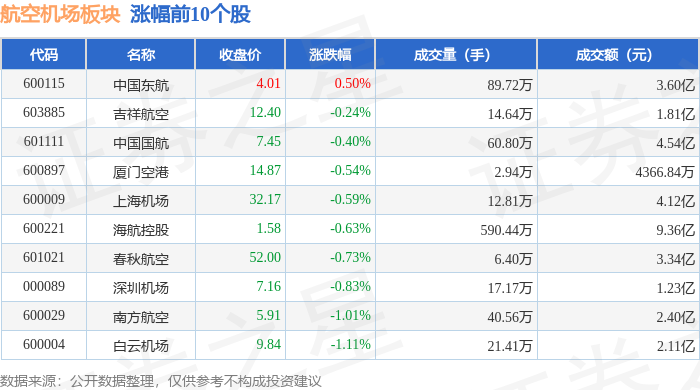
航空机场板块9月2日跌0.63%,华夏航空领跌,主力资金净流出3.22亿元
Zheng Xing Xing Ye Ri Bao· 2025-09-02 08:59
Market Overview - On September 2, the aviation and airport sector declined by 0.63%, with Huaxia Airlines leading the drop [1] - The Shanghai Composite Index closed at 3858.13, down 0.45%, while the Shenzhen Component Index closed at 12553.84, down 2.14% [1] Stock Performance - Key stocks in the aviation sector showed varied performance, with China Eastern Airlines closing at 4.01, up 0.50%, while Huaxia Airlines closed at 8.75, down 2.78% [1][2] - Other notable declines included China Southern Airlines at 5.91, down 1.01%, and Shanghai Airport at 32.17, down 0.59% [1][2] Trading Volume and Capital Flow - The aviation and airport sector experienced a net outflow of 322 million yuan from institutional investors, while retail investors saw a net inflow of 229 million yuan [2] - The trading volume for major stocks included China Eastern Airlines with 897,200 shares traded and a transaction value of 360 million yuan [1] Individual Stock Capital Flow - China National Airlines had a net inflow of 507,500 yuan from institutional investors, while Huaxia Airlines saw a net outflow of 20.93 million yuan [3] - The largest net outflow was recorded for Baiyun Airport at 30.11 million yuan, with retail investors contributing a net inflow of 25.12 million yuan [3]





三大航半年亏了47亿
2 1 Shi Ji Jing Ji Bao Dao· 2025-09-02 06:29
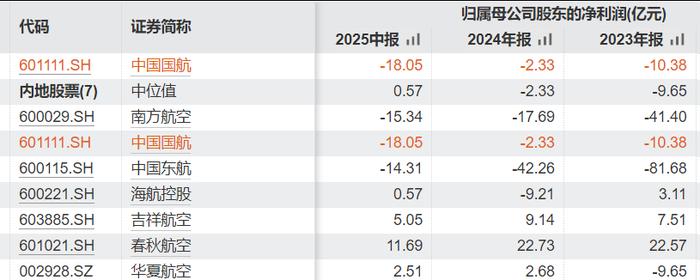
Core Viewpoint - The A-share listed airlines have shown steady revenue growth in the first half of 2025, with state-owned airlines reducing losses significantly while private airlines achieved profitability, marking a notable turnaround in the industry [1][4]. Financial Performance of Major Airlines - The three major state-owned airlines (Air China, China Eastern Airlines, and China Southern Airlines) reported a combined loss of 4.77 billion yuan, a reduction of 2.008 billion yuan compared to the previous year [1][5]. - China Eastern Airlines had the least loss among the three, with a net loss of 1.431 billion yuan, a reduction of 1.337 billion yuan year-on-year [5][6]. - Revenue for the three major airlines increased significantly, with Air China reporting 80.757 billion yuan (up 1.6%), China Eastern Airlines at 66.822 billion yuan (up 4.09%), and China Southern Airlines at 86.291 billion yuan (up 1.77%) [4][5]. International Operations and Capacity - China Eastern Airlines expanded its international operations, opening 14 new international routes and restoring flight numbers to over 110% of 2019 levels [5][6]. - The international passenger capacity for China Eastern Airlines increased by 24.38%, while domestic capacity rose by 1.07% [6]. - The three major airlines saw significant growth in international passenger turnover, with China Eastern Airlines at 28.74%, China Southern Airlines at 25.88%, and Air China at 16.99% [6]. Cost Control Measures - China Eastern Airlines implemented a "cost hard battle" plan, focusing on detailed cost management, which resulted in an 8.08% decrease in fuel costs and a 26.89% reduction in financial expenses [9][10]. - Air China also emphasized cost control, reducing major costs such as fuel and operational expenses, leading to a financial expense reduction of 9.36% [9][10]. Performance of Private Airlines - Private airlines such as Spring Airlines, Juneyao Airlines, Huaxia Airlines, and Hainan Airlines achieved profitability, with Spring Airlines leading with a net profit of 1.169 billion yuan [1][10]. - Spring Airlines has maintained its profitability for two consecutive years, with net profits of 2.257 billion yuan in 2023 and 2.273 billion yuan in 2024 [10]. Market Conditions and Challenges - The average domestic economy class ticket price fell by 6.9% year-on-year in the first half of 2025, indicating pressure on pricing [11]. - The recovery of international routes has not yet reached pre-2019 levels, posing challenges for the three major airlines to achieve profitability [11].
三大航半年亏了47亿
21世纪经济报道· 2025-09-02 06:06
Core Viewpoint - The article highlights the financial performance of China's major airlines during the first half of 2025, indicating that while state-owned airlines continue to incur losses, they have significantly reduced their losses, whereas private airlines have achieved profitability, showcasing a contrasting trend in the industry [1][4]. Group 1: Financial Performance of Major Airlines - The three major state-owned airlines (Air China, China Eastern Airlines, and China Southern Airlines) reported a combined loss of 4.77 billion yuan, which is a reduction of 2.008 billion yuan compared to the previous year [1][4]. - China Eastern Airlines had the least loss among the three, with a net loss of 1.431 billion yuan, a reduction of 1.337 billion yuan year-on-year [4]. - In contrast, four private airlines (Spring Airlines, Juneyao Airlines, China United Airlines, and Hainan Airlines) achieved profitability, with Spring Airlines leading with a net profit of 1.169 billion yuan [1]. Group 2: Revenue Growth and Cost Control - All three major airlines experienced revenue growth, with Air China reporting 80.757 billion yuan (up 1.6%), China Eastern Airlines at 66.822 billion yuan (up 4.09%), and China Southern Airlines at 86.291 billion yuan (up 1.77%) [4]. - The international operations of these airlines have been a significant factor in their revenue recovery, with China Eastern Airlines increasing its international passenger capacity by 24.38% and achieving a 28.74% increase in international passenger turnover [6][4]. - Cost control measures have become crucial, with China Eastern Airlines implementing a "cost hard battle" plan, resulting in an 8.08% decrease in fuel costs and a 26.89% reduction in financial expenses [9][10]. Group 3: Market Conditions and Challenges - Despite the improvements, the three major airlines have not yet returned to profitability due to several factors, including the burden of unprofitable routes and the incomplete recovery of the international market [7][11]. - The average ticket price for domestic economy class has decreased by 6.9% year-on-year, indicating ongoing pressure on revenue [11]. - The article suggests that the major airlines face significant challenges in achieving profitability in the near term, as the domestic ticket prices remain under pressure and international routes have not fully recovered to pre-2019 levels [11].

航司半年报:三大航营收稳步增长 春秋航空蝉联“最赚钱航司”
2 1 Shi Ji Jing Ji Bao Dao· 2025-09-01 11:48
Core Viewpoint - The A-share listed airlines have shown a significant reduction in losses for the first half of 2025, with state-owned airlines still in the red but improving, while private airlines have turned profitable, indicating a contrasting performance in the industry [2][5]. Financial Performance - The three major state-owned airlines (Air China, China Eastern Airlines, and China Southern Airlines) reported a combined loss of 4.77 billion yuan, a reduction of 2.008 billion yuan compared to the previous year [2]. - China Eastern Airlines had the least loss among the three, with a net loss of 1.431 billion yuan, a reduction of 1.337 billion yuan year-on-year [3]. - The revenue for the three major airlines showed growth: Air China at 80.757 billion yuan (up 1.6%), China Eastern at 66.822 billion yuan (up 4.09%), and China Southern at 86.291 billion yuan (up 1.77%) [2]. International Operations - China Eastern Airlines expanded its international operations significantly, opening 14 new international routes and restoring flight numbers to over 110% of 2019 levels [3]. - Air China and China Southern Airlines also increased their international capacity, with Air China's international passenger capacity up 16.7% and China Southern's up 22.5% [4]. Cost Control Measures - Cost control has become a critical focus for the airlines, with China Eastern Airlines implementing a "cost hard battle" plan to manage expenses effectively [6]. - The airlines reported a decrease in fuel costs, with Air China, China Eastern, and China Southern seeing reductions of 10.34%, 8.08%, and 9.15% respectively [7]. Market Conditions - The average ticket price for domestic economy class fell by 6.9% year-on-year in the first half of 2025, indicating ongoing pressure on pricing [8]. - The recovery of international routes remains incomplete, with the overall market still facing challenges in returning to pre-pandemic levels [8].
航司半年报:三大航营收稳步增长,春秋航空蝉联“最赚钱航司”
2 1 Shi Ji Jing Ji Bao Dao· 2025-09-01 11:43
Core Viewpoint - The A-share listed airlines have reported their 2025 semi-annual results, showing steady revenue growth among the three major state-owned airlines, despite still being in a loss position, while private airlines have achieved profitability, indicating a counter-trend breakthrough [1] Group 1: Financial Performance of Major Airlines - The three major airlines (Air China, China Eastern Airlines, and China Southern Airlines) collectively reported a loss of 4.77 billion yuan, with a reduction in losses by 2.008 billion yuan [2] - China Eastern Airlines had the least loss and the most significant reduction in losses among the three, with a net loss of 1.431 billion yuan, a decrease of 1.337 billion yuan year-on-year [3] - Revenue for the three major airlines showed notable growth: Air China reported 80.757 billion yuan (up 1.6%), China Eastern Airlines 66.822 billion yuan (up 4.09%), and China Southern Airlines 86.291 billion yuan (up 1.77%) [3] Group 2: International Operations and Capacity - China Eastern Airlines expanded its international operations significantly, opening 14 new international routes and restoring its international flight numbers to over 110% of 2019 levels [4] - The international passenger capacity for China Eastern Airlines increased by 24.38% year-on-year, while domestic capacity rose by 1.07% [4] - Air China and China Southern Airlines also increased their international capacity, with Air China seeing a 16.7% increase and China Southern Airlines a 22.5% increase [4] Group 3: Cost Control Measures - Cost control has become a crucial focus for the three major airlines, with China Eastern Airlines implementing a "cost hard battle" plan to manage expenses effectively [7] - China Eastern Airlines achieved an 8.08% reduction in fuel costs, while Air China and China Southern Airlines saw reductions of 10.34% and 9.15%, respectively [7] - Financial expenses for China Eastern Airlines decreased by 26.89% year-on-year, while Air China reduced its financial expenses by 9.36 billion yuan [7] Group 4: Performance of Private Airlines - Private airlines such as Spring Airlines, Juneyao Airlines, and others achieved profitability, with Spring Airlines reporting a net profit of 1.169 billion yuan, making it the most profitable airline in the first half of 2025 [2][8] - Spring Airlines' success is attributed to its low-cost model and strong market presence in Shanghai, which aligns well with current market conditions [8] Group 5: Market Challenges - The three major airlines face challenges in turning profitable due to factors such as unprofitable routes and the incomplete recovery of the international market, particularly in long-haul flights [5] - The average domestic economy class ticket price fell by 6.9% year-on-year in the first half of 2025, indicating ongoing pressure on pricing [9] - The recovery of international routes remains below 2019 levels, complicating the path to profitability for the major airlines [9]
半年报总结: Q2航空减亏明显,快递物流表现分化
SINOLINK SECURITIES· 2025-09-01 11:28
Overall Industry Investment Rating - The transportation sector is expected to see revenue and profit growth in H1 2025, with a revenue increase of 1.8% year-on-year and a net profit increase of 4.3% year-on-year [2][20]. Core Insights - The transportation sector's revenue for H1 2025 reached 1.7351 trillion yuan, driven by significant revenue increases in the aviation and express delivery segments [2][27]. - The express delivery segment experienced a substantial volume increase of 19.3% year-on-year, although profits were impacted by price wars, leading to a 1% decline in net profit for Q2 2025 [3][38]. - The aviation sector saw a recovery with a 71% increase in net profit for H1 2025, supported by a 6% increase in domestic passenger volume and a 25% increase in international passenger volume [4][32]. - The shipping sector maintained a stable outlook, with a slight revenue increase of 2.8% year-on-year, although net profit decreased by 2.8% [5][46]. - The port sector benefited from a 2.5% increase in cargo throughput, resulting in a 5% revenue increase and a 10% net profit increase for H1 2025 [6][48]. Summary by Sections Transportation Overview - The transportation sector's revenue for H1 2025 was 1.7351 trillion yuan, up 1.8% year-on-year, with a net profit of 949 billion yuan, up 4.3% year-on-year [2][20][27]. - In Q2 2025, the sector's revenue was 898.1 billion yuan, remaining flat year-on-year, while net profit increased by 6.3% to 477 billion yuan [2][20][32]. Express Delivery and Logistics - The express delivery segment's revenue for H1 2025 was 700 billion yuan, up 10.1% year-on-year, with a volume of 957 billion parcels, up 19.3% year-on-year [3][38]. - The logistics sector faced a 2% revenue decline in H1 2025, with net profit remaining flat [3][60]. Aviation and Airports - The aviation sector's revenue increased by 7% year-on-year in H1 2025, with net profit soaring by 71% [4][32]. - Airport revenues grew by 6% year-on-year, with net profit increasing by 26% [4][32]. Shipping and Ports - The shipping sector's revenue increased by 2.8% year-on-year in H1 2025, while net profit decreased by 2.8% [5][46]. - The port sector's cargo throughput increased by 2.5%, leading to a 5% revenue increase and a 10% net profit increase [6][48]. Road and Rail - The road sector saw a 3.03% revenue decline in H1 2025, but net profit increased by 3.4% [6][60]. - The railway sector's revenue was 778 billion yuan, up 0.4% year-on-year, but net profit decreased by 11.2% [7][60]. Investment Recommendations - The report suggests focusing on the logistics and aviation sectors, highlighting companies like SF Holding and Hai Chen Co. for their growth potential [8].



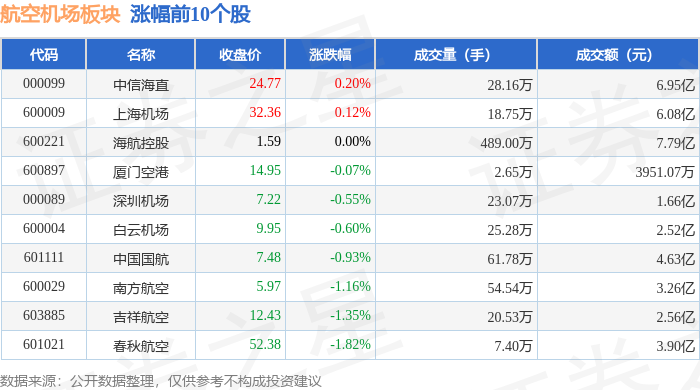
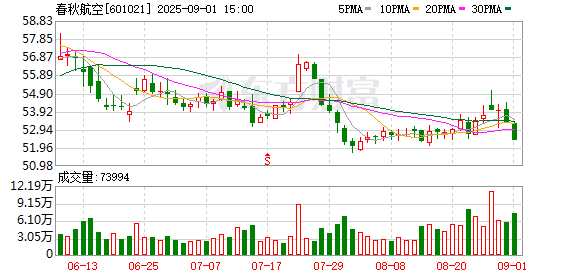
航空机场板块9月1日跌0.94%,华夏航空领跌,主力资金净流出2.93亿元
Zheng Xing Xing Ye Ri Bao· 2025-09-01 08:44
Core Insights - The aviation and airport sector experienced a decline of 0.94% on September 1, with Huaxia Airlines leading the drop [1] - The Shanghai Composite Index closed at 3875.53, up 0.46%, while the Shenzhen Component Index closed at 12828.95, up 1.05% [1] Stock Performance Summary - The following stocks in the aviation and airport sector showed varied performance: - CITIC Haizhi: Closed at 24.77, up 0.20%, with a trading volume of 281,600 shares and a turnover of 695 million yuan [1] - Shanghai Airport: Closed at 32.36, up 0.12%, with a trading volume of 187,500 shares and a turnover of 608 million yuan [1] - HNA Holding: Closed at 1.59, unchanged, with a trading volume of 4.89 million shares and a turnover of 779 million yuan [1] - Xiamen Airport: Closed at 14.95, down 0.07%, with a trading volume of 26,500 shares and a turnover of 39.51 million yuan [1] - Shenzhen Airport: Closed at 7.22, down 0.55%, with a trading volume of 230,700 shares and a turnover of 166 million yuan [1] - Baiyun Airport: Closed at 9.95, down 0.60%, with a trading volume of 252,800 shares and a turnover of 252 million yuan [1] - Air China: Closed at 7.48, down 0.93%, with a trading volume of 617,800 shares and a turnover of 463 million yuan [1] - China Southern Airlines: Closed at 5.97, down 1.16%, with a trading volume of 545,400 shares and a turnover of 326 million yuan [1] - Juneyao Airlines: Closed at 12.43, down 1.35%, with a trading volume of 205,300 shares and a turnover of 256 million yuan [1] - Spring Airlines: Closed at 52.38, down 1.82%, with a trading volume of 74,000 shares and a turnover of 390 million yuan [1] Capital Flow Analysis - The aviation and airport sector saw a net outflow of 293 million yuan from institutional investors, while retail investors contributed a net inflow of 279 million yuan [2] - The following capital flows were noted for specific stocks: - HNA Holding: Net inflow of 45.64 million yuan from institutional investors, but a net outflow of 36.41 million yuan from retail investors [3] - Shenzhen Airport: Net inflow of 13.27 million yuan from institutional investors, with a net outflow of 20.78 million yuan from retail investors [3] - China Southern Airlines: Net outflow of 1.21 million yuan from institutional investors, but a net inflow of 2.78 million yuan from retail investors [3] - Xiamen Airport: Net outflow of 1.79 million yuan from institutional investors, with a net inflow of 178.71 million yuan from retail investors [3] - Huaxia Airlines: Net outflow of 3.68 million yuan from institutional investors, but a net inflow of 542.84 million yuan from retail investors [3] - Air China: Net outflow of 7.48 million yuan from institutional investors, with a net inflow of 38.94 million yuan from retail investors [3] - Juneyao Airlines: Net outflow of 7.64 million yuan from institutional investors, but a net inflow of 682.32 million yuan from retail investors [3] - Spring Airlines: Net outflow of 29.52 million yuan from institutional investors, with a net inflow of 283.88 million yuan from retail investors [3] - Baiyun Airport: Net outflow of 32.34 million yuan from institutional investors, with a net inflow of 239.79 million yuan from retail investors [3]