传音控股

Search documents
股市面面观丨“非洲手机之王”近期股价暴跌超30% 端侧AI方向潜力仍被看好
Xin Hua Cai Jing· 2025-11-11 15:53
Core Viewpoint - Transsion Holdings, known as the "King of African Mobile Phones," has experienced a significant decline in stock price, dropping nearly 35% over 27 trading days since September 25, making it the worst performer among the STAR Market 50 index stocks, which only fell about 6% during the same period [1][3]. Financial Performance - For the first three quarters of 2023, Transsion Holdings reported revenue of 49.54 billion yuan, a year-on-year decrease of 3.33%, and a net profit of 2.148 billion yuan, down 44.97% year-on-year, marking the lowest level for the same period since 2021 [3]. - The company's gross profit margin has fallen to 19.47%, dipping below 20% for the first time in recent years, attributed to market competition and rising supply chain costs [3][4]. - In Q3 2023, Transsion achieved revenue of 20.466 billion yuan, a year-on-year increase of 22.60% and a quarter-on-quarter increase of 27.33%, but the net profit decreased by 11.06% year-on-year to 0.935 billion yuan [3]. Market Competition - Transsion is facing intensified competition in its traditional African market, with domestic brands like Xiaomi, OPPO, and Honor increasing their presence. Xiaomi's market share in Africa has risen to approximately 14%, while Honor holds about 4% [4]. - Despite the competition, Transsion maintains over 50% market share in Africa, indicating its dominant position [4]. Supply Chain Challenges - The recent surge in storage prices has added pressure to Transsion's operations. The company plans to respond to these cost increases through price adjustments and product structure changes [4]. AI Potential - Transsion's potential in edge AI is viewed positively by institutions, with its TECNO AI and Infinix AI being applied in various functions such as image enhancement and voice assistance [5]. - The company is focusing on localized AI solutions to cater to low-resource languages in emerging markets, which could enhance user experience [5]. Strategic Partnerships - Transsion is actively collaborating with major internet companies like NetEase and Tencent to develop mobile internet products, aiming to enhance user experience and market share in key regions [6]. Investment Ratings - In the past month, nine brokerage firms have issued investment ratings for Transsion, with six firms recommending "buy" and two recommending "hold" [7].


寒武纪优化基础软件平台,或加速国产算力落地 | 投研报告
Zhong Guo Neng Yuan Wang· 2025-11-11 02:04
Overall Industry Performance - The electronic industry is experiencing a volatile and differentiated performance, with mixed results across various sectors [3] - The Shanghai Composite Index rose by 1.08%, while the Shenzhen Component Index increased by 0.19%, and the CSI 300 Index went up by 0.82% [2] Sector Analysis - The Other Electronics II sector showed the strongest performance with a weekly increase of 5.03%, leading the entire industry [3] - The Components sector rose by 2.14%, with printed circuit boards increasing by 1.90%, while passive components fell by 3.25%, indicating significant differentiation within the sector [3] - The Semiconductor sector remained flat overall, but there were notable internal differences, with semiconductor equipment rising by 4.80% and discrete devices increasing by 1.28%, while analog chip design and integrated circuit testing fell by 3.56% and 3.17% respectively [3] - The Optical and Optoelectronic sector slightly declined by 0.25%, with LEDs increasing by 1.07% and optical components decreasing by 1.04% [3] - The Consumer Electronics sector dropped by 2.45%, continuing its adjustment trend, with brand consumer electronics down by 6.22% [3] - The Electronic Chemicals II sector fell by 0.82%, with the Electronic Chemicals III sub-sector experiencing a similar decline [3] Notable Company Developments - Anshi China announced it has established sufficient inventory to meet customer demand until the end of the year [4] - Blue Arrow Electronics exited the semiconductor investment fund, terminating the co-investment matter [4] - Supermicro, in collaboration with Intel and Micron, set a world record in quantitative trading performance testing [4] - Samsung SDI is in talks with Tesla regarding LFP battery orders, targeting the U.S. energy storage market [4] - Lite-On Optoelectronics reported growth in both revenue and net profit for the first three quarters, with domestic OLED materials making significant breakthroughs [4] Investment Insights - The recent update of Cambrian's self-developed basic software platform NeuWare is seen as a comprehensive enhancement rather than a simple functional upgrade, shifting the value proposition of domestic computing power from "hardware replacement" to "platform replacement" [5] - As domestic hardware and software platforms accelerate their autonomy, the ecosystem for domestic chips may be strengthened, potentially leading to a new phase for domestic computing power [5]

科创ETF(588050)开盘涨0.35%,重仓股中芯国际涨0.49%,海光信息涨0.50%
Xin Lang Cai Jing· 2025-11-11 01:38
Group 1 - The core point of the article highlights the performance of the Science and Technology Innovation ETF (588050), which opened with a slight increase of 0.35% at 1.451 yuan [1] - The major holdings of the ETF include companies such as SMIC, Haiguang Information, and Cambrian, with respective opening increases of 0.49%, 0.50%, and 0.47% [1] - The ETF's performance benchmark is the Shanghai Stock Exchange Science and Technology Innovation Board 50 Index, managed by ICBC Credit Suisse Asset Management Company, with a return of 0.65% since its inception on September 28, 2020, and a return of -3.07% over the past month [1] Group 2 - The article provides specific stock performance data for the ETF's holdings, including a 1.17% increase for Lattice Semiconductor and a 1.13% increase for Zhongwei Company, while Unisound and Kingsoft Office experienced declines of 0.47% and 0.45%, respectively [1] - The article emphasizes the importance of monitoring market conditions, as the ETF's recent performance reflects broader market trends [1]




传音控股:公司会持续努力做好生产经营工作
Zheng Quan Ri Bao Wang· 2025-11-10 14:13
Core Viewpoint - Transsion Holdings stated on November 10 that its stock price is influenced by multiple factors and the company will continue to focus on production and operations to reward shareholders [1] Group 1 - The company acknowledged that its stock price is affected by various factors [1] - The company is committed to improving its production and operational performance [1] - The company aims to provide returns to its shareholders [1]
传音控股(688036):出货量提升、盈利承压,端侧AI布局提升成长空间
Hua Yuan Zheng Quan· 2025-11-10 11:58
Investment Rating - The investment rating for the company is "Buy" (maintained) [5] Core Views - The company is experiencing an increase in shipment volume, but profitability is under pressure due to market competition and supply chain costs [6] - The company has shown strong performance in the third quarter, with a significant increase in smartphone shipments, achieving a year-on-year growth of 13.6% [6] - The company is actively adapting to cost pressures and is expected to restore profitability through price adjustments and product structure optimization [6] - The company is positioned to benefit from the upcoming commercialization of edge AI technology, enhancing its hardware value proposition [6] Financial Summary - Revenue projections for the company are as follows: - 2023: 62,295 million RMB - 2024: 68,715 million RMB - 2025E: 69,922 million RMB - 2026E: 80,637 million RMB - 2027E: 90,387 million RMB - Year-on-year growth rates for revenue are projected at 33.69% for 2023, 10.31% for 2024, and 1.76% for 2025E [5][6] - The company's net profit attributable to shareholders is forecasted as follows: - 2023: 5,537 million RMB - 2024: 5,549 million RMB - 2025E: 3,039 million RMB - 2026E: 4,073 million RMB - 2027E: 5,898 million RMB [5][6] - The company's earnings per share (EPS) for the forecasted years are: - 2023: 4.81 RMB - 2024: 4.82 RMB - 2025E: 2.64 RMB - 2026E: 3.54 RMB - 2027E: 5.12 RMB [7]
智能眼镜行业“吹牛”成风
Jing Ji Guan Cha Bao· 2025-11-09 05:04
Core Insights - The smart glasses industry is experiencing a surge of optimism, with many companies claiming significant order volumes and potential for growth, but there is a disconnect between what is promised and what is delivered [1][2][3] - The competition is intensifying, with various startups and established tech companies vying for market share, leading to inflated claims about sales and orders [2][4] - The actual sales figures and order fulfillment rates are often much lower than reported, raising concerns about the sustainability of the market [5][6] Group 1: Market Dynamics - Companies like Rokid, VITURE, and others are entering the smart glasses market, with expectations of high demand and significant orders from major tech players [2][4] - The industry is characterized by a high rate of return for smart glasses, with some manufacturers reporting return rates as high as 40% to 50% [6][8] - The gap between projected sales and actual performance is evident, with many companies unable to meet their own ambitious targets [3][5] Group 2: Investment Sentiment - Investors are cautious about the smart glasses sector, with some choosing to focus on upstream supply chain opportunities rather than direct investments in smart glasses manufacturers [13][14] - The trend of over-reporting sales figures and order volumes is prevalent, leading to skepticism among investors regarding the true health of the market [5][6] - The potential for a bubble exists, as many companies are competing to secure funding without delivering on their promises [14][15] Group 3: Product Development Challenges - Smart glasses are still considered "half-finished" products, with many companies struggling to balance performance, weight, and battery life [9][10] - The integration of advanced technologies into smart glasses has led to increased complexity, making it difficult for manufacturers to deliver a viable product [9][10] - The industry is facing significant hurdles in achieving the necessary functionality and user experience that consumers expect [10][14]
智能眼镜行业“吹牛”成风
经济观察报· 2025-11-09 04:19
Core Insights - The article discusses the disparity between the promises made by companies in the AI and AR glasses industry and their actual capabilities, highlighting a potential bubble in the market driven by inflated claims and unfulfilled orders [2][3][5] Group 1: Market Dynamics - A Shenzhen-based AI glasses company announced significant funding and projected order growth, but faced delivery delays and customer dissatisfaction, indicating a disconnect between claims and reality [2][3] - The "hundred glasses war" is characterized by numerous players claiming large orders, but the actual sales figures are often much lower, leading to skepticism among investors [5][6] - The industry is seeing a surge of interest from major tech companies like Huawei and Xiaomi, as well as platforms like Alibaba and Tencent, all seeking new entry points into the consumer electronics market [2] Group 2: Order and Sales Discrepancies - Reports indicate that actual shipments of smart glasses are significantly lower than claimed, with one company stating a shipment of only 20,000 units despite claiming much higher figures [6][10] - Suppliers reveal that many companies are inflating their order numbers, with some using framework contracts to misrepresent sales figures, leading to a lack of trust in reported data [7][10] - High return rates in the smart glasses market, often exceeding 40%, further complicate the reliability of sales data, as many products fail to meet consumer expectations [10][19] Group 3: Investment Sentiment - Investors are becoming increasingly cautious about the smart glasses sector, with some opting to invest in upstream suppliers rather than direct competitors in the hardware space [9][17] - The article highlights a trend where investors prefer to back niche markets within the smart glasses industry, such as gaming or outdoor sports, rather than general-purpose devices that face stiff competition from larger tech firms [17][18] - The overall sentiment in the investment community is one of skepticism, with many believing that the current excitement around smart glasses may not be sustainable [18][19] Group 4: Product Development Challenges - The integration of multiple components in smart glasses, such as chips and sensors, poses significant challenges in terms of weight, power consumption, and user comfort, leading to products that are often seen as "half-finished" [13][14] - Many companies are struggling to achieve the necessary balance between functionality and user experience, with current products often falling short of consumer expectations [14][19] - The article emphasizes that the technology behind smart glasses is still evolving, and many products are not yet ready for mass adoption due to performance and usability issues [12][14]

深圳又一家E-bike攻下北美,年营收7亿
创业邦· 2025-11-07 10:39
Core Viewpoint - The article highlights the growth and strategic positioning of Heybike, a Chinese E-bike brand, in the global market, particularly focusing on its expansion into North America and Europe, while emphasizing the competitive landscape and market dynamics of the E-bike industry. Group 1: Company Background and Growth - Heybike, originally founded as a contract manufacturer, transitioned to a brand in 2021 and quickly gained traction, selling over 15,000 E-bikes in just seven months and ranking among the top three E-bike brands on Amazon within a year [5][16]. - The company has not sought external financing and has focused solely on overseas markets, achieving profitability for three consecutive years with a user base of 170,000 [7][27]. - The founders, Fang Huimin and Li Yifan, leveraged their backgrounds in manufacturing and market operations to establish a strong product line and brand identity [11][12]. Group 2: Market Dynamics and Trends - The E-bike market has seen significant growth, with a projected market size of $23.82 billion in 2024, driven by increasing demand in North America and Europe [9][10]. - The pandemic accelerated the demand for E-bikes, with sales in Europe and North America rising from 2.5 million units in 2017 to 6.4 million units in 2021, marking a 156% increase [12]. - Government incentives, such as tax credits for E-bike purchases in the U.S., have further fueled market growth [12]. Group 3: Strategic Market Positioning - Heybike's strategy involves targeting specific market segments, such as urban commuters and casual riders, by offering products priced below $1,000 to avoid competition with high-end brands [18][19]. - The company has focused on product innovation, utilizing lightweight materials like T800 carbon fiber to enhance performance while reducing weight [21][23]. - Heybike aims to penetrate the European market, which is characterized by established cycling culture and higher consumer expectations, by adapting its product offerings to local preferences [30][32]. Group 4: Competitive Landscape - The E-bike industry is experiencing a shakeout, with several competitors exiting the market, while others like Rad Power and VanMoof have faced significant challenges [42][43]. - Despite the competitive pressures, the overall market is still growing, with a current penetration rate of only 25% in Europe, indicating substantial room for expansion [43]. - Heybike's approach includes building a robust supply chain and enhancing R&D capabilities to stay competitive against both traditional bicycle manufacturers and new entrants from various sectors [44].

MLOps概念下跌1.82%,主力资金净流出16股
Zheng Quan Shi Bao Wang· 2025-11-07 09:13
Group 1 - The MLOps concept declined by 1.82% as of the close on November 7, ranking among the top declines in concept sectors, with companies like Keda Guokuan, Transsion Holdings, and Runhe Software experiencing significant drops [1] - The MLOps sector saw a net outflow of 1.21 billion yuan in main funds today, with 16 stocks experiencing net outflows, and 7 stocks seeing outflows exceeding 30 million yuan, led by Runhe Software with a net outflow of 601 million yuan [2] - Other companies with notable net outflows include Keda Guokuan and Transsion Holdings, with net outflows of 250 million yuan and 143 million yuan respectively [2] Group 2 - The top stocks with net outflows in the MLOps sector include Runhe Software (-4.01%), Keda Guokuan (-7.03%), and Transsion Holdings (-4.39%), with respective turnover rates of 6.08%, 21.83%, and 1.85% [2][3] - Conversely, the stocks with net inflows include Xinghuan Technology and Dongfang Guoxin, with net inflows of 21.58 million yuan and 14.76 million yuan respectively [2]


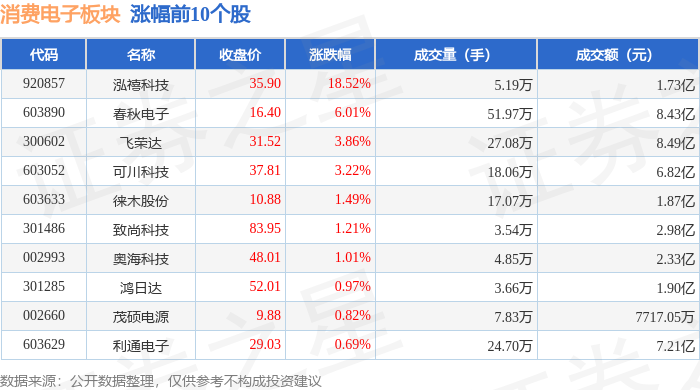
消费电子板块11月7日跌3.19%,统联精密领跌,主力资金净流出42.61亿元



Zheng Xing Xing Ye Ri Bao· 2025-11-07 08:30
Market Overview - The consumer electronics sector experienced a decline of 3.19% on November 7, with Tonglian Precision leading the drop [1] - The Shanghai Composite Index closed at 3997.56, down 0.25%, while the Shenzhen Component Index closed at 13404.06, down 0.36% [1] Stock Performance - Notable gainers in the consumer electronics sector included: - Hongxi Technology, up 18.52% to 35.90, with a trading volume of 51,900 shares and a turnover of 173 million [1] - Spring Autumn Electronics, up 6.01% to 16.40, with a trading volume of 519,700 shares and a turnover of 843 million [1] - Major decliners included: - Tonglian Precision, down 5.72% to 60.68, with a trading volume of 51,000 shares and a turnover of 315 million [2] - Dingye Fuliang, down 4.62% to 72.70, with a trading volume of 1,585,400 shares and a turnover of 11.558 billion [2] Capital Flow - The consumer electronics sector saw a net outflow of 4.261 billion from institutional investors, while retail investors contributed a net inflow of 3.84 billion [2][3] - Specific stock capital flows indicated: - Lansi Technology had a net inflow of 68.39 million from retail investors, while it faced a net outflow of 23.4 million from institutional investors [3] - Feirongda experienced a net inflow of 63.82 million from institutional investors but a net outflow of 65.92 million from retail investors [3]