赛诺菲

Search documents
胰岛素深度:集采出清拐点已现,凝聚创新、出海新共识
Changjiang Securities· 2025-10-19 03:43
Investment Rating - The report maintains a "Positive" investment rating for the insulin industry [10] Core Insights - The insulin market is stabilizing post-collection procurement, with companies focusing on innovation and steady progress in R&D pipelines, creating a closed-loop advantage in insulin, diabetes, endocrine, and metabolism sectors [3][9] - The progress of insulin exports is promising, expected to contribute to new growth [8] - The cash flow of companies is gradually stabilizing, and the valuation of innovative pipelines is likely to be reshaped [9] Summary by Sections Domestic Insulin Collection Procurement - The domestic insulin market is broad, with insulin analogs becoming the main driving force. In 2021, there were approximately 14.1 million diabetes patients in China, with an expected increase to 29.3 million by 2030. The market size for insulin in China is projected to be 22.3 billion yuan in 2024, reflecting a year-on-year decrease of 14.23% [20] - The first round of national collection procurement was moderate, ensuring basic procurement volume and expanding external market channels. Nearly 50% of the insulin market share was not included in the procurement, allowing leading companies to significantly increase sales volume [27][20] - The second round of procurement renewal has seen price increases for some companies, reflecting a balanced approach by the National Medical Insurance Administration [30][27] Insulin Export Progress - Companies like Ganli Pharmaceutical and Tonghua Dongbao are making significant progress in exporting insulin to developed regions like Europe and the US, where the insulin market is valued at $13.2 billion. The market in developing regions such as Asia, Africa, and Latin America is estimated to be between $4.3 billion and $6.5 billion [8][20] Innovative Drug Pipeline - The innovative drug pipeline is gradually yielding results, with a focus on GLP-1 research and development. Insulin companies are expected to leverage their advantages in sales terminals, process development, and production capacity in the GLP-1 sector [9][8] - The management teams and innovation systems of these companies are undergoing significant changes, which may lead to a reshaping of their valuations [9]


大型制药公司屈服于特朗普压力
Shang Wu Bu Wang Zhan· 2025-10-18 15:58
Core Viewpoint - Major pharmaceutical companies are aligning with the Trump administration to avoid punitive tariffs, with agreements to lower drug prices in exchange for tariff relief [1] Group 1: Company Actions - AstraZeneca agreed to sell some drugs at a discount below the U.S. government's Medicaid program price in exchange for three years of tariff relief [1] - Pfizer reached a similar agreement last month, committing to reduce prescription drug prices in the Medicaid program to levels comparable to other developed countries for tariff exemptions [1] - Other companies like AbbVie, Bristol-Myers Squibb, and Sanofi are also reducing drug prices, while Eli Lilly, Roche, and Novo Nordisk are seeking to bypass intermediaries and sell directly to customers [1] Group 2: Market Context - U.S. prescription drug prices are significantly higher, typically nearly three times those in other developed markets [1] - The agreements reached by Pfizer and AstraZeneca are expected to serve as a template for other large pharmaceutical companies in the coming weeks and months [1] Group 3: Government Influence - The Trump administration's aggressive stance has successfully pressured major pharmaceutical companies to comply with price reductions through a form of coercive negotiation [1]


国内首个外企胰岛素原料药生产基地在京启动
Ren Min Ri Bao· 2025-10-17 21:54
Core Insights - Sanofi's investment in a new insulin raw material production base in Beijing highlights China's strategic importance to the company and reflects confidence in the long-term economic outlook of China [1][3] Investment Details - The total investment for the insulin raw material production base project is €1 billion, marking it as the largest investment in the pharmaceutical industry in Beijing since the start of the 14th Five-Year Plan [3] - This facility will be the first insulin raw material production base established by a multinational company in China, with a total construction area of nearly 60,000 square meters [3] - The production base is expected to be fully completed and operational by 2032 [3] Industry Context - The Beijing Economic-Technological Development Area has attracted over 5,000 various biopharmaceutical companies, creating a comprehensive industry chain that encompasses research and development, production, services, and sales [1]


Will Declining Gardasil Sales Ail MRK's Top Line in Q3 Earnings?
ZACKS· 2025-10-17 17:21
Core Insights - Merck is experiencing significant challenges with its second-largest product, Gardasil, which is a vaccine for preventing certain cancers caused by human papillomavirus. Sales, which had been rising until 2022, began to decline in 2024 and continued to struggle in 2025 [1][10]. Sales Performance - In the first half of 2025, Gardasil sales dropped 48% year-over-year to $2.45 billion, primarily due to weak demand in China amid an economic slowdown. This decline has led to higher-than-normal inventory levels at Merck's partner in China, Zhifei [2][10]. - Merck has decided to temporarily halt shipments of Gardasil to China to allow for inventory reduction, with no expected resumption of shipments until at least the end of 2025. Sales are projected to decline significantly in 2025 compared to 2024 levels [3][10]. - Demand for Gardasil is also weak in Japan, with expectations of continued low sales in both China and Japan for the latter half of 2025. Estimates suggest a negative compound annual growth rate (CAGR) of 15.1% for Gardasil sales over the next three years [4]. Other Vaccines and Competitive Landscape - Besides Gardasil, Merck markets several other vaccines, including ProQuad, M-M-R II, Varivax, Vaxneuvance, RotaTeq, Pneumovax 23, and the newly approved Capvaxive [5]. - Sales of other vaccines, such as ProQuad and Pneumovax 23, also saw declines in the first half of 2025. Merck's new RSV antibody, Enflonsia, was approved in the U.S. in June 2025 and is under review in the EU, aimed at protecting infants during their first RSV season [6]. - Enflonsia is the first treatment designed to protect infants with a uniform dose regardless of weight, but it faces competition from AstraZeneca and Sanofi's RSV antibody, Beyfortus, which achieved blockbuster status in its first full year of sales in 2024 [7][8]. Financial Performance and Valuation - Year-to-date, Merck's shares have declined by 15.8%, underperforming the industry, sector, and S&P 500 [9]. - From a valuation perspective, Merck's shares trade at a forward price/earnings ratio of 8.97, which is lower than the industry average of 15.62 and its 5-year mean of 12.64 [11]. - The Zacks Consensus Estimate for 2025 earnings per share has decreased from $8.94 to $8.92, and for 2026, it has decreased from $9.55 to $9.44 over the past 60 days [12].


I-Mab董事长傅唯回应公司转型更名等动作
Sou Hu Cai Jing· 2025-10-17 13:25
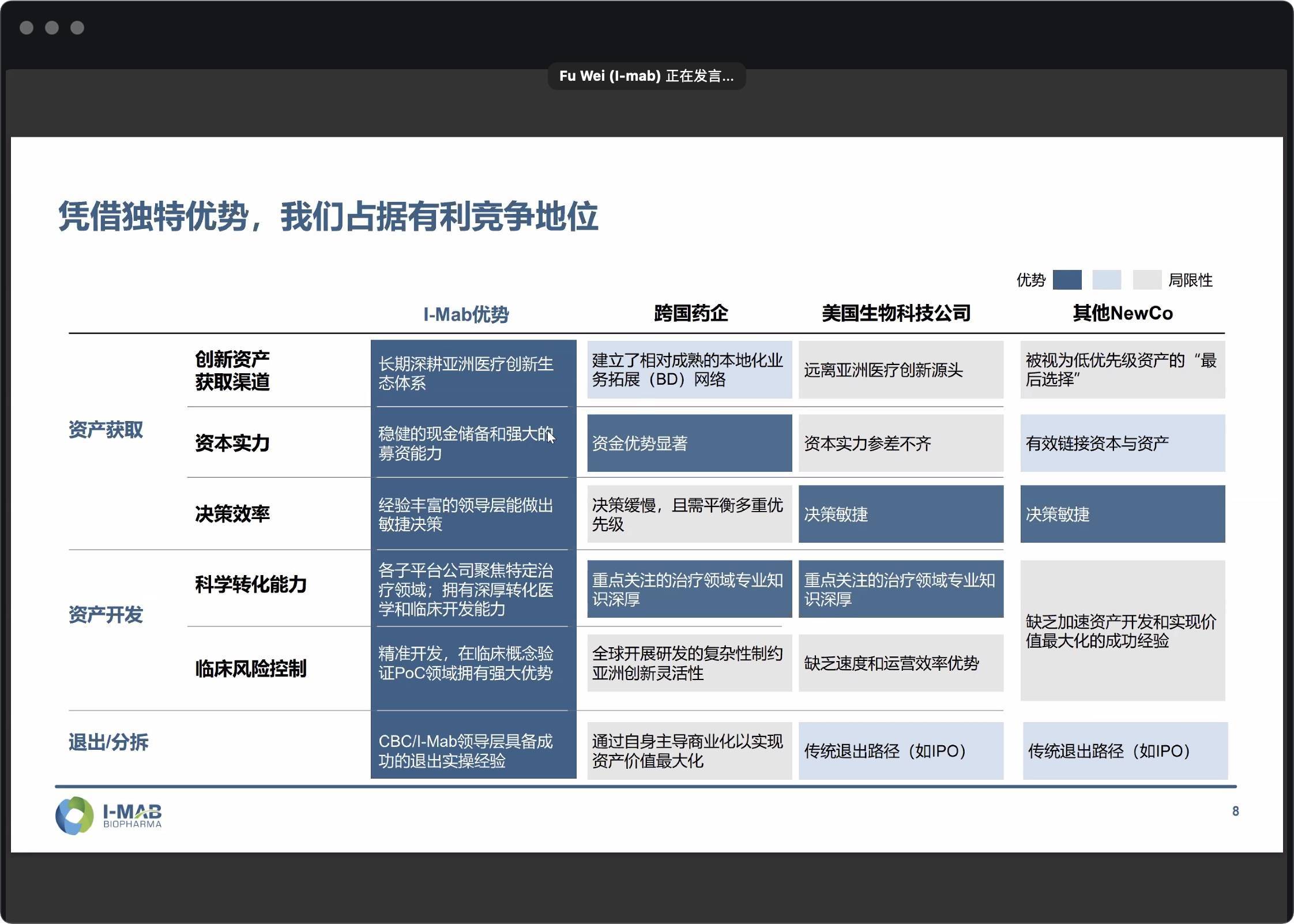
Core Viewpoint - I-Mab is planning to conduct an initial public offering (IPO) in Hong Kong and aims for a dual listing on NASDAQ and the Hong Kong Stock Exchange, rebranding itself as NovaBridge Biosciences, with a focus on transforming into a platform-based enterprise rather than concentrating on single-target research [1][3]. Group 1: Company Transformation and Strategy - I-Mab's core transformation is to create an efficient platform-centric enterprise, leveraging its global vision and organizational resource integration capabilities to facilitate the internationalization of Chinese innovations [1][3]. - The company aims to become the best partner for clinical discovery by establishing multi-layered capital and funding cooperation with partners through various methods, including flexible equity acquisitions [3][12]. - I-Mab has a complete business development (BD) capability, having scanned hundreds of biotech companies and invested in over 30 of them in the past year, demonstrating a deep understanding of the structure and development pace of the Chinese biotech ecosystem [3][12]. Group 2: Financial Background and Market Position - I-Mab has raised over $500 million (approximately 3.23 billion RMB) since its inception, with significant funding rounds, including a $220 million Series C round in June 2018, which was one of the largest in China's innovative drug sector [4]. - However, the company faced a downturn after its IPO, with its market value plummeting from over $7 billion to approximately $754 million due to a tightening investment environment and the bursting of valuation bubbles [5][12]. - The company has been under pressure to restructure, including the transfer of its Chinese assets to a subsidiary, TJ Biopharma, to alleviate financial burdens and meet obligations to shareholders [5][12]. Group 3: Pipeline and Product Development - Following the asset split, I-Mab retained a limited pipeline, including a CD73 monoclonal antibody and two bispecific antibodies, but has faced challenges in advancing these projects [9][12]. - The company announced a pause in the development of its CD73 monoclonal antibody to focus on its bispecific antibody project, Givastomig, while also exploring new partnerships for its remaining assets [12][13]. - I-Mab is acquiring a new bispecific biologic, VIS-101, aimed at treating wet age-related macular degeneration and diabetic macular edema, through a newly established subsidiary, Visara, with an investment of approximately $37 million [13][14].
Press Release: Sanofi’s Wayrilz recommended for EU approval by the CHMP to treat immune thrombocytopenia
Globenewswire· 2025-10-17 11:05
Core Viewpoint - The European Medicines Agency's Committee for Medicinal Products for Human Use (CHMP) has recommended the approval of Wayrilz (rilzabrutinib) for treating immune thrombocytopenia (ITP) in adult patients who are refractory to other treatments, with a final decision expected soon [1][2] Group 1: Product Information - Wayrilz is the first BTK inhibitor for ITP, addressing the root cause of the disease through multi-immune modulation [5][7] - The drug has already received approval in the US and the UAE, and is under regulatory review in China [3] - Wayrilz has received fast track and orphan drug designations in the US, EU, and Japan for ITP and other rare diseases [3] Group 2: Clinical Study - The positive CHMP opinion is based on the LUNA 3 phase 3 study, which demonstrated that Wayrilz met both primary and secondary endpoints, showing a positive impact on sustained platelet counts and other ITP symptoms [2][4] - The LUNA 3 study involved a randomized, multicenter design, comparing Wayrilz to placebo over a treatment period of 12 to 24 weeks [4] Group 3: Disease Context - Immune thrombocytopenia (ITP) is characterized by low platelet counts (<100,000/μL), leading to various bleeding symptoms and risks, including potentially life-threatening episodes [8] - Patients with ITP may experience reduced quality of life, including physical fatigue and cognitive impairment [8]


Press Release: Sanofi provides update on regulatory review in the EU for Rezurock to treat chronic graft-vs-host disease
Globenewswire· 2025-10-17 11:00
Core Viewpoint - Sanofi received a negative opinion from the European Medicines Agency's Committee for Medicinal Products for Human Use (CHMP) regarding the marketing authorization application for Rezurock (belumosudil) for treating chronic graft-versus-host disease (cGVHD) in adults and pediatric patients, and the company plans to seek a re-examination of this opinion [1][3]. Group 1: Product Information - Rezurock is a first-in-class selective ROCK2 inhibitor, currently approved in 20 countries, including the US, UK, and Canada, for patients aged 12 years and older with cGVHD after failure of at least two prior lines of systemic therapy [4][5]. - Since its first approval in the US in July 2021, more than 17,000 patients with cGVHD worldwide have been prescribed Rezurock [4]. Group 2: Clinical Evidence - The efficacy and safety of Rezurock are supported by several clinical studies, including the randomized, multicenter ROCKstar phase 2 study, which demonstrated consistent efficacy and tolerability for patients with cGVHD, as well as durable clinical responses over a period of three years [3][4]. Group 3: Impact of cGVHD - cGVHD is a life-threatening complication affecting up to 50% of patients who undergo stem cell transplants, and it is a major cause of morbidity and late non-relapse mortality following such procedures [2][6].
Is Recursion Pharmaceuticals a Millionaire Maker?
Yahoo Finance· 2025-10-16 13:31
Core Insights - Recursion Pharmaceuticals is positioned as a "TechBio company," emphasizing its integration of technology, particularly artificial intelligence (AI), in drug discovery and development [2][3] - The company has experienced significant stock decline, with an approximately 80% drop since its IPO in 2021, and a year-to-date decrease of around 5% [1] - Recursion's AI platform, Recursion OS 2.0, enhances the drug discovery process by identifying effective molecules and streamlining clinical trials [2][5] Company Overview - Recursion Pharmaceuticals utilizes AI and machine learning to improve the clinical trial process, potentially accelerating patient enrollment by 50% and enhancing evidence quality [3] - The company has established partnerships with major pharmaceutical firms, including Sanofi, Roche, Bayer, and Merck, indicating strong industry interest [3] Business Model and Opportunities - Recursion aims to achieve better, faster, and cheaper drug development, leveraging its AI platform to identify promising molecules for disease treatment [5] - The cost to file an Investigational New Drug (IND) application is significantly lower for Recursion at $10 million, compared to the industry average of around $27 million [6] - The company's pipeline includes four clinical-stage programs, with three focused on experimental cancer therapies currently in phase 1/2 trials [7]

REGN Reports Encouraging Data on Gene Therapy for Genetic Hearing Loss (Revised)
ZACKS· 2025-10-16 07:56
Core Insights - Regeneron Pharmaceuticals, Inc. (REGN) announced updated data on its investigational gene therapy DB-OTO from the CHORD study, which targets profound genetic hearing loss due to variants of the otoferlin (OTOF) gene [1][9] - The latest data was presented at the annual American Academy of Otolaryngology-Head and Neck Surgery (AAO-HNSF) meeting and published in The New England Journal of Medicine [1] Gene Therapy Details - DB-OTO is a cell-selective, dual adeno-associated virus (AAV) vector gene therapy designed to provide durable hearing to individuals with profound, congenital hearing loss caused by OTOF gene variants [2] - The CHORD study is a registrational phase I/II multicenter, open-label study evaluating the safety, tolerability, and efficacy of DB-OTO in infants, children, and adolescents with OTOF-related hearing loss [3] Study Design and Results - The study consists of two parts: Part A involves a single intracochlear infusion of DB-OTO in one ear, while Part B involves administration in both ears at the selected dose from Part A [4] - Results showed that 11 out of 12 participants experienced clinically meaningful hearing improvements, with three achieving normal hearing levels [5][9] - Among the three participants who completed speech assessments, all showed substantial improvement [6] Long-term Efficacy and Tolerability - Hearing improvements remained stable or continued to improve in eight participants with follow-up visits of 36 weeks or more [7] - Both the surgical procedure and DB-OTO were well tolerated across all participants [7] Regulatory Status and Future Plans - DB-OTO has received multiple designations from the FDA, including Orphan Drug and Fast Track status, and the European Medicines Agency granted Orphan Drug Designation [7] - REGN plans to submit regulatory filings for DB-OTO in the United States later this year, pending discussions with the FDA [8] Portfolio Diversification Efforts - REGN is diversifying its portfolio as its lead drug Eylea faces competition from Roche's Vabysmo, which has seen significant uptake [10] - Eylea HD sales surged 29% in the second quarter due to increased demand [13] - The company's oncology franchise has been bolstered by recent FDA approvals for Libtayo and linvoseltamab-gcpt [15][16]

全球与中国胰岛素笔针头市场现状及未来发展趋势(2025版)
QYResearch· 2025-10-15 02:20
Core Viewpoint - The insulin pen needle industry is experiencing rapid growth driven by the increasing prevalence of diabetes and the demand for convenient self-injection methods. Innovations in needle design and safety features are enhancing user comfort and safety, while market dynamics are shifting towards smart and sustainable solutions [5][6][11]. Industry Current Status - The insulin pen needle industry has evolved since the 1980s, transitioning from traditional syringes to more user-friendly pen-style injectors. The design of needles has improved significantly, focusing on comfort and safety, with shorter and thinner needles becoming the norm [5][6]. - The market is currently dominated by standard needles, but safety needles are gaining traction due to their protective features, reducing the risk of needlestick injuries and cross-contamination [6][11]. Development Trends - Key trends include the miniaturization and pain reduction of needles, with 4mm needles becoming mainstream. Future designs may incorporate advanced cutting techniques and lubricants to further enhance comfort [8][17]. - The rise of safety needles is a significant trend, driven by stricter regulations and the need for occupational safety in healthcare settings. These needles are expected to see increased adoption in home care scenarios as well [8][10]. - The industry is moving towards smart and digital integration, with potential for insulin pen needles to connect with smart devices for better medication management [8][17]. Market Size and Forecast - The global insulin pen needle market is projected to grow from $1.178 billion in 2024 to $1.799 billion by 2031, with a CAGR of 6.58% from 2025 to 2031. The Chinese market is expected to grow from $194 million in 2024 to $315 million by 2031 [14][15]. - The demand for insulin pen needles is primarily driven by the rising number of diabetes patients, which exceeds 500 million globally, and the increasing preference for home self-injection [14][15]. Challenges and Opportunities - The market faces challenges such as intense price competition, particularly from local manufacturers in countries like China and India, which may compress profit margins [15][16]. - Patient education and adherence to proper needle usage are critical for market growth, as some patients may not understand the importance of using new needles for each injection [16]. - The push for environmentally friendly materials and cost control is becoming increasingly important, with manufacturers exploring biodegradable and recyclable options [10][17]. Policy Analysis - Insulin pen needles are classified as Class II medical devices, requiring strict regulatory compliance in most regions, including certifications like ISO 13485 and local health authority approvals [18]. - Insurance coverage for insulin pen needles varies by region, with some countries providing reimbursement, which can significantly influence market demand [18].