
江苏银行

Search documents
我国系统重要性银行名单发布,共21家
Bei Ke Cai Jing· 2026-02-13 13:57
Core Viewpoint - The People's Bank of China and the National Financial Regulatory Administration have conducted an assessment of systemically important banks for 2025, identifying 21 domestic banks categorized into five groups based on their systemic importance scores [1] Group 1: Identification of Systemically Important Banks - A total of 21 domestic systemically important banks have been recognized, including 6 state-owned commercial banks, 10 joint-stock commercial banks, and 5 city commercial banks [1] - The banks are categorized into five groups based on their systemic importance scores, with the first group consisting of 11 banks, the second group containing 4 banks, the third group having 2 banks, the fourth group including 4 banks, and the fifth group having no banks [1] Group 2: Breakdown of Bank Groups - **First Group (11 banks)**: Includes China Minsheng Bank, China Everbright Bank, Ping An Bank, Huaxia Bank, Ningbo Bank, Jiangsu Bank, Beijing Bank, Nanjing Bank, Guangfa Bank, Zheshang Bank, and Shanghai Bank [1] - **Second Group (4 banks)**: Comprises Industrial Bank, China CITIC Bank, Shanghai Pudong Development Bank, and China Postal Savings Bank [1] - **Third Group (2 banks)**: Consists of Bank of Communications and China Merchants Bank [1] - **Fourth Group (4 banks)**: Includes Industrial and Commercial Bank of China, Bank of China, China Construction Bank, and Agricultural Bank of China [1] - **Fifth Group**: Currently has no banks included [1] Group 3: Future Regulatory Actions - The People's Bank of China and the National Financial Regulatory Administration will implement additional regulatory measures for systemically important banks according to the "Regulations on Additional Supervision of Systemically Important Banks (Trial)" [1] - The aim is to enhance macro-prudential management and micro-prudential supervision, ensuring the safe and sound operation of systemically important banks and better supporting the high-quality development of the real economy [1]




货币市场日报:2月13日
Zhong Guo Jin Rong Xin Xi Wang· 2026-02-13 13:31
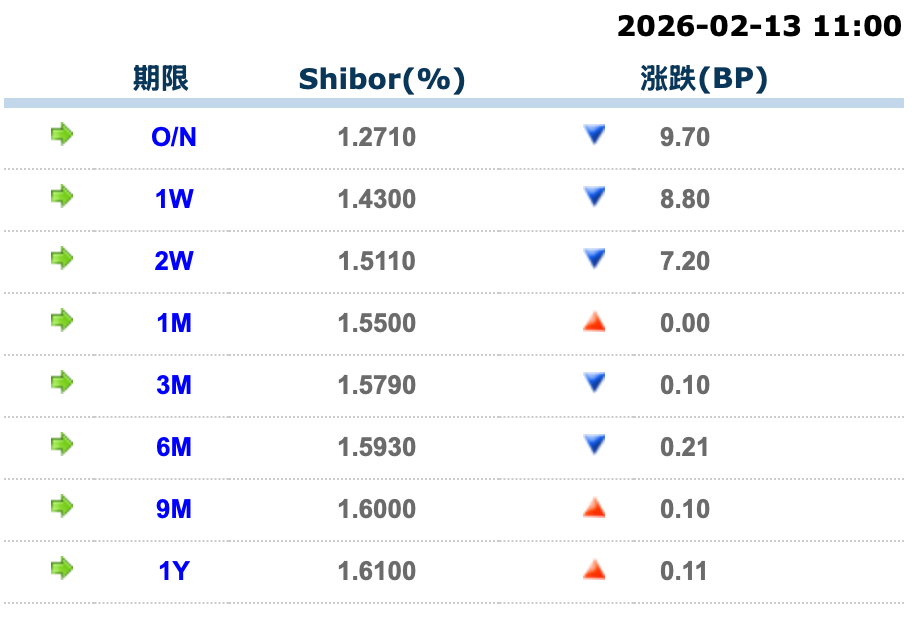
上海银行间同业拆放利率(Shibor)短期品种下行,隔夜品种利率跌至1.3%下方。具体来看,隔夜Shibo下跌9.70BP,报1.2710%;7天Shibor下跌 8.80BP,报1.4300%;14天Shibor下跌7.20BP,报1.5110%。 上海银行间同业拆放利率(2月13日) 转自:新华财经 新华财经北京2月13日电(幸骊莎)人民银行13日以固定利率、数量招标方式开展了1450亿元7天期逆回购操作,中标利率为1.4%。另外,人民银 行当日开展10000亿元买断式逆回购。当日公开市场有315亿元7天逆回购到期,另有5000亿元买断式逆回购到期,实现净投放6135亿元。 | DR001 | | DR007 | | DR014 | | | --- | --- | --- | --- | --- | --- | | 1.2645% | 9.8BP | 1.4259% | 10.0BP | 1.4949% | 7 9.2BP | | 14111 乙 | 9311 Z | 3691亿 | ▲2003亿 | 1839 Z | ▲661亿 | | 71.7% | 17.2% | 18.7% | ▲ 12.3% | ...

我国系统重要性银行扩容,名单新增1家,分组有调整
2 1 Shi Ji Jing Ji Bao Dao· 2026-02-13 12:01
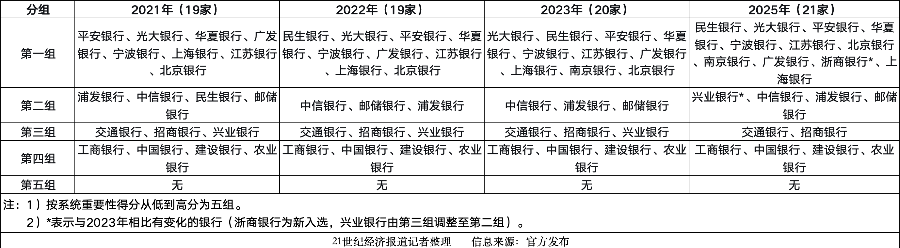
Core Viewpoint - The People's Bank of China and the National Financial Regulatory Administration announced the list of systemically important banks for 2025, identifying 21 banks, an increase of one from the previous assessment, indicating a slight expansion trend in the number of recognized banks [1][4]. Group Structure - The list of systemically important banks has shown a gradual increase over the years, with 19 banks recognized in both 2021 and 2022, 20 in 2023, and 21 in 2025, reflecting a consistent expansion [1][4]. - The fourth group remains stable, consistently comprising the four major banks: Industrial and Commercial Bank of China, Bank of China, China Construction Bank, and Agricultural Bank of China [2][4]. Group Classification - The 21 banks are categorized into five groups based on their systemic importance scores, with the fifth group remaining vacant. The first group increased from 10 to 11 banks, the second group rose from 3 to 4 banks, the third group decreased from 3 to 2 banks, and the fourth group maintained its count at 4 banks [4]. - The first group now includes 11 banks: China Minsheng Bank, China Everbright Bank, Ping An Bank, Huaxia Bank, Ningbo Bank, Jiangsu Bank, Beijing Bank, Nanjing Bank, Guangfa Bank, Zhejiang Commercial Bank, and Shanghai Bank. The second group consists of 4 banks: Industrial Bank, China CITIC Bank, Shanghai Pudong Development Bank, and China Postal Savings Bank. The third group has 2 banks: Bank of Communications and China Merchants Bank. The fourth group includes 4 banks: Industrial and Commercial Bank of China, Bank of China, China Construction Bank, and Agricultural Bank of China [4]. Key Changes - A significant change in this announcement is the inclusion of Zhejiang Commercial Bank in the first group, marking its first entry as a systemically important bank. Additionally, Industrial Bank has been moved from the third group to the second group [4]. Regulatory Framework - The assessment and publication of the list are part of the regulatory authorities' efforts to establish a comprehensive macro-prudential management system and strengthen the supervision of systemically important financial institutions [4][5]. - The People's Bank of China and the National Financial Regulatory Administration will continue to enhance the additional supervision of systemically important banks to promote their safe and sound operation, thereby better serving the high-quality development of the real economy [5].
我国系统重要性银行名单发布,新增浙商银行
证券时报· 2026-02-13 11:31
Core Viewpoint - The People's Bank of China and the National Financial Regulatory Administration released the list of systemically important banks for 2025, identifying 21 domestic banks, including 6 state-owned commercial banks, 10 joint-stock commercial banks, and 5 city commercial banks [1]. Group 1: List of Systemically Important Banks - The 2025 list includes Zhejiang Commercial Bank, which is newly added and placed in the first group, making it the 10th joint-stock commercial bank on the list [2]. - The list is categorized into five groups based on systemic importance scores, with the first group containing 11 banks, the second group 4 banks, the third group 2 banks, the fourth group 4 banks, and no banks in the fifth group [3]. Group 2: Regulatory Framework - Systemically important banks are characterized by their large scale, high complexity, and strong interconnections with the financial system, which significantly impacts economic and financial operations [4]. - The regulatory framework requires additional capital requirements for banks in different groups, ranging from 0.25% for the first group to 1.5% for the fourth group, with specific leverage ratio requirements also in place [4]. - The regulatory bodies aim to enhance macro-prudential management and micro-prudential supervision to ensure the safe and sound operation of systemically important banks, thereby supporting the high-quality development of the real economy [4].



乐购新春享贴息,发票有奖惠民生,江苏银行助力节庆消费更划算!
Zhong Jin Zai Xian· 2026-02-13 11:30
Core Viewpoint - The implementation of the fiscal interest subsidy policy for personal consumption loans aims to stimulate consumer spending and reduce the cost of consumer credit, benefiting citizens directly through lower interest rates and additional incentives [1][3]. Group 1: Fiscal Interest Subsidy Policy - The fiscal interest subsidy policy for personal consumption loans was officially launched in 2026, allowing eligible borrowers to enjoy an annual interest subsidy of 1%, capped at 50% of the loan contract interest rate, with a maximum subsidy limit of 3,000 yuan per individual at one financial institution [1]. - The policy is designed to alleviate the interest burden on citizens, enabling them to experience tangible benefits in everyday consumption scenarios [1]. Group 2: Financial Institutions' Response - Multiple financial institutions have quickly responded to the fiscal interest subsidy policy, with Jiangsu Bank being one of the first to implement this service, offering various promotional activities during the Spring Festival consumption peak [3]. - Jiangsu Bank has introduced a "Happy Shopping Spring" package, which includes consumer installment discounts, daily payment reductions, and incentives for auto loans, allowing consumers to combine these benefits with the interest subsidy [3]. Group 3: Consumer Experience and Technology Integration - Jiangsu Bank's app now features personal consumption loan and credit card bill installment interest subsidy services, enabling consumers to easily sign up online and benefit from the policy [5]. - The bank's system automatically identifies and calculates the subsidy amount during transactions, directly deducting the interest during repayment, while also allowing for manual review of transactions that cannot be automatically matched [5]. - Consumers can track subsidy details and review progress through the Jiangsu Bank app, ensuring transparency and accessibility of the benefits [5].


最新21家系统重要性银行名单出炉
Di Yi Cai Jing Zi Xun· 2026-02-13 10:53
Core Viewpoint - The People's Bank of China and the National Financial Regulatory Administration have published the list of systemically important banks for 2025, identifying 21 domestic banks, with Zheshang Bank newly included, indicating an increase in its systemic importance [3][4]. Group 1: Systemically Important Banks - The 2025 list includes 21 systemically important banks: 6 state-owned commercial banks, 10 joint-stock commercial banks, and 5 city commercial banks [3]. - Zheshang Bank's inclusion in the list signifies its rising importance within the banking system [3]. - The banks are categorized into five groups based on their systemic importance scores, with the first group containing 11 banks, including Zheshang Bank, and the fifth group having no banks [3]. Group 2: Regulatory Framework - Systemically important banks are characterized by their large scale and significant role in the financial system, leading to stricter regulatory measures to ensure stability and prevent financial risks [4]. - The People's Bank of China and the National Financial Regulatory Administration will continue to enhance the additional regulatory framework for systemically important banks to promote their safe and sound operation [4].

我国系统重要性银行名单发布
Shang Hai Zheng Quan Bao· 2026-02-13 10:50
来源:中国人民银行 (文章来源:上海证券报) 为构建覆盖全面的宏观审慎管理体系,强化系统重要性金融机构监管,根据《系统重要性银行评估办 法》,近期中国人民银行、国家金融监督管理总局开展了2025年度我国系统重要性银行评估,认定21家 国内系统重要性银行,其中国有商业银行6家,股份制商业银行10家,城市商业银行5家。按系统重要性 得分从低到高分为五组:第一组11家,包括中国民生银行、中国光大银行、平安银行、华夏银行、宁波 银行、江苏银行、北京银行、南京银行、广发银行、浙商银行、上海银行;第二组4家,包括兴业银 行、中信银行、浦发银行、中国邮政储蓄银行;第三组2家,包括交通银行、招商银行;第四组4家,包 括中国工商银行、中国银行、中国建设银行、中国农业银行;第五组暂无银行进入。 下一步,中国人民银行、国家金融监督管理总局将按照《系统重要性银行附加监管规定(试行)》要 求,发挥好宏观审慎管理与微观审慎监管合力,持续夯实系统重要性银行附加监管,促进系统重要性银 行安全稳健经营和健康发展,更好服务实体经济高质量发展。 中国人民银行国家金融监督管理总局发布我国系统重要性银行名单 ...
4Q25货币政策执行报告点评:新发利率降幅延续收窄,结构性降息或是下阶段常态
ZHONGTAI SECURITIES· 2026-02-13 10:45
Investment Rating - The industry investment rating is "Overweight" (maintained) [2] Core Insights - The report highlights that the "Five Major Articles" loans have surpassed 100 trillion yuan, accounting for nearly 40% of total loans, and continue to maintain a high growth rate, indicating a significant focus on this area for future credit [5][11] - New loan interest rates have seen a significant narrowing in year-on-year declines, with expectations of continued monetary easing, although comprehensive interest rate cuts will be approached with caution, suggesting that structural interest rate cuts may become the norm [5][18] Summary by Sections Section 1: "Five Major Articles" Credit Scale - The total balance of "Five Major Articles" loans reached 108.8 trillion yuan by the end of 2025, with a year-on-year growth of 12.9%, representing 39% of the total loan scale [11] - Traditional industries still dominate corporate loans, but their share is gradually declining, with real estate and infrastructure loans together accounting for over 50% of corporate loans as of Q4 2025 [11] - Technology loans are experiencing high growth, with small and medium-sized technology enterprises' loans at 3.6 trillion yuan, representing 1.9% of corporate loans, and high-tech enterprise loans growing at 19.1% year-on-year [11] - Green loans also show high growth, with a balance of 44.8 trillion yuan, a year-on-year increase of 20.2%, making up 24% of corporate loans [11] Section 2: New Loan Interest Rates - As of December 2025, the new loan interest rates for general loans, personal housing loans, and corporate loans were 3.55%, 3.06%, and 3.10%, respectively, with year-on-year declines of 27 basis points, 3 basis points, and 24 basis points [16] - The report indicates that the decline in new loan interest rates has narrowed significantly, with personal housing loan rates remaining stable for three consecutive quarters [16][18] Section 3: Investment Recommendations - The report suggests a shift in bank stocks from "pro-cyclical" to "weak-cyclical," emphasizing the stability and sustainability of the sector [20] - Two main investment lines are recommended: focusing on city and rural commercial banks with regional advantages and strong certainty, and large banks with high dividend yields [20]
人民银行、国家金融监管总局发布我国系统重要性银行名单,共计21家
Bei Jing Shang Bao· 2026-02-13 10:39
下一步,中国人民银行、国家金融监督管理总局将按照《系统重要性银行附加监管规定(试行)》要 求,发挥好宏观审慎管理与微观审慎监管合力,持续夯实系统重要性银行附加监管,促进系统重要性银 行安全稳健经营和健康发展,更好服务实体经济高质量发展。 北京商报讯(记者 廖蒙)2月13日,据中国人民银行官网,为构建覆盖全面的宏观审慎管理体系,强化 系统重要性金融机构监管,根据《系统重要性银行评估办法》,近期中国人民银行、国家金融监督管理 总局开展了2025年度我国系统重要性银行评估,认定21家国内系统重要性银行,其中国有商业银行6 家,股份制商业银行10家,城市商业银行5家。 按系统重要性得分从低到高分为五组:第一组11家,包括中国民生银行、中国光大银行、平安银行、华 夏银行、宁波银行、江苏银行、北京银行、南京银行、广发银行、浙商银行、上海银行;第二组4家, 包括兴业银行、中信银行、浦发银行、中国邮政储蓄银行;第三组2家,包括交通银行、招商银行;第 四组4家,包括中国工商银行、中国银行、中国建设银行、中国农业银行;第五组暂无银行进入。 ...
单人成军:江苏银行构建AI时代 OPC综合金融服务方案
Jin Rong Jie· 2026-02-13 10:26
Core Insights - The rise of One-Person Companies (OPC) is reshaping organizational structures, with Jiangsu Bank adapting its financial services to support this new model in the digital economy [1][2] Group 1: OPC Ecosystem and Financial Service Transformation - The rapid development of digital platforms and AI tools has led to an increase in knowledge-based, technical, and creative individuals operating as OPCs, characterized by light assets, no collateral, high-frequency transactions, and quick turnover [2][3] - Traditional financial services focus on asset-heavy, low-frequency lending models, which do not meet the needs of OPCs for small, high-frequency, and light-asset financing [2][3] Group 2: Comprehensive Financial Services for OPCs - Jiangsu Bank's OPC financial service model shifts from merely providing loans to offering comprehensive support for OPCs, integrating account management, payment settlement, financial management, and financing support into a full-cycle support system [2][3] - The bank's approach includes a digital operating platform, allowing for seamless service from account opening to operational data management, transforming the bank into a digital financial partner for OPCs [2][3] Group 3: Case Studies of Successful OPCs - The "Nanjing Dream" and "Suzhou Dufeng" are examples of successful OPCs that have benefited from Jiangsu Bank's comprehensive financial services, enabling them to focus on their core business activities while streamlining financial operations [4][5] - Jiangsu Bank has developed specialized financing products for these OPCs, utilizing industry trends and core technology as credit assessment criteria, allowing for rapid loan approvals and flexible repayment options [3][5]