Vivo

Search documents
Festive boom, GST relief help Samsung clock record sales of high-end smartphones, large-screen TVs in India
The Economic Times· 2025-10-07 13:23
Group 1 - Samsung reported record sales growth in premium smartphones during the Navratri-Dussehra festive period, with sales of premium smartphones priced above Rs 30,000 increasing 1.4 times compared to the same period last year [1][6] - The company also experienced a two-fold increase in sales of premium televisions (55 inches and above) during the same festive period, attributed to deals, extended warranties, GST rate cuts, and the rising adoption of AI televisions in India [1][6] - Samsung captured an 18% market share in the overall Indian smartphone market during the first wave of the festive season, closely followed by Apple and Vivo [5][6] Group 2 - The first wave of India's festive season from September 22nd to October 2nd, 2025, saw a 5-6% increase in smartphone sales in units compared to the first wave of the festive season in 2024, with value sales increasing by 11-12% [5][6] - The government reduced GST rates on various consumer products, including large screen televisions, which positively impacted consumer sentiment and sales [2][4][6] - The second wave of festive season sales is expected to commence soon, concluding with Dhanteras and Diwali [6]



面板大厂三季度出货量大幅回升
Ju Chao Zi Xun· 2025-10-03 09:02
Core Insights - The OLED display market is experiencing significant growth driven by increased shipments of flexible OLED panels from Samsung Display, particularly due to the launch of Apple's iPhone 17 and Samsung's Galaxy S25 series [2] - LG Display's panel shipments surged from 10.8 million units in Q2 to 20 million units in Q3, effectively doubling its output [2] - Chinese panel manufacturers also reported growth in Q3, with BOE's shipments increasing by approximately 5.4 million units and Visionox's shipments rising by about 6.7 million units [2] Company Highlights - LG Display is a key supplier for Apple's smartphones, accounting for about 60% of the panels used in the iPhone 17 Pro Max [2] - BOE's main clients include Chinese smartphone brands such as OPPO and Apple, while Visionox primarily supplies panels to brands like Honor, Xiaomi, and Vivo [2] Market Outlook - UBI Research's Vice President, Han Chang-wook, predicts a significant recovery in shipments from Korean panel manufacturers since Q3, with a key challenge being the stability of supply for major client Apple [2]




百度昆仑芯交流
Xin Lang Cai Jing· 2025-09-26 13:24
Group 1: Baidu and Kunlun Chip - Baidu holds a 59.45% stake in Kunlun Chip, which recently won a large-scale procurement project from China Mobile, achieving first place in three bidding packages with market shares of 70%, 70%, and 100% respectively [1] - Kunlun Chip has also secured significant market shares from major clients such as Tencent, Oppo, and Vivo, as well as energy companies like Southern Power Grid and State Grid [1] Group 2: Baidu's Online Marketing and User Engagement - As of June 2025, Baidu's app has 735 million monthly active users, reflecting a 5% year-on-year growth, comparable to domestic Douyin users [1] - Baidu's search services are undergoing AI-driven enhancements, which are expected to improve advertising efficiency [1] Group 3: Baidu's Intelligent Cloud Services - By July 2025, Baidu's intelligent cloud has maintained the top position in China's AI public cloud market for six consecutive years, leading in 48 bidding projects across various sectors including finance, energy, and government [1] Group 4: Baidu's Autonomous Driving Orders - In Q2 2025, Baidu's autonomous driving service, "Luobo Kuaipao," saw order growth exceeding 2.2 million, marking a 148% increase year-on-year, with operations in 16 cities and total orders surpassing 14 million, making it the global leader [1] Group 5: iQIYI's Revenue Sources and Policy Environment - iQIYI's revenue is derived from three main segments: membership services, online advertising, and content distribution [2] - In August 2025, the National Radio and Television Administration issued 21 policies viewed as significant benefits for the industry, similar to the 2023 relaxation of gaming license regulations, favoring companies that operate platforms and create content [2] Group 6: Baidu's Market Valuation - Baidu currently has $30 billion in cash, with an expected net profit of $20 billion in 2026, leading to an estimated valuation of $360 billion based on an 18x PE ratio [2] - Kunlun Star is projected to reach $5.5 billion in revenue by 2025, with a 40x PS ratio valuation of $220 billion, translating to Baidu's 60% stake worth $132 billion [2] - The total estimated valuation approaches $500 billion, while Baidu's latest closing price is below $330 billion, indicating a potential upside of 50% [2]

中国锂电池制造商德赛集团加码越南布局,拟在北宁省增资2500万美元
Shang Wu Bu Wang Zhan· 2025-09-17 17:31
德赛集团成立于1983年,年营业收入超过500 亿元人民币(约合70亿美元),是中国锂电池制造和 新能源解决方案的重要企业,也是苹果、华为、小米、OPPO、Vivo、谷歌、Meta等客户的核心合作伙 伴。 (原标题:中国锂电池制造商德赛集团加码越南布局,拟在北宁省增资2500万美元) ...
苹果iPhone在华销量大幅下滑,17系列能否扭转颓势?
美股IPO· 2025-09-17 12:45
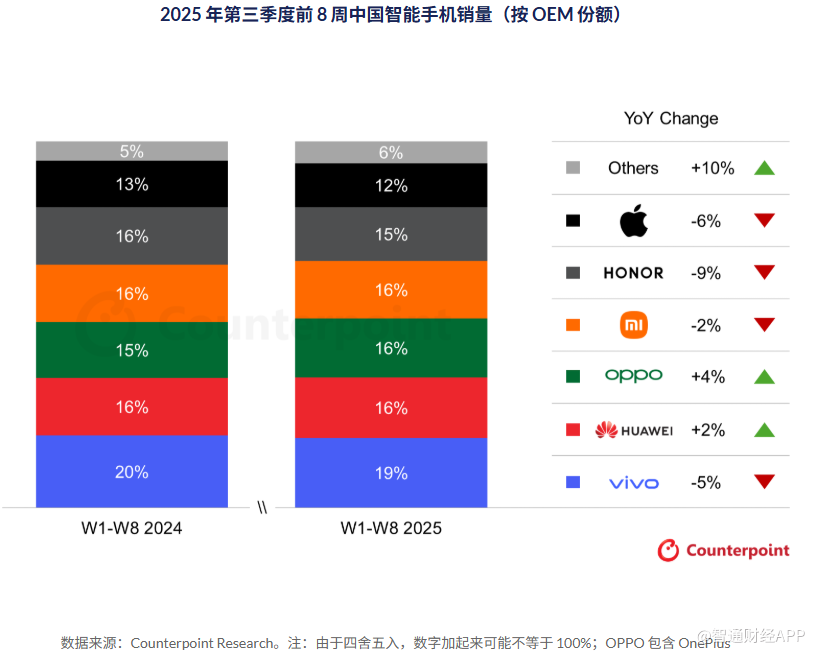
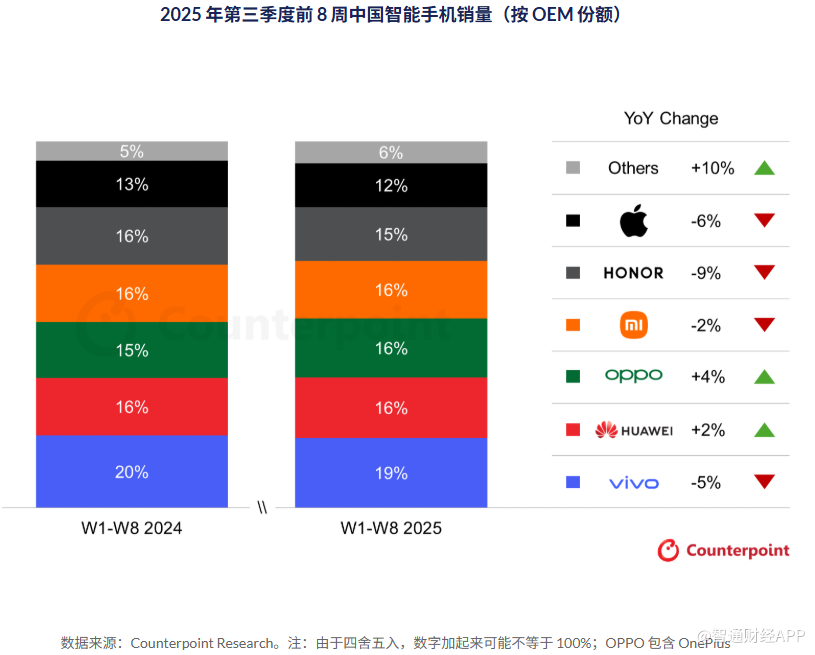
Core Insights - Apple's smartphone sales in China declined by 6% year-on-year in the first eight weeks of Q3, indicating ongoing challenges in regaining market leadership despite a recovery in Q2 [1][4][5] - Currently, Apple holds a 12% market share in China, ranking sixth, while competitors like Xiaomi, OPPO, and Huawei each hold 16%, and Vivo leads with 19% [4][5] - The upcoming iPhone 17, seen as a significant upgrade, is set to launch globally, prompting competitors to adjust their strategies, such as Xiaomi moving up the release of its flagship phone [4][5] Market Performance - Apple's sales recovery in Q2 was partially attributed to government subsidies, but the latest data shows that the company still needs to catch up with competitors [4][5] - Tim Cook noted that the customer base for iPhones in Greater China reached a record in Q2, which has positively impacted sales of other Apple products [5] Competitive Landscape - The competition in the Chinese smartphone market remains intense, with rivals adjusting their strategies in response to Apple's new product launches [5] - Xiaomi's CEO announced an earlier release of their flagship phone to compete directly with Apple's offerings, highlighting the competitive dynamics in the market [5] Consumer Preferences - AI features have not yet become a significant sales driver for Apple in China, with consumers primarily focusing on practical factors like battery life and cost-effectiveness when making purchasing decisions [6]

苹果iPhone在华销量大幅下滑,17系列能否扭转颓势?
Hua Er Jie Jian Wen· 2025-09-17 12:04
Core Insights - Apple's smartphone sales in China have declined by 6% year-on-year in the weeks leading up to the iPhone 17 launch, indicating intense competition in the world's largest smartphone market [1][2] - Despite a recovery in sales during the second quarter, Apple holds only a 12% market share, ranking sixth, while competitors like Xiaomi, OPPO, and Huawei each hold 16%, and Vivo leads with 19% [2] - The upcoming iPhone 17 is considered a significant upgrade, featuring a new design and enhanced camera system, prompting competitors to adjust their strategies, such as Xiaomi moving up the launch date of its flagship phone [1][2] Market Performance - In the first eight weeks of Q3, Apple's sales in China fell by 6%, contrasting with the typical performance before a new product launch [1] - Tim Cook noted that the customer base for iPhones in the Greater China region reached a record in Q2, which helped boost sales of other Apple products [2] Competitive Landscape - Xiaomi's CEO announced an earlier launch for their next flagship phone to compete directly with Apple's new offerings, highlighting the fierce competition in the Chinese smartphone market [2] - AI features have not yet become a significant sales driver for Apple, with consumers primarily focusing on practical factors like battery life and cost-effectiveness when making purchasing decisions [3]
iPhone 17发布前夕 苹果在华手机销量同比下降6%
智通财经网· 2025-09-17 12:01
智通财经APP获悉,根据Counterpoint Research的数据,在iPhone 17发布前的几周里,苹果(AAPL.US)在中国的智能 手机销量同比下降了6%,这一数字比以往新产品发布前的降幅更大。 部分Seeking Alpha分析师表示,苹果最新款iPhone 17没有实质意义的创新,仅提供了些微的更新,并不具备引发大 规模换机热潮的催化剂。 截至发稿,苹果盘前跌0.11%。 数据显示,第三季度前八周,中国智能手机销量同比下降2%。与此同时,华为持续的产品组合拓展助力其销量保持 了正增长态势。 这家美国科技巨头并非唯一一家面临夏季低迷的公司。其竞争对手小米(01810)、Vivo和荣耀在第三季度前八周也出 现了销量下滑的情况。 Counterpoint预计,中国智能手机市场在整个第三季度将出现小幅负增长,2025年全年将持平。 ...
iPhone 17发布前夕 苹果(AAPL.US)在华手机销量同比下降6%
Zhi Tong Cai Jing· 2025-09-17 11:59
Group 1 - Apple's smartphone sales in China declined by 6% year-on-year in the weeks leading up to the iPhone 17 launch, marking a larger drop than previous product launches [1] - Competitors such as Xiaomi, Vivo, and Honor also experienced sales declines in the same period [1] - Overall smartphone sales in China decreased by 2% year-on-year during the first eight weeks of the third quarter [3] Group 2 - Huawei's product portfolio expansion has allowed it to maintain positive sales growth [3] - Counterpoint Research forecasts a slight negative growth for the Chinese smartphone market in the entire third quarter, with expectations of flat growth for the year 2025 [3] - Analysts from Seeking Alpha suggest that the iPhone 17 lacks significant innovation and may not trigger a major upgrade cycle [3]
Apple Inc: From Innovation Pioneer to Technological Stagnation
Medium· 2025-09-15 12:56
Core Viewpoint - Apple is facing criticism for perceived stagnation in innovation, with notable figures like Meta CEO Mark Zuckerberg highlighting the company's reliance on past successes rather than introducing significant new technologies [1][2][5]. Group 1: Criticism of Innovation - Zuckerberg criticized Apple for not making breakthroughs since the introduction of the iPhone, claiming the company is "resting on its laurels" and imposing high App Store commissions [2][5]. - The launch of the iPhone 17 on September 9, 2025, led to a 3.2% drop in Apple's stock, erasing approximately US$100 billion in market capitalization due to minor updates and lack of AI advancements [5][6]. - iPhone market share in the U.S. decreased from 56% to 49%, while Samsung's share increased from 23% to 31%, indicating a shift in consumer preference towards competitors [6]. Group 2: Apple's Achievements and Market Position - Despite criticism, the iPhone 17 introduced features like a scratch-resistant ceramic screen and a larger battery, with third-quarter 2025 sales up 13% year-on-year [8][10]. - Apple has sold over 3 billion iPhones since 2007, and its ecosystem remains superior in integration, providing a seamless user experience [8][10]. - The company is investing in new markets, such as establishing the Apple Developer Academy in Indonesia with a US$160 million investment, indicating a commitment to local technology ecosystems [9]. Group 3: Financial Strength and Market Strategy - Apple's market valuation remains around US$3.48 trillion, making it one of the largest companies globally, despite the stock drop post-iPhone 17 launch [10]. - The company has maintained good relations with the government through a US$100 billion investment in the U.S., demonstrating resilience against external pressures like tariffs [10]. - Apple's focus on privacy and a closed ecosystem, while limiting AI innovation speed, is also seen as a strength in an era of data privacy concerns [11]. Group 4: Future Outlook - Allegations of stagnation have impacted investor confidence, but Apple has opportunities for recovery with plans for a foldable iPhone and a 20th-anniversary edition in 2027 [14]. - The company must balance its "quality over speed" philosophy with the need for radical innovation to meet high market expectations [15].
Q2全球前六大手机品牌产量排名出炉
WitsView睿智显示· 2025-09-14 02:49
Core Viewpoint - TrendForce's latest survey indicates that global smartphone production is expected to reach 300 million units in Q2 2025, driven by seasonal demand and recovery in production from brands like Oppo and Transsion, reflecting a quarter-on-quarter increase of approximately 4% and a year-on-year increase of 4.8% [2]. Group 1: Smartphone Production Overview - In Q2 2025, the top six smartphone brands maintained a combined market share of around 80% [5]. - Samsung, the leading manufacturer, produced approximately 58 million units, experiencing a quarter-on-quarter decrease of 5% [3]. - Apple, in second place, produced 46 million units, down 9% quarter-on-quarter, but up 4% year-on-year, driven by the new iPhone 16e [5]. - Xiaomi ranked third with a production of 42 million units, showing a 1% increase quarter-on-quarter, supported by expansion into emerging markets [3]. - Oppo's production rose significantly by 35% quarter-on-quarter to nearly 37 million units, as inventory adjustments concluded [5]. - Transsion produced over 27 million units, marking a 33% increase quarter-on-quarter and a year-on-year growth of 15.7% [6]. - Vivo's production reached 26 million units, up 8% quarter-on-quarter, benefiting from overseas market contributions and China's subsidy policies [6]. Group 2: Market Dynamics and Trends - The Chinese smartphone subsidy policy temporarily boosted sales of mid-range products and helped reduce inventory, but its overall impact on annual sales is expected to be limited due to constraints on subsidy amounts and product coverage [2]. - The second half of the year is anticipated to see traditional peak season and e-commerce promotions, which will help maintain a quarterly growth pattern for smartphone production throughout the year [2].