
邮储银行

Search documents
【微头条】财政部等四部门发布关于优化实施设备更新贷款财政贴息政策的通知
Xin Lang Cai Jing· 2026-01-20 13:39
Core Viewpoint - The Ministry of Finance and other departments have issued a notice to optimize the implementation of the equipment renewal loan interest subsidy policy, aimed at supporting enterprises in equipment upgrades and technological transformation, reducing financing costs, and promoting effective investment [1][6]. Group 1: Support Scope - The central government will provide a 1.5% interest subsidy on the principal of fixed asset loans for equipment renewal projects, applicable for a maximum of two years from the loan issuance date [1][6]. - The policy will include new technology innovation loans issued by banks starting in 2026, with the implementation period set until December 31, 2026, subject to possible extension [1][6]. Group 2: Expanded Support Areas - The policy expands support to various sectors including construction, municipal services, energy equipment, aviation materials, electronic information, safety production, agricultural facilities, fishing vessels, cold chain facilities, grain and oil processing, waste recycling, small hydropower, commercial facilities, artificial intelligence, and elderly care [2][7]. Group 3: Participating Banks - A total of 26 banks are designated to handle the interest-subsidized loans, including major state-owned banks and several joint-stock commercial banks [2][7]. Group 4: Interest Subsidy Process Optimization - The subsidy funds will be allocated through a "pre-allocation + settlement" method, with provincial banks required to submit annual subsidy fund requests by January 31, 2026 [3][8]. - Provincial finance departments must respond to these requests within 10 working days, and a joint review mechanism will be established to streamline the approval process [3][8]. Group 5: Fund Settlement and Clearing - From 2027, provincial banks must submit annual settlement requests for the previous year's subsidy funds by January 31, with finance departments providing feedback by February 20 [4][9]. - By January 31, 2029, provincial banks will submit clearing requests for subsidy funds, with a one-month response time expected from finance departments [4][9]. Group 6: Implementation and Supervision - The Ministry of Finance, National Development and Reform Commission, and other regulatory bodies will oversee the implementation of the policy, ensuring proper auditing and monitoring of fund usage [5][10]. - Banks are required to maintain strict loan monitoring to prevent misuse of funds, and any violations will lead to penalties, including the recovery of subsidy funds [5][10]. Group 7: Reporting Requirements - Banks must establish reporting systems to submit monthly policy execution reports to the Ministry of Finance, including details on loan issuance and subsidy usage [11].






涉信贷业务内控管理不到位等,邮储银行泉州市分行被罚280万元
Bei Jing Shang Bao· 2026-01-20 11:05
Core Viewpoint - The Quanzhou Financial Regulatory Bureau has imposed a total fine of 2.8 million yuan on Postal Savings Bank's Quanzhou branch due to inadequate internal control in credit business and negligence in pre-loan investigations and post-loan management [1] Group 1: Regulatory Actions - The Quanzhou branch of Postal Savings Bank was fined 2.8 million yuan for violations related to credit business management [1] - Several individuals, including Cai Xiaohua, Su Liansheng, Li Yan, Wu Chao, Guo Zongyuan, Zhuang Gengquan, Wang Jiaping, Fu Guolong, and Su Weimin, received warnings for their roles in the violations [1] - Wang Jiangang and Wu Zhenyue were given warnings and fined 50,000 yuan each for their involvement [1]
消费贷贴息加码:增信用卡分期、城商行等机构
Xin Lang Cai Jing· 2026-01-20 10:41
Core Viewpoint - The Chinese government has extended the personal consumption loan interest subsidy policy until the end of 2026, including credit card installment payments in the subsidy scope, to stimulate domestic consumption and support economic growth [3][12][13]. Policy Extension and Scope Expansion - The personal consumption loan interest subsidy policy's deadline has been extended from August 31, 2026, to December 31, 2026 [4][14]. - Credit card installment payments are now included in the subsidy, with an annual interest subsidy rate of 1% [5][14]. - The policy aims to enhance consumer spending and support the healthy development of credit card businesses [5][14]. Increase in Eligible Institutions and Scenarios - The policy has expanded the range of eligible institutions to include city commercial banks rated 3A and above, rural cooperative financial institutions, foreign banks, consumer finance companies, and auto finance companies [6][16]. - The central and provincial finances will cover 90% and 10% of the subsidy funds, respectively, maintaining the previous funding ratio [6][16]. - The policy encourages innovation in consumer credit products and aims to create more financial support scenarios for consumption, enhancing the coverage and activity of service consumption [8][18]. Impact on Consumer Behavior and Market Dynamics - The subsidy policy is expected to significantly lower the actual costs for consumers, thereby boosting their willingness to spend [5][10]. - The policy's implementation has already led to a substantial increase in consumer loan applications and disbursements, indicating strong market demand [17]. - The removal of previous limits on subsidy amounts is anticipated to provide consumers with greater flexibility and choice, potentially leading to increased consumption [19][20]. Recommendations for Implementation - To optimize the implementation of the subsidy policy, it is suggested to enhance the precision of policy design, improve execution efficiency, and ensure better coordination among related policies [20]. - There is a call for dynamic adjustments to the supported industries and consumption areas based on local consumption trends and industrial planning [20].

个人消费贷款财政贴息政策实施期限将延长至2026年底
Sou Hu Cai Jing· 2026-01-20 09:03
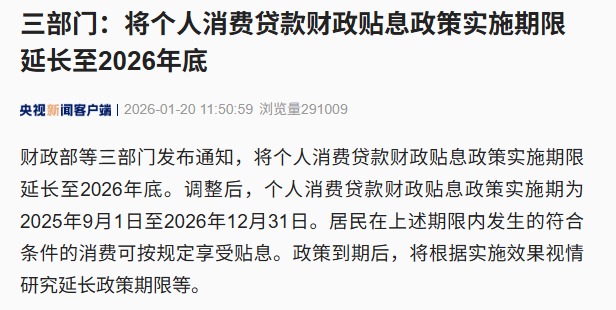
Group 1 - The core point of the news is the extension of the personal consumption loan interest subsidy policy until the end of 2026, aimed at boosting consumer spending and reducing the cost of personal consumption credit [1][4] - The policy will now be effective from September 1, 2025, to December 31, 2026, allowing residents to enjoy interest subsidies on eligible consumption during this period [4][5] - The subsidy rate for credit card installment payments has been set at 1 percentage point [5] Group 2 - The policy has removed the previous cap of 500 yuan on single transaction interest subsidies and the cumulative cap of 1,000 yuan for each borrower at one financial institution [6] - The policy will include more financial institutions, expanding the coverage to include city commercial banks, rural cooperative financial institutions, foreign banks, and consumer finance companies [6][7] - The central and provincial finances will bear 90% and 10% of the subsidy funds, respectively [6] Group 3 - The funding allocation will follow a "pre-allocation + settlement" method, with financial institutions required to submit their subsidy fund needs by January 31, 2026 [6][7] - The Ministry of Finance will conduct joint inspections to ensure compliance with the policy and will hold institutions accountable for any violations [7][8] - Financial institutions must report their policy execution status monthly, including loan issuance and subsidy amounts [7][8]
财政部连发多份重要文件,事关贷款贴息、民间投资贷款担保等 一揽子政策全文公布
Sou Hu Cai Jing· 2026-01-20 09:03
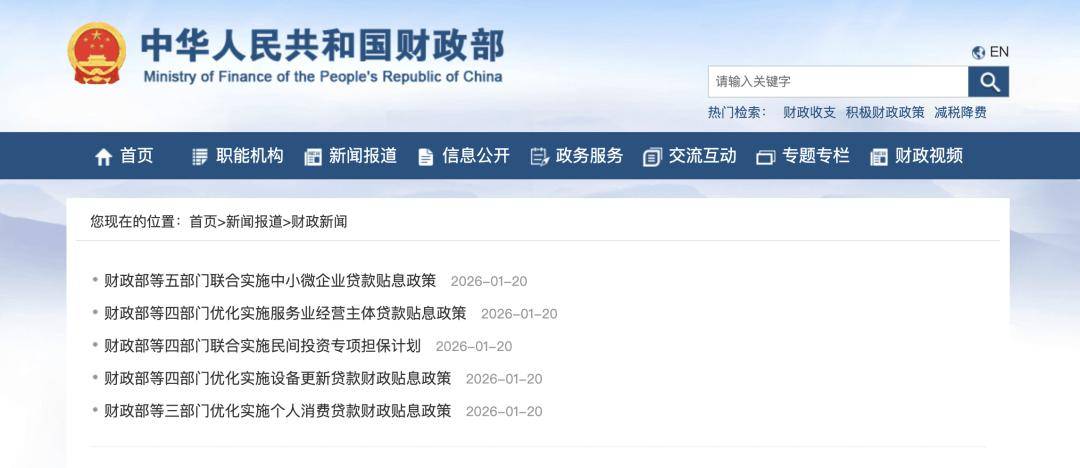
Group 1 - The core viewpoint of the news is the implementation of a financial subsidy policy for equipment renewal loans to support businesses in reducing financing costs and promoting effective investment [3][4][5] - The policy includes a 1.5% interest subsidy on fixed asset loans for equipment renewal projects, applicable for a maximum of two years, and is effective until December 31, 2026 [3][4] - The scope of support has been expanded to include various sectors such as construction, aviation, digital technology, and green energy, emphasizing high-end, intelligent, and digital equipment updates [4][6] Group 2 - A total of 26 banks are designated as eligible for processing the interest subsidy loans, including major national banks and several regional banks [4][5] - The subsidy process has been optimized to include a "pre-allocation + settlement" method, streamlining the application and approval process for banks and provincial financial departments [5][6] - The policy aims to enhance the experience of businesses by ensuring timely communication regarding subsidy payments through modern technology [6][7] Group 3 - The policy for small and micro enterprises includes a 1.5% interest subsidy on fixed asset loans, with a maximum loan amount of 50 million yuan, effective from January 1, 2026 [8][9] - The targeted sectors for this subsidy include new energy vehicles, medical equipment, and various service industries, aiming to stimulate investment and production [9][10] - The operational mechanism involves a "total-to-total" model for coordination between financial institutions and fiscal departments to ensure efficient processing of subsidy funds [11][12] Group 4 - The service industry loan subsidy policy has been extended until December 31, 2026, with an increased maximum loan amount of 10 million yuan and a 1% interest subsidy for one year [16][17] - New sectors such as digital, green, and retail have been added to the support scope, enhancing the policy's relevance to current economic trends [17][18] - The funding allocation process has been refined to improve efficiency and reduce redundancy in the approval process [18][19] Group 5 - A special guarantee plan for private investment has been introduced with a total quota of 500 billion yuan over two years, aimed at supporting small and micro enterprises [22][24] - The plan includes risk-sharing mechanisms where banks bear at least 20% of the loan risk, while the government guarantee fund covers up to 80% [24][25] - The initiative encourages innovative financing models and aims to enhance the capital strength of the government guarantee fund to support private investments effectively [26][27]




国有大型银行板块1月20日涨0.78%,中国银行领涨,主力资金净流入7.21亿元
Zheng Xing Xing Ye Ri Bao· 2026-01-20 08:56
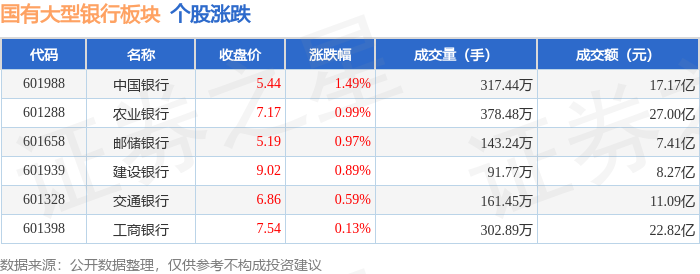
Group 1 - The core viewpoint of the news is that the state-owned large bank sector experienced a rise of 0.78% on January 20, with China Bank leading the gains [1] - The Shanghai Composite Index closed at 4113.65, down 0.01%, while the Shenzhen Component Index closed at 14155.63, down 0.97% [1] - The trading performance of individual stocks in the state-owned large bank sector showed varied results, with China Bank closing at 5.44, up 1.49%, and Agricultural Bank at 7.17, up 0.99% [1] Group 2 - The net inflow of main funds into the state-owned large bank sector was 721 million yuan, while retail investors saw a net outflow of 177 million yuan [1] - The detailed fund flow for individual banks indicated that Agricultural Bank had a net inflow of 210 million yuan from main funds, while it experienced a net outflow of 140 million yuan from speculative funds [2] - Industrial and Commercial Bank had a net inflow of 181 million yuan from main funds, but a significant net outflow of 254 million yuan from speculative funds [2]
财政部:实施中小微企业贷款贴息政策,延长个人消费贷款财政贴息政策实施期限
Sou Hu Cai Jing· 2026-01-20 07:48
Group 1: Small and Micro Enterprises Loan Interest Subsidy Policy - The policy provides a 1.5% annual interest subsidy for eligible small and micro private enterprises' fixed asset loans and new policy financial tools, with a maximum subsidy loan limit of 50 million yuan per enterprise [1][3][9] - The policy is applicable to loans issued from January 1, 2026, and is initially set to last for one year, with the possibility of extension based on future evaluations [1][3] - The focus is on key industries such as new energy vehicles, industrial mother machines, pharmaceuticals, artificial intelligence, and other emerging sectors [3][9] Group 2: Personal Consumption Loan Interest Subsidy Policy - The implementation period for the personal consumption loan interest subsidy policy has been extended to December 31, 2026, allowing residents to enjoy subsidies for eligible consumption during this period [5][15] - The policy now includes credit card installment payments with an annual subsidy rate of 1%, and removes previous restrictions on consumption fields [5][16] - The maximum annual subsidy per individual remains capped at 3,000 yuan, while previous limits on single transaction subsidies have been removed [5][16] Group 3: Private Investment Special Guarantee Plan - The plan has a total quota of 500 billion yuan, to be implemented over two years, aimed at supporting small and micro enterprises in various sectors including technology upgrades and service industry enhancements [2][7][22] - The guarantee fee for private enterprises is capped at 1%, with the government financing guarantee fund reducing re-guarantee fees by half [2][23] - The plan allows for a compensation rate increase from 4% to 5% for government financing guarantees, enhancing risk tolerance for medium to long-term loans [7][24]
财政部连发5个重要文件,事关消费贷、民间投资等
Sou Hu Cai Jing· 2026-01-20 07:14
Group 1 - The Ministry of Finance and other departments have released five documents related to consumer loans and private investment, aiming to stimulate consumption and expand domestic demand [1] - The loan interest subsidy policy for service industry operators has been extended until December 31, 2026, with specific provisions for loans issued between March 16, 2025, and December 31, 2025 [1][2] - The maximum loan amount eligible for interest subsidies has been increased to 10 million yuan, with a subsidy rate of 1% for a maximum period of one year [2][3] Group 2 - The scope of supported sectors has been expanded to include digital, green, and retail consumption areas, in addition to existing categories like catering, health, and tourism [2][3] - A total of 21 national banks and various commercial banks are designated as eligible institutions for processing these loans [3][4] - The funding mechanism for interest subsidies will adopt a "pre-allocation + settlement" approach, ensuring timely disbursement and accountability [4][5] Group 3 - A special guarantee plan for private investment has been introduced with a total quota of 500 billion yuan, to be implemented over two years [8][10] - The plan focuses on supporting small and micro enterprises in various sectors, including technology upgrades and consumption-related activities [10][11] - The risk-sharing ratio has been adjusted, with banks bearing at least 20% of the loan risk and the government guarantee system covering up to 80% [11][12] Group 4 - The equipment update loan interest subsidy policy has been optimized, with a subsidy rate of 1.5% for loans related to equipment updates, applicable for a maximum of two years [15][16] - The supported sectors for equipment updates have been broadened to include high-tech and green industries, enhancing support for modernization [16][17] - A total of 26 banks are authorized to handle these subsidy loans, ensuring a wide reach for the policy [17][18] Group 5 - The personal consumption loan interest subsidy policy has been extended until the end of 2026, with an emphasis on innovative financial products to boost consumer spending [22][23] - The subsidy rate for personal consumption loans has been set at 1%, with the removal of previous caps on subsidy amounts for individual borrowers [23][24] - The funding allocation for these subsidies will also follow a "pre-allocation + settlement" model to enhance efficiency [24][25]
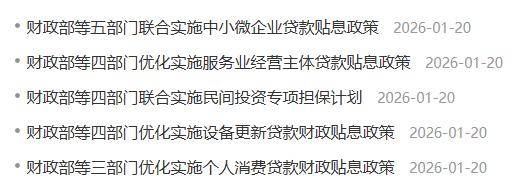
四部门:优化实施设备更新贷款财政贴息政策
Zhong Guo Xin Wen Wang· 2026-01-20 06:23
Core Viewpoint - The joint announcement by four departments aims to optimize the implementation of the equipment renewal loan interest subsidy policy to support enterprises in updating equipment and technology, reduce financing costs, and promote effective investment [1][2]. Group 1: Policy Expansion - The support range is expanded to include fixed asset loans for equipment renewal projects, with a subsidy of 1.5% on the principal for a maximum of two years [2]. - The policy now includes new technology innovation loans issued by banks starting in 2026, which will also receive interest subsidies [2]. - Additional sectors supported include construction, municipal services, energy equipment, aviation materials, and more, focusing on high-end, intelligent, green, and digital equipment updates [3]. Group 2: Implementation and Management - A total of 26 banks are designated as eligible for processing interest-subsidized loans, including major state-owned and commercial banks [3]. - The subsidy process will utilize a "pre-allocation + settlement" method, streamlining the funding request and approval process [4]. - From 2027, annual settlement applications for interest subsidies will be required, with specific deadlines for submission and review [5]. Group 3: Oversight and Compliance - The implementation will be overseen by multiple regulatory bodies, ensuring that banks monitor the use of funds and prevent misuse [6]. - Joint inspections will be conducted to identify any serious violations by enterprises receiving subsidies, with strict penalties for banks involved in collusion [6]. - Banks must establish reporting systems to provide monthly updates on loan issuance and subsidy usage to the relevant authorities [7].
五部门:联合实施中小微企业贷款贴息政策
Zhong Guo Xin Wen Wang· 2026-01-20 05:45
Core Viewpoint - The Chinese government has announced a loan interest subsidy policy aimed at supporting small and micro enterprises, particularly in key industries, to stimulate investment and enhance economic resilience [1][2]. Policy Content - **Eligible Entities**: The policy applies to all small and micro private enterprises involved in key industry chains and their upstream and downstream sectors, including those recommended by financing coordination mechanisms or shared by the Ministry of Industry and Information Technology [2]. - **Targeted Sectors**: The policy supports sectors such as new energy vehicles, industrial mother machines, pharmaceuticals, medical equipment, software, civil aircraft, and various service industries including logistics and environmental services [3]. - **Subsidy Standards**: Starting from January 1, 2026, eligible loans will receive a subsidy of 1.5% per annum for a maximum of two years, with a cap of 50 million yuan per loan. The policy is initially set for one year, with potential extensions [3]. Implementation Mechanism - **Participating Banks**: The policy involves 21 national banks and certain city commercial banks with a financial regulatory rating of 3A or above [4]. - **Operational Process**: Enterprises can apply for loans directly to banks, which will approve based on market principles. The subsidy funds will be allocated through a "pre-allocation + settlement" method [6][7]. - **Funding Settlement**: Banks must report their loan issuance monthly, and the Ministry of Finance will oversee the settlement of subsidy funds [7][9]. Organizational Implementation - **Information Reporting**: Banks are required to report on the execution of the policy monthly, including loan issuance and subsidy usage [9]. - **Collaboration**: The Ministry of Finance will lead the implementation, ensuring budget management and supervision of subsidy usage, while other ministries will provide guidance on loan fund allocation [9][10]. - **Supervision and Management**: The Ministry of Finance and financial regulatory authorities will conduct joint inspections to ensure compliance and prevent misuse of funds [10].