
民间投资专项担保计划

Search documents
1000亿专项资金来了,将重磅加持贷款贴息、融资担保
21世纪经济报道· 2026-03-05 09:17
Core Viewpoint - The government work report emphasizes the importance of building a strong domestic market, expanding domestic demand, and maintaining demand-led growth, with specific policies aimed at enhancing consumer spending and supporting private investment [1][3]. Group 1: Policy Initiatives - A special fund of 100 billion yuan will be established by 2026 to promote domestic demand through financial collaboration, utilizing methods such as loan interest subsidies and risk compensation [1]. - The personal consumption loan subsidy policy, effective from September 1, 2025, offers a 1% annual subsidy on eligible loans, which is approximately one-third of the current commercial bank interest rates [1][2]. - The subsidy policy for personal consumption loans has been expanded to include various categories such as daily expenses under 50,000 yuan and significant purchases like automobiles and education [2]. Group 2: Support for Service Sector and Private Investment - The loan subsidy policy for service sector entities was implemented earlier, covering 11 categories including hospitality, healthcare, and tourism, with the policy period extended to December 31, 2026 [2][3]. - The government is also focusing on private investment by introducing loan subsidy policies for small and micro enterprises, establishing special guarantee plans, and optimizing equipment update loan subsidies to lower financing costs [3]. - The 100 billion yuan fund is seen as a crucial tool for enhancing the effectiveness of fiscal and financial policies, aiming to create a virtuous cycle between consumption and investment [3].


融资担保行业2026年信用风险展望——从信用中介向战略支点“双轨制”下的职能深化与信用筑基
大公信用· 2026-03-01 00:45
Investment Rating - The report indicates a stable credit quality outlook for the financing guarantee industry, with a focus on the dual-track system and strategic deepening of functions [1][47]. Core Insights - In 2025, the financing guarantee industry is expected to enhance its support for technology innovation and inclusive finance, with a notable increase in bond guarantee balances and a willingness to expand loan guarantee businesses [1][46]. - The capital adequacy of market-oriented guarantee institutions is generally sufficient, while government financing guarantee institutions face significant capital replenishment pressures [2][7]. - The industry is projected to continue its transformation in 2026, with leading guarantee institutions maintaining a dominant position despite challenges from a complex economic environment and localized credit risks [1][47]. Supply Capacity Analysis - The capital levels of market-oriented guarantee institutions are robust, with many institutions expected to enhance their capital strength through bond issuance [2][3]. - As of September 2025, market-oriented guarantee institutions had a registered capital primarily above 3 billion yuan, with a guarantee balance to net asset ratio generally within five times [3][5]. - Government financing guarantee institutions have a continuous capital replenishment demand, but face challenges due to local government financial constraints [5][7]. Asset Structure and Quality - The asset safety and liquidity of market-oriented guarantee institutions are generally good, although there are potential risks related to client overlap and concentrated business expansion areas [8][9]. - The proportion of receivables for compensation remains low, and the overall asset quality is expected to remain stable [11][12]. - Guarantee institutions maintain a high proportion of cash and liquid assets to manage potential compensation expenditures effectively [9][11]. Liquidity Analysis - The overall asset-liability ratio of market-oriented guarantee institutions is low, but some institutions have higher interest-bearing debt due to external financing for investment activities [13][14]. - As of September 2025, the asset-liability ratios of market-oriented guarantee institutions were primarily between 15% and 30% [14][16]. - The liquidity risk is manageable, but attention is needed on the efficiency of debt fund applications and long-term repayment capabilities [16]. Demand Matching Capability Analysis - The bond guarantee business is expected to remain focused on urban investment bonds, with new business growth in emerging fields [17][29]. - By November 2025, the bond guarantee balance of guarantee institutions increased by 7.61% to 1.04 trillion yuan compared to the end of 2024 [17][29]. - The market for asset-backed securities is still in its early stages, with a significant portion of the market's total balance being guaranteed by institutions [27][28]. Credit Rating Situation Analysis - As of November 2025, 41 out of 52 guarantee institutions engaged in bond guarantee business held a credit rating of AAA, indicating a stable credit quality [44]. - The overall credit quality of market-oriented guarantee institutions remains high, while government financing guarantee institutions show significant differentiation in credit quality [43][44]. - The report anticipates that the risk control capabilities of market-oriented guarantee institutions will improve, supporting the overall credit quality of the financing guarantee industry [43][44]. Industry Innovation Capability Analysis - The financing guarantee industry is evolving from a traditional intermediary role to a strategic support role for key areas of the economy, focusing on technology innovation and green finance [38][39]. - Guarantee institutions are expected to continue innovating products and cooperation models, enhancing their service quality and adaptability [40][42]. - The report highlights the importance of government policies in driving the development of the guarantee industry, particularly in supporting small and micro enterprises [39][40].
多部门陆续出台系列增量政策 提振民间投资信心
Zhong Guo Zheng Quan Bao· 2026-02-27 23:35
Core Viewpoint - Recent policies aimed at stimulating private investment and supporting private enterprises are being implemented effectively, with various local governments facilitating private capital participation in major projects and infrastructure REITs [1][2]. Group 1: Policy Implementation - Multiple departments have introduced a series of incremental policies to support private enterprises and stimulate private investment, focusing on reducing costs for production expansion and technological upgrades [2]. - The People's Bank of China has established a private enterprise re-loan program with a quota of 1 trillion yuan, with initial loans already disbursed in regions like Beijing, Anhui, and Zhejiang [2]. - A special guarantee plan for private investment has been launched with a total quota of 500 billion yuan over two years, aimed at reducing financing costs for enterprises [2]. Group 2: Project Participation - Major projects are being opened to private capital, with recent announcements for private investment in high-voltage direct current projects in Sichuan and Gansu, with total investments of approximately 311 billion yuan and 246 billion yuan, respectively [4]. - The government has set clear guidelines to encourage private capital participation in various sectors, including railways and nuclear power, with some projects allowing up to 20% private ownership [4]. Group 3: Financial Support Measures - Additional policies have been introduced to address the investment challenges faced by private enterprises, including interest subsidies for loans to small and micro enterprises and mechanisms for risk sharing on private enterprise bonds [3]. - Local governments are implementing substantial measures to enhance market access, financial support, and resource guarantees for private enterprises, including promoting participation in airport construction and advanced manufacturing sectors [7]. Group 4: Future Development Environment - Experts suggest creating a more open and transparent mechanism for private capital participation in projects, ensuring that private investors have clear opportunities from the planning stages [5]. - There is a call for a stable and predictable institutional environment to encourage private investment, particularly in strategic emerging sectors and innovative industries [8].
国盛宏观:力争“开门红”,还有哪些政策可期?
Xin Lang Cai Jing· 2026-02-02 09:19
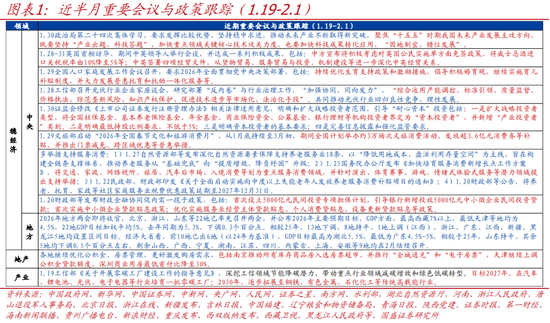
Core Viewpoint - The recent policies focus on expanding domestic demand to achieve a "good start" for 2026, with six major focal points including the UK Prime Minister's visit to China, various measures to support service consumption, the launch of the "2026 National Spring Festival Cultural and Tourism Consumption Month," a comprehensive fiscal and financial policy package to boost domestic demand, modifications to the securities issuance registration management regulations by the CSRC to attract "patient capital," and the commencement of local two sessions [2][44][45]. Group 1: Major Policies - The UK Prime Minister's visit from January 28-31 resulted in several positive outcomes, including a unilateral visa waiver for UK citizens and a reduction in the whisky import tariff from 10% to 5% [3][12][45]. - Multiple measures to support service consumption were introduced, including 18 policies to enhance the elderly care service industry and the release of a plan to cultivate new growth points in service consumption, focusing on transportation, housekeeping, online audio-visual services, tourism, automotive aftermarket, and inbound consumption [3][15][45]. - The Ministry of Culture and Tourism launched the "2026 National Spring Festival Cultural and Tourism Consumption Month," planning approximately 30,000 cultural and tourism consumption activities and distributing over 360 million yuan in consumption vouchers [3][31][45]. - A fiscal and financial policy package was released, including the establishment of a 500 billion yuan special guarantee plan for private investment and the introduction of interest subsidies for small and micro enterprises [3][36][45]. - The CSRC modified the relevant legal opinions on the registration management of securities issuance to attract "patient capital," expanding the types of strategic investors and setting a minimum shareholding requirement of no less than 5% [3][14][45]. - Local two sessions are underway, with 22 regions setting an average GDP target of 5%, down 0.3 percentage points from the previous year, with major economic provinces also reducing their targets by 0.5 percentage points [3][16][45]. Group 2: Local Policies - The local two sessions are concluding, with 22 regions having already set their GDP targets for 2026, with the highest being over 7% in Tibet and the lowest at 4.5% in Tianjin [3][16][39]. - The average GDP target for these regions is 5%, down from 5.3% the previous year, with 13 regions lowering their targets, 8 maintaining them, and 1 (Jiangxi) increasing its target [3][16][39]. Group 3: Industry Policies - Various regions are optimizing housing fund and housing ticket management to stimulate housing demand, including initiatives in Nanjing and Tianjin to enhance accessibility to housing funds [3][18][41]. - The Ministry of Industry and Information Technology issued guidelines for the construction of zero-carbon factories, aiming to tap into energy-saving and carbon-reduction potential in key industries, with a target to cultivate a number of zero-carbon factories by 2027 [3][42][41].
财政金融协同促内需
Sou Hu Cai Jing· 2026-01-29 23:16
Core Viewpoint - The recent series of policies issued by the Ministry of Finance and other departments aims to promote domestic demand through financial and fiscal collaboration, focusing on stimulating private investment and enhancing consumer spending [1] Group 1: Stimulating Private Investment - The new policies significantly enhance support for private investment, utilizing tools like loan interest subsidies and guarantee compensation to lower financing costs and barriers for private enterprises [2] - A new loan interest subsidy for small and micro enterprises will provide a 1.5% annual subsidy on loan principal for up to two years, with a maximum loan amount of 50 million yuan per entity [2] - The newly established special guarantee plan for private investment aims to provide guarantees for loans to small and micro private enterprises, with a total planned amount of 500 billion yuan over two years [2][3] - The policies also expand the scope of support to include medium-sized enterprises, increasing the single credit limit to 20 million yuan [2] Group 2: Enhancing Consumer Spending - The updated personal consumption loan interest subsidy policy significantly broadens its beneficiary scope, allowing for a maximum subsidy of 3,000 yuan per transaction, thus encouraging large-scale consumer spending [4][5] - The service industry loan interest subsidy policy has been optimized, increasing the single loan limit from 1 million yuan to 10 million yuan, with a subsidy of 1% for one year [5] - The implementation period for both personal consumption and service industry loan interest subsidies has been extended to the end of 2026, aiming to create a favorable environment for consumption [5] Group 3: Policy Implementation and Effectiveness - The coordinated fiscal and financial policies are designed to release policy dividends more effectively, aligning with the increased credit issuance in the first quarter [6] - The policies emphasize convenience and efficiency, aiming for direct benefits without complex application processes, thus ensuring that financial support is readily accessible [6] - Sufficient budgetary arrangements have been made for the necessary fiscal expenditures in 2026, encouraging local and managing institutions to actively engage in business [6]
一揽子政策加码支持民间投资和居民消费——财政金融协同促内需
Jing Ji Ri Bao· 2026-01-29 22:12
Core Insights - The recent series of policies from the Ministry of Finance aims to promote domestic demand through financial collaboration, focusing on stimulating private investment and enhancing consumer spending [1][2] Group 1: Stimulating Private Investment - The new policies significantly enhance support for private investment, utilizing tools like loan interest subsidies and guarantee compensation to lower financing costs and barriers for private enterprises [2] - A new loan interest subsidy for small and micro enterprises will provide a 1.5% annual subsidy on loan principal for up to two years, with a maximum loan amount of 50 million yuan [2] - The newly established special guarantee plan for private investment aims to support loans for small and micro private enterprises with a total plan amount of 500 billion yuan over two years, covering various production and operational activities [2][3] Group 2: Enhancing Consumer Spending - The updated personal consumption loan interest subsidy policy significantly broadens its scope, allowing for a maximum subsidy of 3,000 yuan per transaction, thus encouraging larger consumer purchases [4][5] - The service industry loan interest subsidy policy has been optimized, increasing the maximum loan amount from 1 million yuan to 10 million yuan, with a 1% subsidy for one year [5] - The implementation period for both personal consumption and service industry loan interest subsidies has been extended to the end of 2026, aiming to create a favorable environment for consumption [5][6] Group 3: Policy Implementation and Effectiveness - The coordinated approach between fiscal and financial policies aims to release policy dividends more effectively, with a focus on simplifying processes and ensuring direct benefits to enterprises and consumers [6] - The government has made sufficient budget arrangements for the necessary fiscal expenditures related to these policies, encouraging local institutions to actively engage in business [6]
促内需一揽子政策:银行业的四个着力点
Guo Ji Jin Rong Bao· 2026-01-29 06:49
Core Viewpoint - The Chinese government has introduced a comprehensive set of financial policies aimed at reducing financing costs for residents and businesses, stimulating consumption, and enhancing effective investment to invigorate market activity [1] Group 1: Policy Implementation - Financial institutions are urged to accurately implement the collaborative fiscal and financial policies to lower financing costs for both enterprises and residents, enhancing their access to financing [1] - In promoting consumer spending, banks should optimize loan policies for service industry operators and personal consumption loans, effectively reducing credit costs and boosting consumer willingness [1] - Support for private investment should include the implementation of loan interest subsidies for small and micro enterprises, ensuring that fiscal investments translate into tangible benefits for businesses [1] Group 2: Credit Structure and Service Optimization - Financial institutions should adjust credit allocations to focus on key areas such as stimulating private investment and promoting consumer spending [2] - Increased lending to small and micro enterprises for long-term fixed asset loans is necessary to address previous financing gaps [2] - More credit resources should be directed towards emerging sectors like digital, green, and retail, while streamlining loan application and approval processes to enhance accessibility [2] Group 3: Collaboration and Coordination - Strengthening collaboration between fiscal departments, banks, guarantee institutions, and enterprises is essential to maximize the effectiveness of the financial policies [3] - Financial institutions should actively participate in the design and implementation of policies, particularly in providing effective risk-sharing and financing support for small and micro enterprises [2][3] Group 4: Innovation and Forward-Looking Strategies - Financial institutions are encouraged to maintain a balance between proactive planning and continuous innovation to enhance the overall synergy of the policies [3] - Developing financial products that align with equipment upgrades and consumption upgrades is crucial, alongside exploring partnerships with social capital to direct more resources to the real economy [3] - Continuous monitoring of policy implementation progress and adjusting service strategies is necessary to sustain the vitality of microeconomic entities and enhance internal economic momentum [3]
【财金视野】“六箭齐发”彰显宏观调控创新
Sou Hu Cai Jing· 2026-01-25 23:28
Core Viewpoint - The Ministry of Finance, in collaboration with the central bank and other relevant departments, has launched a series of coordinated fiscal and financial policies aimed at boosting domestic demand, which is identified as a top priority for economic development this year [2]. Group 1: Policy Implementation - A comprehensive set of innovative policy tools has been introduced to strengthen the synergy between fiscal and financial policies, effectively stimulating private investment and promoting consumer spending [2]. - The central economic work conference emphasized the need for consistency and effectiveness in macroeconomic policy orientation, with previous collaborative efforts already yielding positive results [2]. - The newly introduced policies include interest subsidies for loans to small and micro enterprises, a special guarantee plan for private investment, and a risk-sharing mechanism for bonds issued by private enterprises [2][3]. Group 2: Policy Optimization - The newly released six policies include three that focus on optimizing existing measures, such as interest subsidies for equipment upgrades and personal consumption loans, which have been crucial in expanding domestic demand [3]. - The optimization highlights include the inclusion of credit card installment payments in the personal consumption loan subsidy and the expansion of support to digital, green, and retail sectors under the service industry loan subsidy [3][4]. - Measures to extend implementation periods, broaden support areas, and increase participating banks have enhanced the precision and effectiveness of existing policies [3]. Group 3: Policy Impact - The six policies are characterized by substantial financial backing, with the private investment guarantee plan amounting to 500 billion yuan, significantly increasing the loan limits for individual enterprises [4]. - The service industry loan subsidy has raised the loan limit per entity from 1 million yuan to 10 million yuan, while the interest subsidy for small and micro enterprises is set at 1.5% of the total loan amount for a maximum of two years [4]. - The broad applicability and strong support of these policies reflect a more proactive macroeconomic policy stance [4].

全国首批!烟台融资担保集团成功落地民间投资专项担保计划
Qi Lu Wan Bao· 2026-01-24 02:54
Core Insights - The Yantai Financing Guarantee Group has successfully registered a private investment special guarantee plan with the National Guarantee Fund, providing 5.2 million yuan in guarantee loans to two market entities [1] - This initiative is part of the first batch of private investment special guarantee plans in the country, aimed at boosting domestic demand, transforming the economy, and enhancing confidence in private investment [1] - The Ministry of Finance and three other departments have issued a notice to support private investment through a government financing guarantee system, directing private capital towards key sectors [1] Group 1 - The Yantai Financing Guarantee Group is acting as a leading guarantee institution at the municipal level, aligning with national and local policy directions to meet the financing needs of market entities [1] - The group has streamlined business processes and simplified approval procedures to efficiently implement the special guarantee plan, successfully providing 5.2 million yuan in support to two market entities in Yantai [1] - A seafood processing company expressed gratitude for the timely mid-to-long-term guarantee loan, which is crucial for its operations during a peak period for seafood procurement [2] Group 2 - The financing guarantee group has collaborated with Haiyang Rural Commercial Bank to issue a three-year guarantee loan at a favorable guarantee fee rate of 0.3%, injecting strong momentum into the development of small and micro enterprises [2] - The Yantai Financing Guarantee Group plans to deepen strategic cooperation with banking institutions to provide precise and efficient guarantee support for more private investment projects [2] - The initiative aims to contribute significantly to the stabilization and quality improvement of the Yantai economy [2]
“组合拳”精准发力 财政金融协同促内需
Jing Ji Wang· 2026-01-23 02:16
Core Viewpoint - The Ministry of Finance has released a comprehensive set of five fiscal and financial policies aimed at boosting consumption, supporting investment, and nurturing key entities, with a focus on precise implementation to drive high-quality economic development in the first year of the 14th Five-Year Plan [1][2]. Group 1: Consumption Promotion - The policies include optimized fiscal interest subsidy measures for personal consumption loans, equipment upgrade loans, and support for service industry loans, forming a three-dimensional support system for consumption, investment, and strengthening entities [2][3]. - The personal consumption loan subsidy policy has been expanded to include credit card bill installments, with a maximum annual subsidy of 3,000 yuan per person, allowing for compliant consumption amounts up to 300,000 yuan [3][4]. - The service industry loan subsidy has increased the maximum loan amount from 1 million yuan to 10 million yuan, with new focus areas including digital, green, and retail sectors [3][4]. Group 2: Investment Support - The policies target private investment and equipment upgrades, addressing financing challenges with a special guarantee plan for private investment set at 500 billion yuan over two years, focusing on supporting small and medium-sized enterprises [5][6]. - The new policy for small and medium-sized enterprise loans offers a 1.5% annual subsidy for fixed asset loans up to 50 million yuan, significantly reducing interest expenses for businesses [6][7]. - The equipment upgrade loan subsidy has been expanded to include a wider range of sectors, including artificial intelligence and green development, reflecting a shift towards supporting high-end, intelligent, and sustainable industries [7][8]. Group 3: Fiscal and Financial Coordination - The policies emphasize a 9:1 funding sharing ratio between central and provincial finances for service industry loan subsidies, ensuring efficient use of fiscal resources and accountability at the local level [8]. - The combination of interest subsidies and guarantees is designed to guide social resources towards key areas, enhancing support for domestic demand expansion [8][9]. - The fiscal policy for 2026 will focus on increasing total expenditure while optimizing structure and effectiveness, ensuring robust support for employment, enterprises, and market stability [9].