
民间投资专项担保

Search documents
南方基金2026年2月资产配置展望
2026-02-04 02:31
Summary of Conference Call Notes Industry or Company Involved - The conference call discusses macroeconomic trends and asset allocation outlook for 2026, focusing on both domestic and overseas markets. Core Points and Arguments 1. Market Review - Global markets showed an overall increase in January, with emerging markets outperforming developed markets [6][15] - Major commodities experienced significant price fluctuations, particularly metals, which saw a sharp correction at the end of the month [6][15] - Domestic asset performance was mixed, with equities showing high volatility, interest rates declining, and commodities performing strongly [10][15] 2. Domestic Macro Insights - Economic indicators suggest a stable start to the year, with PPI declines expected to narrow due to various factors including rising metal prices [20][22] - Credit demand in Q1 is anticipated to remain stable, with a focus on the performance of new home sales post-Spring Festival [23][25] - The central bank has implemented structural interest rate cuts and indicated potential for further easing, with a focus on maintaining liquidity [26][28] - Fiscal policies are becoming more proactive, with various support measures for small and medium enterprises and consumer loans [29][33] 3. Overseas Macro Insights - The U.S. economy may have reached a bottom, as indicated by recent employment data showing a rebound in non-farm payrolls [39][41] - Tariff policies under the Trump administration are shifting towards more aggressive measures, with potential implications for international trade [42][45] - The nomination of Walsh as the new Federal Reserve Chair raises questions about future monetary policy direction, particularly regarding interest rate adjustments [49][51] 4. Asset Allocation Outlook - A-shares are viewed as having reasonable valuation levels, with a slight preference for growth stocks in the upcoming quarter due to seasonal effects [56][66] - Hong Kong stocks are expected to perform well in the medium term, supported by domestic economic stabilization and potential foreign capital inflows [67][69] - Interest rates are likely to remain in a range-bound state, with limited upside potential [70][72] - U.S. Treasury yields are expected to stay elevated due to ongoing fiscal pressures, despite recent rate cuts by the Fed [73][75] - The AI sector is identified as a key driver for U.S. stock performance, with implications for technology investments [76][78] 5. Commodity Insights - Oil prices are expected to experience increased volatility due to geopolitical factors, although overall supply may remain excessive [81][83] - Copper prices are projected to remain strong amid tight supply conditions, while gold is anticipated to see short-term fluctuations [84][89] Other Important but Possibly Overlooked Content - The conference highlighted the importance of monitoring credit demand and fiscal policy developments as indicators of economic health [23][29] - The potential impact of U.S. tariff policies on global trade dynamics and market sentiment was emphasized [42][45] - The discussion on the structural changes in the U.S. economy and their implications for monetary policy and asset allocation strategies was noted as critical for investors [51][52]
一揽子政策加码支持民间投资和居民消费 财政金融协同促内需
Jing Ji Ri Bao· 2026-01-29 23:22
Core Viewpoint - The recent series of policies issued by the Ministry of Finance and other departments aims to promote domestic demand through financial and fiscal collaboration, focusing on stimulating private investment and enhancing consumer spending, which will provide tangible benefits to businesses and individuals [1][2]. Group 1: Stimulating Private Investment - The new policies significantly enhance support for private investment, utilizing tools such as loan interest subsidies and guarantee compensation to lower financing costs and barriers for private enterprises [2]. - A new loan interest subsidy for small and micro enterprises will provide a 1.5% annual subsidy on the principal for up to two years, with a maximum loan amount of 50 million yuan per entity, covering 14 key industries including new energy vehicles and medical equipment [2]. - The newly established special guarantee plan for private investment aims to provide guarantees for loans to small and micro private enterprises, with a total planned amount of 500 billion yuan over two years, supporting various production and operational activities [2][3]. Group 2: Enhancing Consumer Spending - The policies also focus on boosting consumer spending, which is crucial for improving livelihoods and sustaining economic growth, with updates to personal consumption loan interest subsidies and service industry loan interest subsidies [4]. - The updated personal consumption loan interest subsidy allows for a maximum subsidy of 3,000 yuan per transaction, significantly increasing the potential support for large purchases and enhancing consumer purchasing power [5]. - The service industry loan interest subsidy has been optimized, increasing the maximum loan amount from 1 million yuan to 10 million yuan, with a 1% interest subsidy for one year, benefiting a wider range of consumption sectors [5]. Group 3: Implementation and Effectiveness - The comprehensive policies aim to enhance support for private investment and consumer spending, aligning fiscal policy with bank credit activities to release policy dividends more effectively [6]. - The Ministry of Finance emphasizes the need for efficient implementation, simplifying processes to ensure that benefits are accessible without cumbersome applications, and ensuring that fiscal expenditures are adequately budgeted for 2026 [6].
收益率曲线陡峭化
Qi Huo Ri Bao· 2026-01-22 07:22
Group 1 - The monetary policy has implemented structural interest rate cuts, reducing rates by 0.25 percentage points for various structural monetary policy tools, optimizing some tools, and increasing their quotas to support key strategic areas and weak links [2] - The fiscal policy aims for a more proactive approach, with a budget deficit rate expected to remain around 4% in 2026, and the issuance of special long-term bonds projected to increase by 200 billion to 500 billion, reaching between 1.5 trillion and 1.8 trillion [2] - A package of policies focused on boosting domestic demand has been introduced, including interest subsidies for loans to small and micro enterprises, a special guarantee plan of 500 billion for private enterprise loans, and measures to lower the threshold for private enterprise bond issuance [3] Group 2 - The economy is expected to maintain resilience with a GDP growth rate of 5.0% in 2025, highlighting structural optimization and the growth of new economic drivers, despite weaknesses in traditional sectors like real estate and infrastructure [4] - Consumer price index (CPI) rose by 0.8% year-on-year in December 2025, the highest since March 2023, while core CPI remained above 1% for four consecutive months, indicating a gradual recovery in domestic demand [4] - The bond market is experiencing wide fluctuations due to a combination of loose funding, improving economic conditions, and rising prices, with expectations of a steepening yield curve as long-term bonds underperform relative to short-term bonds [5]
财政金融促内需六项新政,谁获益?
Sou Hu Cai Jing· 2026-01-21 07:14
Core Viewpoint - The Chinese government is implementing a series of fiscal and financial policies aimed at boosting domestic demand, with a focus on increasing fiscal spending, supporting consumption, and enhancing residents' income through various channels [2][3][10]. Fiscal Policy Overview - In 2026, the fiscal deficit, total debt, and overall spending will be maintained at necessary levels, ensuring that overall spending increases and key areas are strongly supported [2][3]. - The deficit rate for 2025 is set at around 4%, with new government debt issuance expected to reach 11.86 trillion yuan, significantly higher than previous years [2]. Key Policies - The fiscal and financial package includes six policies, four of which focus on stimulating private investment, while the other two aim to promote consumption [5][10]. - Specific measures include loan interest subsidies for small and micro enterprises, personal consumption loans, equipment upgrade loans, and guarantees for private investment [5][7][8]. Support for Private Investment - A new special guarantee plan for private investment has been introduced, increasing the credit guarantee limit and risk-sharing ratio to encourage banks to lend more [6][10]. - The maximum guarantee amount for individual enterprises has been raised to 20 million yuan, with the government covering up to 40% of the risk [6]. Consumption Support Measures - Personal consumption loans will now benefit from a 1% interest subsidy, with the maximum subsidy amount per transaction increased from 500 yuan to 3,000 yuan [9]. - The scope of eligible consumption areas has expanded to include digital, green, and retail sectors, alongside existing categories [9]. Focus on Technology and Innovation - The government will prioritize support for technological self-reliance and innovation, with a 10% increase in central government spending on technology in 2025 [11]. - Policies will include tax incentives and financial support for technology innovation and integration with industry [11]. Regulatory Adjustments - Starting April 1, 2026, export tax rebates for certain products will be canceled to promote efficient resource use and reduce environmental impact [12]. - The government is committed to standardizing fiscal subsidies and addressing any irregularities in local subsidy practices [12][13]. Tax and Fiscal Reforms - Ongoing reforms will clarify fiscal responsibilities between central and local governments, particularly in public services [13]. - The tax system will be reformed to adapt to new economic realities, including the digital economy [13].

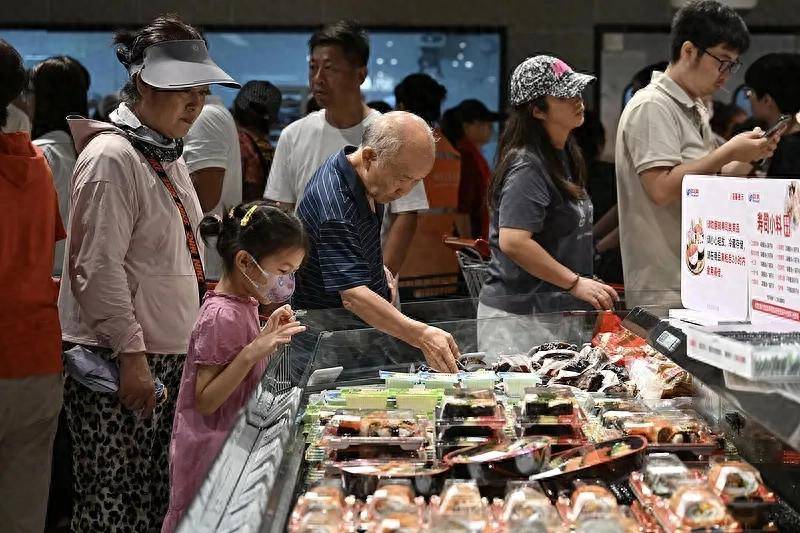
事关贷款贴息、信用卡账单分期贴息等,六项重大利好出炉→
Jin Rong Shi Bao· 2026-01-20 13:16
Core Viewpoint - The Chinese government is implementing a series of fiscal policies aimed at stimulating domestic demand and promoting high-quality economic development, focusing on enhancing private investment and consumer spending [1][5][18]. Group 1: Policy Overview - The policies can be summarized as "one goal," "two focuses," "three principles," and "six policies" [3]. - "One goal" refers to the aim of "expanding domestic demand" [4]. - "Two focuses" emphasize the need to "stimulate private investment" and "promote consumer spending," both of which are crucial components of domestic demand [6]. - "Three principles" guide the execution of these policies: 1. "Convenient and efficient" processes to simplify policy implementation [8]. 2. "Precise and effective" targeting of key sectors and groups to lower financing costs [8]. 3. "Standardized and efficient" practices to balance efficiency with regulatory compliance [8]. Group 2: Six Key Policies - The six policies include four aimed at supporting private investment and two focused on promoting consumption [9]. 1. **Small and Micro Enterprises Loan Interest Subsidy Policy**: Offers a 1.5% interest subsidy on loans for key industries, with a maximum loan amount of 50 million yuan and a subsidy period of up to 2 years [10]. 2. **Private Investment Special Guarantee Plan**: Provides guarantees for loans to small and micro private enterprises, with a maximum loan guarantee of 20 million yuan [11]. 3. **Risk Sharing Mechanism for Private Enterprise Bonds**: Allocates risk-sharing funds to support bond issuance by private enterprises, helping to lower financing thresholds [12]. 4. **Equipment Upgrade Loan Interest Subsidy Policy**: Expands the scope of existing policies to include loans for equipment upgrades and technology innovation, with similar interest subsidy terms [13]. 5. **Service Industry Loan Interest Subsidy Policy**: Increases the maximum loan amount eligible for interest subsidies from 1 million to 10 million yuan, covering 11 categories of consumer services [14]. 6. **Personal Consumption Loan Interest Subsidy Policy**: Offers a 1% interest subsidy on personal loans used for consumption, including credit card installment payments, with over 500 financial institutions involved [14]. Group 3: Expected Outcomes - The policies are expected to significantly lower financing costs for enterprises, addressing the issue of high financing expenses for private enterprises [18]. - For example, a manufacturer seeking a 50 million yuan loan for an automated production line could save 1.5 million yuan in interest over two years due to the subsidy [18]. - The policies also aim to lower financing barriers, making it easier for private enterprises to access funds through enhanced guarantees and risk-sharing mechanisms [19].
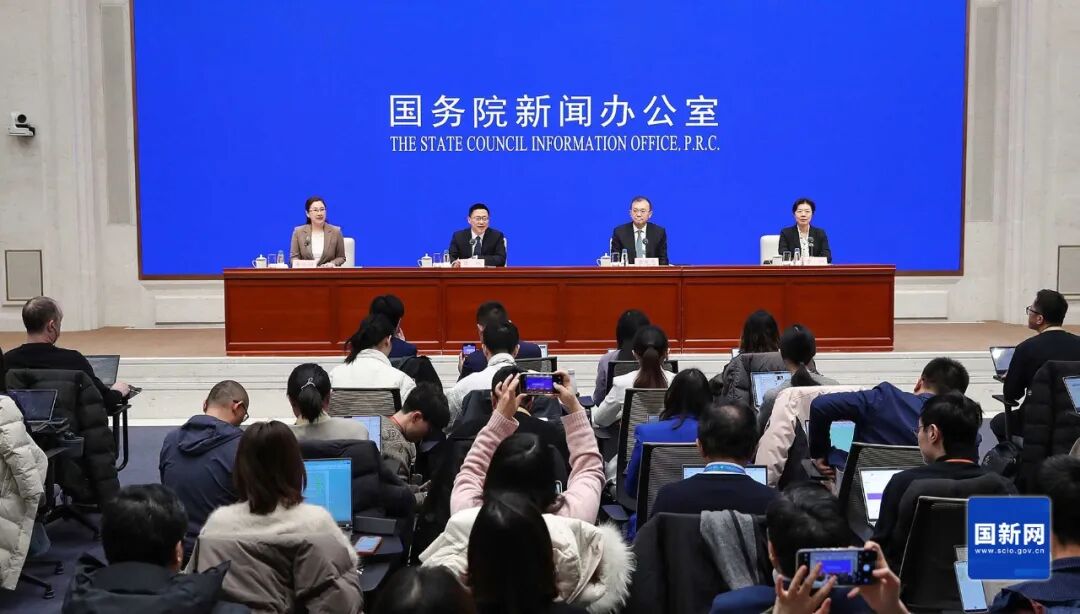
激发民间投资、促进消费,财政部公布一揽子扩内需政策
Sou Hu Cai Jing· 2026-01-20 12:54
Core Viewpoint - The Ministry of Finance, in collaboration with relevant departments, has launched a comprehensive policy package aimed at expanding domestic demand and stimulating private investment and consumer spending [1][2]. Group 1: Policy Overview - The policy package includes six key initiatives: 1. Loan interest subsidies for small and micro enterprises 2. Special guarantee plan for private investment 3. Risk-sharing mechanism for private enterprise bonds 4. Loan interest subsidies for equipment upgrades 5. Loan interest subsidies for service industry operators 6. Loan interest subsidies for personal consumption [1][2][3][4]. Group 2: Specific Policies - The first initiative provides a 1.5% interest subsidy on loans for small and micro enterprises, with a maximum loan amount of 50 million yuan and a subsidy period of up to 2 years, targeting 14 key industries including new energy vehicles and medical equipment [2][3]. - The second initiative offers a new guarantee plan for small and micro enterprises, allowing for a loan guarantee of up to 20 million yuan for eligible businesses [3]. - The third initiative introduces a risk-sharing mechanism for bonds issued by private enterprises, providing credit enhancement support to lower financing thresholds [3]. - The fourth initiative expands the scope of interest subsidies for equipment upgrades, including fixed asset loans related to equipment updates and technology innovation [4]. - The fifth initiative increases the loan limit for service industry operators from 1 million yuan to 10 million yuan, with a 1% interest subsidy for one year [4]. - The sixth initiative allows personal consumption loans to receive a 1% interest subsidy, including support for credit card installment payments, with over 500 financial institutions participating [4]. Group 3: Implementation and Financial Planning - The financial expenditures required for these policies have been adequately planned in the 2026 budget, encouraging local and financial institutions to actively engage in business [5].
财政部发布一揽子政策:消费贷贴息扩围,大力激发民间投资
2 1 Shi Ji Jing Ji Bao Dao· 2026-01-20 10:51
Core Viewpoint - The Ministry of Finance has announced a comprehensive set of policies aimed at stimulating domestic demand through financial and fiscal collaboration, focusing on enhancing consumer spending and private investment [1][3]. Group 1: Policy Overview - The package includes six key policies designed to support private investment and consumer spending, reflecting the government's commitment to boost domestic demand as outlined in the Central Economic Work Conference [3][8]. - The policies are structured around "one goal," "two focuses," "three principles," and "six policies," emphasizing the importance of facilitating private investment and promoting consumer consumption [3][4]. Group 2: Specific Policies - The first policy is a loan interest subsidy for small and micro enterprises, providing a 1.5% subsidy on loans up to 50 million yuan for key industries such as new energy vehicles and medical equipment, with a maximum subsidy period of two years [4][5]. - The second policy introduces a special guarantee plan for private investment, allowing eligible small and micro enterprises to access guaranteed loans up to 20 million yuan, significantly increasing the previous limit [5][6]. - The third policy establishes a risk-sharing mechanism for private enterprise bonds, where the central government will provide financial support to mitigate investor losses, thereby lowering financing barriers for enterprises [6][7]. - The fourth policy optimizes the equipment update loan interest subsidy, expanding the scope to include fixed asset loans related to equipment updates and technological innovation, with a 1.5% subsidy for up to two years [7]. - The fifth policy enhances the loan interest subsidy for service industry operators, increasing the maximum loan amount from 1 million to 10 million yuan, with a 1% subsidy for one year [7][8]. - The sixth policy optimizes the personal consumption loan interest subsidy, allowing consumers to benefit from a 1% subsidy on loans used for consumption, including credit card installment payments, with over 500 financial institutions eligible to provide these loans [8].
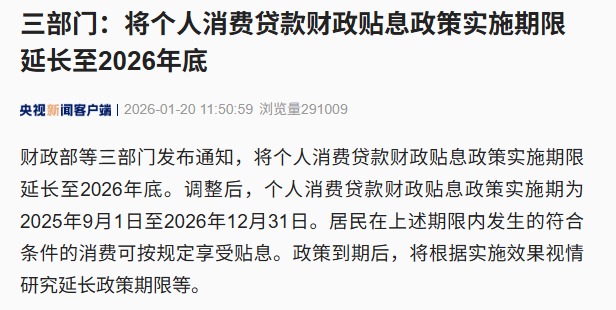
个人消费贷款财政贴息政策实施期限将延长至2026年底
Sou Hu Cai Jing· 2026-01-20 09:03
Group 1 - The core point of the news is the extension of the personal consumption loan interest subsidy policy until the end of 2026, aimed at boosting consumer spending and reducing the cost of personal consumption credit [1][4] - The policy will now be effective from September 1, 2025, to December 31, 2026, allowing residents to enjoy interest subsidies on eligible consumption during this period [4][5] - The subsidy rate for credit card installment payments has been set at 1 percentage point [5] Group 2 - The policy has removed the previous cap of 500 yuan on single transaction interest subsidies and the cumulative cap of 1,000 yuan for each borrower at one financial institution [6] - The policy will include more financial institutions, expanding the coverage to include city commercial banks, rural cooperative financial institutions, foreign banks, and consumer finance companies [6][7] - The central and provincial finances will bear 90% and 10% of the subsidy funds, respectively [6] Group 3 - The funding allocation will follow a "pre-allocation + settlement" method, with financial institutions required to submit their subsidy fund needs by January 31, 2026 [6][7] - The Ministry of Finance will conduct joint inspections to ensure compliance with the policy and will hold institutions accountable for any violations [7][8] - Financial institutions must report their policy execution status monthly, including loan issuance and subsidy amounts [7][8]
财政部连发多份重要文件,事关贷款贴息、民间投资贷款担保等 一揽子政策全文公布
Sou Hu Cai Jing· 2026-01-20 09:03
Group 1 - The core viewpoint of the news is the implementation of a financial subsidy policy for equipment renewal loans to support businesses in reducing financing costs and promoting effective investment [3][4][5] - The policy includes a 1.5% interest subsidy on fixed asset loans for equipment renewal projects, applicable for a maximum of two years, and is effective until December 31, 2026 [3][4] - The scope of support has been expanded to include various sectors such as construction, aviation, digital technology, and green energy, emphasizing high-end, intelligent, and digital equipment updates [4][6] Group 2 - A total of 26 banks are designated as eligible for processing the interest subsidy loans, including major national banks and several regional banks [4][5] - The subsidy process has been optimized to include a "pre-allocation + settlement" method, streamlining the application and approval process for banks and provincial financial departments [5][6] - The policy aims to enhance the experience of businesses by ensuring timely communication regarding subsidy payments through modern technology [6][7] Group 3 - The policy for small and micro enterprises includes a 1.5% interest subsidy on fixed asset loans, with a maximum loan amount of 50 million yuan, effective from January 1, 2026 [8][9] - The targeted sectors for this subsidy include new energy vehicles, medical equipment, and various service industries, aiming to stimulate investment and production [9][10] - The operational mechanism involves a "total-to-total" model for coordination between financial institutions and fiscal departments to ensure efficient processing of subsidy funds [11][12] Group 4 - The service industry loan subsidy policy has been extended until December 31, 2026, with an increased maximum loan amount of 10 million yuan and a 1% interest subsidy for one year [16][17] - New sectors such as digital, green, and retail have been added to the support scope, enhancing the policy's relevance to current economic trends [17][18] - The funding allocation process has been refined to improve efficiency and reduce redundancy in the approval process [18][19] Group 5 - A special guarantee plan for private investment has been introduced with a total quota of 500 billion yuan over two years, aimed at supporting small and micro enterprises [22][24] - The plan includes risk-sharing mechanisms where banks bear at least 20% of the loan risk, while the government guarantee fund covers up to 80% [24][25] - The initiative encourages innovative financing models and aims to enhance the capital strength of the government guarantee fund to support private investments effectively [26][27]






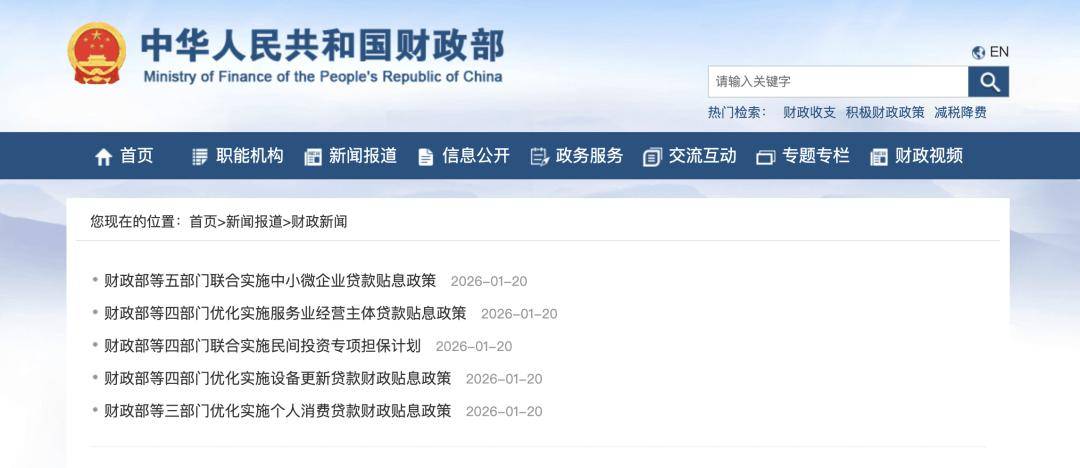
财政部:实施中小微企业贷款贴息政策,延长个人消费贷款财政贴息政策实施期限
Sou Hu Cai Jing· 2026-01-20 07:48
Group 1: Small and Micro Enterprises Loan Interest Subsidy Policy - The policy provides a 1.5% annual interest subsidy for eligible small and micro private enterprises' fixed asset loans and new policy financial tools, with a maximum subsidy loan limit of 50 million yuan per enterprise [1][3][9] - The policy is applicable to loans issued from January 1, 2026, and is initially set to last for one year, with the possibility of extension based on future evaluations [1][3] - The focus is on key industries such as new energy vehicles, industrial mother machines, pharmaceuticals, artificial intelligence, and other emerging sectors [3][9] Group 2: Personal Consumption Loan Interest Subsidy Policy - The implementation period for the personal consumption loan interest subsidy policy has been extended to December 31, 2026, allowing residents to enjoy subsidies for eligible consumption during this period [5][15] - The policy now includes credit card installment payments with an annual subsidy rate of 1%, and removes previous restrictions on consumption fields [5][16] - The maximum annual subsidy per individual remains capped at 3,000 yuan, while previous limits on single transaction subsidies have been removed [5][16] Group 3: Private Investment Special Guarantee Plan - The plan has a total quota of 500 billion yuan, to be implemented over two years, aimed at supporting small and micro enterprises in various sectors including technology upgrades and service industry enhancements [2][7][22] - The guarantee fee for private enterprises is capped at 1%, with the government financing guarantee fund reducing re-guarantee fees by half [2][23] - The plan allows for a compensation rate increase from 4% to 5% for government financing guarantees, enhancing risk tolerance for medium to long-term loans [7][24]