
光迅科技

Search documents
A股卫星通信业ESG相关报告披露率46% 太空环境治理议题待完善
Mei Ri Jing Ji Xin Wen· 2025-08-31 13:49
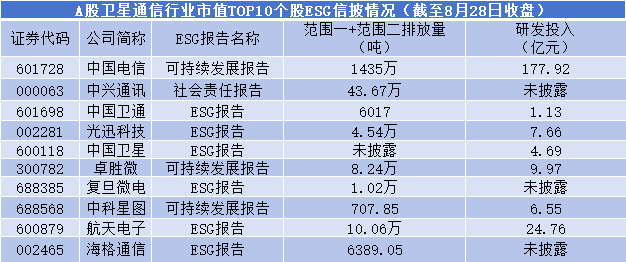
Core Viewpoint - The satellite communication industry is experiencing significant policy changes with the issuance of the "Guiding Opinions on Optimizing Business Access to Promote the Development of the Satellite Communication Industry" by the Ministry of Industry and Information Technology, which outlines 19 measures across six areas to expand market access and foster industry growth [1] Group 1: ESG Disclosure in the Satellite Communication Industry - As of August 29, 2025, there are 50 stocks in the Wind "Satellite Communication" sector, with 23 companies disclosing ESG-related reports for 2024, resulting in a disclosure rate of 46%, slightly below the overall industry rate of 46.81% [2] - Among the top ten companies by market capitalization, nine have disclosed carbon emission data, with three companies also reporting scope three emissions [2][3] - The company with the highest carbon emissions is China Telecom, emitting 14.35 million tons of CO2, while the lowest is Zhongke Xingtu, with only 707.85 tons [3] Group 2: Variability in Carbon Emission Reporting - The disparity in carbon emission levels among companies is attributed to selective disclosure and differing methodologies, as carbon data reporting is currently voluntary [3][4] - Companies may choose different accounting boundaries, leading to significant differences in reported emissions, with some only calculating direct emissions from specific facilities [3][4] - The lack of a unified standard for data collection and processing in the industry further complicates accurate carbon emission measurement [3][4] Group 3: Importance of R&D and Product Quality - Innovation, R&D, product quality, and supply chain management are prioritized as significant issues within the satellite communication industry [6] - Seven of the top ten companies disclosed R&D investment amounts, while others reported R&D expenses as a percentage of revenue [6] - Companies like China Satcom and Zhongke Xingtu have established quality control systems to ensure product quality [7] Group 4: Unique ESG Considerations for Satellite Communication - The satellite communication industry has unique ESG disclosure needs, including the impact on both terrestrial and outer space environments [8][9] - Key issues include satellite decommissioning plans, debris management, and the energy consumption and carbon emissions of ground facilities [8][9] - The social value of satellite communication in emergency rescue and education in remote areas should also be highlighted in ESG reports [8][10]
光迅科技(002281):数通业务需求高企,收入增速显著
Minsheng Securities· 2025-08-31 10:34
Investment Rating - The report maintains a "Buy" rating for the company [3][5]. Core Views - The company's revenue and net profit saw significant growth in the first half of 2025, with revenue reaching 5.243 billion yuan, a year-on-year increase of 68.6%, and net profit attributable to shareholders reaching 372 million yuan, a year-on-year increase of 79.0% [1][2]. - The demand for data communication business is high, driven by AI needs, contributing to the company's strong performance [2][3]. - The company is positioned as a rare supplier covering the entire spectrum of optical chips, devices, modules, and subsystems in China, with a strong capability in high-end data communication optical modules [3]. Revenue Breakdown - Transmission business revenue for the first half of 2025 was 1.517 billion yuan, a year-on-year decrease of 3.7%, accounting for 28.94% of total revenue [2]. - Data and access business revenue reached 3.715 billion yuan, a year-on-year increase of 149.27%, accounting for 70.86% of total revenue [2]. - Domestic revenue was 3.934 billion yuan, a year-on-year increase of 91.2%, while international revenue was 1.309 billion yuan, a year-on-year increase of 24.4% [2]. Financial Performance - The company reported a gross margin of 20.35% for domestic sales, with a slight increase of 0.12 percentage points year-on-year, while the gross margin for international sales was 29.00%, an increase of 1.51 percentage points year-on-year [2]. - R&D expenses in the first half of 2025 reached 491 million yuan, a significant year-on-year increase of 42.9% [3]. - The company expects net profits for 2025, 2026, and 2027 to be 1.104 billion yuan, 1.505 billion yuan, and 1.900 billion yuan, respectively, with corresponding PE ratios of 50, 37, and 29 [3][5]. Market Opportunities - The rapid development of AI is expected to significantly boost the demand for high-end data communication optical modules, positioning the company to benefit from this trend [3]. - Emerging fields such as data center interconnect (DCI) demand, the commercialization of 25G/50G PON networks, and quantum communication are anticipated to provide important growth opportunities for the company [3].

预见2025:《2025年中国光电芯片行业全景图谱》(附市场现状、竞争格局和发展趋势等)
Qian Zhan Wang· 2025-08-30 16:39
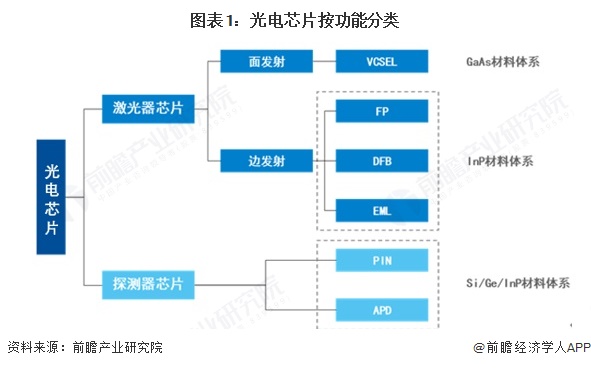
Industry Overview - The optical chip industry, also known as photonic chips, is categorized into laser chips and detector chips, with laser chips converting electrical signals to optical signals and detector chips converting optical signals back to electrical signals [1][4] - The industry chain consists of upstream material and equipment suppliers, midstream chip design and production, and downstream optical device manufacturers and end customers [1][4] Industry Development Stages - The development of China's optical chip industry has gone through three stages: initial exploration from the late 1980s to 2000, technology accumulation from 2000 to 2017, and rapid breakthroughs since 2017 with accelerated domestic substitution [8][10] Policy Background - National policies are promoting the development of the optical chip industry through technology research, standard establishment, and ecosystem construction, aiming to enhance competitiveness and application levels across various fields [10][11] Investment Trends - Investment activity in the optical chip industry has seen a decline, with 50 financing events in 2022, but only 15 events with approximately 1.7 billion yuan in funding from early 2025 to July 2025 [13] Market Size and Growth - The market size of China's optical chip industry is projected to reach approximately 15.2 billion yuan in 2024, with a compound annual growth rate of about 10% from 2020 to 2024 [14] Domestic Production Levels - The domestic production levels of optical chips vary by speed and type, with higher levels of localization in lower-speed chips, while high-speed chips still show significant reliance on imports [15][19] Application Areas - The primary application of optical chips is in telecommunications, where they serve as core components in fiber optic communication systems [20] Competitive Landscape - High-end optical chip products are heavily reliant on foreign suppliers, with leading companies in the high-speed optical chip market being from Europe, the US, and Japan, while Chinese companies dominate the mid-to-low-speed chip market [22] Regional Distribution - The midstream optical chip manufacturing industry is concentrated in central and southeastern coastal regions of China, with Hubei province having the highest concentration of companies [24] Future Market Predictions - The optical chip manufacturing industry is expected to approach a market size of 35 billion yuan by 2030, driven by significant demand in telecommunications, consumer electronics, and automotive sectors [27] Industry Trends - The industry is witnessing trends such as expanding application scenarios into smart computing, autonomous driving, and medical sensing, along with a focus on high integration and energy efficiency in technology [30]



卫星通信行业ESG相关报告披露率为46%,太空环境治理议题待完善
Mei Ri Jing Ji Xin Wen· 2025-08-29 13:10
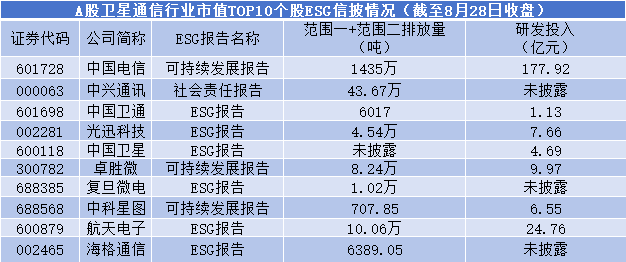
Core Viewpoint - The satellite communication industry is experiencing significant policy support from the Ministry of Industry and Information Technology, which has issued guidelines to optimize business access and promote industry development through 19 measures across six areas [1]. Industry Overview - The satellite communication sector consists of 50 listed companies, with 23 companies disclosing ESG-related reports for 2024, resulting in a disclosure rate of 46%, slightly below the overall industry rate of 46.81% as of August 29 [1][2]. - The top ten companies by market capitalization have all disclosed ESG reports, with nine of them providing carbon emission data [2]. ESG Disclosure Insights - The carbon emissions reported by companies vary significantly, with China Telecom reporting the highest emissions at 14.35 million tons of CO2, while China Science and Technology Corporation reported the lowest at 707.85 tons [2][4]. - The differences in carbon emission disclosures are attributed to selective reporting and methodological discrepancies, as companies may choose different accounting boundaries for their emissions [3][4]. R&D and Product Quality - Innovation, product quality, and supply chain management are prioritized as significant issues within the satellite communication industry, with seven of the top ten companies disclosing R&D investment amounts [5][7]. - Companies like China Satellite and China Telecom have implemented measures to enhance product quality and customer service, including establishing quality control systems and monitoring customer complaints [7][9]. Unique Industry Challenges - The satellite communication industry faces unique challenges regarding ESG disclosures, such as the need to address space environment protection, satellite decommissioning plans, and debris management [9][10]. - Experts suggest that the industry should emphasize its distinct characteristics in ESG reports, including the environmental impact of launch activities and the sustainable use of critical raw materials [9][10].




ESG信披观察 | 卫星通信行业ESG相关报告披露率为46%,太空环境治理议题待完善
Mei Ri Jing Ji Xin Wen· 2025-08-29 13:04
Core Insights - The satellite communication industry is experiencing significant policy support with the Ministry of Industry and Information Technology issuing guidelines to optimize business access and promote industry development through 19 measures across six areas [1] ESG Disclosure - The "satellite communication" sector consists of 50 listed companies, with 23 companies disclosing ESG-related reports for 2024, resulting in a disclosure rate of 46%, slightly below the overall industry rate of 46.81% as of August 29 [1][2] - Among the top ten companies by market capitalization, all have disclosed ESG reports, with nine companies providing carbon emission data, indicating a growing awareness of ESG principles in the emerging industry [2][6] - The carbon emissions reported by the top companies vary significantly, with China Telecom reporting the highest at 1,435,000 tons of CO2, while Zhongke Xingtou reported the lowest at 707.85 tons [2][4] Challenges in ESG Reporting - The current voluntary nature of carbon emission disclosure leads to inconsistencies in reporting, as companies may choose different accounting boundaries, affecting comparability [3][5] - The lack of unified standards and high-quality data in the industry complicates accurate measurement of carbon emissions throughout the satellite manufacturing and launch lifecycle [3][12] R&D and Product Quality - Innovation, product quality, and supply chain management are prioritized in the ESG reports of the satellite communication industry, with seven of the top ten companies disclosing R&D investment amounts [6][9] - Specific measures for quality control have been implemented by various companies, such as establishing customer service systems and quality inspection frameworks [9][12] Unique Industry Considerations - The satellite communication sector has unique ESG considerations, including the environmental impact of satellite launches and space debris management, which should be highlighted in ESG disclosures [12][13] - The industry is encouraged to address the sustainability of raw material procurement and the social value of satellite applications in areas like emergency rescue and education [12][13]

海信系分拆纳真科技赴港上市:“以价换量”毛利率垫底 净利润暴涨靠卖合营企业 百亿估值是否含水分?
Xin Lang Zheng Quan· 2025-08-29 10:41
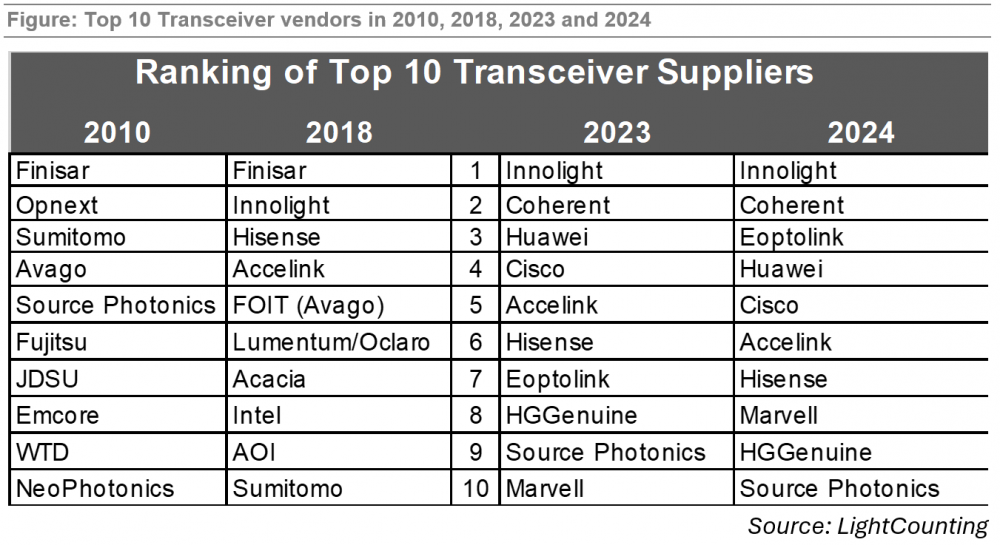
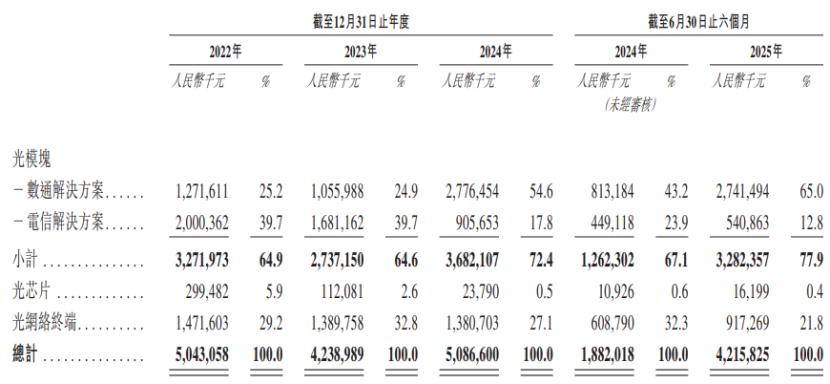
Core Viewpoint - Ligent Technologies, Inc. (纳真科技) has submitted its listing application to the Hong Kong Stock Exchange, aiming to raise funds for product development, capacity expansion, market promotion, strategic investments, and working capital [1][2]. Financial Performance - In the first half of 2025, Ligent Technologies experienced explosive growth, with revenue and net profit increasing by 124.01% and 6501.97% year-on-year, respectively [1]. - The company's revenue for 2022-2025 showed fluctuations, with revenues of 50.43 billion, 42.39 billion, 50.87 billion, and 42.16 billion RMB, and net profits of 4.29 billion, 2.16 billion, 0.89 billion, and 5.1 billion RMB [13][17]. Market Position and Competition - Ligent Technologies claims to be the "fifth globally and third in China" in the professional optical module market, but discrepancies exist with rankings from LightCounting, which places it seventh globally and fifth in China [2][10]. - The optical module industry is becoming increasingly competitive, with Ligent's average selling price significantly lower than its peers, reflecting a "price-for-volume" sales strategy [1][18]. Product Segmentation - The main business segments of Ligent Technologies include optical modules and optical network terminals, with optical module revenues showing a V-shaped trend from 32.72 billion to 36.82 billion RMB [15][17]. - The company has also ventured into producing optical chips, although their revenue contribution remains minimal [17]. Profitability and Margins - Ligent Technologies has seen a decline in gross margins across its product lines, with the gross margin for data communication modules dropping from 31.2% to 25.2% from 2022 to 2024 [18][20]. - The company's gross margins are significantly lower than those of industry leaders, indicating a potential loss of competitive edge [20]. Future Outlook - The global market for optical modules, particularly those with speeds of 400G and above, is expected to grow significantly, with 1.6T optical modules projected to see a compound annual growth rate of 180.0% from 2024 to 2029 [21]. - Ligent Technologies has begun delivering samples of its 1.6T optical modules, with commercial production expected by 2026 [21].
中金:OCS或为AI新型网络架构下创新光学底座 建议关注相关产业趋势
Zhi Tong Cai Jing· 2025-08-29 06:12
OCS是直接实现光信号在光纤端口间切换的交换设备,其原理是直接对光信号进行物理路径的重构,从 而在输入/输出端口之间建立专用光路。无需光电转换的特性带来低时延、低功耗、协议与数据无关的 透明性和兼容性、可靠性等性能增益,但其技术原理也导致光路切换时间长、通道灵活性差的局限性, 较难满足高并发、多对一、随机性强的通信负载。现阶段,OCS的技术路径尚未完全收敛,包括 MEMS(微机电系统)、数字液晶、压电陶瓷直接光束偏转等方案,目前OCS参与者中采用基于3D MEMS 技术的厂商较多。 中金发布研报称,海外光通信公司COHR、LITE在2Q25财报中均提到已获得OCS(光路交换机)初期收 入,且预期相关收入将持续增长。Coherent认为OCS存有20亿美元的潜在增量市场空间。2025年7月, 开放计算项目(OCP)宣布成立OCS子项目,成员包括Lumentum、谷歌、微软等,行业生态向开放化发 展、行业规范的逐步确立有望进一步赋能OCS市场增长。建议关注OCS产业趋势、及该产业链中的在位 厂商和潜在进入厂商。 中金主要观点如下: OCS无需光电转化,相较于电交换机具有低功耗、低延迟、高兼容等优势 谷歌前瞻自研O ...
进出口总值首破800亿元 武汉东湖综保区全国排名跃升14位
Chang Jiang Ri Bao· 2025-08-29 05:30
Core Insights - The Customs General Administration announced the 2024 performance evaluation results for national comprehensive bonded zones, with Wuhan Donghu Comprehensive Bonded Zone (Donghu CBZ) rated as an "A-class" zone nationally and in the central region, rising 14 places in the national ranking [1][5] Group 1: Evaluation Process - The evaluation of comprehensive bonded zones began in 2019 and is conducted annually, led by the Customs General Administration with participation from multiple ministries [4] - A total of 154 bonded zones participated in this evaluation, with only the top 20% receiving the highest "A-class" rating [4] Group 2: Performance Metrics - Donghu CBZ ranked 15th nationally and 3rd among 23 evaluated units in the central region, showing improvements in institutional environment, industrial structure, and openness efficiency [5] - The total import and export value of the zone exceeded 80 billion yuan for the first time in 2024, becoming a significant driver of foreign trade growth in Hubei [8] Group 3: Industry Development - Donghu CBZ focuses on high-tech industrial trade, leveraging the advantages of the Optics Valley industry, with key enterprises like Guangxun Technology and Xian Dao Rare Materials established in the zone [7] - The zone has also fostered several specialized and innovative "little giant" enterprises, creating a collaborative innovation ecosystem among leading and small to medium-sized enterprises [7] Group 4: Strategic Importance - The recent "double A-class" rating reflects Donghu CBZ's comprehensive strength in institutional innovation, business model expansion, and operational efficiency, highlighting Wuhan's substantial progress in building high-level open platforms [9]

山东青岛跑出一家光通信IPO,英特尔前员工担任CEO,与中际旭创、新易盛竞争
3 6 Ke· 2025-08-29 03:05
Core Viewpoint - The recent surge in A-share technology stocks, particularly in the optical communication sector, is driven by advancements in AI, cloud computing, and the widespread deployment of 5G networks [1][2]. Industry Overview - The global optical communication industry is rapidly developing, with key products including optical chips, optical modules, and optical network terminals forming a tightly integrated value chain [2]. - The optical module market is projected to grow from RMB 77.5 billion in 2020 to RMB 126.7 billion by 2024, with a compound annual growth rate (CAGR) of 13.1% [12]. - By 2029, the global optical module market is expected to reach RMB 295.4 billion, with China's market size projected to be RMB 32.9 billion in 2024, accounting for 26% of the global market [12]. Company Overview - Nazhen Technology, a key player in the optical communication sector, is preparing for an IPO in Hong Kong, with Citigroup and CITIC Securities as joint sponsors [2][3]. - The company specializes in providing critical optical communication products for AI computing networks and is one of the few globally with capabilities in both optical module and optical chip R&D and mass production [2]. Financial Performance - Nazhen Technology's revenue is primarily derived from optical modules, which accounted for over 64% of total revenue during the reporting period, with a growing trend [3][4]. - The company's revenue for 2022, 2023, 2024, and the first half of 2025 was approximately RMB 5.04 billion, RMB 4.24 billion, RMB 5.09 billion, and RMB 4.22 billion, respectively [9]. - Net profit has fluctuated significantly, with 2023 and 2024 showing declines due to market price drops and reduced sales volumes in telecom optical modules [9][10]. Competitive Landscape - Nazhen Technology faces intense competition from companies like Zhongji Xuchuang, Xinyi Technology, and Coherent, which have stronger financial and technological resources [16]. - The company ranks fifth globally in the optical module market with a 2.9% market share and third in China with a 7.2% market share [16]. Supply Chain and Client Base - The company sources optical chips and components from third-party suppliers, with the top five suppliers accounting for a significant portion of total procurement [8]. - Major clients include cloud service providers and telecom equipment suppliers, with over 65% of revenue coming from sales in China [8]. Research and Development - Nazhen Technology has invested significantly in R&D, with expenses representing 10.9%, 13.1%, 12.3%, and 8.1% of total revenue during the reporting period [12]. - The company aims to enhance its product line and expand production capacity through the funds raised from the IPO [19].

助力6G,全球首款全频段高速通信芯片研发成功
Xuan Gu Bao· 2025-08-28 14:47
Group 1 - The first adaptive, full-band, high-speed wireless communication chip based on optoelectronic integration technology has been developed by Chinese scholars, utilizing advanced thin-film lithium niobate photonic materials [1] - The innovative system based on this chip can achieve ultra-high wireless transmission rates exceeding 120 Gbps, breaking the traditional limitation of "one device per frequency band" [1] - This development meets the peak rate requirements for 6G communication and ensures consistent performance across all frequency bands, with no degradation observed in high-frequency performance [1] Group 2 - The full-band reconstruction solution is expected to foster more flexible and intelligent AI wireless networks, potentially reshaping the future wireless communication landscape [1] - This breakthrough lays the hardware foundation for a truly "AI-native network," capable of dynamically adjusting communication parameters through built-in algorithms to adapt to complex electromagnetic environments [1] - It serves as an ideal carrier for integrated communication and sensing systems, enabling future base stations and vehicular devices to accurately perceive their surroundings while transmitting data, achieving "communication equals perception" [1] Group 3 - From an industrial perspective, this breakthrough will significantly drive the upgrade of key components such as broadband antennas and optoelectronic integrated modules, leading to a comprehensive transformation across the entire supply chain from materials and devices to complete systems and networks [1] - Companies such as Feilu Co., Ltd. and Guangxun Technology are mentioned in relation to this development [1]