赛诺菲

Search documents
新药品关税“雷声大雨点小”?瑞银:主要药企已在美投资数百亿美元,可获完全豁免
Hua Er Jie Jian Wen· 2025-09-26 14:27
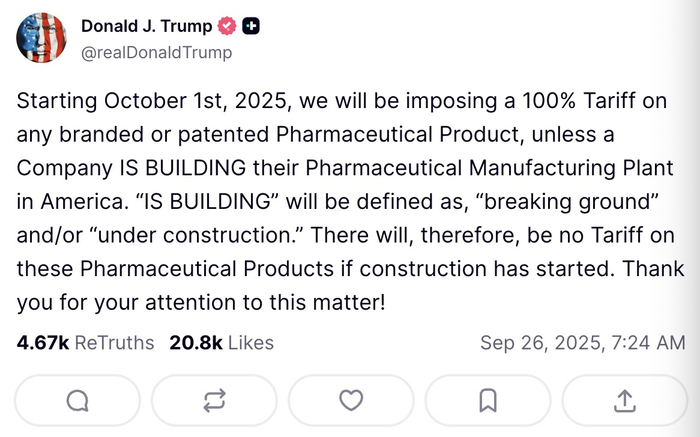
特朗普周四晚间宣布对进口药品征收100%关税后,瑞银等投行纷纷告诉客户,这一政策的实际影响或 将微乎其微。分析师指出,由于大型制药公司已在美国投资数百亿美元建设生产设施,大多数企业可获 得关税豁免。 据央视新闻报道,当地时间9月25日,美国总统特朗普在其社交媒体"真实社交"宣布,自10月1日起,美 国将对多类进口产品实施新一轮高额关税,其中对专利及品牌药品加征100%关税。 根据特朗普在社交媒体上的表态,对"任何品牌或专利药品"的100%关税将从10月1日起生效,但正在美 国建设制药生产厂的公司可获豁免。这一豁免条款被定义为"破土动工"或"在建中",只要开始施工就无 需缴纳关税。 周五亚洲股市因关税消息走低,亚洲制药股出现下滑。但欧洲大型制药股在特朗普隔夜宣布药品进口关 税后表现相对稳定。 市场普遍认为,鉴于主要药企已有大量美国生产布局,新关税政策的实际冲击有限。分析师预计,这一 政策更多具有象征意义,旨在推动制药业回流美国,而非真正打击进口药品贸易。据彭博经济学家分 析,受此举影响最大的国家是新加坡和瑞士。英国也有一些重要的对美制药出口——其与美国的贸易协 定提到,如果出现新的232条款关税,将考虑特殊税率 ...


Trump Pharma Plan Looks Like Reprieve for Many Drugmakers
Yahoo Finance· 2025-09-26 13:36
A production line of Wegovy injection pens at a Novo Nordisk A/S pharmaceutical manufacturing facility. President Donald Trump’s plan to impose a 100% tariff on branded drug imports was greeted with a shrug by many investors, who are betting his exemptions for companies with US manufacturing will soften any blow. While Trump’s move threatens to double the cost of some imported treatments if construction on US manufacturing sites hasn’t begun by Oct. 1, many big drugmakers already have US plants or are bu ...

国泰海通|产业:呼吸系统专题(一):慢阻肺治疗缺口突出,PDE3/4及多疗法共破局
国泰海通证券研究· 2025-09-26 11:08
Core Viewpoint - Chronic Obstructive Pulmonary Disease (COPD) has a high prevalence and mortality rate, indicating a significant unmet medical need for new treatment options [1] Group 1: Unmet Medical Needs in COPD - COPD is a leading cause of disability and death globally, with approximately 300 million cases worldwide and 100 million in China [1] - Current standard treatments (LAMA/LABA/ICS) have been in use for 40 years and carry risks of pneumonia, cardiovascular issues, and urinary tract infections, highlighting the urgent need for new therapies [1] Group 2: PDE3/4 Inhibitors and Market Activity - Merck acquired Verona for $10 billion to obtain Ensifentrine, while GSK spent approximately $12.5 billion to acquire HRS-9821 from Hansoh Pharma, reflecting the importance of the respiratory market and PDE3/4 targeted drugs [2] - PDE3 and PDE4 inhibitors have synergistic effects, potentially improving airway smooth muscle contraction and controlling inflammation, thus showing significant application potential [2] - Ensifentrine received FDA approval in June 2024, with sales reaching $217 million by Q2 2025, representing a 44% quarter-over-quarter growth, indicating substantial market potential [2] Group 3: Targeted Therapies for Eosinophilic Phenotype - Dupilumab (IL-4R) and mepolizumab (IL-5) have been successfully approved for COPD, focusing on high eosinophil count populations [3] - Dupilumab, the first targeted therapy for COPD, was approved by the FDA in 2024, with sales exceeding $14 billion in 2024 [3] - Mepolizumab showed positive results in trials with eosinophilic phenotype patients, demonstrating a correlation between eosinophil count and reduced acute exacerbation rates [3] Group 4: Emerging Targets and Domestic Innovations - TSLP and ST2/IL33 targets currently lack approved drugs, but domestic companies are innovating [4] - Amgen/AZ's tezepelumab is the only TSLP monoclonal antibody on the market, while domestic firms like Zhengda Tianqing and Kangnuo are developing differentiated therapies with promising efficacy [4] - The ST2/IL33 target, which is upstream of IL-4/IL-13, is being explored by domestic companies, with no approved drugs globally yet [4]


特朗普100%药品关税又是“狼来了”?多家上市药企高管回应
经济观察报· 2025-09-26 10:22
Core Viewpoint - The potential imposition of a 100% tariff on imported brand and patented drugs by the Trump administration starting October 1, 2025, has raised concerns among pharmaceutical companies, particularly those in China, leading to a decline in their stock prices [2][3]. Group 1: Impact on Pharmaceutical Companies - The announcement of the tariff has caused significant declines in the stock prices of Chinese pharmaceutical companies, with Heng Rui Pharmaceutical dropping 3.03% in A-shares and 2.23% in Hong Kong shares, and BeiGene falling 4.38% in A-shares and 1.55% in Hong Kong shares [2]. - The Hang Seng Innovative Drug Index (HSIDI) fell by 2.37%, with notable declines in stocks such as Fosun Pharma, which dropped 5.82%, and 3SBio, which fell by 5.34% [3]. - Industry experts suggest that the impact of the tariff on Chinese pharmaceutical companies may be limited, as many are focused on generic drugs and active pharmaceutical ingredients (APIs) [4]. Group 2: Industry Perspectives - Some industry leaders believe that the tariff policy may not be implemented as proposed, citing the high cost of drugs in the U.S. and the potential for political changes in future administrations [4][5]. - Companies like Heng Rui Pharmaceutical indicated that their current exports primarily consist of generics and APIs, suggesting minimal impact from the proposed tariffs [4]. - Other companies, such as Lepu Biopharma, noted that their licensing partnerships would shield them from significant effects [5]. Group 3: U.S. Policy Context - The Trump administration has previously threatened to impose tariffs on imported drugs, with discussions around a 200% tariff and subsequent smaller tariffs leading to a potential increase over time [6][7]. - Major multinational pharmaceutical companies have responded to the tariff threats by committing to significant investments in U.S. manufacturing, with companies like Novartis and Roche pledging $23 billion and $50 billion respectively over the next five years [8].

特朗普100%药品关税又是“狼来了”?多家上市药企高管回应
Sou Hu Cai Jing· 2025-09-26 10:21
Core Viewpoint - The potential implementation of a 100% tariff on all brand-name and patented drugs by the U.S. government starting October 1, 2025, unless companies are building drug manufacturing plants in the U.S. [2] Group 1: Market Reaction - Pharmaceutical stocks in multiple markets, including China, Japan, and South Korea, experienced a collective decline following the announcement [3] - Specific declines included a 3.03% drop in Hengrui Medicine (600276.SH/01276.HK) A-shares and a 2.23% drop in Hong Kong shares, while BeiGene (ONC.NASDAQ/06160.HK/688235.SH) saw a 4.38% drop in A-shares and a 1.55% drop in Hong Kong shares [3] - The Hang Seng Innovative Drug Index (HSIDI) fell by 2.37%, with notable declines in stocks such as Fosun Pharma (600196.SH/02196.HK) down 5.82% and 3SBio (01530.HK) down 5.34% [4] Group 2: Industry Perspectives - Industry experts suggest that Chinese pharmaceutical companies aiming to expand internationally need to consider the potential implementation of this policy and explore possible solutions [5] - Some executives believe that the high cost of drugs in the U.S. may hinder the realization of this policy [5] - Hengrui Medicine's executive noted that the impact of the potential policy would be limited as their exports mainly consist of generic drugs and APIs [5] - Other companies, such as Lepu Biopharma, indicated that their licensing partnerships would not be significantly affected [5] - Investors pointed out that this is a political issue that could change with future administrations, suggesting that while there may be short-term negative impacts, the long-term effects may not be significant [5] Group 3: Historical Context - Historically, pharmaceuticals have been excluded from tariff lists, but President Trump has repeatedly threatened to impose tariffs on imported drugs this year [5] - The Trump administration initiated a "232 investigation" under the Trade Expansion Act of 1962, which allows for tariffs if imports threaten national security [6] - Previous statements from Trump indicated plans for escalating tariffs on imported drugs, with initial small tariffs leading to potential increases up to 250% [7] Group 4: Investment Commitments - In response to the tariff threats, several multinational pharmaceutical companies have committed to investing in U.S. manufacturing facilities, with significant investments announced by companies like Novartis, Roche, Sanofi, and AstraZeneca [8] - Notably, Novartis and Roche pledged $23 billion and $50 billion respectively over five years, while AstraZeneca committed to a $50 billion investment by 2030 [8]
特朗普要对药品加征100%关税,国产创新药将受什么影响?
Xin Lang Cai Jing· 2025-09-26 10:16
Core Viewpoint - The U.S. plans to impose a 100% tariff on all branded and patented drugs starting October 1, 2023, with exemptions for companies building drug manufacturing plants in the U.S. [1][12] Drug Tariff Impact - The proposed tariff primarily targets branded pharmaceutical products and patented drugs, likely excluding generic drugs and biosimilars [2][4] - Branded drugs are typically sold under trademark names and can include both patented and off-patent products, which are often more expensive than generics [2][4] - Patented drugs are those still under patent protection, allowing only the original developer to produce and sell them [3][4] Export Data and Structure - In 2024, China's pharmaceutical exports to the U.S. are projected to reach $19.047 billion, with $6.425 billion in Western medicines and $0.87 billion in traditional Chinese medicine [4][5] - Raw materials account for 70.35% of China's pharmaceutical exports to the U.S., with $4.52 billion in raw material exports [4][5][6] Impact on Chinese Innovative Drugs - Several Chinese innovative drugs sold in the U.S. may be affected by the new tariffs, including products from companies like BeiGene and Legend Biotech [7][8] - The number of affected drugs is currently limited, with only a few Chinese companies having received FDA approval for their products [7][8] Global Manufacturing Trends - The new tariff policy is seen as an attempt to encourage pharmaceutical manufacturing to return to the U.S., with exemptions for companies already investing in U.S. production [11][12] - Major pharmaceutical companies have announced plans to increase investments in U.S. manufacturing, including companies like Eli Lilly, Novartis, and Roche [12][15] Global Supply Chain Dynamics - The global pharmaceutical manufacturing landscape has been shaped by cost-saving measures, with China and India becoming key players in raw material production [15][16] - The U.S. relies heavily on imports for raw materials, with 80% of its raw materials sourced from China and India [18] - The geopolitical climate is prompting a shift towards localized production, as companies seek to mitigate tariff and geopolitical risks [19]
关税巨浪下出口药企成本或翻倍,全球供应链或重塑
智通财经网· 2025-09-26 09:21
Core Viewpoint - The proposed 100% tariff on brand-name and patented drugs by President Trump could significantly increase costs for pharmaceutical companies without U.S. production capabilities, putting additional pressure on companies that have not yet initiated manufacturing in the U.S. [1] Group 1: Impact on Pharmaceutical Companies - Companies like Novartis (NVS.US) and Sanofi (SNY.US) have announced large-scale investments in the U.S., but the progress of these projects remains unclear [1] - Merck (MRK.US), Novo Nordisk (NVO.US), and Eli Lilly (LLY.US) have initiated U.S. manufacturing plans in states like Delaware, North Carolina, and Texas to support production of key drugs in oncology, diabetes, and immunology [1] - AbbVie (ABBV.US) plans to expand its production facilities in Illinois for cancer drug Imbruvica and immunology drug Skyrizi [1] Group 2: Economic Estimates and Trade Agreements - Economists estimate that the new tariffs could affect approximately $220 billion in U.S. drug imports, raising the average tariff rate by 3.3 percentage points [2] - There is uncertainty regarding whether countries with trade agreements with the U.S. can be exempt from these new tariffs, as seen in the EU's recent agreement which set drug tariffs at 15% [2] Group 3: Market Reactions and Stock Performance - Major pharmaceutical stocks in Tokyo, Seoul, and Hong Kong experienced declines following the tariff announcement, as investors assessed the risks to Japanese drugs [3] - Companies like Chugai Pharmaceutical Co. and Daiichi Sankyo Co. are particularly at risk due to their heavy reliance on the U.S. market [3] Group 4: Operational Impact on Asian Companies - The operational impact of the new tariffs on Asian pharmaceutical companies is expected to be limited, particularly for Japanese firms, as few sell brand-name drugs in the U.S. [3] - Shionogi & Co. is still considering whether to move its antibiotic production line for multi-drug resistant infections to the U.S. [3] Group 5: Chinese Pharmaceutical Companies - Few Chinese companies sell brand-name drugs in the U.S., primarily through multinational partnerships, which may mitigate the impact of the tariffs [5] - BeOne Medicines, a company with origins in China, has achieved significant sales in the U.S. with its cancer therapy Brukinsa, highlighting the complexities of defining imported drugs [5] Group 6: Long-term Market Entry Plans - The tariffs may affect the long-term plans of Chinese pharmaceutical companies aiming to enter the U.S. market, as many are eager to introduce innovative therapies [6] - There are unresolved questions regarding the implementation details of the tariff policy, including definitions of "under construction" and potential exemptions for using U.S. contract manufacturing [6]
Prediction: 2 Stocks That Will Be Worth More Than BigBear.ai 5 Years From Now
The Motley Fool· 2025-09-26 08:42
Group 1: BigBear.ai Overview - BigBear.ai has experienced significant stock price growth, with shares up over 70% year to date in 2025 [1] - The company currently has a market capitalization of approximately $2.9 billion [5] - BigBear.ai reported an 18% year-over-year revenue decline in Q2 2025 and has not achieved positive free cash flow [5][6] Group 2: Diebold Nixdorf Analysis - Diebold Nixdorf has a market capitalization of just over $2 billion, which is lower than BigBear.ai's [5] - The company serves major global financial institutions and retailers, providing cash management solutions and software applications [4] - Diebold Nixdorf's revenue fell only 2.6% year-over-year in Q2 2025, and it reported a 9% revenue increase from Q1 2025 [5] - The company ended Q2 with a backlog of around $980 million and has generated three consecutive quarters of positive free cash flow [6] - Diebold Nixdorf's price-to-sales ratio is significantly lower at 0.59 compared to BigBear.ai's 14.4 [6] - The company is also focused on AI, with its Vynamic Smart Vision technology recently winning an award [7] Group 3: Recursion Pharmaceuticals Insights - Recursion Pharmaceuticals has a smaller market capitalization compared to BigBear.ai, but its AI-driven drug discovery approach is seen as a potential game changer [8][10] - The company is currently reliant on collaboration agreements for revenue, with major partners including Roche, Sanofi, Bayer, and Merck KgAA [12] - Recursion has three experimental cancer therapies in development and is exploring treatments for rare genetic diseases [11] - The company has attracted significant interest from Nvidia, which owns approximately 7.7 million shares of Recursion [12] - There is optimism that Recursion's innovative approach could lead to a higher valuation than BigBear.ai in five years if its pipeline performs well [13]



特朗普宣布100%药品关税 瑞士巨头罗氏火速援引美国产能扩张计划
智通财经网· 2025-09-26 08:35
Core Viewpoint - The announcement of a 100% tariff on imported brand or patented drugs by the U.S. government, effective October 1, has prompted Roche to accelerate its investment plans in the U.S. pharmaceutical market, including a $50 billion commitment for manufacturing and R&D [1][2]. Group 1: Roche's Response - Roche has begun construction on a new manufacturing facility in Holly Springs, North Carolina, as part of its commitment to significant investment in the U.S. market [1]. - The company aims to meet the U.S. government's requirements to avoid the new tariffs by establishing a large manufacturing presence in the country [1][2]. Group 2: Impact on the Pharmaceutical Industry - The new tariff policy is expected to heavily impact European pharmaceutical giants like Novartis, Roche, Sanofi, AstraZeneca, and Bayer, forcing them to choose between absorbing high tariff costs or investing billions to relocate production to the U.S. or its trade partners [2]. - The transition of supply chains to the U.S. is complex and costly, potentially leading to disruptions and challenges in the short term [2]. Group 3: Strategic Implications - The tariff policy will reshape the pathways for global pharmaceutical companies entering the U.S. market, with significant implications for pricing and profit models if production remains overseas [3]. - Companies that choose to produce in the U.S. or partner with U.S.-based contract development and manufacturing organizations (CDMO) can avoid tariffs, although this will increase initial capital expenditures and unit costs [3].

特朗普宣布新关税最高达100%!谁最受伤?
第一财经· 2025-09-26 05:49
Group 1: Tariffs on Heavy Trucks - President Trump announced a 25% tariff on imported heavy trucks, which follows an investigation by the U.S. Department of Commerce to assess whether such imports pose a national security threat [4] - The tariffs aim to protect U.S. truck manufacturers like Peterbilt, Kenworth, and Freightliner from foreign competition, although previous tariffs on steel and aluminum have already increased production costs for U.S. manufacturers [4][5] - Mexico is the largest exporter of medium and heavy trucks to the U.S., with a significant increase in imports since 2019, raising concerns about the impact of tariffs on the supply chain [5][3] Group 2: Pharmaceutical Tariffs - A new 100% tariff on all imported brand and patented drugs will apply unless companies have already begun construction of manufacturing plants in the U.S. [7] - The pharmaceutical industry has seen a decline in stock prices in Asia following the announcement, with companies like Sumitomo Pharma and CSL experiencing significant drops [7] - Major pharmaceutical companies have committed to investing over $350 billion in U.S. manufacturing and R&D by the end of the century, indicating a shift towards domestic production in response to tariff threats [8][9] Group 3: Furniture Tariffs - Trump stated that tariffs on imported furniture are necessary to restore U.S. manufacturing strength, particularly in states like North Carolina and South Carolina [12] - The furniture and wood products manufacturing sector has seen a significant decline in jobs, with employment halved since 2000 [12] - Recent tariffs have led to a 4.7% increase in overall furniture prices, with living and dining room furniture prices rising by 9.5% over the past year [12][13]