追觅科技

Search documents
追觅科技:2025上半年营收远超2024全年
Xin Lang Ke Ji· 2025-09-04 07:45
Group 1 - The core point of the article is that Chasing Technology has achieved significant revenue growth in the first half of 2025, surpassing the total revenue of 2024 within just six months [1] - Chasing Technology's sweeping robot has reached the top position in 22 countries and regions globally, with over 40% market share in 12 of those areas, establishing a new high-end smart living ecosystem [1] - The company has launched its first television product featuring a mini LED panel, promising high refresh rates and low latency, aimed at enhancing high-end audio-visual experiences through AI and aesthetic design [1]
追觅“全家桶”亮相:从扫地机到智能戒指,一口气发布30余款新品
Feng Huang Wang· 2025-09-04 07:31
Core Insights - The company, Chasing Technology, launched over 30 new products at its "Dare to Dream" event, expanding its product line from smart cleaning to home care, major appliances, kitchen electronics, smart displays, and wearable devices, showcasing its technological depth and systematic product layout capabilities [1][4] Smart Cleaning - Chasing Technology introduced the world's first AI "dual-scrubbing" robotic arm in its flagship floor washing machines, T60 Ultra and H60 Ultra, providing industry-leading solutions for sticky stains, water marks, and corner dirt [1] - The Matrix10 Ultra vacuum cleaner features a unique "smart cloth zone replacement system" that changes cloth materials based on different floor areas, addressing cross-contamination during home cleaning [1] - The V30 Pro vacuum cleaner incorporates the company's innovative constant clean water washing system 2.0, enabling it to handle mixed dry and wet waste, achieving a thorough clean in one go [1] Home Care - The PM30 humidifying air purifier utilizes the world's first intelligent dual air duct and AI perception dynamic tracking technology for rapid and uniform humidification and purification in large spaces [2] - The X30 hair dryer focuses on hair and scalp health with its ultra-high frequency micron-level mist technology, which helps retain moisture and reduce dryness [2] Major Appliances - Chasing Technology's major appliances, showcased at AWE 2025, include the Extreme Series refrigerator with a global first 5% ultra-low oxygen freshness technology, enhancing food preservation [2] - The X-Wind air conditioner features robotic wind control and a 126° wide-angle natural wind technology, improving cooling and heating comfort by 200% [2] - The L9 all-variable frequency washing and drying set integrates various innovative functions for a comprehensive garment care experience [2] Kitchen and Culinary Appliances - The company emphasizes solid and reliable foundational capabilities in kitchen appliances, with innovations in smoke control, temperature management, cleaning, and storage [3] - The Aura MiniLED 4K smart screen V3000 and AI smart ring were introduced, showcasing the company's high-end positioning in the display and wearable device markets [3] Systematic Technological Innovation - The event highlighted the company's ability to platform core technologies across different scenarios, with a total of 6,379 global patent applications as of June 2025 [4] - The launch of multiple globally pioneering technologies and over 30 all-scenario products indicates the company's strategy to build comprehensive competitiveness in the high-end smart living sector [4]
追觅造车:扫地机器人的“速度梦想”能否驶入现实?
Xin Lang Zheng Quan· 2025-09-04 07:01
Core Viewpoint - Chasing Technology officially announced its entry into the automotive industry, aiming to create the "fastest car in the world," with its first ultra-luxury electric vehicle set to debut in 2027, directly competing with Bugatti Veyron [1] Group 1: Technological Foundation and Global Presence - Chasing Technology's decision to enter the automotive sector is backed by a long-term vision, having drafted its first car plan as early as 2013 [2] - The company has accumulated significant technological expertise in high-speed digital motors, smart sensing, and AI algorithms, with a total of 6,379 global patent applications by the end of 2024, of which 45% are invention patents [2] - Its patents cover key areas in smart automotive technology, providing a solid technical foundation for its vehicle production [3] - The company has established over 6,000 offline channels in more than 100 countries, boasting a user base of 30 million, which will support its high-end automotive brand's marketing and service [3] Group 2: Challenges in the Automotive Sector - The automotive industry is characterized by long cycles, heavy investment, and slow returns, with intense competition leading to the exit of many smaller players [4] - Chasing Technology is not yet publicly listed, limiting its financing capabilities, and faces uncertainty regarding its ability to support mass production with its asset-light model [4] - The company’s core business in robotic vacuum cleaners is under pressure, with a projected global market share of 8% in 2024, ranking fifth, and a revenue of 15 billion yuan, nearly doubling from 2023, but with a 6% decrease in gross margin and a 12% drop in average selling price [4] Group 3: Strategic Approach and Market Positioning - Chasing Technology employs a "left-hand and right-hand model," where the left-hand represents its ODM business for cash flow, while the right-hand focuses on self-developed vehicle projects [5] - The company aims for a differentiated strategy by targeting the ultra-luxury electric vehicle market, avoiding direct competition with mainstream brands like Tesla and BYD [6] - Plans include launching vehicles overseas before entering the domestic market, with a focus on high-end branding [6] Group 4: Internal Challenges and Future Prospects - Progress on vehicle production has faced delays, with the first model still in the design review stage, and the original production timeline for February 2027 is no longer emphasized internally [7] - The company plans to showcase prototype vehicles to attract financing, but internal confusion exists regarding priorities between prototype development and ODM operations [7] - The automotive venture reflects a broader trend among Chinese smart hardware companies seeking new growth avenues amid increasing competition in the cleaning appliance market [8] Group 5: Industry Context and Competitive Landscape - Chasing Technology's entry into the automotive sector highlights the maturity of China's electric vehicle supply chain, allowing for lower barriers to entry [10] - The ultra-luxury market remains dominated by traditional brands like Bugatti and Bentley, which are slow to adopt electric and smart technologies, providing a competitive edge for Chasing Technology [10] - The company’s ability to transition from a successful cleaning appliance brand to a notable automotive player remains uncertain, with significant challenges ahead [10]

追觅科技:2025年上半年营收远超2024年全年
Mei Ri Jing Ji Xin Wen· 2025-09-04 07:00
Core Insights - The company,追觅科技, announced that its revenue for the first half of 2025 will significantly exceed the total revenue for the entire year of 2024 [1] - This breakthrough is attributed to a technology-driven product matrix upgrade and a deepened global strategy [1] Company Expansion - 追觅科技's products are now available in over 100 countries and regions [1] - The company has established a presence in more than 6,000 physical retail stores worldwide [1] - It has cumulatively served over 30 million households [1]
跨界造车背后,一场被业绩增长与资本焦虑绑架的冒险
Xin Lang Cai Jing· 2025-09-03 08:52
Core Viewpoint - The automotive ambitions of Chasing Technology reflect a strategic shift in response to growth challenges in its core cleaning appliance business, raising questions about the feasibility and risks of such a transition [1][4][16]. Company Overview - Chasing Technology, founded in 2017, has evolved from a smart cleaning appliance company to a player in the automotive sector, with plans to launch its first model, a range-extended SUV, by 2027 [2][4]. - The company has applied for a total of 6,379 patents globally, with 45% being invention patents in key areas such as sensor fusion and motor control [2]. Market Context - The cleaning appliance market is nearing saturation, with the penetration rates for robotic vacuums and floor washers at only 5.5% and 3.1% respectively, leading to increased competition among key players [4][12]. - Chasing Technology's revenue surged from 2 billion to 15 billion RMB between 2020 and 2023, but the company now faces a growth ceiling as market dynamics shift [4][15]. Strategic Expansion - The company is pursuing a "boundary-less" expansion strategy, entering various sectors including drones and automotive, leveraging its existing technological capabilities [3][4]. - Chasing Technology has established a nearly 1,000-person automotive team and is expanding its capabilities in electric drive systems and intelligent cockpit technologies [1][3]. Challenges in Automotive Transition - The transition to automotive manufacturing poses significant challenges, including the need for deep technical expertise in electric vehicle systems, which differ greatly from home appliance technologies [6][8]. - The company faces high barriers to entry in the automotive sector, including the need for production qualifications and the establishment of a robust quality control system [9][10]. Competitive Landscape - The automotive market is increasingly competitive, with established players like Tesla and BYD reducing prices and enhancing technology, making it difficult for new entrants to gain a foothold [11][12][13]. - Chasing Technology's ability to compete against established automotive brands is questioned, particularly regarding its technological capabilities and market positioning [15][16]. Financial Considerations - The company has not secured new funding since May 2023, raising concerns about its financial sustainability as it embarks on a capital-intensive automotive venture [5][15]. - The potential for a "second curve" of growth through automotive manufacturing is seen as a necessary move to revitalize investor interest, but it carries significant risks [5][16]. Conclusion - Chasing Technology's decision to enter the automotive market reflects broader anxieties within the Chinese tech consumer sector as companies seek new growth avenues amid market saturation [15][16]. - The success of this transition will depend on the company's ability to navigate the complexities of automotive manufacturing while maintaining its core business [17].
追觅跨界无人机 低空经济迎来新玩家
Xin Lang Zheng Quan· 2025-09-02 10:31
Core Insights - Chasing Technology has confirmed its expansion into the drone business, strategically positioning itself in the trillion-dollar low-altitude economy market [1] - The company is assembling a professional drone R&D team, indicating a serious commitment to this new venture [1] Technology and Cross-Industry Strength - The founding team of Chasing Technology includes members from Tsinghua University's "Sky Factory," providing a strong aerospace technology background as a competitive advantage [2] - The company has developed three core technologies in the smart cleaning sector that can be directly applied to drone flight control and navigation systems, enhancing operational efficiency [2] - Chasing Technology follows a "mass production, R&D, and reserve" principle in its technology development, ensuring a solid foundation for cross-industry expansion [2] Strategic Path and Market Positioning - The initial operational model for Chasing's drone project will focus on e-commerce and "OEM" strategies to quickly penetrate the market [3] - The company is recruiting for key positions, indicating a focus on the industrial-grade drone market, which has significant applications in agriculture, surveying, and security [3] - Chasing has established a headquarters in Suzhou and a branch in Shenzhen to leverage the local drone industry ecosystem [3] Low-Altitude Economy and Industry Cross-Over - The low-altitude economy is emerging as a trillion-dollar market, attracting various companies, including Chasing Technology and Insta360 [4] - There is a trend of cross-industry movement, with established drone companies like DJI entering the smart cleaning sector, indicating a competitive landscape [4] - Chasing's cross-industry strategy aligns with its broader "boundary-less" expansion approach, having already entered multiple sectors through internal incubation [4] Challenges and Future Outlook - Chasing Technology faces significant challenges in entering the drone market, particularly due to DJI's dominant market share of 70% to 85% globally [5] - The company must maintain long-term focus amidst a vast business ecosystem, which poses a real challenge [6] - Chasing's unique advantages include its self-built smart manufacturing base and integrated global supply chain, which could facilitate agile responses to market demands [6] - The drone could become a key component of Chasing's smart home ecosystem, providing enhanced user engagement [6] - The future of the consumer drone market may shift from a "monopoly" to a "dual-hero" competition, potentially transforming the industry landscape [6]
追觅全系列新品即将登场,以创新变革居家体验
Huan Qiu Wang· 2025-09-02 07:14
Core Insights - Chasing Technology will hold a product launch event on September 4, themed "Dare to Dream, Dare to Act," showcasing multiple self-developed technologies focused on real household usage scenarios [1] Group 1: Cleaning Technology Innovations - The T60 Ultra and H60 Ultra floor washing machines feature AI "dual-scrubbing" mechanical arms, simulating human hand movements to address edge cleaning and sticky stain removal [3] - The Matrix10 Ultra sweeping robot introduces a "smart mop zone replacement system," allowing for area-specific mop changes to reduce cross-contamination in different functional spaces like kitchens and bathrooms [3] - The new generation vacuum cleaner has been optimized for hair entanglement and deep cleaning issues, with specific technical details to be revealed at the launch event [3] Group 2: Major Appliance Innovations - Several innovative technologies will enhance user experience in major appliances, including the mechanical arm wind control technology for air conditioners, which aligns airflow more closely with human comfort [3] - The "Extreme" series refrigerator focuses on food preservation and nutrition protection, featuring a 5% ultra-low oxygen preservation and AI Cooling "Nutrition Master" function [3] - The AI full-variable frequency washing and drying set L9 introduces interactive upgrades with a bionic mechanical arm knob and a truly flat embedded design, along with cold power oxygen protection washing and plasma fresh air cruising functions [3] Group 3: Additional Product Offerings - The launch event will also present a variety of products including air purifiers, water purifiers, televisions, and large kitchen appliance sets, aimed at enhancing the overall home experience [4] - These innovative technologies and products are designed to provide users with a more comfortable and convenient home life, ensuring natural airflow, better food preservation, cleaner air, and easier cleaning and care [4]

白电“三巨头”PK:美的狂奔,海尔稳健,格力再垫底
Hu Xiu· 2025-09-02 05:08
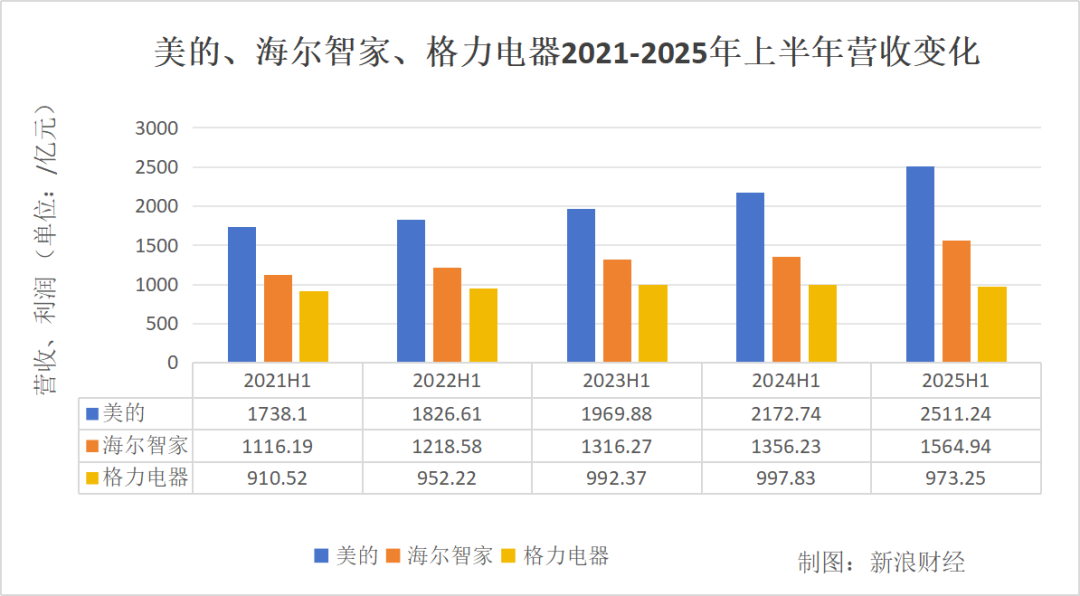
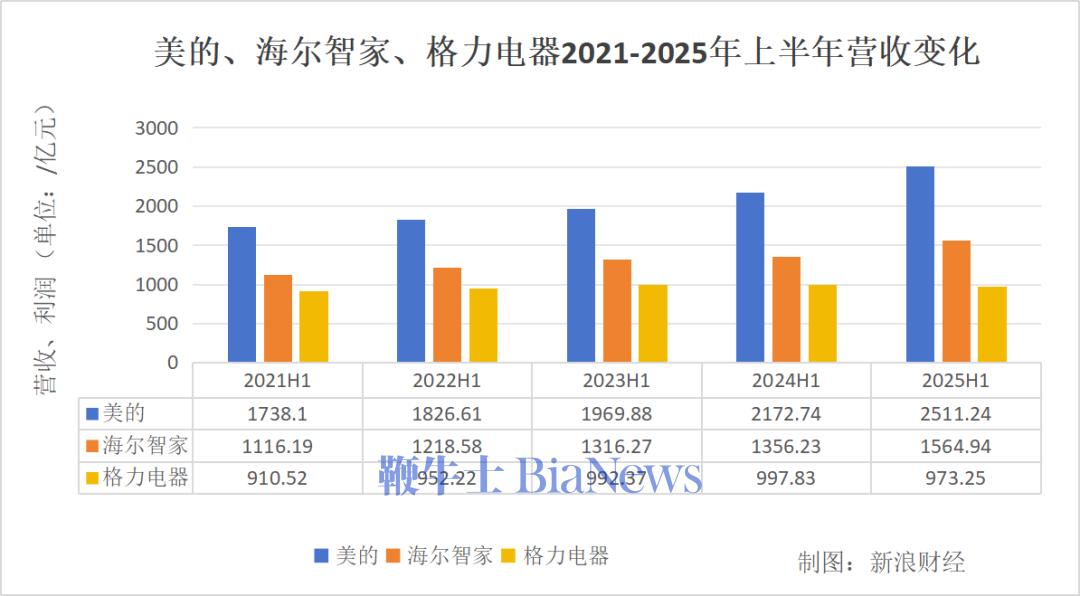
Core Viewpoint - The three major white goods companies, Midea Group, Haier Smart Home, and Gree Electric Appliances, have reported their semi-annual results for 2025, showcasing varied performance in revenue and net profit growth, with Midea leading significantly in both metrics [1][2][3]. Revenue and Profit Performance - Midea Group reported revenue of 251.12 billion yuan, a year-on-year increase of 15.58%, and a net profit of 26.01 billion yuan, up 25.04% [1][8]. - Haier Smart Home achieved revenue of 156.49 billion yuan, growing 10.22%, with a net profit of 12.03 billion yuan, reflecting a 15.59% increase [1][10]. - Gree Electric Appliances experienced a revenue decline to 97.32 billion yuan, down 2.46%, while net profit grew slightly to 14.43 billion yuan, up 1.95% [1][14]. Market Trends and Dynamics - The domestic home appliance market (excluding 3C products) reached a retail value of 453.7 billion yuan, growing 9.2% year-on-year, with significant growth in air conditioning and washing machine sectors [5][6]. - The air conditioning market saw retail sales of 38.45 million units, a 15.6% increase, while the retail scale reached 126.3 billion yuan, up 12.4% [5][6]. Company-Specific Insights - Midea Group's revenue and profit growth rates have not slowed despite its size, maintaining a consistent upward trend for four consecutive years [10][12]. - Haier Smart Home has shown stable growth without any year-on-year declines since 2021, with net profit growth consistently above 12% [12][10]. - Gree Electric Appliances has shown a noticeable decline in revenue growth since 2021, with a significant drop in its core air conditioning business, which traditionally contributes over 70% of its revenue [16][21][23]. Competitive Landscape - The competitive environment has intensified, with Midea and Haier gaining market share in the air conditioning sector, while Gree has seen a decline [22][24]. - Midea has implemented operational restructuring to enhance efficiency, while Gree is diversifying its product offerings beyond air conditioning [25][26]. - Haier is actively expanding its business through investments and acquisitions, indicating a strategic focus on growth through diversification [27][28]. Industry Challenges - The home appliance industry is facing challenges such as price competition and market saturation, leading to a need for companies to adapt their strategies to maintain market share [29].



白电「三巨头」PK:美的狂奔,海尔稳健,格力再垫底
Xin Lang Ke Ji· 2025-09-02 02:00
Core Viewpoint - The performance of major home appliance companies in the first half of 2025 shows varied results, with Midea Group leading in both revenue and profit growth, while Gree Electric experienced a decline in revenue and slower profit growth [1][2][3]. Revenue and Profit Performance - Midea Group reported revenue of 251.12 billion yuan, a year-on-year increase of 15.58%, and a net profit of 26.01 billion yuan, up 25.04% [1][8]. - Haier Smart Home achieved revenue of 156.49 billion yuan, growing by 10.22%, with a net profit of 12.03 billion yuan, reflecting a 15.59% increase [1][10]. - Gree Electric's revenue was 97.32 billion yuan, down 2.46%, with a net profit of 14.43 billion yuan, showing a modest growth of 1.95% [1][13]. Market Trends - The domestic home appliance market (excluding 3C products) reached a retail value of 453.7 billion yuan, growing by 9.2% year-on-year in the first half of 2025 [5][6]. - The air conditioning sector saw retail sales of 12.63 billion yuan, up 12.4%, while washing machines and refrigerators also experienced growth [5][6]. Company-Specific Insights - Midea Group's revenue and profit growth rates have not slowed despite its large scale, maintaining a positive trend for four consecutive years [10][12]. - Haier Smart Home has shown stable growth without any year-on-year declines since 2021, with a net profit growth consistently above 12% [12][10]. - Gree Electric has faced a noticeable decline in revenue growth, with its core air conditioning business contributing over 70% of its revenue, which has been under pressure [19][21]. Competitive Landscape - The competitive dynamics in the air conditioning market have shifted, with Midea and Haier gaining market share while Gree has seen a decline [20][22]. - Midea has made operational adjustments to enhance efficiency, while Gree is diversifying its product offerings to reduce reliance on air conditioning [22][23]. - The industry is witnessing increased competition from emerging players, leading to price wars and a focus on brand reputation and distribution channels [24].
中国白电“三巨头”半年报PK:美的营收2511亿狂奔,海尔1564亿稳健,格力973亿垫底!格力利润增幅明显放缓
Sou Hu Cai Jing· 2025-09-02 01:42
Core Viewpoint - The performance of major home appliance companies in China, specifically Midea Group, Haier Smart Home, and Gree Electric Appliances, shows significant differences in revenue and profit growth for the first half of 2025, with Midea leading the pack. Group 1: Company Performance - Midea Group reported revenue of 251.12 billion yuan, a year-on-year increase of 15.58%, and a net profit of 26.01 billion yuan, up 25.04% [2][5] - Haier Smart Home achieved revenue of 156.49 billion yuan, growing 10.22% year-on-year, with a net profit of 12.03 billion yuan, an increase of 15.59% [2][8] - Gree Electric Appliances saw revenue decline to 97.32 billion yuan, down 2.46%, while net profit grew slightly to 14.43 billion yuan, up 1.95% [2][15] Group 2: Market Trends - The domestic home appliance market (excluding 3C products) reached a retail value of 453.7 billion yuan, growing 9.2% year-on-year in the first half of 2025 [4] - The air conditioning sector saw retail sales of 38.45 million units, a 15.6% increase, with a retail scale of 126.3 billion yuan, up 12.4% [4] - The washing machine market reported retail sales of 47.6 billion yuan, growing 11.5%, while the refrigerator market reached 67.28 billion yuan, up 3.5% [4] Group 3: Competitive Landscape - Midea has established itself as a dominant player, nearly matching the combined revenue of Haier and Gree, indicating its capability to "compete against two" [6][8] - Gree's air conditioning business, a core revenue driver, has shown signs of decline, with a 5.09% drop in the consumer electronics segment [13][15] - The competitive environment is intensifying, with new entrants like Xiaomi gaining market share, prompting established players to adjust strategies [17][18]