
中国太平

Search documents
非银行业周报:政治局会议提到“巩固资本市场向好势头”,高活跃度有望延续-20250803
SINOLINK SECURITIES· 2025-08-03 08:40
Investment Rating - The report suggests a focus on three main investment lines within the securities and insurance sectors, indicating a positive outlook for the industry [3][5]. Core Insights - The securities sector has shown a clear improvement in performance in the first half of the year, with 27 listed brokerages reporting profit increases of over 40% year-on-year, driven by a rebound in market activity [2]. - The insurance sector is experiencing significant changes, particularly in the development of commercial health insurance products, emphasizing differentiated pricing and market-oriented operations [4][37]. Summary by Sections Securities Sector - The political bureau meeting on July 30 emphasized the importance of stabilizing the capital market, suggesting sustained high activity levels in the market [2]. - The report highlights the mismatch between high profitability and low valuations in the brokerage sector, recommending attention to leading brokerages with significantly lower valuations than the average [3]. - Key performance indicators include a year-on-year increase of 65.7% in average daily stock fund transaction volume for the first half of 2025 [16]. Insurance Sector - The insurance industry reported a 5.04% increase in original premium income, totaling 3.74 trillion yuan in the first half of 2025, with life insurance premiums growing by 5.34% [37]. - Regulatory changes are pushing for a return to market-oriented operations in health insurance, which is expected to enhance the sustainability of health insurance projects [4]. - The impact of the reintroduction of VAT on bond interest income is expected to have a limited effect on insurance company profits, with estimated profit impacts for major insurers ranging from 1.11 million to 5.74 million yuan [4].


保险业换帅潮
经济观察报· 2025-08-02 04:01
Core Viewpoint - The insurance industry is experiencing a significant turnover in management, with over 50 companies undergoing leadership changes since 2025, reflecting a shift from rapid expansion to a focus on long-term operations [1][3][13] Group 1: Management Changes - As of mid-2025, more than 30 insurance companies have seen changes in their top management, including key positions such as chairman and general manager [13] - The turnover includes both strategic adjustments in leading firms and urgent replacements in companies facing risks [3][14] - The approval of over 40 executive appointments in the first half of 2025 marks a notable increase compared to fewer than 30 in the same period of 2024 [3] Group 2: Industry Challenges - The insurance sector is under pressure from declining traditional growth models, strict regulations, and concerns over interest rate margins, necessitating the search for new growth avenues [3][19] - Companies are grappling with a changing market landscape, including the impact of regulatory changes and shifts in consumer demand, which complicate their operational strategies [18][21] Group 3: Strategic Implications - Leadership changes present a "window of opportunity" for companies to restart strategic planning, optimize governance structures, and rebuild organizational culture [9][18] - The need for executives with strategic vision and integration capabilities is emphasized, as companies face the challenge of aligning with shareholder expectations and market realities [10][19] Group 4: Specific Company Examples - North Bay Insurance is set to appoint a new chairman after a nine-month vacancy, while Huatai Life has recently filled its general manager position after a three-year gap [2][9] - The frequent changes in management at smaller insurance firms reflect survival anxieties amid competitive pressures and limited operational flexibility [15][21] - Major players like China Life and China Insurance have also undergone significant leadership transitions, indicating a broader trend across the industry [19][20]






【金融头条】保险业换帅潮
Jing Ji Guan Cha Wang· 2025-08-01 14:40
Group 1 - The insurance industry is experiencing an unprecedented wave of leadership changes, with over 50 companies undergoing management transitions since 2025, reflecting a shift towards long-term operational stability [2][3][12] - In the first half of 2025, more than 40 executives received approval for their positions, surpassing the previous year's figures, indicating a trend of increased executive turnover [3][12] - The changes in leadership are driven by the need for companies to adapt to a challenging market environment characterized by declining traditional growth models and regulatory pressures [3][17] Group 2 - The management reshuffles are not limited to smaller firms; major players like China Life, China Pacific, and AIA have also seen significant personnel changes, highlighting a broader industry trend [18][19] - The leadership changes are seen as opportunities to restart strategic planning, optimize governance structures, and rebuild organizational culture [8][20] - The insurance sector is at a critical juncture, with a focus on high-quality transformation, necessitating leaders who possess strategic vision and the ability to integrate resources effectively [9][20] Group 3 - The frequent turnover in management, particularly in property and casualty insurance companies, reflects the industry's struggle with business model limitations and competitive pressures [15][17] - Companies like Qianhai Insurance have faced challenges with high executive turnover, indicating instability within their leadership [6][7] - The need for new leadership is often driven by internal pressures to align with evolving market demands and external competitive dynamics [17][20]

太平人寿:“邪修”分红险
阿尔法工场研究院· 2025-08-01 00:08
Core Viewpoint - The article emphasizes that Taiping Life Insurance has gained a competitive edge in the dividend insurance market due to its early strategic positioning and proactive measures, despite facing challenges in maintaining long-term competitiveness and customer base [3][4][22]. Group 1: Market Dynamics - The adjustment of the guaranteed interest rate for life insurance, effective July 25, has created both challenges and opportunities for the life insurance industry, with dividend insurance emerging as a key growth area [4][5]. - The potential increase in dividend insurance new business premium share to 50% over the next three years could lead to an incremental premium exceeding 1.8 trillion yuan [5]. - Major insurance companies, including China Life and Ping An, have set ambitious targets for dividend insurance, indicating a strong industry shift towards this product type [5][6]. Group 2: Taiping Life's Strategy - Taiping Life has achieved a remarkable 98.9% share of dividend insurance in its individual insurance channel and over 90% across all channels, thanks to its early strategic foresight and decisive execution [6][11]. - The company has implemented an "internal and external" strategy to promote dividend insurance, enhancing its importance in performance evaluations and incentivizing sales teams [7][10]. - Taiping Life's asset allocation strategy includes a significant increase in long-term bonds, with a target of 74.5% in bond allocation by 2024, positioning itself for higher floating returns [10][11]. Group 3: Competitive Challenges - Despite its current lead, Taiping Life faces significant challenges, including a notable decline in individual life insurance customers, with a drop from 15.17 million to 13.91 million, representing an 8.3% decrease [14][16]. - The company's agent workforce has also contracted, with a reduction of 8,613 agents, or 3.7%, which may weaken its sales foundation [14][16]. - Frequent management changes within Taiping Life could disrupt strategic execution and decision-making during a critical transformation period [18][22]. Group 4: Industry Outlook - The competition in the dividend insurance sector is expected to intensify, potentially leading to a market structure similar to Hong Kong, where a few companies dominate the market [20][22]. - The unique mechanisms of dividend insurance present dual challenges in sales and investment, requiring strong capabilities to manage customer expectations and investment returns [21][22].

官宣!又有金融高管,赴任地方
Zhong Guo Ji Jin Bao· 2025-07-31 11:20
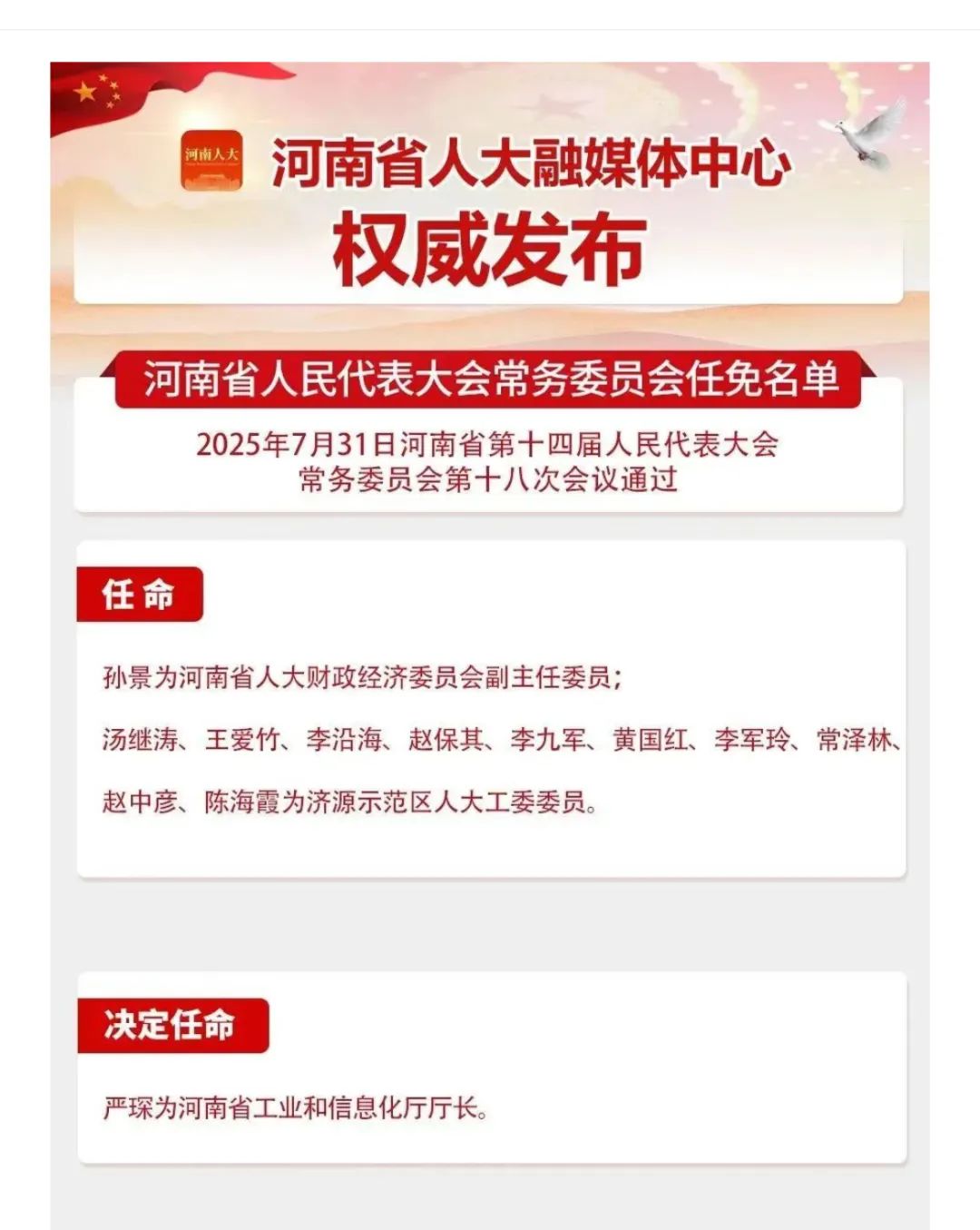
从过往履历来看,严琛不仅是"70后"金融高管,还拥有金融和地方党政部门等复合背景。 7月31日,据微信公众号"河南发布"消息,河南省十四届人大常委会第十八次会议通过,决定任命严琛为河南省工业和信息化厅厅长。 公开资料显示,严琛,1972年8月出生,湖北襄阳人,博士研究生学历,曾任国家开发银行综合计划局计划处正科级行员,国家开发银行党委宣传部综合 处副处长,国家开发银行信用管理局评级方法与标准处副处长,安徽省中小企业发展局副局长,安徽省经济委员会副主任,安徽省经济和信息化委员会副 主任,池州市委常委、副市长,宣城市委常委、组织部部长,宣城市委副书记,安徽省信用担保集团有限公司董事长兼安徽省融资再担保有限公司董事 长、奇瑞汽车股份有限公司董事等职。 2021年4月,严琛就任徽商银行党委书记,并于同年7月获得监管核准任该行董事长。 【导读】徽商银行原董事长严琛跨省担任河南省工业和信息化厅厅长 此前,严琛曾担任徽商银行董事长一职。 又有金融高管奔赴地方 金融高管赴任地方逐渐常态化 近年来,金融系统高管赴任地方逐渐常态化。 今年以来,有多名金融系统高管赴地方任职。例如,3月25日,据"南方+"客户端消息,广东省十四届人 ...
官宣!又有金融高管,赴任地方
中国基金报· 2025-07-31 11:13
【 导读 】 徽商银行原董事长严琛跨省担任河南省工业和信息化厅厅长 中国基金报记者 马嘉昕 7 月 31 日,据微信公众号 " 河南发布 " 消息, 河南省十四届人大常委会第十八次会议通 过,决定任命严琛为河南省工业和信息化厅厅长 。 此前,严琛曾担任徽商银行董事长一职。 又有金融高管奔赴地方 从过往履历来看,严琛不仅是 "70 后 " 金融高管,还拥有金融和地方党政部门等复合背景。 公开资料显示,严琛, 1972 年 8 月出生,湖北襄阳人,博士研究生学历,曾任国家开发银 行综合计划局计划处正科级行员,国家开发银行党委宣传部综合处副处长,国家开发银行信 用管理局评级方法与标准处副处长,安徽省中小企业发展局副局长,安徽省经济委员会副主 任,安徽省经济和信息化委员会副主任,池州市委常委、副市长,宣城市委常委、组织部部 长,宣城市委副书记,安徽省信用担保集团有限公司董事长兼安徽省融资再担保有限公司董 事长、奇瑞汽车股份有限公司董事等职。 2021 年 4 月,严琛就任徽商银行党委书记,并于同年 7 月获得监管核准任该行董事长。 据悉,稍早之前,原任河南省工信厅厅长的李建涛已跨省调任江西上饶市委副书记、代市 长。 ...

太平财险河南分公司违规被罚 涉跨省经营保险业务等
Zhong Guo Jing Ji Wang· 2025-07-31 09:15
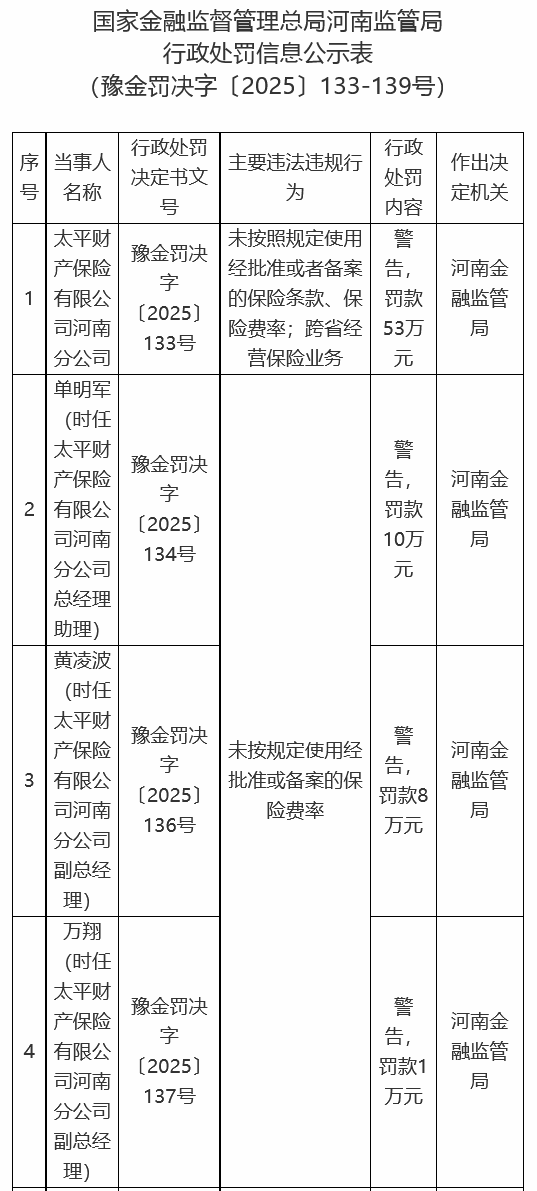
Summary of Key Points Core Viewpoint - The Henan Financial Regulatory Bureau has imposed administrative penalties on Taiping Property Insurance Co., Ltd. Henan Branch for violations related to the use of approved insurance terms and rates, as well as for conducting cross-provincial insurance business. Group 1: Administrative Penalties - Taiping Property Insurance Co., Ltd. Henan Branch was fined 530,000 yuan for not using approved or filed insurance terms and rates, and for conducting cross-provincial insurance business [1]. - The assistant general manager, Shan Mingjun, received a warning and a fine of 100,000 yuan for similar violations regarding the use of approved insurance rates [1]. - Huang Lingbo, the deputy general manager, was also fined 80,000 yuan for not adhering to the approved insurance rates [1]. - Another deputy general manager, Wan Xiang, was fined 10,000 yuan for the same issue of not using approved insurance rates [1].
上半年绿色保险发展提速
Jin Rong Shi Bao· 2025-07-30 14:48
Core Viewpoint - Green finance is becoming a key force in driving high-quality economic and social development in response to climate change and low-carbon transition [1] Policy Support - A series of policies have been introduced to guide the insurance industry in developing green finance, including the implementation plan for high-quality development of green finance in the banking and insurance sectors [1][2] - Local governments are launching tailored green finance plans, such as the initiatives from the People's Bank of China in Guangdong to promote green financial services [2] Product Innovation - Insurance institutions are increasing innovation in green insurance products, expanding coverage areas and enhancing product functionality to meet diverse market demands [3] - Specific products like the "property all-risk insurance (for the energy storage industry)" have been introduced to mitigate risks associated with renewable energy projects [3][4] Climate Change Response - The insurance industry is increasingly prioritizing climate change in strategic management, with many companies integrating climate policies into their operational practices [5][6] - There is a growing demand for weather index insurance across various sectors, with over a hundred products available nationwide [6] Financial Support for Green Industries - Insurance funds are aligning well with the funding needs of green industries, with significant investments being made in low-carbon and energy transition sectors [7] - As of March 2025, the green investment scale of China Life Asset Management exceeded 450 billion yuan [7] Future Development Recommendations - Industry experts suggest enhancing investment in risk assessment technologies and models, utilizing big data and AI for more accurate risk evaluations [8] - There is a call for increased promotion of green insurance knowledge to raise public awareness and acceptance [8]
保险框架:“慢牛市”下的戴维斯双击
2025-07-30 02:32
Summary of Conference Call on the Insurance Industry Industry Overview - The insurance industry is currently experiencing a "slow bull market" driven primarily by investment yield improvements, with a low proportion of new business relative to existing liabilities. The key to future profitability lies in the widening gap between investment yields and liability costs [1][2]. Core Insights and Arguments - **Investment Yield and Liability Costs**: The pricing rate for ordinary life insurance is set to decrease by 50 basis points (BP), which will improve existing liability costs, although the extent of this improvement remains to be seen. The dynamic adjustment mechanism and cost control measures are expected to continue enhancing the cost of existing liabilities [1][2]. - **Regulatory Adjustments**: Regulatory changes and market stabilization measures have increased the capacity and willingness of insurance funds to allocate to equity assets. It is anticipated that 30% of new premiums will be allocated to equity assets, which will help boost investment yields [1][2]. - **Market Valuation**: The market currently undervalues the existing business of insurance companies, failing to fully account for the potential impacts of increased equity allocation and reduced cost structures. This presents an opportunity for valuation recovery within the industry [1][3]. - **Davis Double Opportunity**: The current insurance industry presents a Davis Double opportunity based on three factors: investment yield, liability costs, and leverage effects. Historical data indicates that investment yield improvements have significantly influenced valuations during previous upturns [2]. Stock Selection Criteria - **High Leverage Life Insurance Stocks**: Focus on companies that are significantly impacted by expected improvements in interest spreads, such as New China Life, China Life, and China Pacific Insurance [4]. - **Stable Dividend Stocks**: Consider companies with stable operations and dividend outlooks, such as Ping An Insurance, China Re, and China Taiping [4]. Future Profitability and Valuation - **Valuation Recovery Potential**: The insurance industry's valuation should be assessed from both net asset and existing business perspectives. The current low market valuation of existing business does not consider the potential for equity allocation and cost reductions. In an ideal scenario, industry valuations could recover to one times net asset value, with further upside potential [3]. - **Profitability Model Breakdown**: The profitability model can be dissected into investment yield, liability cost rate, and leverage. All three factors currently show growth potential, supporting the case for industry valuation recovery [6]. Additional Considerations - **Leverage and Investment Yield**: The potential for increased leverage and investment yield, combined with declining liability costs, suggests that future interest spreads have room for improvement. This is supported by the current market and regulatory environment [5][6].
保险股沸腾!新华保险创新高,太保、平安涨逾3%,是何原因
Guo Ji Jin Rong Bao· 2025-07-29 10:54
Core Viewpoint - The insurance sector in China has experienced significant stock price increases, driven by adjustments in the predetermined interest rates for insurance products, which are expected to enhance the competitiveness of participating insurance products and improve the overall financial health of insurance companies [2][3][5]. Group 1: Stock Performance - As of July 28, the A-share insurance sector led the market with a 3.50% increase, with companies like New China Life Insurance rising over 4% and hitting historical highs [2]. - In the Hong Kong market, insurance stocks also showed strong performance, with AIA Group increasing over 4% and New China Life Insurance seeing a rise of more than 7% [2]. Group 2: Regulatory Changes - On July 25, the China Insurance Industry Association held a meeting where experts suggested a new predetermined interest rate of 1.99% for ordinary life insurance products, leading to adjustments in the maximum rates for various insurance products effective September 1 [3][4]. - The maximum predetermined interest rate for ordinary insurance products is set at 2.0%, while for participating insurance products, it is 1.75%, and for universal insurance products, it is 1.0% [3]. Group 3: Market Dynamics - The reduction in predetermined interest rates is expected to create a favorable environment for participating insurance products, which may see increased market share as traditional insurance products face lower rates [4][5]. - The adjustment is anticipated to alleviate the pressure on liability costs and investment risks for insurance companies, allowing for a higher allocation of equity investments and improved yield flexibility [5]. Group 4: Premium Growth - In the first half of the year, the insurance industry reported a total premium income of 3.74 trillion yuan, reflecting a year-on-year growth of over 5%, with life insurance companies contributing 2.77 trillion yuan, a 5.4% increase [6]. - New China Life Insurance reported a premium income of 121.26 billion yuan, marking a 23% increase, while China Pacific Insurance achieved 282.01 billion yuan, a 5.9% growth [6]. Group 5: Future Outlook - Analysts predict that the transition towards participating insurance products will accelerate, with improvements in liability costs and a continued increase in new business value (NBV) despite challenges in value realization due to low interest rates [7]. - The property insurance sector is expected to see slow growth, influenced by fluctuations in new car sales and declining average premiums, but overall profitability is anticipated to improve due to better cost management and reduced catastrophic losses [7].
